AI can draft a clinical trial protocol, in the narrow sense that a large language model will produce fluent, correctly-termed protocol prose on demand. Whether it should is a different question, and the published evaluations answer it with unusual precision: an off-the-shelf model scores above 80% on content relevance and clinical terminology and around 40% on clinical thinking and on transparency and references — and the second pair of scores rises to about 80% only when the model is made to retrieve from real documents instead of generating from nothing. That gap is the whole design problem. Clinical Protocol Authoring is built on the retrieval side of it: six narrow agents that read a synopsis, reuse approved language from final protocols with its source, write, check and score, while a named medical writer approves every section.
The trial, the drug and the people in the product figures are invented sample data: VLT-302, a Phase 3 study of Veltrimab in plaque psoriasis, with Lena Ortiz as the medical writer and Dana Okafor as head of medical writing. The research and regulatory figures are linked where they appear.
Can AI write a clinical trial protocol?
Yes, and that is not the useful question. A model asked for an endpoints section will return one: well structured, in the right register, using the right instruments. The failure is never in the prose. It is in the two places a reviewer cannot check by reading — whether the clinical reasoning follows the guidance it is supposed to follow, and whether the statements in the text are traceable to anything.
The useful question is therefore about the design around the model, not the model. Can it state a number it was not given? Can it cite a document that does not exist, or a page that does not say what it claims? Can a sentence reach a final protocol without a named person having approved it? A drafting tool that cannot answer no to all three is a liability however good its first draft looks.
What published evaluations actually found
The clearest evaluation to date generated protocol sections across a range of diseases and phases with an off-the-shelf model, then scored them on four dimensions: clinical thinking and logic, transparency and references, medical and clinical terminology, and content relevance and suitability. The finding is worth quoting in full: "We find that the off-the-shelf large language model delivers reasonable results, especially when assessing content relevance and the correct use of medical and clinical terminology, with scores of over 80%. However, the off-the-shelf large language model shows limited performance in clinical thinking and logic and transparency and references, with assessment scores of ≈40% or less" (Markey et al., Clinical Trials, 2025).
The second half of the study is the part that matters for anyone choosing a tool. "The use of retrieval-augmented generation substantially improves the writing quality of the large language model, with clinical thinking and logic and transparency and references scores increasing to ≈80%." The same model, given real source documents to retrieve from, roughly doubles its score on exactly the two dimensions that decide whether a protocol is correct rather than merely well written.
The same model, generating from nothing and retrieving from documents
A second study points the same way from the review side rather than the drafting side. Evaluating a model on the statistical analysis plan and pharmacokinetic components of fifteen protocols, it reports that "ChatGPT accurately identified the disease, intervention, and comparator groups for all trials, as well as the study sample size for 14 out of 15 trials" (large language models for clinical trial protocol assessments, 2025). Extracting what a document says is close to solved. Deciding what the document should say is not, and the same study found limitations in contextual accuracy, including one trial whose site location it reported as Japan when the protocol said the United States.
Does the FDA's AI guidance cover drafting a protocol?
Mostly not, and the exception is the part worth reading carefully. FDA's January 2025 draft guidance on AI to support regulatory decision-making sets its own boundary in its scope section: it does not cover AI used in drug discovery, nor AI used for operational efficiencies — internal workflows, resource allocation, or drafting and writing a regulatory submission — where that use does not affect patient safety, drug quality or the reliability of results from a nonclinical or clinical study (FDA draft guidance, January 2025).
The scope exclusion, clause by clause
Out of scope: AI used for operational efficiencies — internal workflows, resource allocation, drafting or writing a regulatory submission — where it does not affect patient safety, drug quality or the reliability of results from a nonclinical or clinical study.
Outside the guidance
Assembling a document from text a person wrote and approved; finding the passage a writer asked for; formatting into a template; checking a draft against itself and telling a person what it found.
Not safely outside it
Anything that decides a design: an eligibility criterion, an endpoint timepoint, a dose, a monitoring rule, a sample size, a statistical strategy. A protocol is the instrument that produces the study's results.
The sentence excludes drafting a submission only while that drafting does not touch the reliability of a study's results. A protocol is not a cover letter: it is the document that determines what the study measures and therefore what its results mean. A tool that merely assembles approved text sits comfortably in the exclusion. A tool that chooses an endpoint timepoint does not, and a sponsor who treats the two as the same thing has made a regulatory judgement without noticing.
What FDA and EMA now say about AI in drug development
In January 2026 FDA and EMA published ten joint guiding principles of good AI practice in drug development, covering AI used to generate or analyse evidence across the whole product life cycle. They are principles rather than requirements, but they are the clearest statement of what two regulators expect to see, and they read like a specification for a drafting tool.
Three of them do most of the work here. The first is that AI should be "Human-centric by design: The development and use of AI technologies align with ethical and human-centric values." The sixth asks for data governance and documentation: where data came from, how it was processed and which analytical decisions were taken should be recorded in enough detail to be traced and verified, in line with GxP — which, in a drafting tool, means every reused sentence keeps the document, version and page it came from. The eighth asks for assessment of the whole system, not the model alone: "Risk-based performance assessments evaluate the complete system including human-AI interactions, using fit-for-use data and metrics appropriate for the intended context of use, supported by validation of predictive performance through appropriately designed testing and evaluation methods" (FDA and EMA, guiding principles of good AI practice in drug development, January 2026).
The ten joint principles, turned into ten questions for a vendor
- Human-centric by design — who is the human, and where?
Name the role that approves each section and the role that signs the final version. "A reviewer can edit it" is not an answer.
- Risk-based approach — what is the risk rating of this use?
Ask how validation effort is scaled to context of use and model risk, and what the vendor considers the riskiest thing their tool does.
- Adherence to standards — which GxP expectations does it meet?
Ask for the mapping to ICH E6(R3) computerised-systems expectations, not a general compliance statement.
- Clear context of use — what is it for, and what is it not for?
A written scope that says which decisions the tool never makes is worth more than a feature list.
- Multidisciplinary expertise — who checked the clinical side?
Ask who, with what qualification, reviewed the drafting behaviour against regulatory guidance — not who built the model.
- Data governance — where does every sentence come from?
Each reused passage should carry its document, version and page and open at that passage, and the export should carry them too.
- Model design — how is an invented number prevented?
The honest answer is architectural: new text cites the synopsis, retrieval is restricted to final approved documents, and numbers are never generated.
- Risk-based performance assessment — was the whole system tested?
Including the human interaction: what a reviewer catches, what they miss, and how the screen is designed around that.
- Life cycle management — what happens when the model changes?
Ask about scheduled monitoring, periodic re-evaluation and what triggers a revalidation of your configuration.
- Clear, essential information — is the limitation written in plain language?
The tenth principle asks for plain language about context of use, performance, limitations and underlying data. Ask to see that page.
Stopping a model inventing numbers in a protocol
The reliable way to stop a model inventing a number is to never ask it for one. A number in a protocol comes from exactly three places: the synopsis, a past approved protocol, or a calculation. If the drafting system can only take numbers from those three and must name which, there is no position from which a plausible wrong number can enter.
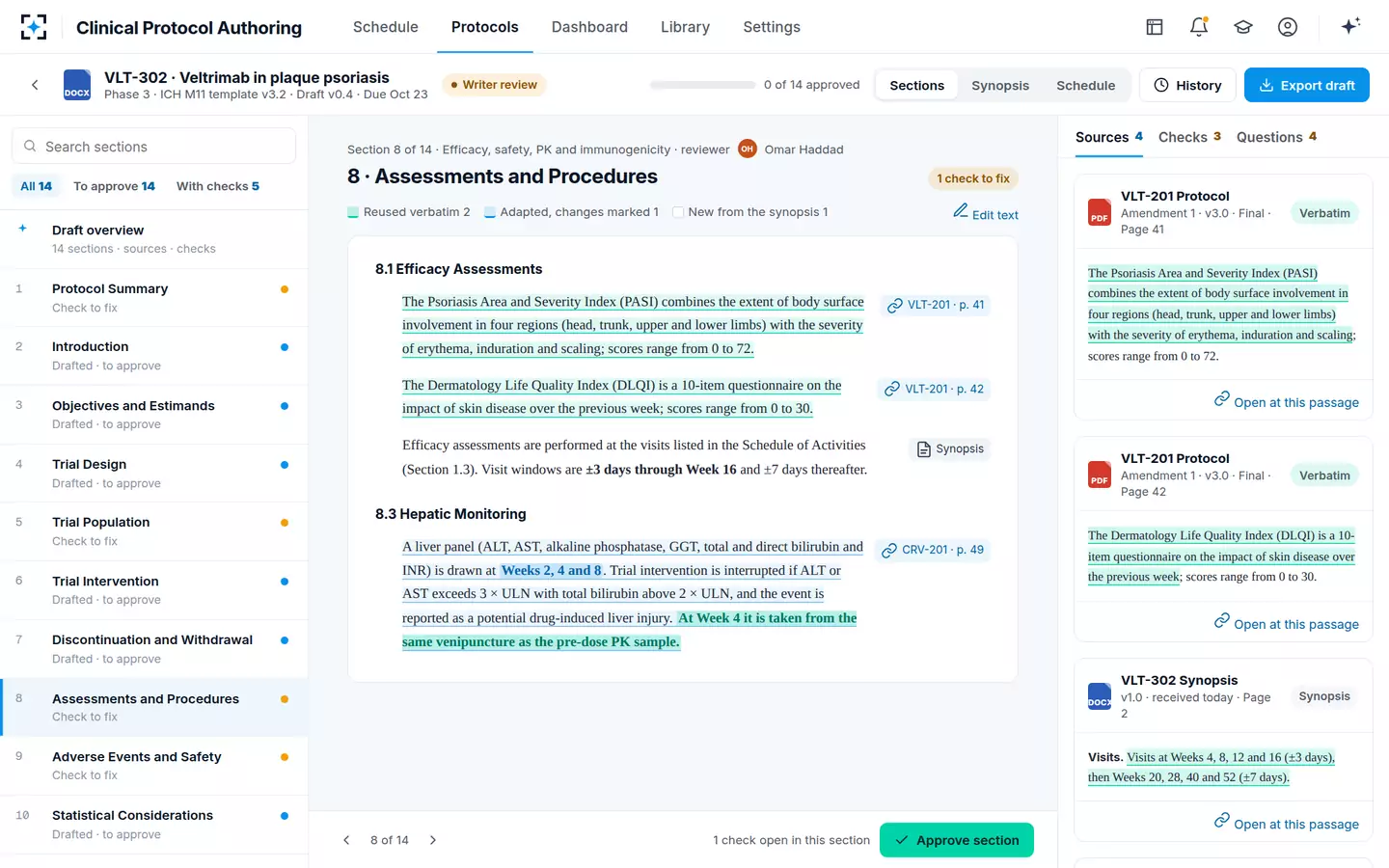
That turns into concrete constraints. The agent that reads the synopsis quotes endpoint wording rather than paraphrasing it, and marks a timepoint as missing rather than inferring one — which is how the sample trial's Week 16 problem surfaced at all, instead of being quietly filled in from the earlier study's Week 12. The agent that finds reusable language searches final, approved protocols only, never drafts or superseded versions, and flags a source protocol that was later amended. The agent that writes a section reuses a passage verbatim when it fits, marks every changed word when it does not, and cites the synopsis for anything new.
A generated sentence and a reused one, on the same fact
Generated from nothing: Fluent, correctly termed, confident. Indistinguishable from the right answer on a first read.
Reused from a final protocol, with its source: Identical prose, with the document, version and page beside it and the passage openable at that page.
Generated from nothing: The model’s distribution over plausible numbers for a sentence of that shape.
Reused from a final protocol, with its source: The synopsis, or the source protocol the passage was taken from. Nowhere else.
Generated from nothing: Verify every factual claim independently, with no way to know which ones are at risk.
Reused from a final protocol, with its source: Check that the source still applies — and see immediately which words were changed and which were not.
Generated from nothing: Content relevance and terminology over 80%; clinical thinking and transparency and references around 40%.
Reused from a final protocol, with its source: Clinical thinking and logic, and transparency and references, rising to about 80% once retrieval is used.
Generated from nothing: An assertion that a qualified person reviewed it.
Reused from a final protocol, with its source: A traceable chain from each sentence to the approved document it came from, kept in the export as well as on the screen.
Every passage marked reused, adapted or new — with its source open
Six narrow jobs instead of one general writer
The architectural choice that matters most is how many jobs the system is trying to do at once. One general writer asked to produce a protocol has to read, retrieve, compose, check its own work and judge what it cannot know — and the one it is worst at, judging what it cannot know, contaminates everything else. Six narrow agents, each with a stated limit, fail visibly instead.
Six agents, each with the thing it may never do
Agent
Synopsis readerReads the trial synopsis into 31 structured fields — design, population, objectives, endpoints, dosing, visits, sample size — each with the exact wording and the page it came from.
Never: Never paraphrases endpoint wording; never infers a timepoint the synopsis does not state
Agent
Approved-language retrieverFinds passages in final protocols that fit each section, ranked by population, phase and therapeutic area, and returns each with its document, version, page and the differences the writer must see.
Never: Never a draft or a superseded version; never strips the source
Agent
Section writerWrites each template section from the synopsis fields and the retrieved passages, in the sponsor template and house style — fourteen sections in parallel.
Never: Never invents a number; new text cites the synopsis
Agent
Consistency checkerChecks the draft against the synopsis and against itself — endpoint timepoints, objectives against endpoints and estimands, eligibility, dose, visit windows, abbreviations — showing both passages for every mismatch.
Never: Never applies a fix
Agent
Patient burden scorerScores every visit for minutes, blood and needle sticks, and proposes the smallest change that brings a visit back under the limit.
Never: Never applies a suggestion; never drops an assessment an endpoint or safety rule depends on
Agent
Open-question collectorTurns a gap in the synopsis into one short question for the right person, and writes the answer back into its section with the name and the time.
Never: Never decides on anyone’s behalf
A person decides
Lena Ortiz, medical writerApproves each of the fourteen sections, accepts or dismisses every check with a reason, and decides every burden suggestion with the clinical operations lead.
Never: Never skipped
A person decides
Dana Okafor, head of medical writingSigns the final version with a reason after a full consistency re-check and team review. The version is then locked.
Never: Never signs before all fourteen sections are approved and the full re-check has run
What an AI protocol drafting tool may never do
Three prohibitions carry most of the risk, and all three are easier to test than to argue about.
It may never state a number it was not given. Sample size, dose, visit windows, blood volumes, endpoint thresholds and timepoints all come from the synopsis, from a named source document or from arithmetic shown on the screen.
It may never apply its own suggestion. A consistency finding and a burden suggestion are proposals with a named decision-maker; the sample trial names the medical writer and the clinical operations lead, and a dismissal is kept with the reason given.
And it may never remove something a study depends on. The burden scorer is explicitly barred from proposing the removal of an assessment that an endpoint or a safety rule requires — a constraint that has to live in the tool, because a tired reviewer on a Friday afternoon is exactly the person who would accept it. How that scoring works, and what it may safely cut, goes through the arithmetic.
Who is the author, and who signs
Authorship does not move. A protocol is approved by the sponsor's named people and signed by whoever the sponsor's procedures say signs it, and no part of any regulation contemplates a model holding that role. The practical question is narrower: can the sponsor demonstrate that a qualified person actually exercised judgement, rather than clicking through fourteen sections in an afternoon?
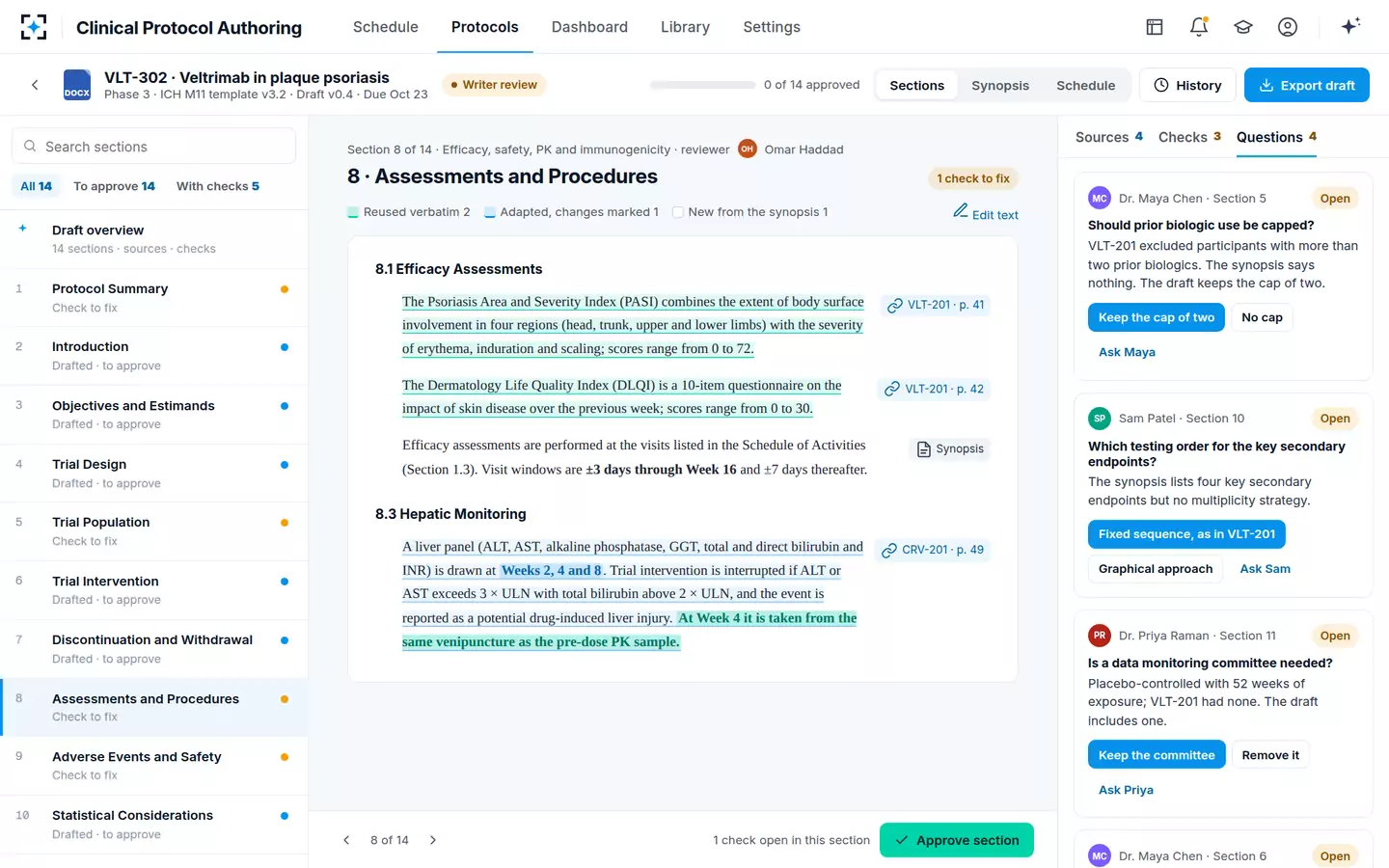
That is a design question about the screen, not a policy question. Approval section by section rather than document-wide, with each section showing what is reused, what is adapted and what is new; each mismatch presented as two passages rather than a verdict; each open decision routed to the person who owns it by name; every acceptance, dismissal, answer and approval kept with name, time and version, and nothing overwritten. The sample trial's protocol goes to the head of medical writing for e-signature with a reason only after all fourteen sections are approved and a full consistency re-check has run, and the version is locked afterwards.
One question per open decision, to the person who owns it
The same five seats, before and after
Today
Copies from the last protocol on the same drug and hopes every Week 12 became a Week 16. Chases reviewers for decisions the synopsis left open.
With agents
Opens a sourced first draft on its schedule of assessments, fixes what the checker found, and approves each section herself.
Still theirs: Approval of every section
Today
Learns a visit is too long when sites say so, after two hundred people have enrolled.
With agents
Sees every visit’s score and its arithmetic before the draft goes out.
Still theirs: The decision on any burden change
Today
Asks for the safety assessments and leaves the scheduling to someone else.
With agents
Her request lands in the schedule and in the section at the weeks she asked for, written from approved language.
Still theirs: What safety requires
Today
Reads a hundred pages to find what changed from the last study.
With agents
Gets one question per open decision, and sees every changed word marked against the source protocol.
Still theirs: Population and intervention
Today
Signs a version whose reused sentences nobody can trace.
With agents
Signs a version where every reused passage carries its document, version and page.
Still theirs: The signature, with a reason
How to test a drafting tool before a real protocol goes through it
ICH E6(R3) sets the standard for any computerised system in a trial, and it applies to a drafting tool the moment its output becomes the protocol: "Validation should demonstrate that the system conforms to the established requirements for completeness, accuracy and reliability and that its performance is consistent with its intended purpose" (ICH E6(R3), adopted January 2025). "Intended purpose" is doing real work in that sentence — you validate against what you will actually use it for.
The most informative test is retrospective and cheap. Take a protocol you finalised two years ago, feed the tool its synopsis and the final protocols that existed at the time, and compare what comes out with what your team actually wrote. Three things are then measurable rather than assertable: how much of the draft is reused language with a real, checkable source; which of the inconsistencies your reviewers found in the real cycle the checker finds in the draft; and — the question most pilots forget — how many findings are wrong, because a checker that cries wolf will be switched off by the third protocol.
Then run the same protocol through with a deliberate error planted in the synopsis, and see whether the tool carries it through silently or raises it as a question. The twelve questions worth asking before buying one covers the rest of the evaluation, including what your own configuration has to prove.
A finding that is not for a model to settle
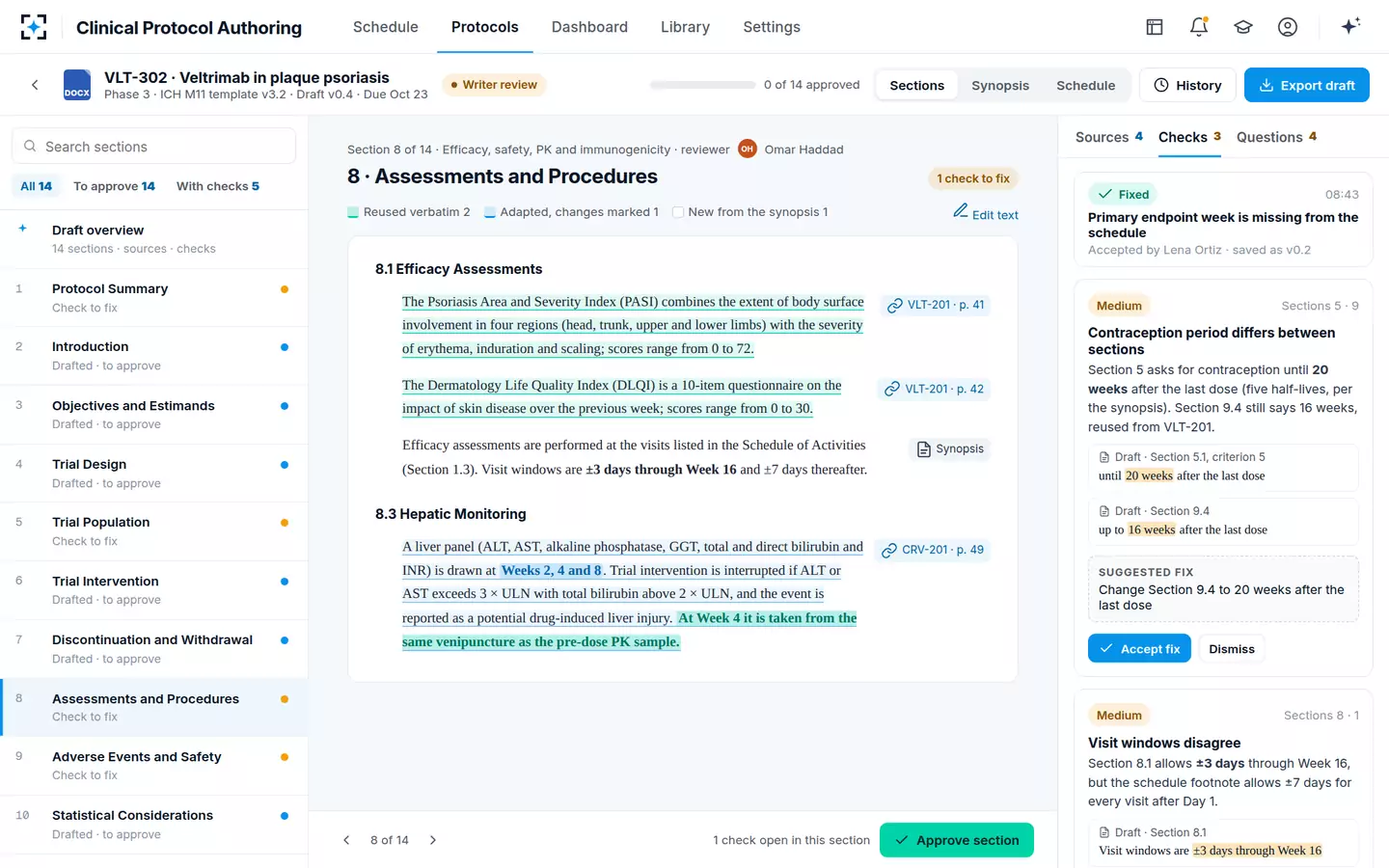
Used this way the question stops being whether a model is trustworthy and becomes whether a system is constructed so that trust is not required. To see the sources, the checks and the approvals together, start from Clinical Protocol Authoring.
Questions people ask
Does the FDA allow AI to draft a protocol?
No regulation forbids it, and FDA's draft AI guidance explicitly places the drafting of a regulatory submission outside its scope — but only where that drafting does not affect patient safety, drug quality or the reliability of a study's results. A protocol determines what a study measures, so a sponsor should treat anything that influences the design as inside scope, and engage with FDA early if it is unsure.
How good are language models at writing protocol sections?
Good at prose, weak at reasoning and sourcing. A published evaluation scored an off-the-shelf model above 80% on content relevance and on medical and clinical terminology, but at 40% or less on clinical thinking and logic and on transparency and references. Retrieval from real source documents raised those two to about 80%, with the largest gain on eligibility criteria sections.
How do you stop AI inventing numbers in a protocol?
By never asking it to produce one. Numbers should come only from the synopsis, from a named source protocol or from arithmetic shown on screen, and the tool should mark a missing value as missing rather than filling it. In practice this means the agent that reads the synopsis quotes rather than paraphrases, and flags an endpoint timepoint that is not stated instead of inferring it from a previous study.
Who is the author of an AI-drafted protocol?
The sponsor's people, exactly as before. What changes is what they can show: approval section by section with each passage marked reused, adapted or new, every check accepted or dismissed with a reason, and a final e-signature with a reason after a full re-check. The audit question is not whether a model helped but whether a qualified person exercised judgement and left evidence of it.
Do you have to tell a regulator that AI drafted the protocol?
There is no general disclosure requirement for drafting assistance today, and the joint FDA and EMA principles are principles rather than rules. They do ask for documented, traceable and verifiable records of data sources and processing steps in line with GxP, and for plain-language information about an AI technology's context of use, performance and limitations — which is a strong argument for being able to show exactly what was generated, what was reused and who approved it.
What audit trail does AI drafting need?
Enough to reconstruct any sentence in the final protocol. In practice: the source document, version and page for every reused passage; a marked difference for every adapted one; the synopsis citation for anything new; the name, time and version for every accepted fix, dismissed check with its reason, answered question and approved section; every version kept rather than overwritten; and the sources carried into the Word export as comments or an appendix, so the trail survives leaving the system.