Writing a clinical trial protocol takes a medical writer days to weeks of actual writing, inside a development cycle that published programmes measure in months. Those are two different clocks, and conflating them is why protocol timelines are argued about so unproductively. The National Cancer Institute's reformed targets allow 7 months from concept to an activated Phase I–II trial and 10 months for Phase III; a first draft inside that is a matter of weeks of writer time, most of which is spent copying from the last protocol and waiting for someone to answer a question. Clinical Protocol Authoring attacks those two lines specifically, because they are the only ones that can be shortened without reviewing less.
The sample trial, drug and people in the product figures are invented: VLT-302, a Phase 3 study of Veltrimab in plaque psoriasis, written by Lena Ortiz. The timeline and cost figures come from published studies, linked where they appear.
How long does it take to write a clinical trial protocol?
There is no published median for the writing alone, because almost nobody measures it separately from the approval cycle around it. The honest ranges, from the way the work decomposes, are these: a first draft of a Phase 3 protocol in a sponsor template is a few weeks of writer effort spread over longer, because the writer is waiting; a synopsis-to-final cycle on a programme that is not in a hurry runs several months; and the whole distance from concept to a trial open to enrolment is measured against published targets of seven to ten months.
What drives the spread is not the length of the document. A Phase III protocol averages about 116 pages (Getz, Smith and Kravet, 2022), and a competent writer does not take months to produce 116 pages of prose. It is that a good share of those pages cannot be finished until someone else decides something, and the queue for those decisions is the calendar.
What a protocol writer’s days are actually spent on
Decompose a Phase 3 first draft and the largest block is not writing at all. It is adaptation: opening the last protocol on the same drug, copying a section, and changing it line by line while checking that each change has been made everywhere it needed to be.
Estimated working days for one Phase 3 first draft, by what the day is spent on
Eighteen of those thirty-eight days — copying, finding and cross-checking — produce no sentence that did not exist somewhere already. They are the price of reuse done by hand. Ten days produce genuinely new text from the synopsis, and five build the table everything else refers to.
The two-day figure for chasing open questions is the one that most understates reality, because it counts the writer's effort rather than the elapsed time. Two days of chasing can occupy three weeks of calendar.
Concept to activated trial: the published timelines
The best public evidence on the whole cycle comes from the National Cancer Institute, which set hard timelines for its own trials after an operational efficiency review and then published what happened. "For phase I-II studies and phase III studies, the target timelines are 7 months and 10 months, whereas the absolute deadlines were set at 18 and 24 months, respectively. Trials not activated by the absolute deadline are automatically disapproved" (Abrams et al., Journal of the National Cancer Institute, 2013).
The results are the interesting part. "The initial experience is encouraging and indicates a reduction in development times for phase I-II studies from the historical median of 541 days to a median of 442 days, an 18.3% decrease." Phase III studies, on a smaller sample of twenty-five, showed a 45.7% decrease in median days. On that evidence the institute then cut the absolute deadlines further, to 15 and 18 months.
A cancer trial from proposal to activation, against the targets set for it
- Development, proposal to activation541 days
- Development, proposal to activation442 days
- Target timeline7 months
- Target timeline10 months
- After which a trial is automatically disapproved24 months
Two lessons travel out of oncology. First, a historical median of 541 days — about eighteen months, against a target of seven — is not writing time; the gap is review, negotiation and queue. Second, the thing that moved the median was not a new drafting tool. It was a deadline with a consequence attached, plus new staff positions to monitor progress and protocol-tracking websites to watch the clock.
What a day of delay costs
The figures most often quoted for a day of delay are decades old and, in the words of the researchers who replaced them, "outdated and based on anecdotal evidence". Tufts CSDD rebuilt them from data: 645 drugs launched since 2000 and 409 clinical trial budgets. "The estimated direct daily cost to conduct a clinical trial is approximately $40,000 per day for phase II and III clinical trials, with those in respiratory, rheumatology, and dermatology having the highest relative daily direct costs" (Smith, DiMasi and Getz, Therapeutic Innovation & Regulatory Science, 2024).
What a day of delay costs, rebuilt from 409 trial budgets and 645 launches
$40K
approximate direct cost of a day of a Phase II or Phase III trial
$500K
approximate value of a day of lost prescription drug or biologic sales
$80–100K
how much average sales per day have fallen each year
Two cautions before anyone multiplies. The daily figure is the direct cost of conducting a trial — it is not the cost of a day spent writing the protocol before approval, when the trial is not yet burning site and vendor money. And the same study is corrective about the other number people reach for: a day of lost prescription sales is worth roughly $500,000, far below the multi-million figure long repeated, and average sales per day have been falling by roughly $80,000 to $100,000 a year.
What the daily figure does price honestly is anything that extends the trial after it starts — most obviously an amendment that adds a visit, a country or a cohort. Note too which therapeutic areas sit at the top of the daily cost ranking: respiratory, rheumatology and dermatology. A dermatology Phase 3 like the sample trial is at the expensive end.
The rework nobody puts in the plan
Every protocol timeline is drawn as though the protocol will be written once. Published data says otherwise. Tufts CSDD found that a majority of protocols — 57% — took at least one substantial amendment, that nearly half of those amendments were judged avoidable, and that the median direct cost of implementing one was $141,000 for a Phase II protocol and $535,000 for a Phase III protocol (Getz et al., 2016).
An amendment is not only a cost; it is a second timeline. The change has to be written, classified, submitted or notified, assessed, approved by ethics committees and adopted site by site — and in the European Union a substantial modification may not be used until it has been authorised in that Member State. A protocol finished four weeks early and amended twice has not saved anybody four weeks. Which changes need which route, and why the classification is expensive, works through that sequence.
Why copying from the last protocol is the slow option
Copying feels fast because the first hour is fast. The cost arrives later, in two forms. The first is the change that was made in six places and needed seven: a study whose primary endpoint moved from Week 12 to Week 16 can carry a schedule in which Week 16 has no efficacy ratings at all, which is exactly the finding sitting at the top of the sample trial's draft. The second is the cross-check, five full days of reading a hundred pages against a nine-page synopsis and a table, looking for the one number that did not move.
Copying the last protocol, and assembling from sourced approved language
Copy and adapt by hand: Two days of asking colleagues and searching a document store, then reading to judge the fit.
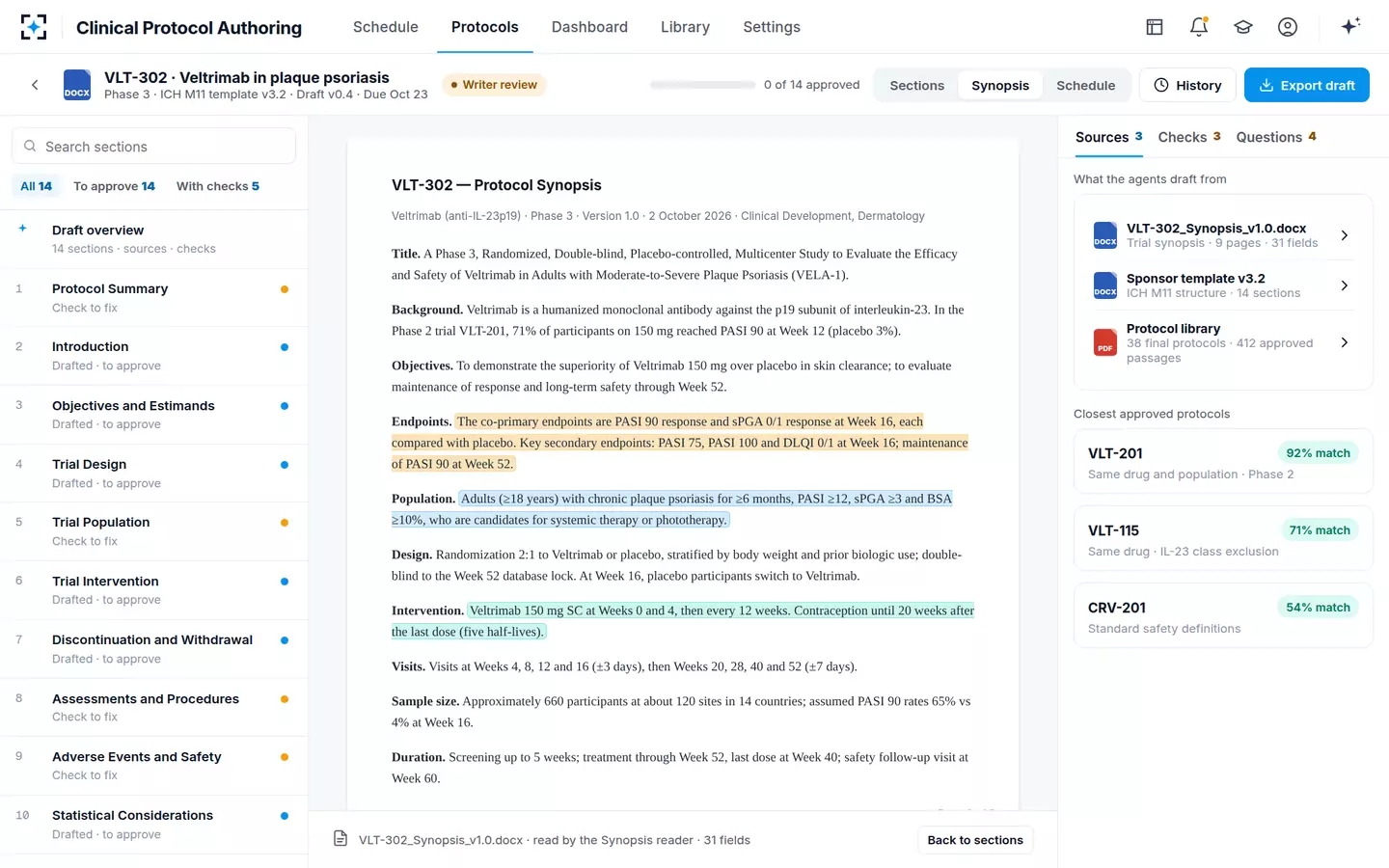
Assemble with the source kept: Candidates ranked by population, phase and therapeutic area, with the match stated — in the sample trial 92%, 71% and 54%.
Copy and adapt by hand: A manual diff, or trust. Changed words are invisible once the document is saved.
Assemble with the source kept: Every adapted passage marks each changed word; every reused passage keeps its document, version and page.
Copy and adapt by hand: Five days of cross-checking, late, by the person least able to see their own omissions.
Assemble with the source kept: Checks run on the draft before any reviewer opens it — endpoint timepoints, objectives against estimands, windows, dose, abbreviations.
Copy and adapt by hand: Nothing tells you. The amendment lives in a different document.
Assemble with the source kept: The source is flagged as later amended before its language is reused.
Copy and adapt by hand: A document, and an assurance that it was checked.
Assemble with the source kept: A draft where each passage is marked reused, adapted or new, and every source opens at its page.
A nine-page synopsis, read into the fields a draft needs
Waiting for decisions: the queue inside the calendar
A synopsis is nine pages and a protocol is a hundred; the gap is filled with decisions the synopsis did not make. Four of them in the sample trial are typical of the genus, and each one blocks a different section.
The decisions a synopsis leaves open, who answers each, and what waits
| The open question | Who answers it | What is stalled while it is open |
|---|---|---|
| Should prior biologic use be capped? The earlier study excluded participants with more than two prior biologics; the synopsis says nothing. | Dr. Maya Chen, clinical lead | Section 5, the eligibility criteria — and with them the screening row of the schedule and the sample size assumptions. |
| Which testing order for the four key secondary endpoints? The synopsis lists them but gives no multiplicity strategy. | Sam Patel, biostatistician | Section 10, statistical considerations, and the estimand table in Section 3. |
| Is a data monitoring committee needed for a placebo-controlled trial with 52 weeks of exposure? | Dr. Priya Raman, medical monitor | Section 11, trial oversight, and the safety reporting arrangements that follow from it. |
| Is the Week 16 switch from placebo to active treatment blinded? | Dr. Maya Chen, clinical lead | Sections 4 and 6, trial design and intervention, and the Week 16 column of the schedule. |
This is why "the protocol is nearly finished" can be true for a month. The remaining work is not writing; it is four people, three of whom are on other trials, and none of whom has been asked a question small enough to answer between meetings. A question that names the decision, states what the previous study did and what the draft currently assumes is answerable in one minute. A request to "review the draft" is not.
What a realistic timeline looks like now
With the copying, the searching and the cross-checking taken out, and the open decisions turned into four named questions, the writing side of the estimate collapses from about thirty-eight working days to about four. That is a design target rather than a measured customer result, and it covers synopsis to a checked first draft — not to an approved protocol, which still contains every review the sponsor's procedures require.
The same Phase 3 first draft, estimated by hand and against the design target
| What the day is spent on | By hand (days) | Design target (days) |
|---|---|---|
| Reading the synopsis and finding the closest past protocol | 2 | 0.1 |
| Copying and adapting approved language, section by section | 14 | 1 |
| Writing new text from the synopsis | 10 | 1.5 |
| Building the schedule of assessments | 5 | 0.5 |
| Cross-checking sections, synopsis and schedule | 5 | 0.5 |
| Chasing open questions with clinical, statistics and safety | 2 | 0.4 |
| Total working days | 38 | 4 |
Note what has not moved. Writing genuinely new text from the synopsis still takes real time, because it is real work. The four days are bought almost entirely from the eighteen that produced nothing new, plus the two spent chasing people who can now answer in writing.
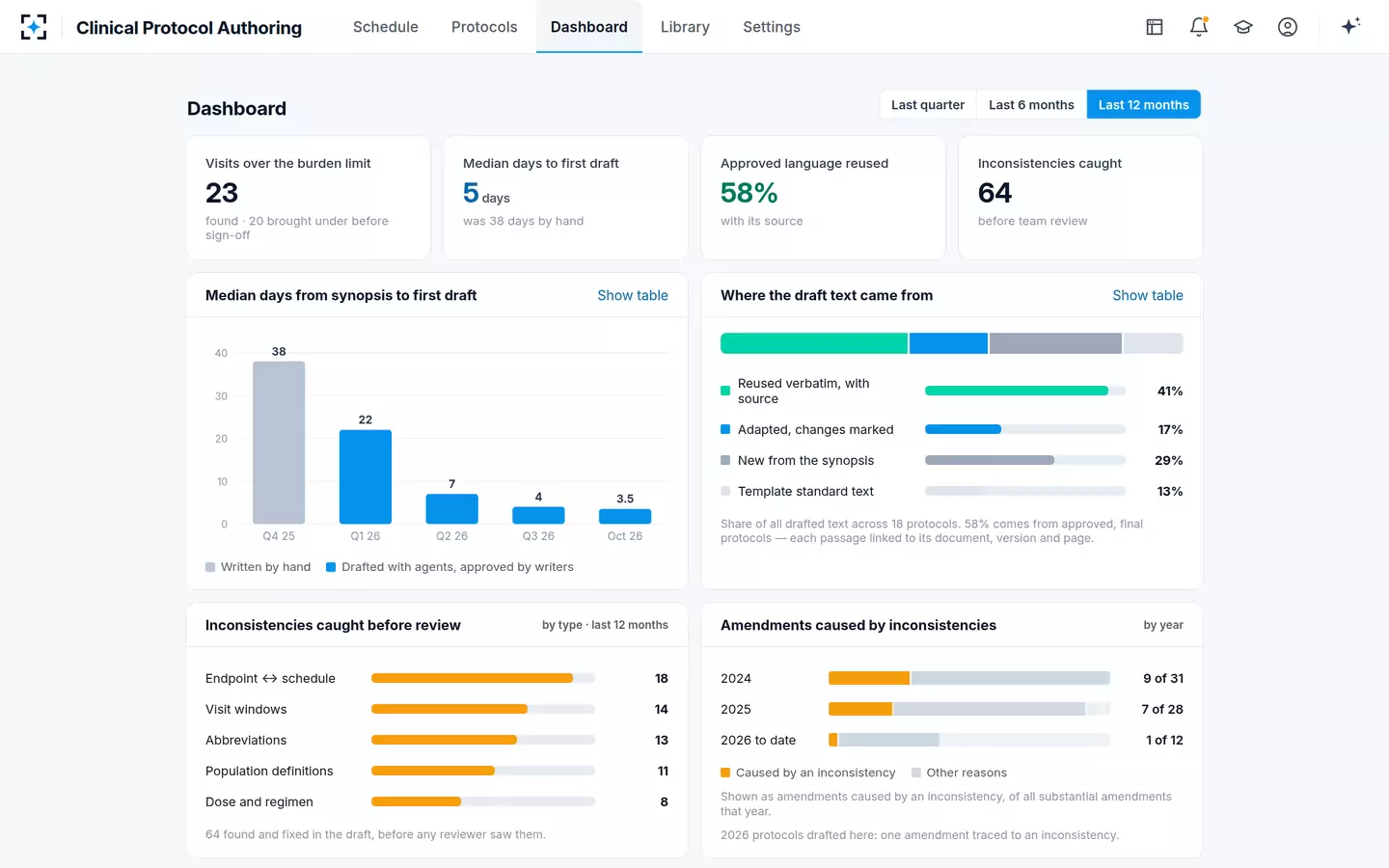
Days to first draft across a portfolio, not one protocol
Can it be faster without being riskier?
Only if the time comes out of the right places. Every hour saved on finding, copying and re-checking is an hour that was never adding judgement, and removing it makes the draft more reliable rather than less, because those are precisely the steps where human attention fails. Every hour "saved" by shortening review is borrowed against an amendment.
There is a second, slower effect worth stating. Protocols have been getting heavier: mean total procedures per Phase II–III protocol rose 67.3% between 2009–2012 and 2017–2020 (Getz, Smith and Kravet, 2022), and the average duration of each visit rose with them, "in large part due to the volume of procedures performed per visit" (Dirks et al., 2025). A protocol that is quick to write and heavy to run is not a win. Measuring that weight while the schedule is still being drawn is the other half of a faster cycle.
Eight ways to take real days out of protocol development
- Put a deadline on activation, with a consequence
An intervention with published evidence behind it: NCI cut phase I–II median development time from 541 to 442 days by setting targets, absolute deadlines and automatic disapproval.
- Make the open decisions explicit on day one
List every question the synopsis does not answer, name the person who owns each, and send them as questions rather than as a draft to review.
- Start at the schedule of assessments, not Section 1
The table constrains eligibility, intervention, assessments, safety and statistics. Writing prose before it is settled guarantees rewriting.
- Reuse with the source attached, not by copying
A passage that carries its document, version and page can be checked in seconds; a pasted one has to be re-verified from scratch.
- Run the consistency checks before the first human review
Reviewers should spend their attention on design, not on finding the Week 12 that should have become Week 16.
- Review in parallel, by section, with named owners
Sequential review of a whole document is the slowest possible arrangement and the one most likely to produce contradictory comments.
- Score patient burden before the draft leaves the building
A visit that sites reject after enrolment costs an amendment; the same finding before approval costs an afternoon.
- Measure days to first draft, and the amendments afterwards
Either number alone is misleading. A team that is getting faster and amending more has moved work, not removed it.
Ten protocols, and where each one actually is
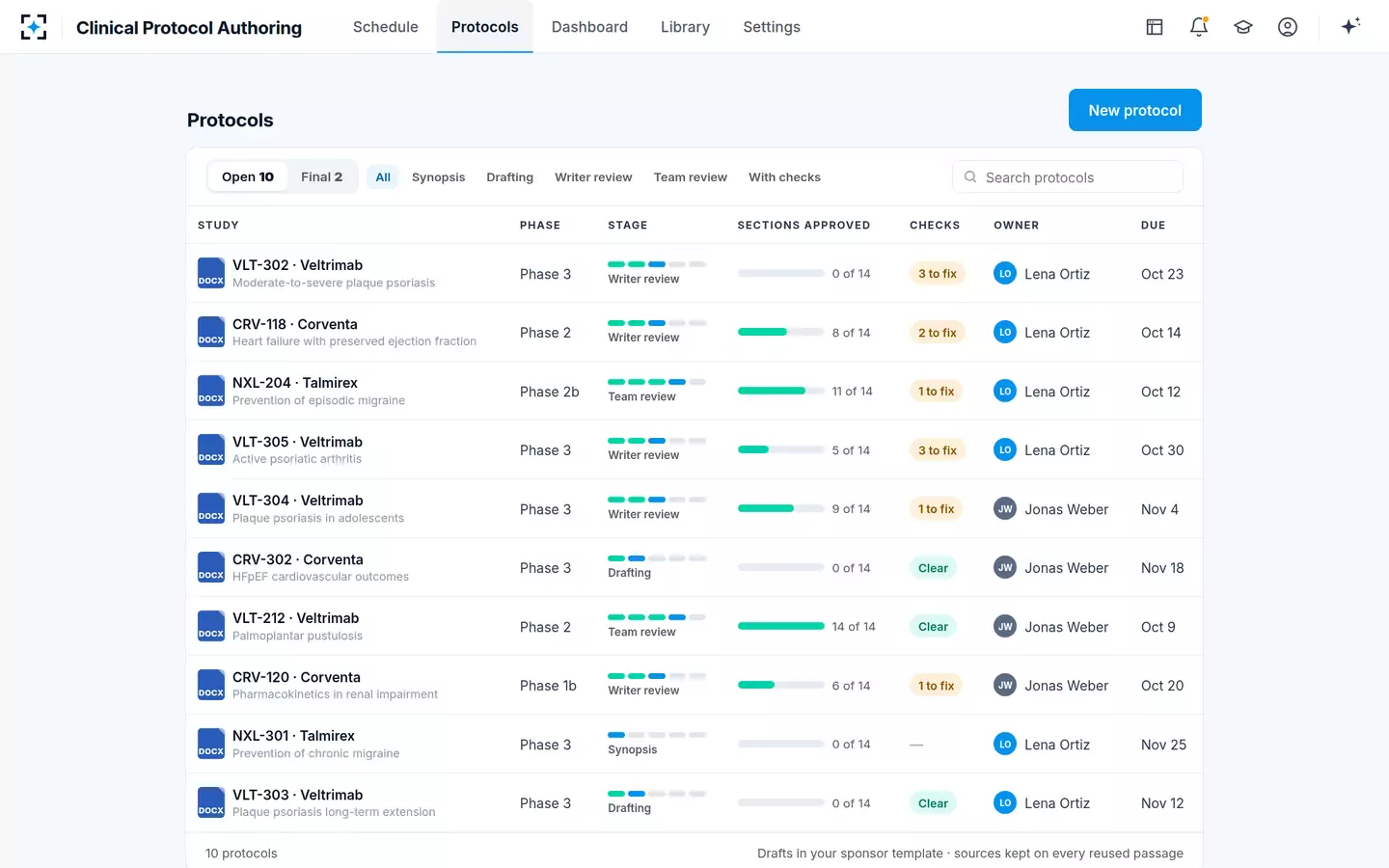
Protocol timelines shorten when the mechanical work stops being done by people and the decisions stop waiting in an inbox. To see the synopsis, the schedule and the checks on one screen, start from Clinical Protocol Authoring.
Questions people ask
How long does protocol development take from concept to final?
Months rather than weeks, and the published benchmarks are from oncology: NCI set targets of 7 months for phase I–II and 10 months for phase III from proposal to an activated trial, against a historical phase I–II median of 541 days. After the reforms that median fell to 442 days. Industry cycles vary widely, but the shape is the same — writing is a small share of the elapsed time.
Why do protocols take so long to write?
Because most of the work is not writing. In our estimate of a Phase 3 first draft, eighteen of about thirty-eight working days go on finding the closest past protocol, copying and adapting its language, and cross-checking the result — none of which produces a sentence that did not already exist. The rest of the calendar is spent waiting for decisions the synopsis did not make.
How much does a day of delay cost in a clinical trial?
About $40,000 a day in direct costs for a Phase II or Phase III trial, according to a 2024 peer-reviewed analysis of 409 clinical trial budgets, with respiratory, rheumatology and dermatology trials the most expensive per day. The same study puts a day of lost prescription drug or biologic sales at roughly $500,000, and finds that figure falling by about $80,000 to $100,000 a year.
How many people review a protocol?
In the sample trial, five: the medical writer approves every section, then each section goes to its named reviewer — the biostatistician for objectives and estimands, the clinical lead for population and intervention, the clinical operations lead for the schedule and procedures, the medical monitor for safety — before a full team review and the head of medical writing's signature. The number matters less than whether they review in parallel by section or sequentially over the whole document.
Can a protocol be written faster without more risk?
Yes, if the time comes out of copying, searching and cross-checking rather than out of review. Those are the steps where human attention is weakest, so automating them makes a draft more reliable. Time taken out of review has the opposite effect, and tends to come back as an amendment at a median direct cost of $535,000 for a Phase 3 protocol.
What slows a protocol down most often?
An unanswered question that blocks a section. In the sample trial four decisions the synopsis left open — a cap on prior biologic use, the testing order for key secondary endpoints, whether a data monitoring committee is needed, and whether the Week 16 switch is blinded — each hold up a different section and the parts of the schedule that depend on it. Asking them as four named questions rather than as one review request is the single cheapest improvement available.