A protocol authoring tool is software that helps a medical writer turn a trial synopsis into a full protocol in the sponsor's own template, and almost every one of them demonstrates well. What separates them is not how quickly a first draft appears but four things a demonstration rarely shows: whether the tool holds your template and your standard text rather than its own, whether every reused sentence keeps the document, version and page it came from, whether your configuration and its automated checks can be validated as well as the base system, and whether a named person still approves every section. Clinical Protocol Authoring is used here as the worked example, because the questions are easier to judge against something concrete than in the abstract.
The trial, the drug and the people in the product figures are invented sample data: VLT-302, a Phase 3 study of Veltrimab in plaque psoriasis, written by Lena Ortiz and signed by Dana Okafor. The regulatory references are linked where they appear.
What is a protocol authoring tool?
The term covers three quite different things that are usually sold with the same words.
The first is a document template with macros: a Word file with the sponsor's headings, boilerplate and some automation around numbering and cross-references. It is cheap, universally compatible and does nothing about reuse, consistency or the schedule of assessments.
The second is a structured authoring system: content is held as components in a repository, assembled into documents, and published. It is strong on reuse and on publishing the same content into several documents, and it usually demands a serious content model and a migration before it does anything at all.
The third drafts from sources: it reads the synopsis, retrieves passages from final approved protocols, writes each section in the sponsor's template, keeps each passage's origin, checks the draft against itself, and routes what it cannot decide to a person. The three can coexist — but they fail differently, and a procurement that does not name which one it is buying tends to get the first and expect the third.
Three things sold as protocol authoring, and what each actually changes
What it does well: Enforces headings, numbering and standard text at near-zero cost, with no migration and no new system to validate.
What it leaves you doing: All of the reuse, all of the cross-checking, and all of the schedule of assessments — by hand, as now.
What it does well: Holds content as reusable components and publishes it into several documents from one source, with controlled versions.
What it leaves you doing: Building and maintaining the content model, migrating the library, and deciding what is a component — a programme in its own right.
What it does well: Produces a first draft in your template from your final protocols, with each passage marked reused, adapted or new and linked to its page, and the draft checked before review.
What it leaves you doing: Judgement: approving every section, deciding every check and every burden change, and validating your own configuration.
What it does well: All three look similar for the first ten minutes: a protocol appears in a template.
What it leaves you doing: Ask instead to see the source of one sentence, the second protocol built from the same library, and the checks that fired.
Structured authoring, templates with macros, and drafting from sources
The reason the distinction matters is that ICH M11 has made reuse an explicit design goal of the protocol itself. Its general design principles list five: build common core content, serve the needs of stakeholders, define content for electronic exchange, design for content re-use, and maintain flexibility (ICH M11 Guideline, Step 4, 19 November 2025). Reuse is in the standard now, not just in the vendor's deck.
That has dates attached. The EMA adopted the M11 guideline at CHMP on 11 December 2025 with a date for coming into effect of 11 June 2026 (EMA, ICH M11 Step 5), and FDA published the guidance for industry on 22 May 2026, noting that "The technical specification document contains harmonized terminologies and standardized data fields to enable electronic exchange of clinical protocol information" (91 FR 30310). A tool bought this year will be asked to produce M11-shaped protocols, and the structured-exchange question — can this content leave the system as data, not only as a document — stops being hypothetical. What M11 changes for writers covers the template itself.
The twelve questions worth asking
Each of these has an answer that should end the conversation, which is why they are worth asking early rather than in a second-round demonstration.
Twelve questions, and the answer that should worry you
- Whose template does a draft come out in?
Worrying answer: "ours, and we can map yours." Your template, its section numbering and its standard text should be configuration, and changing to a new version should not be a project.
- Where did this sentence come from?
Ask it of a sentence picked at random on screen. Worrying answer: a model name. Good answer: a document, a version, a page, and a link that opens at the passage.
- Which documents may the tool reuse from?
Worrying answer: "everything you upload." Final approved protocols only; drafts and superseded versions should be unreachable, and a source later amended should be flagged.
- What happens when the tool does not know?
Worrying answer: it writes something plausible. Good answer: it marks the gap and asks a named person one question, and the answer is written back with the name and the time.
- Can it produce a number that was not given to it?
Worrying answer: "the reviewer would catch it." The architecture should make it impossible: numbers come from the synopsis, from a named source document, or from arithmetic shown on screen.
- What does it check before a human reads the draft?
Ask for the list. Endpoint timepoints against the schedule, objectives against endpoints and estimands, eligibility against the synopsis population, dose and regimen, visit windows, abbreviations — and ask what its false-finding rate was in the vendor’s own testing.
- Does anything get applied without a person?
Worrying answer: "only safe fixes." A proposed fix and an applied fix are different products; a dismissal should be kept with its reason.
- Who approves, and at what grain?
Section by section with a named reviewer per section is meaningfully different from one approval over a hundred pages, and only one of them is evidence of judgement.
- What does the export carry?
Worrying answer: a clean Word file. The sources should travel as comments or an appendix, so the trail survives leaving the system.
- What is validated, and by whom?
Worrying answer: "the platform is validated." ICH E6(R3) expects protocol-specific configurations and automated checks and calculations to be validated too — and that part is yours.
- Where do the drafts live, and what trains on them?
An unpublished protocol is among the most sensitive documents a sponsor has. Ask where it is stored, who can reach it, and get the answer about model training in writing.
- What happens when the model changes?
Ask about scheduled monitoring, periodic re-evaluation, and what triggers revalidation of your configuration — the ninth of the FDA and EMA guiding principles.
Does protocol authoring software have to be validated?
If its output becomes the protocol, yes — and the validation expected is risk-based rather than uniform. ICH E6(R3) states the approach: "The approach to validation of computerised systems should be based on a risk assessment that considers the intended use of the system; the purpose and importance of the data/record that are collected/generated, maintained and retained in the system; and the potential of the system to affect the well-being, rights and safety of trial participants and the reliability of trial results" (ICH E6(R3), adopted January 2025).
Run a protocol authoring tool through that test honestly and it scores high on two of the three limbs. The record it generates is the protocol, which is as important as records get; and the protocol determines participant safety arrangements and the reliability of the trial's results by definition. A sponsor who concludes that a drafting tool is low risk because "a person reviews everything" has answered a question the guideline did not ask.
The guideline also expects the system to be on a list. The sponsor should "Have a record of the important computerised systems used in a clinical trial. This should include the use, functionality, interfaces and validation status of each computerised system, and who is responsible for its management" — with access controls and security measures described. A drafting tool that nobody put on that list is a finding waiting to happen.
What the configuration has to prove, not just the system
This is the sentence that catches sponsors out, and it is worth reading twice: "Both standard system functionality and protocol-specific configurations and customisations, including automated data entry checks and calculations, should be validated. Interfaces between systems should also be defined and validated."
What ICH E6(R3) expects to have been validated, item by item
The vendor's
Standard system functionality
The base product: authentication, versioning, the editor, the export, the audit records. Ask for the validation summary and the release process that keeps it current.
Yours
Protocol-specific configurations and customisations
Your template and its standard text, your section reviewers, your reuse rules, your style guide, the age limit on reusable language. Configuration is not exempt because somebody else wrote the code.
Yours
Automated checks and calculations
The consistency checks you switched on, and any score the tool computes — including a patient burden calculation and its weights. These are calculations, and the guideline names calculations explicitly.
Shared
Interfaces between systems
Where the synopsis comes from, where the final protocol goes, and anything that moves a document between the drafting tool and a document management system. Defined and validated, both.
Two practical consequences. The first is scope: your validation effort is proportional to how much you configure, so a tool whose useful behaviour lives entirely in configuration has moved work to you rather than removing it — ask how much of what you saw in the demonstration was configuration. The second is change: every time you switch a check on, change a burden weight or adopt a new template version, you have changed something that was validated. Ask the vendor how they expect that to be managed, and be suspicious of a shrug.
Your template, your standard text, your reviewers
A protocol authoring tool that imposes its own template is solving a problem you do not have. Sponsors have spent years aligning their templates with their standard operating procedures, their statistical conventions and their regulatory history; a tool that cannot hold that is asking for a change programme disguised as a purchase.
Look at what is expressed as a setting rather than as behaviour. In the sample trial the template is a setting (a sponsor template v3.2 built on ICH M11, with a legacy v3.1 still selectable), as are the style guide, the Word export format, the oldest language that may be reused — from one to fifteen years since the source protocol was finalised — which of the seven consistency checks are on, and who reviews each section by name. The patient burden weights, the per-visit limit and the eight-week blood limit are settings too.
What is configuration, and what is behaviour
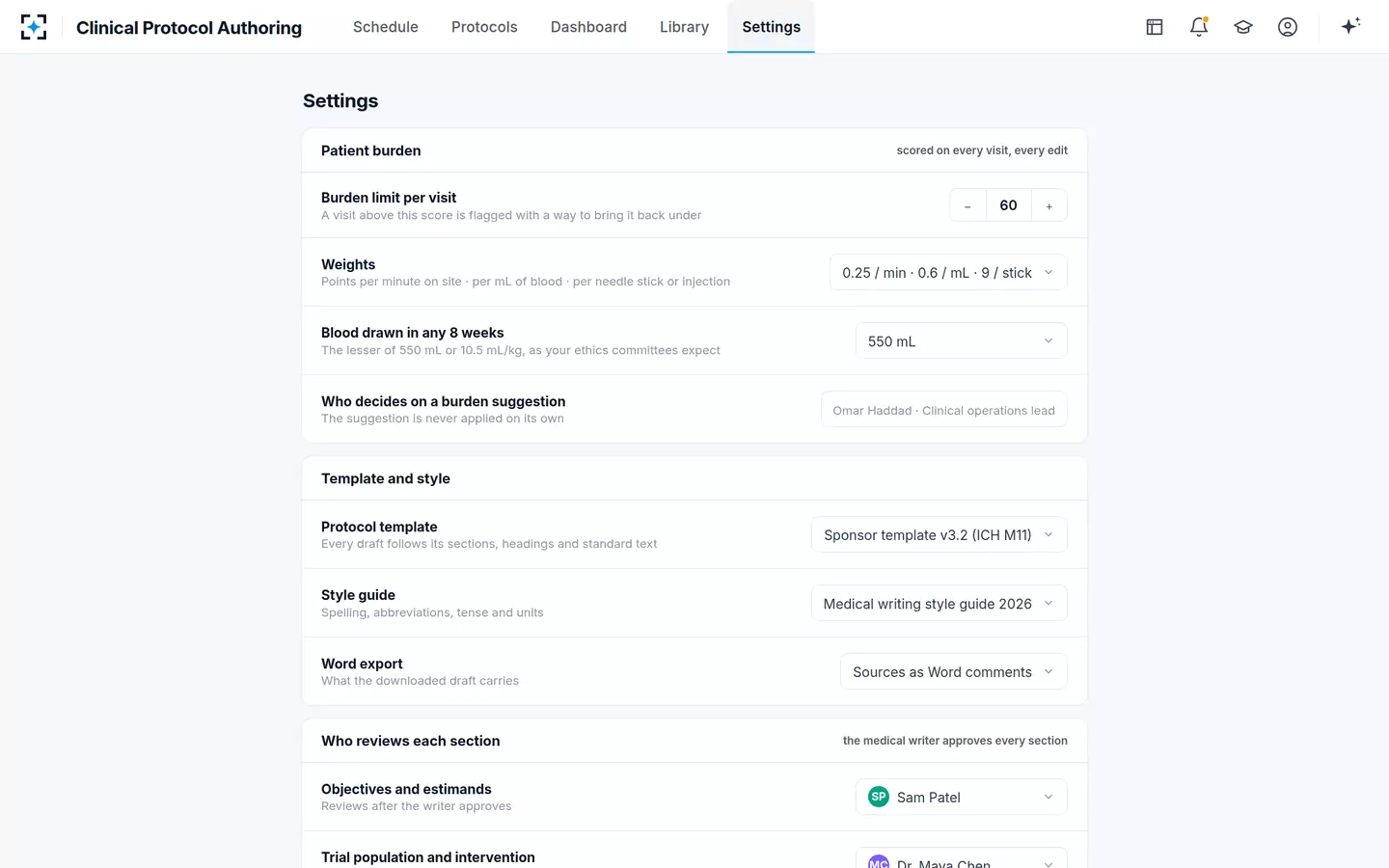
The rows with no control are as informative as the rows with one. Sources kept on every reused passage, final protocols only as a source, a named person approving every section, e-signature with a reason before a version is locked, every version kept rather than overwritten — a tool that lets a buyer turn those off is a tool that will be asked to, on the week a timeline slips.
The inputs you need before anyone can start
A pilot stalls more often on missing inputs than on the software. Five things have to exist, and four of them usually exist already in a form nobody has collected.
What a pilot needs, who owns it, and what goes wrong without it
| Input | Who owns it | What happens if it is missing or stale |
|---|---|---|
| Your protocol template — sections, headings, standard text | Medical writing | The draft comes out in somebody else’s structure, and every comparison with your real protocol is about layout instead of content. |
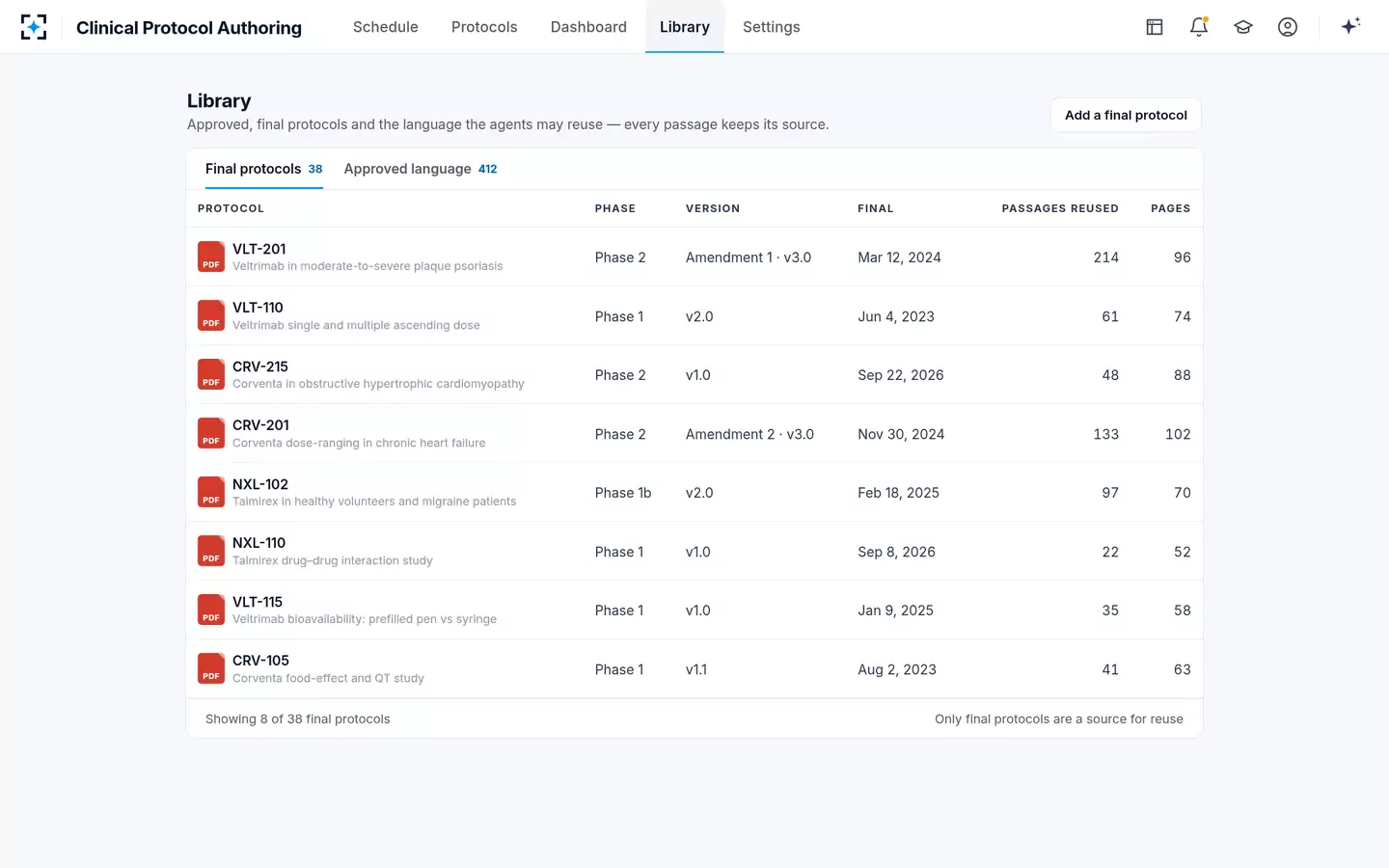
| A set of final, approved protocols and their amendments | Medical writing or document management | Nothing to reuse. Reuse quality is bounded by the library: in the sample data it is 38 final protocols and 412 approved passages. |
| The style guide — spelling, abbreviations, tense, units | Medical writing | Every reviewer comment is about house style, and the pilot never reaches the questions that matter. |
| A procedure burden table — minutes, millilitres, needle sticks per procedure | Clinical operations | No visit can be scored, so the one finding most likely to change a design is unavailable. |
| One trial synopsis, ideally for a protocol you have already written | Clinical development | No comparison is possible. A synopsis for a finished protocol lets you judge the output against what your team actually produced. |
What a reuse library looks like when it is working
38protocols
final, approved protocols — the only documents the agents may reuse language from
412passages
approved passages in the library, each with how often it has been reused
58%
of the sample first draft reused from final protocols, every passage with its document, version and page
The library is the ceiling on everything else
How to run a pilot that tells you something
The most informative pilot is retrospective, and it costs almost nothing to set up. Take a protocol you finalised eighteen months ago. Give the tool its synopsis and the final protocols that existed at that date. Compare what comes out against what your team actually wrote, and against what your reviewers actually found.
A pilot on one past protocol, from set-up to a decision
A person decides
Choose the protocolA finished one, in a therapeutic area where you have a library, whose review history you can still reconstruct. Ideally one that was amended, so you know what was missed.
Never: Never a trial still in design — you will have nothing to compare against
A person decides
Set the clock backLoad only the final protocols that existed when the real draft was written, so the tool is not reusing from the document it is being judged against.
Never: Never leave the target protocol in the library
Agent
DraftProduce the first draft in your template, with each passage marked reused, adapted or new, and the checks run before anyone reads it.
Never: Never counted as the result on its own
A person decides
Measure three thingsHow much is reused with a source you can open and verify; which of the inconsistencies your reviewers really found the checker also found; and how many findings were wrong.
Never: Never measure speed alone
A person decides
Plant an errorRun it again with a deliberate contradiction in the synopsis — a timepoint that does not match the endpoint — and see whether it is carried through silently or raised as a question.
Never: Never skip this step: it is the only test of the failure mode that matters
A person decides
Validate before anything realQualify your configuration and your automated checks and calculations, add the system to the record of computerised systems, and only then put a live protocol through it.
Never: Never rely on the vendor’s validation of their own product for your configuration
The false-finding count is the measurement easiest to skip and costliest to skip. A consistency checker with a high false rate is switched off by the third protocol, after which every claim made for it is moot. What a drafting tool may and may not do sets out the rest of the design constraints worth testing.
What good looks like a year in
A year after a tool goes in, four things should be true and measurable. The library should have grown, because every protocol finalised adds to the language the next one can reuse. The share of each draft that is reused with a traceable source should be rising. Inconsistencies caught before the first human review should be a number somebody reports. And the amendments that were traced to an inconsistency rather than to science should be falling.
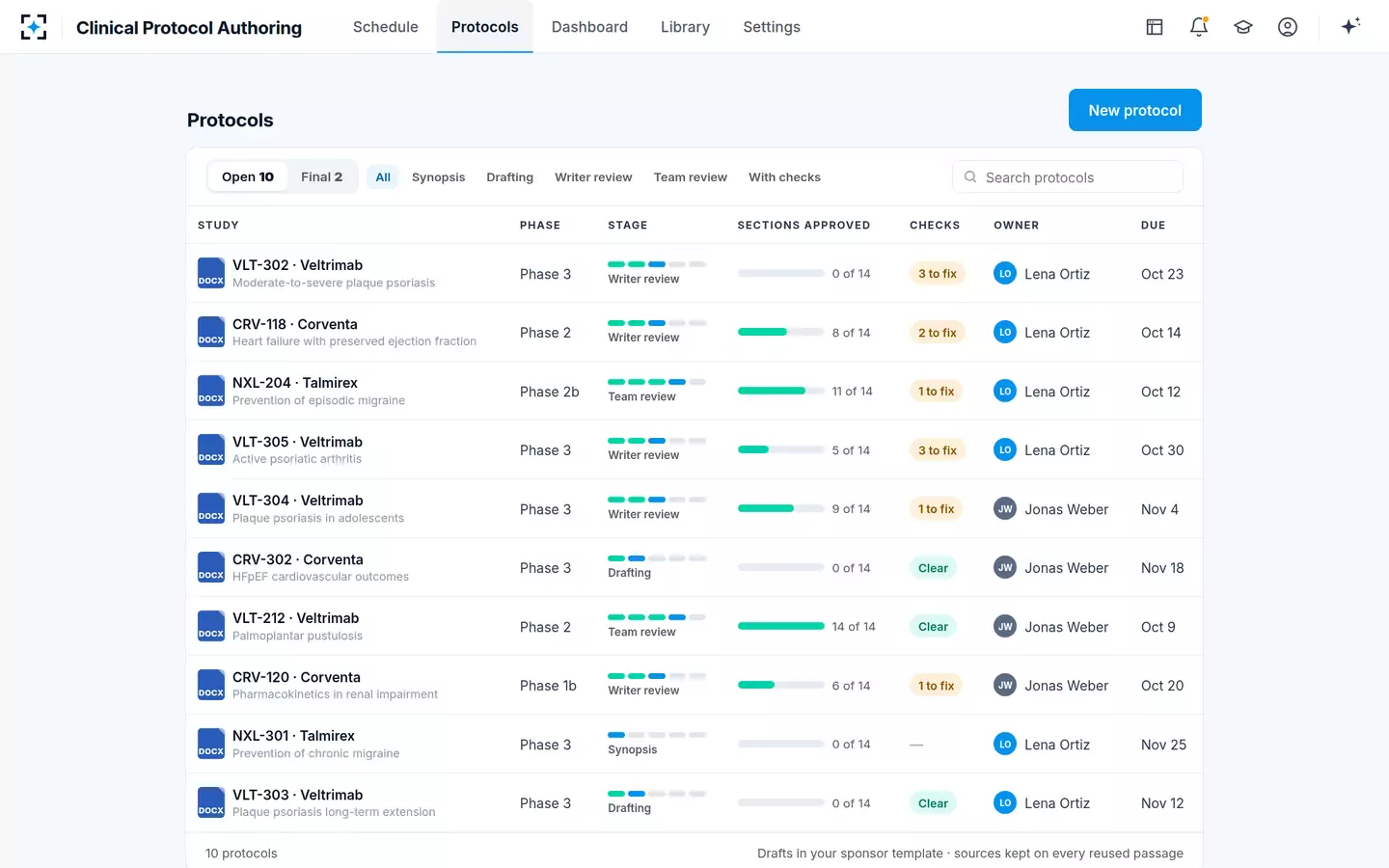
That last one is the only measurement that proves the purchase. Drafting faster is pleasant; drafting faster while amending at the same rate means the work moved rather than disappeared. The sample dashboard reports it as a ratio by year — amendments caused by an inconsistency against all substantial amendments that year — which is the shape a sponsor should ask for.
Two things should not have changed. A named person should still approve every section, and the head of medical writing should still sign the final version with a reason before it is locked. If either has quietly become a formality, the tool has not made the process faster; it has made the approval cheaper, which is a different and worse thing.
Where a portfolio actually stands, protocol by protocol
Buying well here is mostly a matter of asking the four structural questions — template, sources, validation, control — before the demonstration starts, and refusing to be moved off them by how good the first draft looks. To see the library, the settings and the approvals on one screen, start from Clinical Protocol Authoring.
Questions people ask
What should you look for in protocol authoring software?
Four structural things, in this order: that it holds your template and your standard text as configuration rather than imposing its own; that every reused sentence keeps the document, version and page it came from and opens at that passage; that your configuration and its automated checks and calculations can be validated, not just the vendor's base system; and that a named person approves every section and signs the final version. Speed of first draft is the least informative thing a demonstration shows.
Is structured authoring different from drafting a protocol from sources?
Yes. Structured authoring holds content as reusable components in a repository and assembles documents from them — it is about the content model, and it needs one before it does anything. Drafting from sources reads a synopsis, retrieves passages from final approved protocols and writes each section with its origin kept. They can be combined, but they need different preparation and they fail in different ways.
Does protocol authoring software need to be validated?
If its output becomes the protocol, yes, on a risk-based approach. ICH E6(R3) asks sponsors to consider the intended use, the importance of the records generated, and the system's potential to affect participants' wellbeing, rights and safety and the reliability of trial results. A protocol scores high on all three, and the system should also appear on the sponsor's record of important computerised systems with its validation status and its owner.
Is the vendor's validation enough?
No. ICH E6(R3) is explicit that both standard system functionality and protocol-specific configurations and customisations, including automated data entry checks and calculations, should be validated, and that interfaces between systems should be defined and validated too. The configuration half is the sponsor's work, and it recurs whenever a check, a weight or a template version changes.
Will it work with our own protocol template?
That is a question to answer with your actual template before signing anything. Ask to see a draft produced in your section numbering, with your standard text in place, and ask what changing to a new template version involves. If the answer is a professional services engagement, the template is the vendor's rather than yours — and ICH M11 will make that an expensive position, since the EMA guideline came into effect on 11 June 2026 and FDA published the guidance on 22 May 2026.
How do you keep control of the final protocol?
By keeping approval at a grain where judgement is visible. Section-by-section approval with a named reviewer per section, every proposed fix accepted or dismissed with a reason, every open decision routed to a named person and answered in writing, a full consistency re-check before team review, and an e-signature with a reason after which the version is locked and every earlier version is kept. None of that is about the software; all of it is about what the software is allowed to do without a person.