To write a clinical trial protocol, start with the two tables that bind everything else — the schedule of activities and the estimand table — and draft the prose outwards from them. The work is turning a nine-page synopsis into ninety to a hundred and twenty pages that agree with themselves: objectives, eligibility, intervention, assessments, safety, statistics and oversight, each stating facts the others repeat. It is hard because the three rulebooks that say what a protocol must contain say nothing about the order it is written in, and the order is what decides whether the draft is consistent when it reaches review. Clinical Protocol Authoring is Botminds' software for that work: it reads the synopsis, builds the schedule, drafts the fourteen sections from language already approved in past protocols, and checks the draft against itself before a reviewer sees it.
The worked example on this page is the sample study that ships with the solution: VLT-302, a Phase 3 trial of Veltrimab in moderate-to-severe plaque psoriasis. The trial, the drug, the sponsor and everyone named in it are invented. The rules quoted around it are not, and each is linked where it appears.
One Phase 3 protocol, by the numbers
9pages
of synopsis, read into 31 fields with the page each came from
14
sections to draft, eleven in the main body and three appendices
58%
of the sample first draft reused from language already approved
11 × 15
visits across by procedures down in the schedule of activities
What sections does a clinical trial protocol have?
A clinical trial protocol has fourteen numbered sections under the ICH M11 template: eleven in the main body and three appendices. Sponsors have long numbered them differently, and the M11 guideline is blunt about what that cost — "variability in format and core content among sponsors contributes to inefficiencies and difficulties in searching, reviewing, and assessing protocols" (ICH M11 guideline, adopted 19 November 2025). The template fixes where each fact sits. It does not fix whether the fact is right.
Read the list once as a list of obligations rather than headings. Each section owes a set of statements that other sections will repeat, and almost every line of a protocol can be traced back to the synopsis, to a past protocol, or to a decision only a named person can make.
The fourteen sections of a protocol, what each owes, and where its facts come from
| Section | What it owes | Where the facts come from |
|---|---|---|
| 1 Protocol summary | The synopsis, the schema and, at 1.3, the schedule of activities | Written last from the finished sections; the schedule is built first |
| 2 Introduction | Why the trial is needed, and the risk and benefit assessment | The investigator brochure and the synopsis background |
| 3 Objectives and estimands | Each objective refined into a precise clinical question, with its estimand table | The synopsis objectives, settled with the statistician |
| 4 Trial design | The design and a rationale for each choice, including the estimands | The synopsis design paragraph and the design team |
| 5 Trial population | Inclusion, exclusion, contraception, lifestyle restrictions, rescreening | The synopsis population, usually adapted from a past protocol |
| 6 Intervention and concomitant therapy | Dose, regimen, administration, blinding, randomisation, adherence | The synopsis intervention; the pharmacy and the randomisation plan |
| 7 Discontinuation and withdrawal | When intervention stops for one participant, and when they leave the trial | Standard sponsor language, aligned to the estimand strategies |
| 8 Assessments and procedures | Each assessment in detail, without repeating the schedule | The schedule of activities and the approved text behind each scale |
| 9 Adverse events and safety reporting | Definitions, timing, collection, reporting, special situations | Standard sponsor language and regional reporting rules |
| 10 Statistical considerations | Analysis sets, analyses per objective, missing data, sample size | The statistician, working from section 3 |
| 11 Trial oversight | Ethics, consent, committees, data protection, deviations, dissemination | Standard sponsor language and the regions in scope |
| 12 Appendix: supporting details | Laboratory tests, country differences, prior amendments | The laboratory manual and the amendment history |
| 13 Appendix: glossary and abbreviations | Every abbreviation, spelled out once | Built from the finished draft, not written ahead of it |
| 14 Appendix: references | Every work cited in the text | Collected as each section is drafted |
Start at the end: the schedule of activities and the estimand table
Two tables decide what the rest of the protocol may say, and both sit in the first third of the document. The first is the schedule of activities at section 1.3, which lists every visit across the top and every procedure down the side. The template puts it there deliberately: "the Template is designed with the most vital information for execution (e.g., Synopsis, Schema, Schedule of Activities) near the front," because investigators and site staff are the people who have to run it.
The second is the estimand table at 3.1.1, which turns each objective into a precise clinical question through five rows — population, treatment, endpoint, population-level summary and a strategy for each intercurrent event. Its instruction in the template is one sentence long and carries most of the risk in a protocol: "precisely define each trial objective and refine each trial objective into a precise clinical question of interest by defining the associated estimand … Ensure alignment with every other section of the protocol."
The schedule of activities, with the fourteen sections drafting beside it
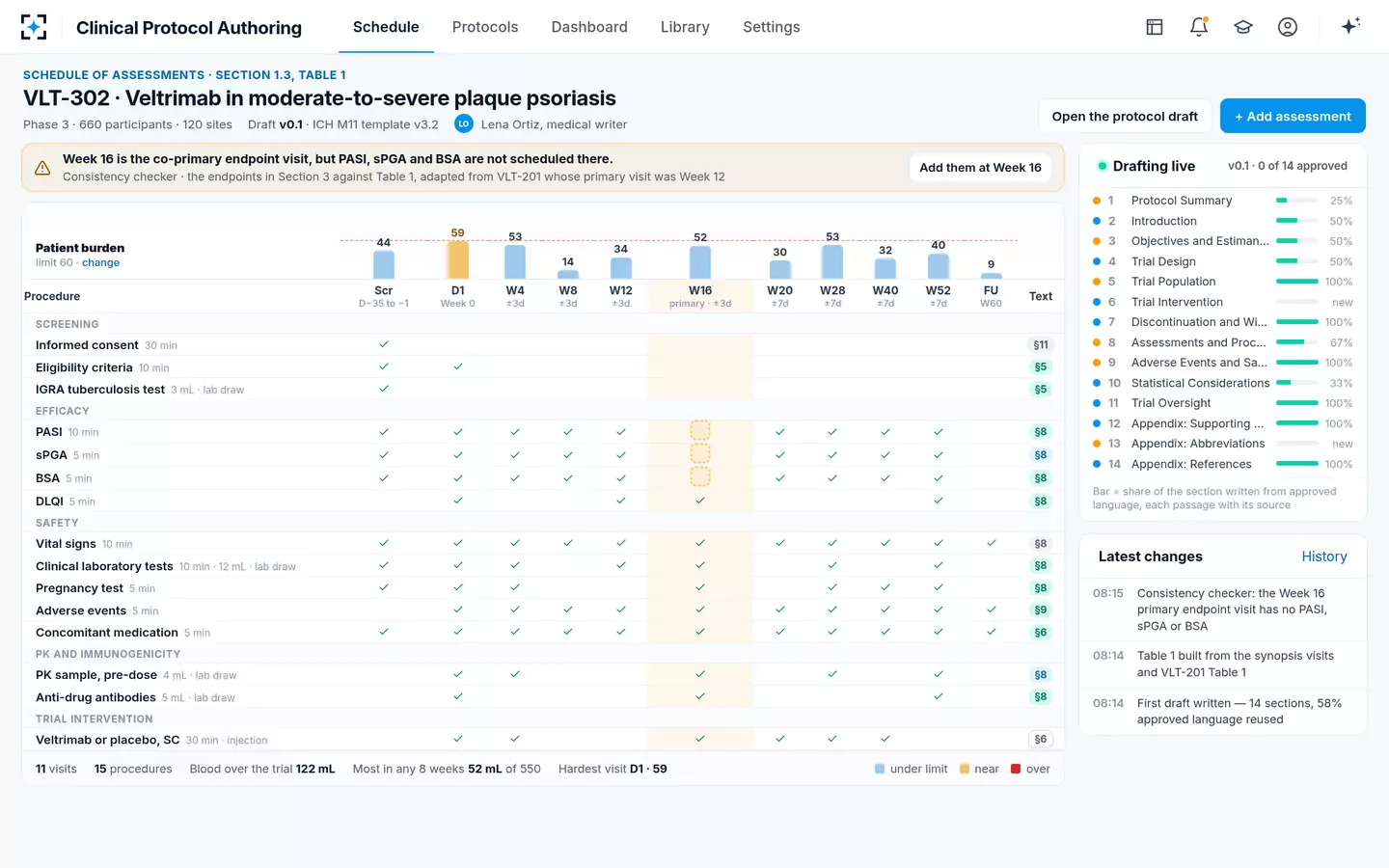
Once those two are fixed, a great deal of the protocol is already determined. The schedule decides which eligibility tests exist, when each endpoint is measured, how often safety is checked and what a site has to do at every contact. The estimand table decides what section 10 may analyse and what section 7 has to say about stopping. Draft the prose first and you will write sentences the tables later contradict — which is exactly the failure a cross-check finds, two weeks before the review date. Building the schedule of activities and making objectives, endpoints and estimands agree each take one of those tables on its own.
The three content rulebooks, and where they differ
Three documents tell a writer what a protocol must contain, and they agree more than they disagree. ICH E6(R3) Appendix B lists the content of a protocol for good clinical practice; 21 CFR 312.23(a)(6) is the United States regulation on what an investigational new drug application's protocols must contain; and SPIRIT 2025 is the academic reporting guideline for protocols of randomised trials, an "evidence-based checklist of 34 minimum items to address in a trial protocol, along with a diagram illustrating the schedule of enrolment, interventions, and assessments for trial participants."
The differences are small in number and large in consequence, because each rulebook asks for at least one thing the other two do not list.
Three rulebooks on protocol content: what each demands that the others do not
What it is: The good clinical practice content list for a protocol, adopted 6 January 2025. Asks for a clear description of the scientific objectives, "information on estimands, when defined", and "a description of the schedule of events (e.g., trial visits, interventions and assessments)".
What only this one asks for: Estimands. Neither the US regulation nor SPIRIT 2025 names them; an estimand table is an ICH obligation, carried into the M11 template.
What it is: What an investigational new drug application's protocols must contain. Seven items, from "a statement of the objectives and purpose of the study" to the procedures used "to monitor the effects of the drug in human subjects and to minimize risk".
What only this one asks for: People and places inside the protocol: each investigator's name, address and qualifications, each subinvestigator, the research facilities and every reviewing ethics committee.
What it is: Thirty-four minimum items for protocols of randomised trials, published April 2025, with a schematic participant timeline at item 18.
What only this one asks for: Open science and the public as protocol items: where the de-identified data and statistical code will be accessible, plans to communicate results to participants, and patient and public involvement. E6(R3) encourages the last two in its principles, but its Appendix B content list does not itemise them.
One clause in the US regulation is worth reading twice, because it is about writing rather than content. "A protocol for a Phase 2 or 3 investigation should be designed in such a way that, if the sponsor anticipates that some deviation from the study design may become necessary as the investigation progresses, alternatives or contingencies to provide for such deviation are built into the protocols at the outset." A writer who knows a dose may need reducing, or a visit may need a window, is being told to write the contingency now rather than amend later.
From a nine-page synopsis to a 100-page protocol
The synopsis is the input and the authority. For VLT-302 it is nine pages: title, background, objectives, endpoints, population, design, intervention, visits, sample size, duration. Every fact in it will be repeated three or four times in the protocol, in different vocabularies, and every one of those repetitions is a chance to drift.
The first job is therefore mechanical and worth doing properly: read the synopsis into structured fields, keeping the page each one came from and the exact wording of anything that will be quoted. Endpoint wording in particular should be lifted, never paraphrased — "the co-primary endpoints are PASI 90 response and sPGA 0/1 response at Week 16, each compared with placebo" has to survive into section 3, section 8 and section 10 unchanged. And where the synopsis is silent, the silence is the finding. If it names an endpoint without a timepoint, the right move is to mark the timepoint missing and ask, not to infer it from the last study.
The synopsis read into 31 fields, with the past protocols ranked beside it
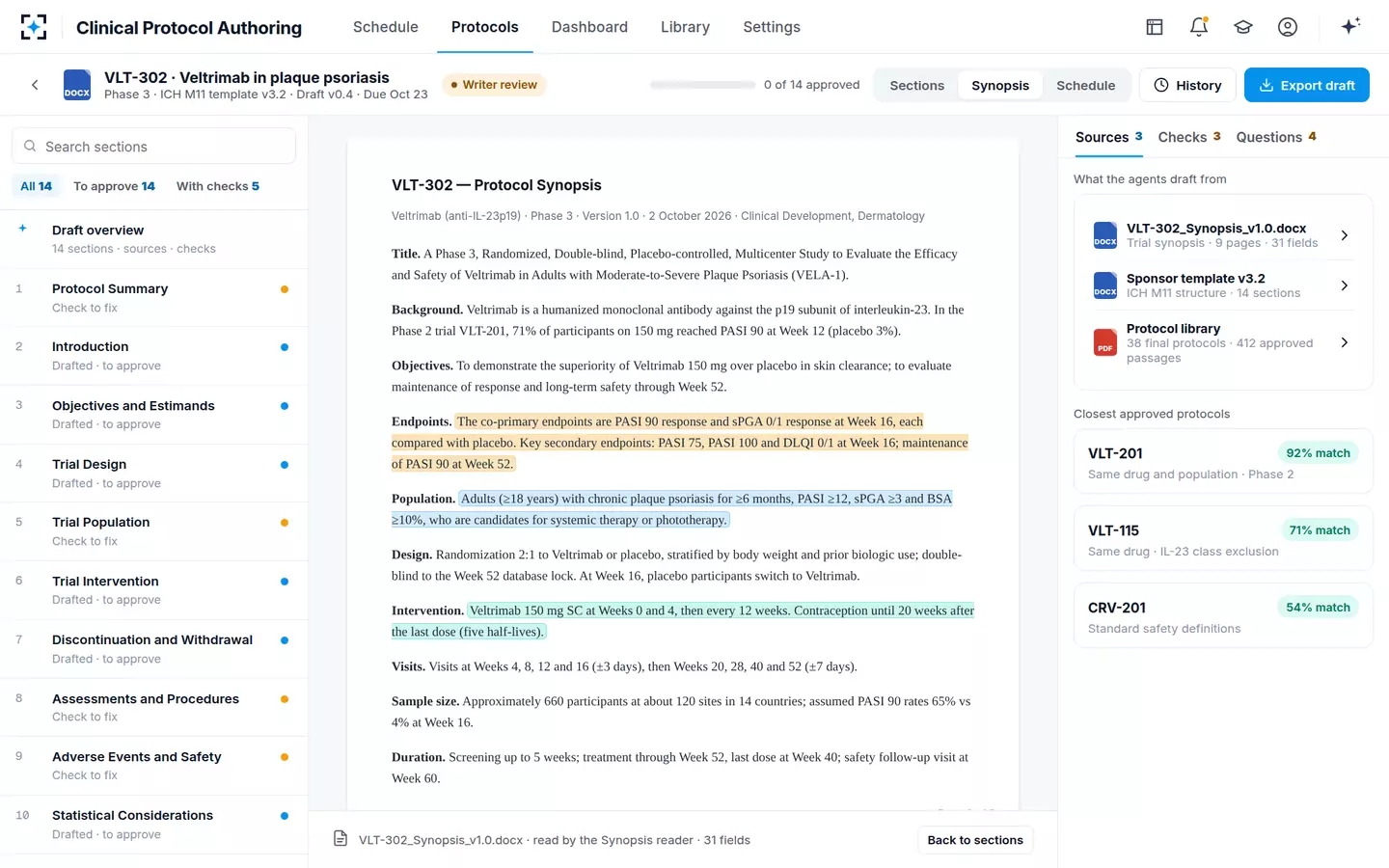
The second job is to find the closest past protocol, because most of what you are about to write already exists in approved form. For VLT-302 the ranking is unambiguous: VLT-201 at 92% match — same drug, same population, one phase earlier — then VLT-115 at 71% and CRV-201 at 54%. In the sample draft, 58% of the first draft is reused approved language. That number is the prize and the trap at once, and the section on reuse below is about the trap.
Section 8 and why it is drafted last but decided first
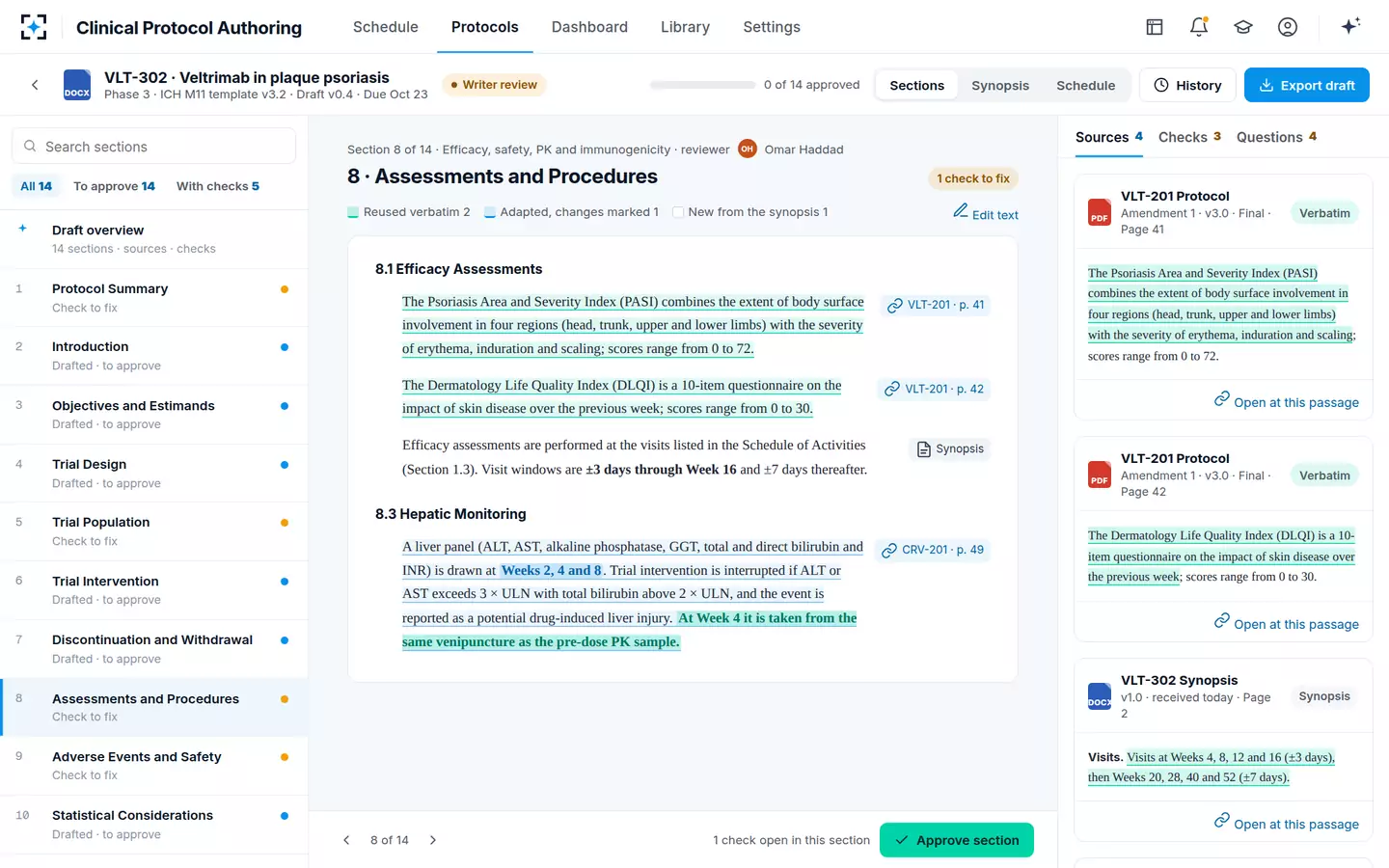
Section 8, trial assessments and procedures, is the section that most often holds up a review, and the template explains why in its own instruction. It must align with four other sections at once: the intercurrent events and strategies in section 3, the intervention and concomitant therapy in section 6, the discontinuation procedures in section 7, and the statistical analysis in section 10. It must also describe each assessment without repeating the schedule — "provide details that are not already presented in the SoA, taking care not to duplicate information."
That makes section 8 downstream of almost everything, which is why it is drafted late. But its content was decided early, when the schedule was built: every row in the schedule becomes a paragraph in section 8, and every window in the schedule becomes a sentence in 8.1. Write section 8 before the schedule is settled and you will write it twice.
Section 8 with every passage showing where it came from
In what order do you write a protocol?
The order below is the one that produces the fewest contradictions, and it is roughly the inverse of the numbering. Read the synopsis; build the schedule; fix the estimand table with the statistician; draft the sections that depend only on those two, in parallel; draft section 8 against the finished schedule; draft section 10 against the finished estimand table; then write the synopsis section, the glossary and the references from the document you now have.
The drafting order, with the two tables that control every section after them
Agent
Read the synopsis into fieldsDesign, population, objectives, endpoints, dosing, visits and sample size, each with the page it came from and the exact wording of anything quotable.
Never: infer an endpoint timepoint the synopsis does not state — mark it missing
Agent
Build the schedule of activitiesVisits across, procedures down, a window on every column, every contact with a participant included. This is section 1.3, and it is the first thing written.
A person decides
Fix the estimand tableWith the statistician: population, treatment, endpoint, population-level summary and a strategy for each intercurrent event, for the primary objective and each secondary one.
Agent
Draft 2, 4, 5, 6, 7, 9 and 11 in parallelThe sections that depend on the synopsis and the two tables, most of them from language already approved in a past protocol, with every changed word marked.
Agent
Draft 8, then 10Section 8 from the finished schedule, row by row; section 10 from the finished estimand table, objective by objective.
Agent
Cross-check the whole draftEndpoint timepoints against the schedule, objectives against endpoints and estimands, eligibility against the synopsis, doses, windows and abbreviations — each finding showing both passages.
Never: apply a fix on its own
A person decides
Write 1.1, 13 and 14; approve each sectionThe synopsis section, the glossary and the references are written from the finished document. The medical writer approves each section, then its named reviewer.
A person decides
Sign and lockWhen all fourteen are approved, a full re-check runs, the team reviews, and the head of medical writing signs with a reason. The version is locked and kept.
The decisions a writer cannot make alone
A synopsis is a summary, so it leaves gaps, and a writer who fills a gap quietly has made a clinical decision. The honest move is to collect the gaps as questions, send each to the one person who owns it, and write the answer back into the section with the name and the date attached. Nine recur on nearly every first draft.
Nine decisions to settle before drafting, and who settles each
- Does each objective have an estimand, and which strategy covers each intercurrent event?
The statistician. ICH E6(R3) asks for "information on estimands, when defined"; the M11 template asks for the table.
- What is the exact wording and timepoint of every endpoint?
The clinical lead. Quote the synopsis; if a timepoint is missing, ask rather than assume.
- Which eligibility criteria carry over from the last study, and which do not?
The clinical lead. A cap inherited from an earlier trial is a decision, not a formatting choice.
- How long after the last dose must contraception continue?
The medical monitor, from the half-life. Section 5.4 and section 9.3 have to say the same number.
- What visit window applies, and does it change after a given visit?
Clinical operations. The schedule footnote and section 8.1 are the two places it has to match.
- Is a data monitoring committee needed, and what are its stopping rules?
The medical monitor. It changes sections 4.3, 10.9 and 11.4 together.
- What is the testing order for the key secondary endpoints?
The statistician. It belongs in 10.10, and it decides what the trial may claim.
- Which assessments are required for an endpoint, and which are exploratory?
The clinical lead with clinical operations — the difference decides what may be cut if a visit is too long.
- Which past protocols may be reused, and how old is too old?
The head of medical writing. In the sample settings, final protocols only, nothing finalized more than five years ago.
Reusing language from a past protocol without inheriting its mistakes
Reuse is the right instinct. Approved language has already survived an ethics committee and a regulator, and rewriting it from scratch introduces risk for no gain. The danger is narrower than it looks: a passage is usually correct and simply no longer true of this trial.
The sample draft shows the pattern exactly. Its schedule was adapted from VLT-201, whose primary endpoint sat at Week 12. VLT-302's co-primary endpoints are at Week 16. The adapted schedule carried PASI, sPGA and BSA at every visit it had before — and not at Week 16, the one visit the trial exists to measure. Nothing in the inherited text was wrong about VLT-201. It was simply silent about the change that mattered.
Three habits keep reuse honest. Reuse only from final, approved protocols, never from a draft or a superseded version, and flag any source that was later amended so the writer reads the amendment first. Mark every changed word when a passage is adapted, so a reviewer reads the difference rather than the paragraph. And keep the document, version and page on every reused passage, all the way into the exported file — in the sample settings the Word export carries them as comments, or as an appendix if the reviewer prefers a clean copy.
Clinical trials should be described in a clear, concise, scientifically sound and operationally feasible protocol. … A well-designed trial protocol is fundamental to the protection of participants and for the generation of reliable results.
ICH E6(R3), Good Clinical Practice, adopted 6 January 2025
What review will send back, and how to pre-empt it
Reviewers rarely object to a protocol's prose. They object to two sections saying different things, and they find it by reading one section against another — which is slow, which is why it happens late. The four findings on the sample draft are the four kinds, and all of them are mechanical enough to catch before a human reads anything.
The first is a missing timepoint: an endpoint defined in section 3 at a visit the schedule does not test. The second is a number that differs between sections — contraception for twenty weeks after the last dose in the population section and sixteen weeks in the safety section, both inherited from the same past protocol, one of them updated for the new half-life and one of them not. The third is a window that differs between the text and the table, plus or minus three days through Week 16 in section 8.1 against plus or minus seven in the schedule footnote. The fourth is an abbreviation used before it is spelled out.
Each has a cheap pre-emption. Build the schedule first and test every endpoint timepoint against it. Search the draft for every duration and every dose and read the hits together rather than in place. Compare each window in the text with its column in the table. Generate the abbreviation list from the finished draft rather than maintaining it by hand. In Clinical Protocol Authoring these run as a check over the whole draft before the writer sends it out, and each finding shows both passages and one proposed fix — the fix is proposed, never applied, and the writer accepts it or dismisses it with a reason. The deeper question of what a late change costs once a protocol is approved is taken up in protocol amendment versus deviation.
One more pre-emption is easy to skip and expensive to skip: add up what a visit asks of a participant before the sites do. The template's own schedule instruction covers the clock, and ICH E6(R3) asks that a protocol "minimise unnecessary complexity". How much blood a single visit may ask for, and the limits that answer it, are worked through in blood draw limits for research. To see the drafting order, the schedule and the cross-checks together on one trial, start from Clinical Protocol Authoring.
Questions people ask
Who writes the clinical trial protocol?
A medical writer or clinical scientist drafts it, but the protocol is a team document. The clinical lead owns the population and the intervention, the statistician owns the estimands and section 10, the medical monitor owns safety, and clinical operations owns the schedule and the procedures. In most sponsors the writer approves each section first, named reviewers follow, and the head of medical writing signs the final version.
What is the difference between a synopsis and a protocol?
The synopsis is the input — usually around nine pages, written by clinical development, stating the design, objectives, endpoints, population, intervention and sample size. The protocol is the operational document a site runs the trial from, ninety pages or more. Confusingly, the finished protocol contains a synopsis of its own at section 1.1, which is written last, from the finished sections, not copied from the input synopsis.
How many pages is a clinical trial protocol?
A benchmark of industry protocols found an average of about 116 pages for Phase III, 108 for Phase II and 87 for Phase I (Getz, Smith and Kravet, 2022); the sample Phase 3 protocol here is 90 to 120. Page count is a poor measure of effort, though: the number of distinct procedures in the schedule and the number of objectives predict the work far better, because each one creates obligations in three or four separate sections.
What does ICH E6(R3) require in a protocol?
Appendix B of ICH E6(R3), adopted on 6 January 2025, lists the content: trial identifiers and sponsor details, background and rationale, "a clear description of the scientific objectives and the purpose of the trial", information on estimands when defined, design, population, intervention, "a description of the schedule of events", assessments, safety reporting, statistics, data handling and oversight. The guideline also sets a design standard — the protocol should "minimise unnecessary complexity".
How do you stop two sections of a protocol contradicting each other?
Give every repeated fact a single home and quote it everywhere else. Durations, doses, windows and endpoint timepoints are the four that drift, because each is written in two or three sections by different people on different days. Then test the draft mechanically: every endpoint against the schedule, every window against its column, every duration against its first statement. A reviewer who finds the contradiction instead has spent an expensive afternoon on something a search could have caught.
Who signs a clinical trial protocol?
Sponsor practice varies, but the usual signatories are the sponsor's responsible medical officer or medical monitor, the statistician, and the head of the function that owns the document — commonly medical writing or clinical development. Each investigator then signs a separate agreement to conduct the trial according to the protocol. In the sample workflow here, all fourteen sections must be approved and a full re-check must run before the signature is offered at all.