A protocol amendment and a protocol deviation are not two sizes of the same event. An amendment is a change to the protocol, made deliberately and before the fact, and in the European Union and the United States it generally may not be implemented until it has been authorised or submitted and approved. A deviation is what happened at a site to a protocol that was not changed — discovered after the fact, recorded, assessed and sometimes reported. Knowing which one you are holding decides who has to say yes, how long you wait and what it costs, and the sorting is done case by case by the sponsor, not by a regulator. Clinical Protocol Authoring sits one step upstream of all of it, catching the mismatches inside a draft that later turn into changes nobody wanted to make.
The trial, the drug and the people in the product figures are invented sample data: VLT-302, a Phase 3 study of Veltrimab in plaque psoriasis, drafted by Lena Ortiz with Omar Haddad, Dr. Priya Raman and Dr. Maya Chen reviewing. The regulatory figures are linked to the rules and studies they come from.
What is the difference between a protocol amendment and a protocol deviation?
The difference is tense and intent. An amendment is prospective and deliberate: the sponsor decides the protocol should say something else, writes the change, and in the European Union and under a US IND waits for an authorisation or an approval before the change can be used. A deviation is retrospective and unintended: a participant was dosed outside the window, an assessment was missed, a consent was signed on the wrong form. Nobody intended the protocol to say that, and nobody changes it.
Three consequences follow from the tense. First, an amendment is a regulatory submission with a process and a timetable; a deviation is a quality event with an assessment and a record. Second, an amendment can be planned, budgeted and batched; a deviation cannot. Third — and this is the part teams underestimate — a pattern of the same deviation at many sites is often evidence that the protocol, not the sites, is wrong, and the proper answer to it is an amendment.
ICH E6(R3) points at the relationship between the two from the design side: "Building adaptability into the protocol, for example, by including acceptable ranges for specific protocol provisions, can reduce the number of deviations or in some instances the requirement for a protocol amendment" (ICH E6(R3), adopted January 2025). A visit window written as ±3 days when the clinic can only manage ±7 generates deviations every month until somebody amends it.
Four routes a change can take, and what each one needs before it can be used
What it is: A change likely to have a substantial impact on the safety or rights of subjects, or on the reliability and robustness of the data. Defined in Article 2(2)(13) of Regulation (EU) No 536/2014.
What has to happen first: An application through the EU portal, assessed by the Member States concerned. "The SM can be implemented only after the SM application has been authorised in that MSC."
What it is: A change that is not substantial but that Member States need for oversight — the Article 81(9) route.
What has to happen first: The information is permanently updated in the EU database. No assessment; a change that triggers further changes needing an application cannot go this way.
What it is: A change with no substantial impact on safety, rights, reliability or robustness, and not needed for oversight. Typos and administrative corrections are always in this box.
What has to happen first: Nothing is notified at the time. It is listed in the cover letter of the next substantial modification application covering the same part of the dossier.
What it is: Under 21 CFR 312.30, a change in a Phase 1 protocol that significantly affects subject safety, or a change in a Phase 2 or 3 protocol affecting safety, the scope of the investigation or the scientific quality of the study.
What has to happen first: Submitted to FDA and approved by the reviewing IRB — in either order — before the change is made. A new investigator is notified within 30 days of being added.
What it is: A departure from the protocol as written, found after it happened. ICH E6(R3) asks sponsors to define which ones are important for their trial.
What has to happen first: Nothing is approved. It is assessed, recorded, and reported in line with the sponsor’s procedures and the trial’s reporting requirements.
What makes a change substantial in the EU
The European definition is one sentence, and it is worth reading slowly. A substantial modification means "any change to any aspect of the clinical trial which is made after notification of a decision referred to in Articles 8, 14, 19, 20 or 23 and which is likely to have a substantial impact on the safety or rights of the subjects or on the reliability and robustness of the data generated in the clinical trial" (Regulation (EU) No 536/2014, Article 2(2)(13)).
Two tests, joined by "or". A change that touches neither safety and rights nor reliability and robustness is not substantial, however much work it makes. A change that touches either one is, however small it looks on the page. And "likely to have a substantial impact" is a judgement about effect, not a judgement about size: moving a single assessment can be substantial if it is the assessment the primary endpoint is measured on.
Who makes that judgement is explicit. "It is, in principle, the responsibility of the sponsor to assess whether a modification is to be regarded as 'substantial'. This assessment is to be made case-by-case based on the definition as per CTR," says the European Commission's Q&A, adding that sponsors in doubt should contact the national contact point (European Commission, clinical trials Q&A, chapter 3). The same chapter warns that the classification is not a free choice: incorrect use of the non-substantial route "could lead to corrective measures" by the Member States concerned, and a non-substantial change submitted alongside a substantial one "cannot under any circumstances be considered to have been assessed and approved."
There is also a ceiling. A sponsor must consider whether a modification, or a combination of them, changes the trial so far that it has become a new trial — an unplanned new investigational medicinal product, a change of the main objective or primary endpoint, an unplanned and unjustified new arm or placebo group. Those need a new authorisation, not a modification of the old one.
What makes a change reportable in the US
Under an IND, the test is written into 21 CFR 312.30: "A sponsor shall submit a protocol amendment describing any change in a Phase 1 protocol that significantly affects the safety of subjects or any change in a Phase 2 or 3 protocol that significantly affects the safety of subjects, the scope of the investigation, or the scientific quality of the study" (21 CFR 312.30(b)(1)).
The regulation then does something the EU definition does not: it gives examples. Any increase in dosage or in duration of exposure beyond the current protocol, or any significant increase in the number of subjects. Any significant change in design, "such as the addition or dropping of a control group". And the addition of a new test or procedure intended to improve monitoring for, or reduce the risk of, a side effect — or the dropping of a test intended to monitor safety. That third example is the one that catches teams out, because adding a safety test feels like caution rather than a change.
The sequencing is the same shape as the European one, with the order left open: the change may be made once the sponsor has submitted it to FDA for review and the IRB with responsibility for the study has approved it, and the sponsor "may comply with these two conditions in either order."
One change, from the moment it arrives to the moment it is recorded
A person decides
Whoever asksA medical monitor, a site, a statistician or a regulator asks for a change, or a reviewer finds an inconsistency in the draft.
Never: Never starts by writing the new text
A person decides
The sponsorClassifies it: substantial, non-substantial relevant to supervision, non-substantial, or a change that makes it a new trial. In the US, tests it against the significance of the effect on safety, scope or scientific quality.
Never: Never leaves the classification to a template
Agent
The draftCarries the change into every section it touches, with the earlier wording kept, so the extent of the change is visible before anyone signs it.
Never: Never applies a change on its own
A person decides
The authority or the boardAuthorises, or is notified. In the EU a substantial modification may be implemented only once authorised in that Member State; under an IND the submission and the IRB approval may come in either order.
Never: Never retrospective, except for an immediate hazard
A person decides
The sitesImplement the change on the date it takes effect, with the new version, the new consent where needed, and the new schedule.
Never: Never before the effective date
A person decides
The trial master fileKeeps the reason for the change, the version it created and the date each site adopted it, so deviations before and after are read against the right protocol.
Never: Never overwrites the earlier version
The change that may be implemented immediately
There is one route where the change comes first and the paperwork follows. Under 21 CFR 312.30, "a protocol change intended to eliminate an apparent immediate hazard to subjects may be implemented immediately provided FDA is subsequently notified by protocol amendment and the reviewing IRB is notified in accordance with § 56.104(c)". The condition is narrow — an apparent immediate hazard, and a change intended to eliminate it — and it is not a general emergency exception for a change that is merely urgent.
The European Union handles the same situation under a different heading. Article 54 of the Clinical Trials Regulation covers urgent safety measures: "Where an unexpected event is likely to seriously affect the benefit-risk balance, the sponsor and the investigator shall take appropriate urgent safety measures to protect the subjects." The sponsor then notifies the Member States concerned through the EU portal "without undue delay but no later than seven days from the date the measures have been taken."
Both are mechanisms for acting first. Neither is a classification: once the hazard is handled, the change still has to find its route, and in the EU the urgent safety measure is explicitly without prejudice to the modification chapters.
Important deviations, and who defines them
"Important protocol deviation" is a defined category whose contents the sponsor writes. ICH E6(R3) is explicit on both halves: "The sponsor should determine necessary trial-specific criteria for classifying protocol deviations as important. Important protocol deviations are a subset of protocol deviations that may significantly impact the completeness, accuracy and/or reliability of the trial data or that may significantly affect a participant's rights, safety or well-being."
Notice how closely the wording tracks the European substantial-modification test — data reliability on one side, participant rights and safety on the other. The same two questions decide whether a planned change is substantial and whether an unplanned departure is important. A team that writes one list can usually write the other from it.
The criteria have to exist before the trial opens, trial by trial. A deviation category inherited from a previous study will mark the wrong things important: a missed PASI at the co-primary endpoint visit is an important deviation in this trial and might be routine in another.
Administrative changes, and the trap in calling a change one
An administrative change is a change with no effect on the content or the meaning of the protocol — a typographical correction, a department name, a reformatted table. The European Commission's Q&A puts them squarely in the lowest box: "Correction of typos and other administrative changes with no impact on the content and meaning of the information are always expected to be updated as NSM," the non-substantial route.
The trap is the word "administrative" doing work it cannot do. A correction that changes meaning is not administrative, however obviously it is a mistake. If the population section says contraception is required until 20 weeks after the last dose and the safety section says 16 weeks, choosing a number is not a typographical fix: it changes what participants are told to do, which is a change to their safety and rights. The sponsor's assessment has to be made on the effect, not on how the change was born.
A second trap is accumulation. Several Article 81(9) changes, each harmless, "can cumulate into a change that needs to be submitted as an SM". A sponsor that classifies every change on its own and never looks at the stack will eventually have changed something substantial by instalments.
The two questions the ICH M11 amendment section now asks
The ICH M11 template, adopted at Step 4 on 19 November 2025, makes the assessment part of the protocol document rather than a thing the regulatory team does afterwards. The amendment section asks for a summary of the key changes, a primary and secondary reason chosen from set categories, and then two questions with a yes or no answer and an explanation where the answer is yes.
What an M11 protocol amendment has to answer about itself
"Is this amendment likely to have a substantial impact on the safety or rights of the participants?"
Yes / No — and if yes, briefly explain.
"Is this amendment likely to have a substantial impact on the reliability and robustness of the data generated in the clinical trial?"
Yes / No — and if yes, briefly explain.
Those are the two limbs of the European definition, lifted into the protocol template itself and asked of every amendment anywhere. The practical effect is that a sponsor can no longer finish an amendment without having written down its own classification reasoning, in a field a reviewer will read. What else the M11 template changes for protocol writers, goes through the rest of the structure.
What an amendment costs, and how many protocols get one
The most widely cited measurement is Tufts CSDD's 2016 study of amendment impact: "Tufts CSDD found that 57% of protocols had at least one substantial amendment, and nearly half (45%) of these amendments were deemed 'avoidable.' ... The median direct cost to implement a substantial amendment was US$141,000 for a phase II protocol and $535,000 for a phase III protocol" (Getz et al., Therapeutic Innovation & Regulatory Science, 2016).
What a substantial amendment costs, and how often one happens
57%
of protocols had at least one substantial amendment
45%
of those substantial amendments were judged avoidable
$535K
median direct cost of one Phase 3 substantial amendment
Read the three numbers together and the arithmetic is uncomfortable. If more than half of protocols take at least one substantial amendment, and nearly half of those were avoidable, then a meaningful share of Phase 3 programmes are carrying a six-figure direct cost, plus the delay it causes, for a change that a better draft would have made unnecessary. What a day of that delay costs is the other half of the bill.
The amendments that were avoidable, and where they were born
Avoidable amendments are rarely born in a committee. They are born in a draft, when a sentence in one section stops agreeing with a sentence in another or with the table everybody works from. The sample trial's draft has four of them before any reviewer has opened it, and all four are the kind that would eventually be found by a site.
Five changes from the sample trial, and the route each one takes
| The change | Which route | Why |
|---|---|---|
| The co-primary endpoint visit at Week 16 has no PASI, sPGA or BSA scheduled — the schedule was adapted from a study whose primary visit was Week 12. | Fixed in the draft; no amendment | Caught before the protocol was finalised. Had it been found after approval, restoring the measurements the primary endpoint depends on would plainly touch the reliability and robustness of the data. |
| Contraception required until 20 weeks after the last dose in the population section and 16 weeks in the safety section. | Fixed in the draft; no amendment | A contradiction, not a typographical slip: the two numbers tell a participant to do different things, so choosing one is a change to safety and rights, not an administrative correction. |
| A liver panel added at Weeks 2, 4 and 8 at the medical monitor’s request, before the protocol is final. | Written into the draft | After approval, the same change would be the 21 CFR 312.30 example of adding a test to improve monitoring for a side effect, and would need submission and board approval first. |
| Visit windows of ±3 days in Section 8.1 against ±7 days in the schedule footnote. | Fixed in the draft; no amendment | Left in, it would generate deviations at every site that read the footnote, and the eventual fix would be an amendment to stop them. |
| An abbreviation used in Section 1.1 before it is spelled out. | Fixed in the draft; administrative if later | No effect on content or meaning — the one category that is genuinely administrative. |
Four mismatches in a draft, each with both passages and one proposed fix
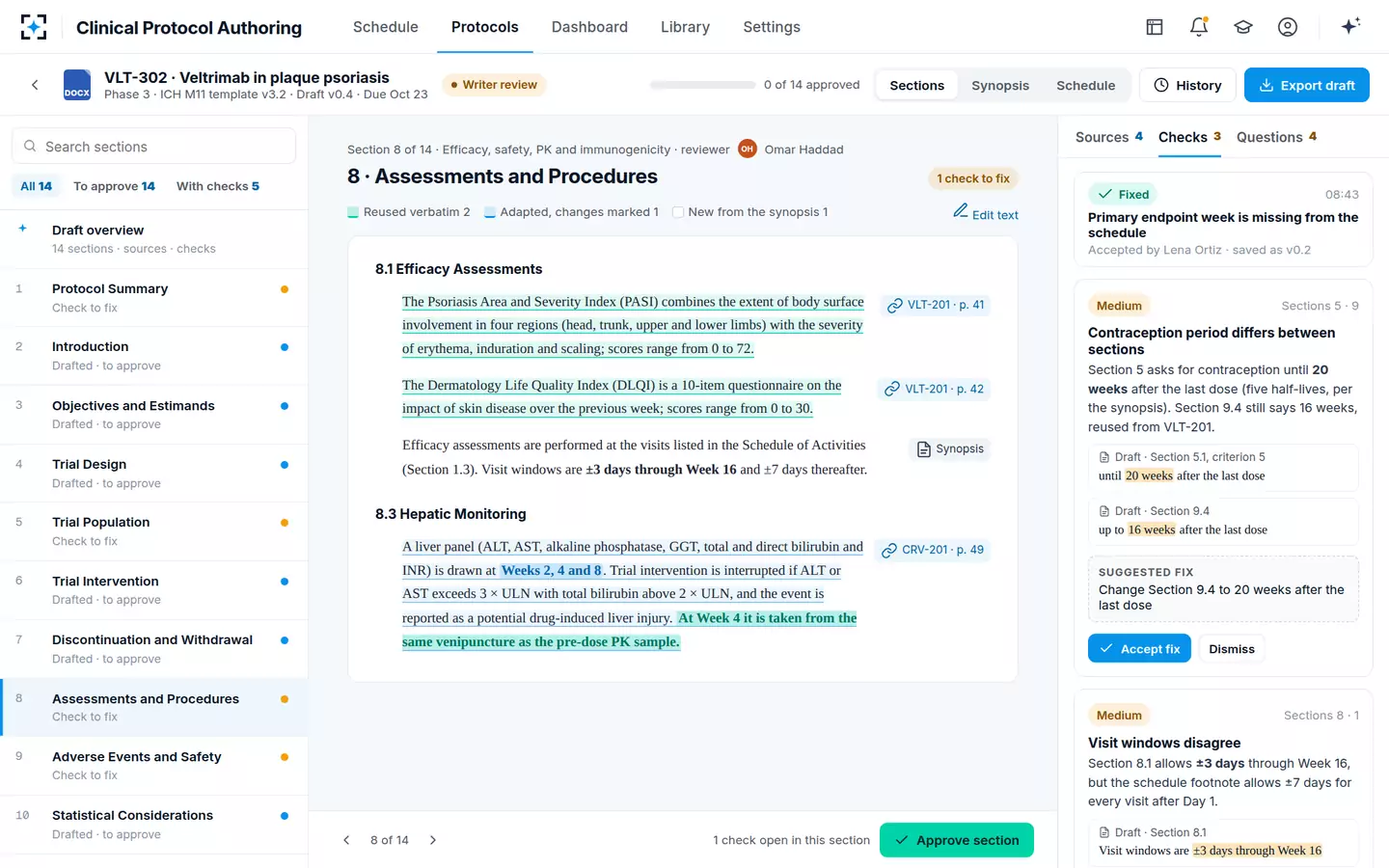
Catching a change while it is still only a draft
The cheapest amendment is the one that never has to be made, and the window for that closes when the protocol is approved. Everything before that point is editing; everything after it is a regulatory process with a classification, a queue and a six-figure median.
That is the whole case for checking a draft mechanically before people read it. Endpoint timepoints against the schedule of assessments, objectives against endpoints and estimands, eligibility against the synopsis population, dose and regimen between the intervention section and the table, visit windows between the text and the footnote, abbreviations against their first use — six of the seven checks in the sample trial are the kinds of thing a human reviewer reads past on the fourth pass through a hundred-page document, and a machine never does.
Two design rules keep that from becoming its own problem. The checker shows both passages and proposes one fix, but never applies it, because deciding which of two numbers is right is a clinical judgement. And a dismissal is recorded with a reason, so the next reviewer sees that the mismatch was considered rather than missed. What an automated drafting tool may and may not do sets out the rest of those limits.
Open questions that are not for a checker to settle
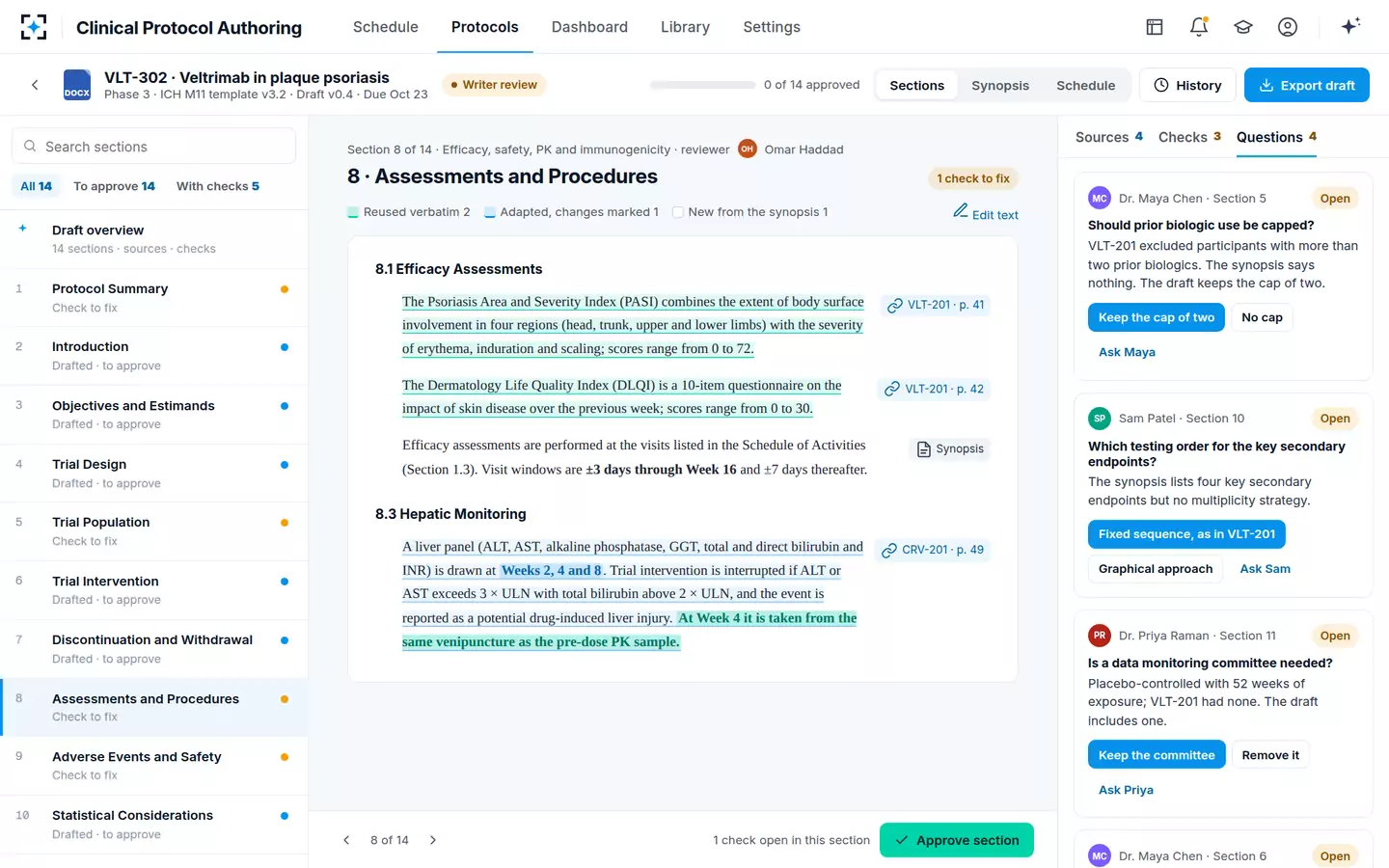
Eight questions that decide the route, in order
The order matters more than the list. Most classification arguments are really two people answering different questions at once.
Working out which route a change takes
- Has it already happened?
If the departure is in the past, it is a deviation, and the question is whether it is important under your trial-specific criteria — not whether it is substantial.
- Is the trial authorised yet?
The European definition applies to changes made after notification of the authorisation decision. Before that, you are still answering questions on the application.
- Does it affect the safety or rights of participants?
The first limb of the substantial test, and the first of the two questions the M11 amendment section asks. Consent, contraception, dosing, monitoring and withdrawal all land here.
- Does it affect the reliability or robustness of the data?
The second limb. Endpoints, their timepoints, the estimand, the analysis population and the statistical strategy land here.
- Is there an apparent immediate hazard?
If so, protect the participants first: in the US the change may be implemented immediately with FDA and the board notified afterwards; in the EU the measure is taken and notified within seven days.
- Does it change what the trial is?
A new investigational product, a different main objective or primary endpoint, an unplanned extra arm — in the EU these need a new authorisation, not a modification.
- Do the Member States need it for oversight?
If it is not substantial but is relevant to supervision, it is the Article 81(9) route, updated in the EU database rather than assessed.
- What else is in the stack?
Several non-substantial changes can cumulate into a substantial one. Classify the pile, not only the newest item.
Ten protocols, and the checks still open in each
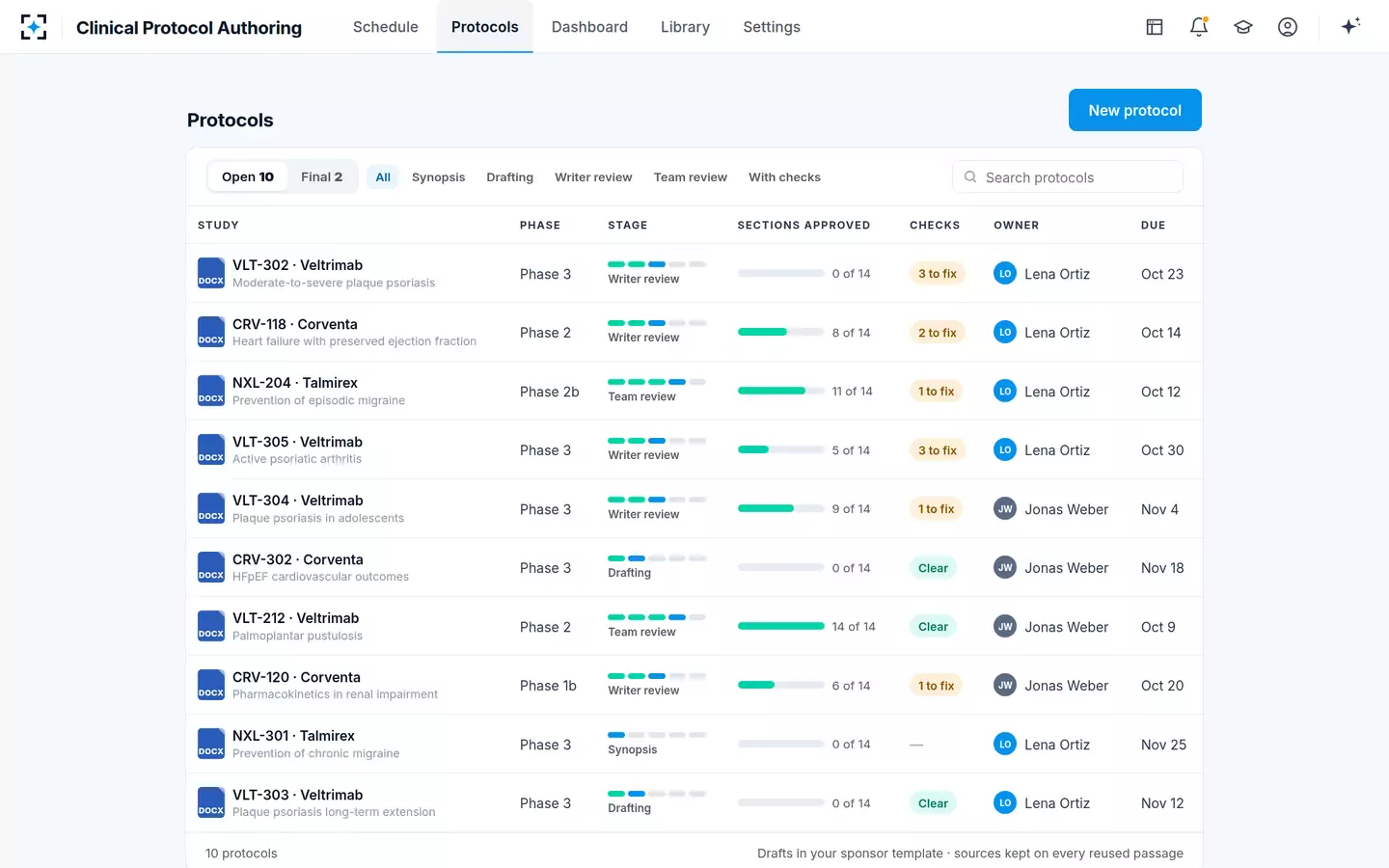
Classification is the sponsor's work and it always will be. What a drafting tool can do is make sure that the changes you end up classifying are the ones the science actually required, and not the ones an inherited table left behind. To see the checks, the sources and the schedule together, start from Clinical Protocol Authoring.
Questions people ask
Is a protocol deviation the same as a protocol violation?
Many sponsors use "violation" informally for a serious deviation, but it is not a term ICH E6(R3) defines. The defined distinction is between protocol deviations and the subset the sponsor classifies as important — those that may significantly affect data completeness, accuracy or reliability, or a participant's rights, safety or wellbeing. Writing those criteria before the trial opens is a sponsor obligation.
Can you implement a protocol change before approval?
Only in the narrow case of an apparent immediate hazard. Under 21 CFR 312.30 a change intended to eliminate one may be implemented immediately, with FDA notified by protocol amendment afterwards and the reviewing IRB notified under § 56.104(c). In the EU the equivalent is an urgent safety measure under Article 54, notified through the EU portal within seven days. Otherwise a substantial modification may be implemented only after it has been authorised.
How many protocols are amended?
The most cited measurement found that 57% of protocols had at least one substantial amendment, and that about 45% of those amendments were judged avoidable. Protocols with an amendment tended to be larger in scope, with longer recruitment and study durations, which is why the avoidable share is the number worth watching rather than the total.
How much does a protocol amendment cost?
The median direct cost to implement one substantial amendment was $141,000 for a Phase II protocol and $535,000 for a Phase III protocol. Direct cost is only part of it: an amendment also consumes calendar time at every site and every ethics committee, and that delay is priced separately.
Who decides whether a modification is substantial?
The sponsor, case by case, against the definition in the regulation — not the authority, and not a template. The European Commission's Q&A says so in terms and encourages sponsors to contact the national contact point in case of doubt. Getting it wrong has consequences: misuse of the non-substantial route can lead to corrective measures by the Member States concerned.
What is the difference between an amendment and an addendum?
An amendment changes the protocol and produces a new version of it. An addendum adds a document alongside the protocol, usually for a sub-study or a country-specific requirement, without reissuing the main text. Whether an addendum's content is a substantial modification is decided the same way as anything else: by its likely impact on participants' safety and rights or on the reliability and robustness of the data.