The ICH M11 template is the harmonised protocol template adopted at Step 4 on 19 November 2025, and for a writer it changes one thing completely and another not at all. It fixes where every piece of content sits — fourteen numbered sections, eleven in the main body and three appendices, with an instruction under each heading — so that a reviewer, an ethics committee and a registry all find the same fact in the same place. It changes nothing about whether that fact is right, or whether two sections agree, and the guideline says so in as many words. The work it creates is mapping and structure; the work it leaves exactly where it was is consistency. Clinical Protocol Authoring drafts in whichever template a sponsor uses, and the sample draft here is written in a sponsor template v3.2 built on ICH M11, with the section numbers to match.
Everything on this page about a trial, a drug or a person is sample data from the solution's invented Phase 3 study, VLT-302. Everything about the template is quoted from the ICH, EMA and FDA documents themselves, each linked where it appears.
ICH M11 in four numbers
3
documents: a guideline, a template and a technical specification
14
sections — eleven in the main body, three appendices
1.3
the section number the schedule of activities now carries, near the front
38mo
from release for public consultation to Step 4 adoption
What is ICH M11, and what is CeSHarP?
ICH M11 is the International Council for Harmonisation's standard for the structure and content of clinical trial protocols. CeSHarP is its own name for itself: Clinical Electronic Structured Harmonised Protocol. The acronym is doing real work — "electronic" and "structured" are the point, not decoration. M11 is not only a layout; it is an attempt to make a protocol something a computer can read field by field.
The reason given for it is bluntly operational. "Variability in format and core content among sponsors contributes to inefficiencies and difficulties in searching, reviewing, and assessing protocols," the guideline says, and the template "aids the sponsor or sponsor-investigator in the development of a protocol that is complete, unambiguous, well organised, and aligned with quality by design principles". It applies across the board: the template and technical specification "are applicable to interventional clinical trials of medicinal products across all phases and therapeutic areas of clinical research".
Is the ICH M11 template mandatory, and from when?
It depends on the region, and the two answers are genuinely different.
In the European Union it is in effect. The EMA's Committee for Medicinal Products for Human Use adopted the ICH M11 guideline at Step 5 on 11 December 2025, and the document states a "date for coming into effect" of 11 June 2026. An EMA scientific guideline is not a regulation, but it is the standard applicants are expected to meet, and a departure from it needs a reason.
In the United States the position is softer and the words are unusually clear. FDA issued the guidance on 22 May 2026 (91 FR 30310), finalising draft guidances from December 2022 and June 2025. The notice states that the guidance "represents the current thinking of FDA" and "does not establish any rights for any person and is not binding on FDA or the public. You can use an alternative approach if it satisfies the requirements of the applicable statutes and regulations." The content obligations in 21 CFR 312.23 are binding; the template's structure is not.
The practical reading for a sponsor running trials in both regions: treat M11 as the structure you write in, because the European date has passed and because a single structure is cheaper than two. Do not treat it as a certification — there is nothing to certify against, and no software is M11-compliant on a sponsor's behalf. What a tool can do is write in the sponsor's template, and keep the numbering straight.
How ICH M11 got here, and what each date actually did
| Date | What happened | What it meant |
|---|---|---|
| 27 September 2022 | Endorsed by the ICH Assembly under Step 2 and released for public consultation | A draft to comment on. Sponsors that built templates on it at this point were betting on a draft. |
| 26 October 2022 | Released for public consultation by the CHMP, with comments due 26 February 2023 | The European consultation window; revisions followed, addressing comments and clarifying key terms and scope. |
| 19 November 2025 | Adopted by the regulatory members of the ICH Assembly under Step 4 | The guideline, template and technical specification became final text. This is the version a writer should be working from. |
| 11 December 2025 | Final adoption by the CHMP | The European Step 5 step: the ICH guideline becomes an EMA guideline. |
| 22 May 2026 | Issued as FDA guidance for industry, 91 FR 30310 | Available and recommended in the United States — explicitly not binding. |
| 11 June 2026 | Date for coming into effect in the European Union | The date after which a European submission is expected to follow it. |
Three documents, not one: guideline, template, technical specification
Teams that say "we are moving to M11" usually mean the template, and then discover there are three documents with three different audiences. Only one of them is a writer's daily concern.
The three M11 documents, and who actually uses each
The guideline
3 pages of design principles
Says what the other two are for and how they were built: "to describe the general protocol design principles and approach used to develop the separate associated documents". It binds nothing by itself.
Read by: The standards lead, once.
The template
The protocol itself
Table of contents, section headers and an instruction under each one. This is the document a writer works in, and the only one that says what belongs where.
Read by: Every writer, every day.
The technical specification
Data elements and attributes
The data elements and technical attributes — definition, conformance, cardinality — that let protocol content be exchanged electronically rather than read as a file.
Read by: Systems, registries and regulators receiving the protocol.
The split matters because the three move at different speeds. The guideline is short and stable. The template is where a sponsor's own house style attaches, and where every optional heading decision gets made. The technical specification is the one that reaches into systems, and it is the reason a sponsor's answer to "are we on M11?" can be yes in the writing team and no everywhere else.
The fourteen sections, and what moved
Most of M11's content exists in every sponsor template already; what changes is where it lives and what it is called. The moves below are the ones that cost real work in a migration, because each one either relocates a block of text, splits it, or asks for something a legacy template did not have a home for.
The moves that cost work: where content sits in ICH M11, and where it usually came from
| In ICH M11 | What it holds | Where it commonly sat before |
|---|---|---|
| 1.1 Protocol synopsis | A short summary, with objectives and estimands in layperson language | Front matter or an appendix; often written first rather than last |
| 1.2 Trial schema | The diagram of the design | Frequently absent, or buried in the design section |
| 1.3 Schedule of activities | Visits, procedures, contacts and a window on each | An appendix at the back, in many legacy templates |
| 2.2 Assessment of risks and benefits | Risk summary and mitigation, benefit summary, overall assessment | A paragraph in the introduction, or a separate risk document |
| 3 Objectives and associated estimands | Each objective refined into a clinical question, with an estimand table per objective | Prose under "objectives and endpoints", with no table |
| 4.1.1 Stakeholder input into design | Who was consulted on the design, including participants | Usually nowhere |
| 4.5 Access to trial intervention after end of trial | What participants get after the trial ends | Usually nowhere, or in the oversight section |
| 5.4 Contraception | Childbearing potential definitions and contraception requirements, as their own subsections | Inside the exclusion criteria, which is how it drifts out of step with safety |
| 7 Discontinuation and withdrawal | Its own numbered section, separating stopping intervention from leaving the trial | Split across the population and intervention sections |
| 8 Assessments and procedures | Each assessment in detail, aligned to sections 3, 6, 7 and 10 and not duplicating 1.3 | A long section that often repeated the schedule in prose |
| 10 Statistical considerations | Analyses per objective, with missing data handled per estimand | A statistics section organised by analysis type rather than by objective |
| 11.6–11.12 Oversight detail | Risk-based quality management, data governance, data protection, source records, protocol deviations, early site closure, data dissemination | Scattered through oversight, or left to the monitoring plan |
| 12–14 Appendices | Supporting details, glossary and abbreviations, references | Varied widely; appendices carry equal weight to the main body under M11 |
Two of those rows are where migrations stall. The estimand table at section 3 is new text, not relocated text: a sponsor that wrote objectives and endpoints as prose has to construct the table and agree it with the statistician, and that is a separate piece of work. And moving the schedule from an appendix to section 1.3 changes the drafting order, because a table at the front is a table that has to exist before the prose does.
What M11 explicitly does not do
The guideline forecloses the obvious misreading itself, in a passage worth keeping to hand when someone asks whether moving to M11 will improve protocol quality.
Neither this guideline nor the Template or Technical Specification are intended to specify processes related to development and maintenance of a protocol. They do not supersede or negate other guidelines that establish requirements for protocol content. They neither provide instruction on the development of a well-designed trial nor do they characterise a well-crafted final protocol.
ICH M11 guideline, Step 4, adopted 19 November 2025
Read carefully, that sentence rules out three things at once. M11 does not tell a sponsor how to run protocol development, so the drafting order, the review sequence and the approval rules stay the sponsor's own. It does not replace the content requirements in ICH E6(R3) or 21 CFR 312.23, so a protocol that fills every M11 heading can still be missing something a regulator requires. And it offers no opinion on whether a trial is well designed or a protocol well written — which is precisely the ground on which protocols are sent back.
What the technical specification changes about a protocol
The technical specification is the part that is easy to defer and expensive to defer for long. It defines the data elements and their attributes — "definition, conformance, cardinality" — so that protocol content can be exchanged between systems rather than attached as a file. The FDA notice describes the same document as containing "harmonized terminologies and standardized data fields to enable electronic exchange of clinical protocol information".
For a writer, two consequences are immediate. First, several things that used to be free text become choices from a list: population type, intervention model, control type, blinding and the blinded roles, the intervention assignment method, whether the design is adaptive. Writing "double-blind" in a sentence no longer satisfies a field that expects a value. Second, reuse becomes an explicit design goal of the document rather than a side effect — the guideline lists "design for content re-use", so that protocol content can be re-used "for publishing on clinical trial registries to promote clinical trial transparency, or for standardised clinical trial data capture". A protocol whose synopsis fields are already structured is a registry entry that does not have to be rekeyed.
Moving a sponsor template onto M11: a mapping, not a rewrite
The cheapest migration treats the old template as the source and the new one as the destination, and writes the mapping down once. Almost every paragraph of standard text has a home; the work is finding it, deciding what to do with the handful that do not, and renumbering every cross-reference in the standard text that survives.
The same Phase 3 protocol in a legacy sponsor template and in ICH M11
A legacy sponsor template: Front matter before section 1, sometimes a separate document, often written first and then left behind by the draft.
ICH M11, Step 4: Section 1.1, inside the protocol summary, with objectives and estimands summarised "in natural, nontechnical (layperson) language".
A legacy sponsor template: A diagram in the design section, or none at all.
ICH M11, Step 4: Section 1.2, immediately after the synopsis and before the schedule.
A legacy sponsor template: An appendix at the back, numbered after the references.
ICH M11, Step 4: Section 1.3, near the front, because the template puts what is needed for execution where site staff will find it.
A legacy sponsor template: A prose section pairing each objective with an endpoint.
ICH M11, Step 4: Section 3, each objective refined into a clinical question with an estimand table beneath it.
A legacy sponsor template: Split between the population section and the intervention section.
ICH M11, Step 4: Section 7, with stopping intervention and leaving the trial kept apart.
A legacy sponsor template: A dumping ground of lower status than the main body.
ICH M11, Step 4: Sections 12 to 14, with content that "carries equal weight and rigor as the content in the Main Body".
The template as a setting, alongside style and the people who review each section
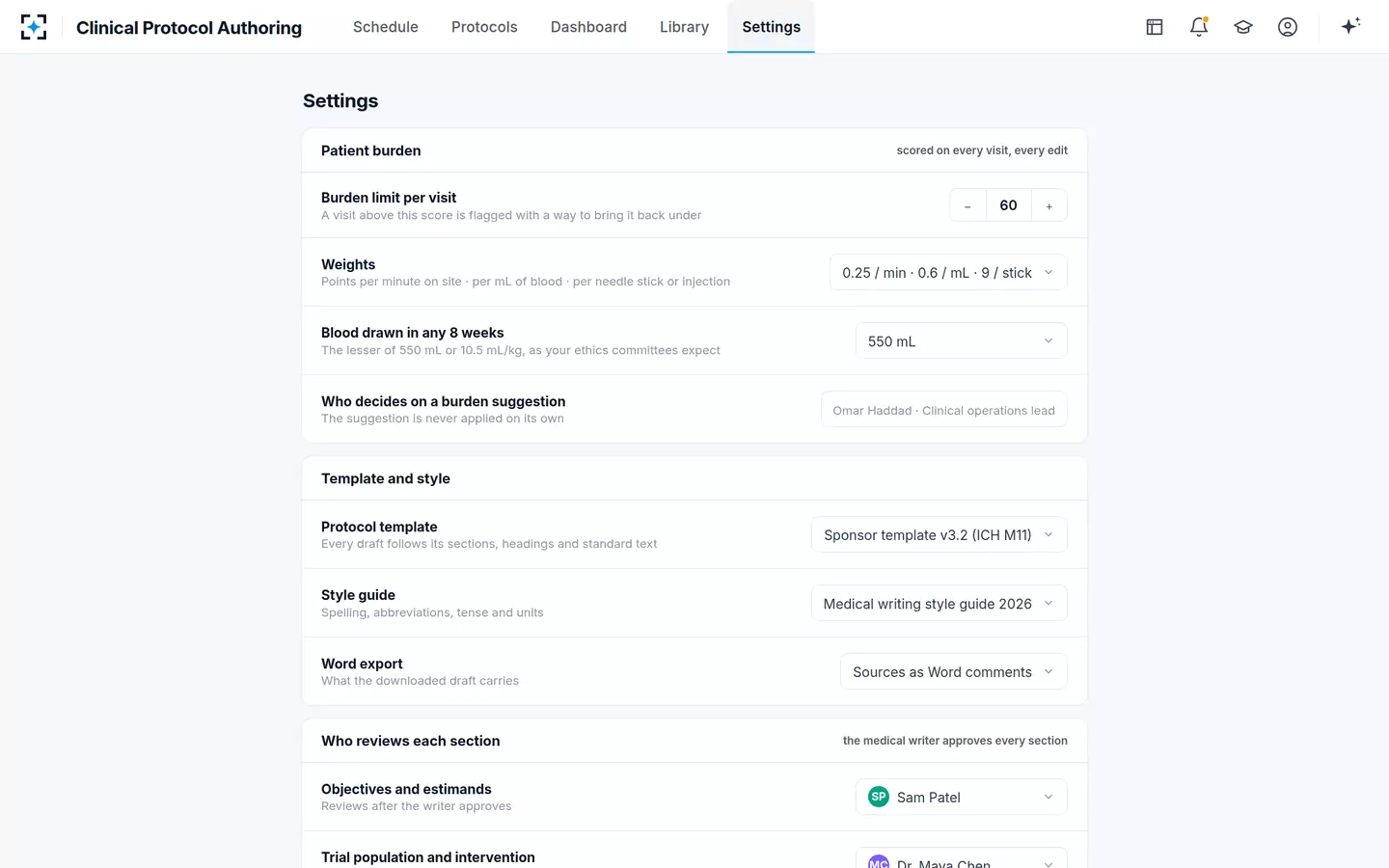
Four decisions are worth making before the first protocol rather than during it. Which optional lower-level headings the sponsor keeps, since the template allows them to be "added, removed, or modified as needed" while the higher-level structure is retained. What happens to standard text whose cross-references now point at different numbers. Whether trials already in flight move or stay on the legacy template. And who owns the glossary, because section 13 is now an appendix with the same weight as the main body rather than a courtesy list.
Where M11 leaves a writer more exposed, not less
A harmonised structure makes some failures more visible, not less likely, and a writer should know which ones.
The first is the estimand table. Prose can be vague about a population or an intercurrent event; a table with five labelled rows cannot. The template's instruction is to define each objective precisely and "ensure alignment with every other section of the protocol", and a reviewer reading a table will notice a missing row in seconds.
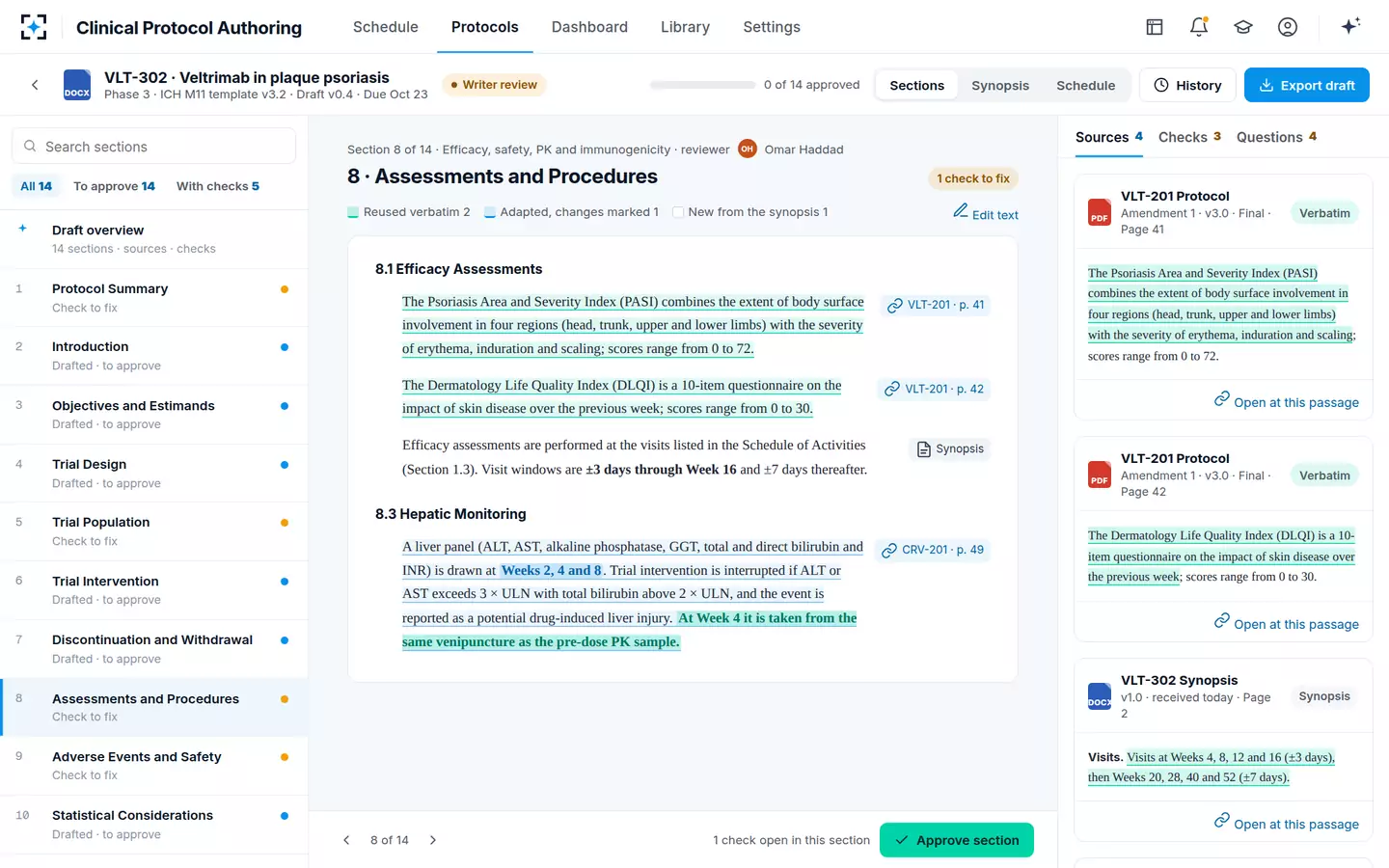
The second is section 8. Its instruction lists, explicitly, the four sections it must align with — the intercurrent events and strategies in section 3, the intervention in section 6, the discontinuation procedures in section 7, and the statistical analysis in section 10 — and tells the writer to give details "not already presented in the SoA, taking care not to duplicate information". Four stated alignment obligations are four stated things a reviewer can check against.
The third is the amendment section. When a protocol is amended, the template asks the writer to "choose from the available categories the primary reason and secondary reason(s) for the amendment", and adds that "changes to primary estimand, endpoints, or related measures should be listed as a change of strategy". A reason that used to be a sentence is now a classification, and classifications are counted. What that means in practice is taken up in protocol amendment versus deviation.
Section 8 under the alignment obligations M11 names
What to put in place before the first M11 protocol
Ten things, in roughly the order they bite. None of them is difficult; all of them are cheaper before the first protocol than during the third.
Ten things to settle before the first protocol in the M11 template
- The section map from the old template to the new one, written down once
Every heading, including the ones that have no destination and the ones that have no source.
- Standard text renumbered, with every internal cross-reference checked
The commonest migration defect is a correct paragraph pointing at the wrong section number.
- Which optional lower-level headings the sponsor keeps
The template retains the higher-level structure while lower-level sections "can be added, removed, or modified as needed".
- An estimand table pattern, agreed with biostatistics
Population, treatment, endpoint, population-level summary, and a strategy for each intercurrent event.
- The schedule of activities moved to the front, and built first
Section 1.3 is near the start of the document, which changes the drafting order, not just the page order.
- The amendment categories understood before an amendment is needed
A primary reason and secondary reasons are chosen from a list; a change to the primary estimand or endpoints counts as a change of strategy.
- The glossary and references treated as appendices of equal weight
Appendix content "carries equal weight and rigor as the content in the Main Body".
- A decision about trials already in flight
Moving a protocol mid-trial means an amendment whose only content is renumbering. Usually not worth it.
- Structured fields identified, and who fills them
Population type, intervention model, control type, blinding and blinded roles stop being prose and become values.
- A consistency check that runs across sections, not within them
M11 tells section 8 which four sections it must align with. Nothing in M11 performs the check.
Ten protocols, every one at fourteen sections in the sponsor template
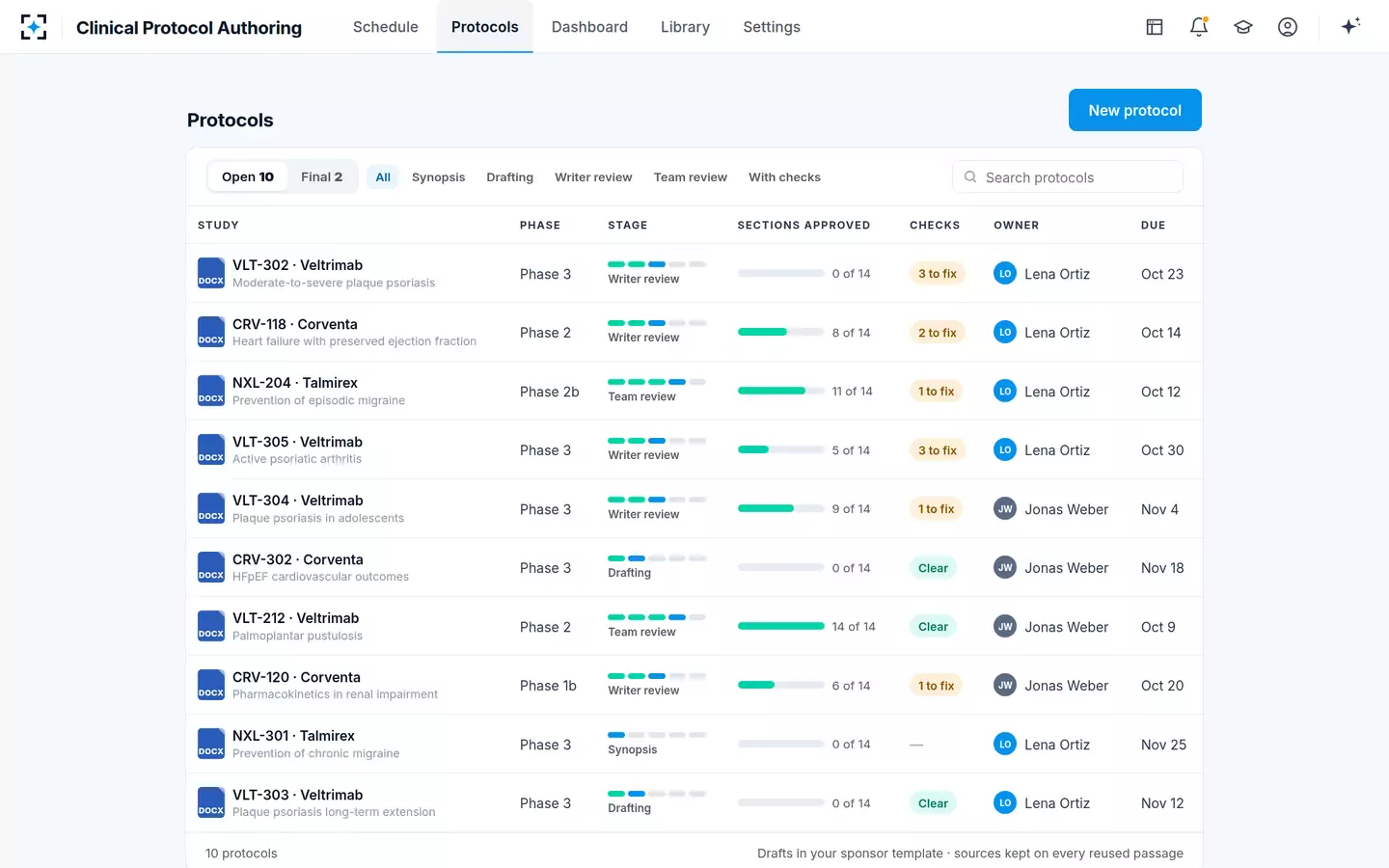
The template is the easy half. The half that decides whether a protocol comes back is whether its sections agree with each other, and M11 says plainly that it does not address that. The drafting order that keeps them in step is set out in how to write a clinical trial protocol, and the table that now sits at section 1.3 in the schedule of activities. To see a draft in a sponsor template built on M11, start from Clinical Protocol Authoring.
Questions people ask
What does CeSHarP stand for?
Clinical Electronic Structured Harmonised Protocol. It is the formal name of the ICH M11 work: a protocol that is harmonised in structure across sponsors and regions, and structured enough to be exchanged electronically rather than only read. The ICH M11 guideline, template and technical specification all carry CeSHarP in their titles.
Does the FDA accept the ICH M11 protocol template?
Yes, and it recommends it, but it does not require it. FDA issued the guidance on 22 May 2026 (91 FR 30310), describing the intent as "to create an internationally harmonized standard for the content and exchange of clinical trial protocol information". The same notice states the guidance "does not establish any rights for any person and is not binding on FDA or the public" and that an alternative approach may be used if it satisfies the applicable statutes and regulations. The content requirements of 21 CFR 312.23 are separate, and they are binding.
What is the M11 technical specification for?
For machines. It sets out the data elements and their technical attributes — definition, conformance, cardinality — so that protocol content can be exchanged between sponsors, regulators and registries as structured data rather than as a document. It is why several things that were once free text, such as control type or blinded roles, are now values chosen from a list, and why a sponsor can be using the template without yet being able to exchange anything.
How do you move an existing protocol into the M11 template?
By mapping, not rewriting. Build the heading-to-heading map once, move the standard text, then fix every cross-reference the move broke. Expect three pieces of genuinely new work: an estimand table for each objective, a trial schema if the old template had none, and homes for content M11 asks about that legacy templates often skipped — stakeholder input into the design, and access to the trial intervention after the trial ends. A protocol already enrolling is usually better left where it is, since moving it means an amendment whose only content is renumbering.
What is the difference between the M11 template and a sponsor template?
The M11 template is the ICH's harmonised structure and its instructions. A sponsor template is a sponsor's own document — usually the M11 structure plus house style, standard text, approval rules and any optional headings the sponsor has chosen to keep or drop. The template allows this: the higher-level heading structure is retained while lower-level sections can be added, removed or modified. The sample draft in this guide is written in a sponsor template v3.2 built on ICH M11, which is the normal arrangement.
Is the ICH M11 template mandatory?
In the European Union, the EMA adopted it at Step 5 on 11 December 2025 with a date for coming into effect of 11 June 2026, so a European submission after that date is expected to follow it. In the United States it is recommended guidance and explicitly not binding. Other ICH regions adopt on their own timetables. The sensible planning assumption for a sponsor working in both regions is that M11 is the structure to write in, while the binding content requirements remain ICH E6(R3) and the regional regulations.