Objectives, endpoints and estimands are three different things, and treating them as three names for one thing is the most expensive habit in protocol writing. The objective is the clinical question: does this drug clear psoriasis. The estimand is that question made precise enough to be answered — in whom, under what treatment regimen, measured how and when, summarised by what comparison, and with what to do about participants whose course is interrupted. The endpoint is one attribute of the estimand, the measurement itself. Getting them to agree is hard because they are written in three places by three people, and the drift is silent. Clinical Protocol Authoring drafts the objectives and estimand section against the synopsis, then checks it against the schedule and the analysis section, so a mismatch surfaces while it is still cheap to fix.
The study used throughout is the solution's invented Phase 3 sample: VLT-302, 660 participants randomised 2:1 to Veltrimab or placebo at about 120 sites in 14 countries, with co-primary endpoints PASI 90 and sPGA 0/1 at Week 16. The trial, the drug and the people are sample data. The guidance quoted around them is real and linked where it appears.
What is the difference between an objective, an endpoint and an estimand?
Take one sentence from a synopsis and watch it split three ways. "To demonstrate the superiority of Veltrimab 150 mg over placebo in skin clearance" is an objective — a statement of intent, written for a human, with no commitment to how it will be measured or in whom.
"PASI 90 response at Week 16, compared with placebo" is an endpoint — a measurement, a threshold and a timepoint. It is precise about the instrument and silent about almost everything else: which participants are counted, what happens to someone who stops the drug at Week 8, and what comparison will be reported.
The estimand is what closes those gaps. ICH E9(R1) defines it exactly: "an estimand is a precise description of the treatment effect reflecting the clinical question posed by a given clinical trial objective. It summarises at a population level what the outcomes would be in the same patients under different treatment conditions being compared." The endpoint sits inside it as one attribute. So does the population, so does the treatment regimen, and so does the way each interrupting event is handled.
One sentence of intent, turned into a question that can be answered
Agent
The synopsis sentenceRead as written, with its exact wording kept and its page recorded. "To demonstrate the superiority of Veltrimab 150 mg over placebo in skin clearance."
Never: paraphrase endpoint wording, or infer a timepoint the synopsis does not state
A person decides
The objectiveThe clinical question, stated in natural language for everyone who will read the protocol — sponsor, investigator, site staff, participant, ethics committee, regulator.
A person decides
The estimand attributesWith the statistician: treatment condition, population, variable, population-level summary, and a strategy for each intercurrent event that the first three do not already settle.
Agent
The endpoint definitionThe measurement, its threshold and its timepoint, written once and quoted wherever it reappears — section 3, section 8 and the schedule of activities.
Agent
The analysisSection 10, written per objective: the method, the handling of data and of missing data in relation to that estimand, and any sensitivity analysis.
Never: send a change back up the chain — an analysis that needs a different question needs a different estimand, agreed first
What is an estimand, in the words of ICH E9(R1)?
The addendum that introduced the idea is short on rhetoric and clear on cost. It warns, in one line, what happens if the step is skipped.
Avoiding or over-simplifying the process of discussing and constructing an estimand risks misalignment between trial objectives, trial design, data collection and method of analysis.
ICH E9(R1), Estimands and Sensitivity Analysis in Clinical Trials, adopted 20 November 2019
Four things are named there, and the order is the order a protocol is built in: objective, design, data collection, analysis. An estimand is the joint that holds them together. Skip it and each of the four can be internally reasonable while the set of them describes no single question — the objective promises superiority in skin clearance, the design randomises two to one, the schedule measures at Week 16, and the analysis reports something about completers. Every piece defensible, nothing coherent.
ICH E6(R3) carries the requirement into good clinical practice from the other direction, asking a protocol for "a clear description of the scientific objectives and the purpose of the trial. Information on estimands, when defined (see ICH E9(R1))." And ICH M11 gives it a home and a shape, which is the subject of the next two sections.
The five attributes, one at a time
A point of vocabulary first, because it confuses people reading the source documents. ICH E9(R1) names four attributes in its own list — treatment, population, variable, population-level summary — and handles interrupting events through strategies that are applied to those attributes. The ICH M11 estimand table has five kinds of row, because it gives intercurrent events a row of their own. Both describe the same construct, and many writers count five. What matters is that nothing is left out, not what the count is.
The four attributes ICH E9(R1) names, quoted, with what each costs a writer
Treatment
“The treatment condition of interest and, as appropriate, the alternative treatment condition to which comparison will be made.”
Not just the drug: the regimen. A fixed dose every twelve weeks after two loading doses is a different treatment condition from the same dose given on demand, and the two answer different questions.
Population
“The population of patients targeted by the clinical question.”
The whole trial population, a baseline-defined subgroup, or a principal stratum. If the question is about adults who have already failed a biologic, saying so here is what stops section 5 and section 10 drifting apart.
Variable, or endpoint
“The variable (or endpoint) to be obtained for each patient that is required to address the clinical question.”
The measurement, its definition and its timepoint. This is the attribute people mean when they say "endpoint" — one of several, not the whole thing.
Population-level summary
“Finally, a population-level summary for the variable should be specified, providing a basis for comparison between treatment conditions.”
A difference in proportions, a risk ratio, a hazard ratio, a mean difference. Without it, two analyses of the same endpoint can both be correct and disagree.
The population-level summary is an attribute protocols often leave implicit, and the one that causes the quietest argument later. A trial measuring PASI 90 response can report a difference in proportions, a risk ratio or an odds ratio, and the three answer the same clinical question with different numbers and different confidence intervals. Deciding in section 3, before anyone has seen data, is the whole point.
Intercurrent events, and the five strategies for them
An intercurrent event is something that happens after treatment starts and changes what the measurement means — stopping the drug, adding a rescue therapy, switching treatments, or dying. ICH E9(R1) is careful that these are not a defect: "unlike missing data, intercurrent events are not to be thought of as a drawback to be avoided in clinical trials. Discontinuation of prescribed treatment, use of additional medication, and other such events may occur in clinical practice as they do in clinical trials."
Five strategies are set out for them, and a protocol may use different strategies for different events. The guideline is explicit that "it is not necessary to use the same strategy to address all intercurrent events".
The five strategies for intercurrent events, and the question each one asks
| Strategy | What it does with the event | The question it answers |
|---|---|---|
| Treatment policy | Ignores it for the purpose of the definition: "the value for the variable of interest is used regardless of whether or not the intercurrent event occurs." | What happens when this treatment is prescribed, whatever patients then do — closest to the intention-to-treat idea. |
| Hypothetical | Envisages a scenario "in which the intercurrent event would not occur" and uses the value the variable would have taken there. | What would happen if nobody needed rescue therapy — useful, but only when the scenario is stated precisely. |
| Composite variable | Folds the event into the definition of the outcome: a participant who stops for toxicity may be "considered not to have been successfully treated". | What happens when the treatment has to work and be tolerable at once. |
| While on treatment | Uses the response "prior to the occurrence of the intercurrent event". | What the treatment does for as long as it is taken — common for symptom relief. |
| Principal stratum | Narrows the population: the effect "only within the principal stratum" in which the event would, or would not, occur. | What happens in the patients who can tolerate the treatment, or in those who become infected. |
Choosing between them is a clinical conversation, not a statistical one, and it is the part of the estimand a writer must never settle alone. A hypothetical strategy in particular has to say which scenario is envisaged: the guideline warns that wording such as "if the patient does not take additional medication" can leave a reader unsure whether the drug was unavailable or simply not needed.
Where each of the three lives in the protocol
The ICH M11 template is specific about placement, and the placement is what makes the three testable against each other. Section 3 holds the objectives and, beneath each one, a table of estimand characteristics. Section 1.1.1 holds the same objectives and estimands in layperson language, inside the synopsis. Section 8 describes how each assessment is performed; section 1.3 says when it happens; section 10 analyses it, with a subsection per objective.
The template's instruction for section 3 is one sentence of placement and one of obligation: "precisely define each trial objective and refine each trial objective into a precise clinical question of interest by defining the associated estimand … Ensure alignment with every other section of the protocol."
An estimand table as ICH M11 asks for it, filled in for one co-primary objective
| Row | What the template asks for | For this sample objective |
|---|---|---|
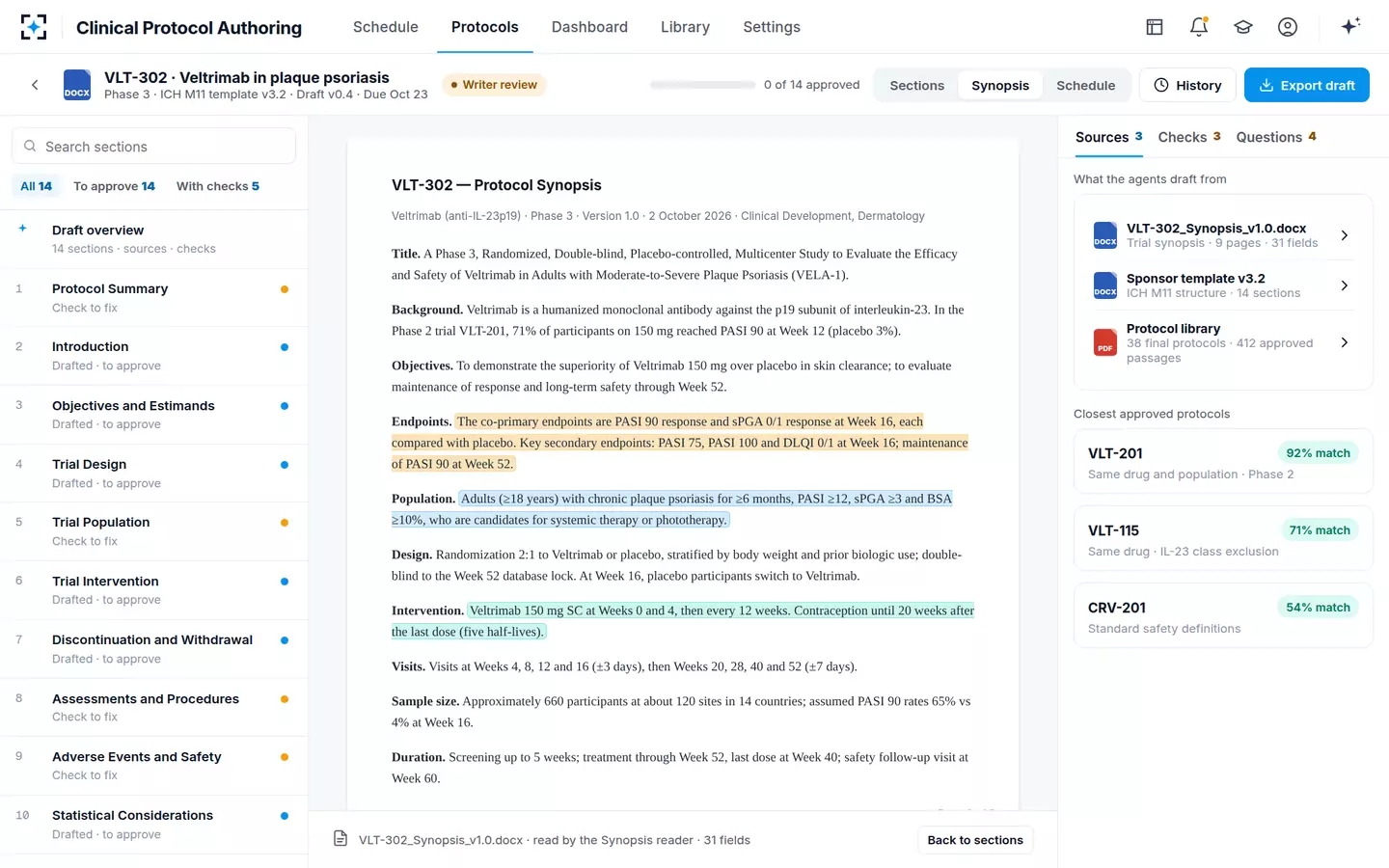
| Population | Key demographic and clinical characteristics — age, sex, prior therapies, symptoms, severity, biomarker status | Adults of 18 years or over with chronic plaque psoriasis for six months or more, PASI 12 or above, sPGA 3 or above and BSA 10% or above, who are candidates for systemic therapy or phototherapy (from the synopsis) |
| Treatment | Key aspects of the regimen in each group — at least the agents, dosage and route | Veltrimab 150 mg subcutaneously at Weeks 0 and 4, then every 12 weeks, against placebo, randomised 2:1 (from the synopsis) |
| Endpoint | The definition of the endpoint — the only row the template requires at a minimum | PASI 90 response at Week 16, compared with placebo; co-primary with sPGA 0/1 at the same visit (quoted from the synopsis) |
| Population-level summary | For example a mean difference or a relative risk | Not yet settled in this draft. Shown here only to make the row concrete: a difference in response proportions at Week 16 would be one defensible choice |
| Intercurrent event and strategy | A description of the event and the strategy for it, cross-referenced to the rationale in section 4 | Not yet settled in this draft. The events a trial like this has to name are discontinuation of trial intervention and use of prohibited rescue therapy |
The synopsis the estimand has to be built from, with the endpoint wording quoted
Writing the estimand in plain language for the synopsis
Section 1.1.1 asks for something the technical table cannot give: "summarise the primary and secondary objectives and any associated estimands in natural, nontechnical (layperson) language." The audience named for it is everyone — sponsors, investigators, site personnel, participants, ethics committees and regulators.
The useful discipline is to write one sentence that carries all five parts without naming any of them. In whom, given what, measured how and when, compared how, and what is done about people whose course is interrupted. If the sentence cannot be written, the estimand is not settled yet; the gap in the sentence is exactly the row that is missing from the table.
The same objective written three times, and the words that have to match
Where it is written: Plain language, for everyone who reads the protocol: what is being asked, in whom, and how the answer will be judged — with no technical vocabulary.
What must survive unchanged: The measurement, the threshold and the timepoint. If the plain-language sentence says "after about four months" and the table says Week 16, a reader has to reconcile two statements that should have been one.
Where it is written: The precise clinical question: population, treatment, endpoint, population-level summary, and a strategy for each intercurrent event.
What must survive unchanged: The endpoint definition, word for word as the synopsis stated it, and the population as section 5 will go on to define it in eligibility criteria.
Where it is written: The statistical method, the handling of data in relation to the estimand, the handling of missing data, and any sensitivity analysis.
What must survive unchanged: The population-level summary and every intercurrent-event strategy. An analysis that handles an event differently from section 3 has changed the question.
The mismatch that causes an amendment
The costly mismatches are not the ones between a protocol and a guideline. They are the ones inside the protocol, and three kinds recur.
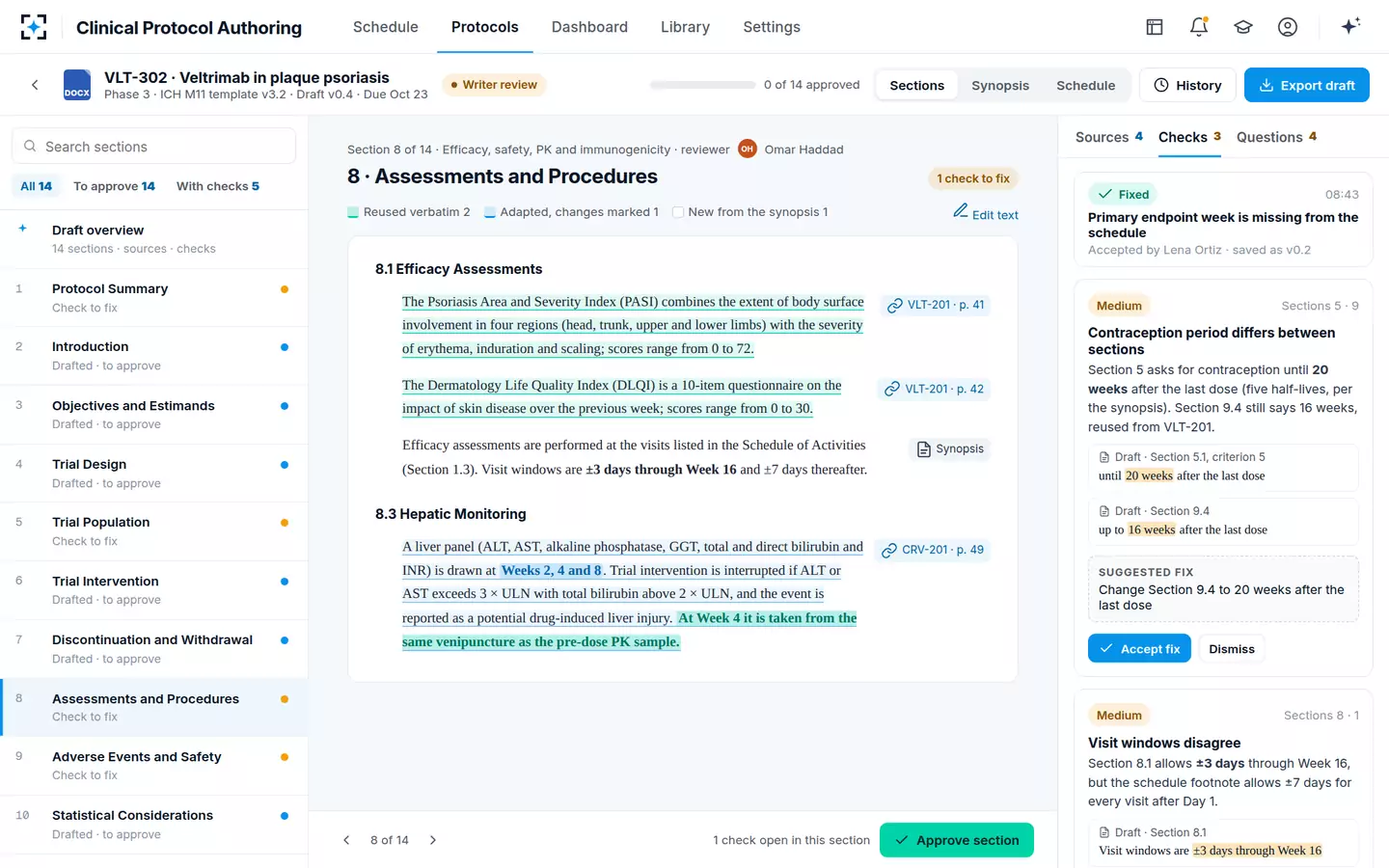
The first is an endpoint with no visit. The sample draft began with exactly this: co-primary endpoints defined at Week 16 and a schedule, adapted from an earlier study whose primary endpoint sat at Week 12, that scheduled no PASI, sPGA or BSA at Week 16 at all. Section 3 was right, section 1.3 was wrong, and no amount of reading section 3 would have found it.
The second is an objective that has quietly become a different objective. A synopsis says superiority; a draft, reusing text from a non-inferiority study, carries a margin into section 10. Nothing in section 3 changed, and the trial now tests something else.
The third is a population that differs between section 3 and section 5. The estimand names adults with moderate-to-severe disease who are candidates for systemic therapy; the eligibility criteria, inherited from a past protocol, cap prior biologic use at two. If the cap stays, the population in the estimand table is not the population being enrolled, and the honest fix is to say so in the table rather than to leave the two sentences to differ.
A mismatch between two sections, with both passages and one proposed fix
Secondary and exploratory objectives: how much precision is enough
The template's answer is graded. For secondary objectives, section 3.2 says to describe them "as outlined in Section 3.1 … Use the same approach as above and include table for a precise estimand description". For exploratory objectives, section 3.3 is softer: state each one, generally including its endpoints, and "it may be helpful in some cases to describe precise estimands to provide clarity on what is being estimated". In both, the table must carry "including endpoint at a minimum".
The practical rule follows from what the objective is for. If a result will be claimed — in a label, in a registration dossier, in a headline comparison — it needs a full estimand, because a claim is a statement about a defined effect in a defined population. If a result will be described, an endpoint and a timepoint usually suffice.
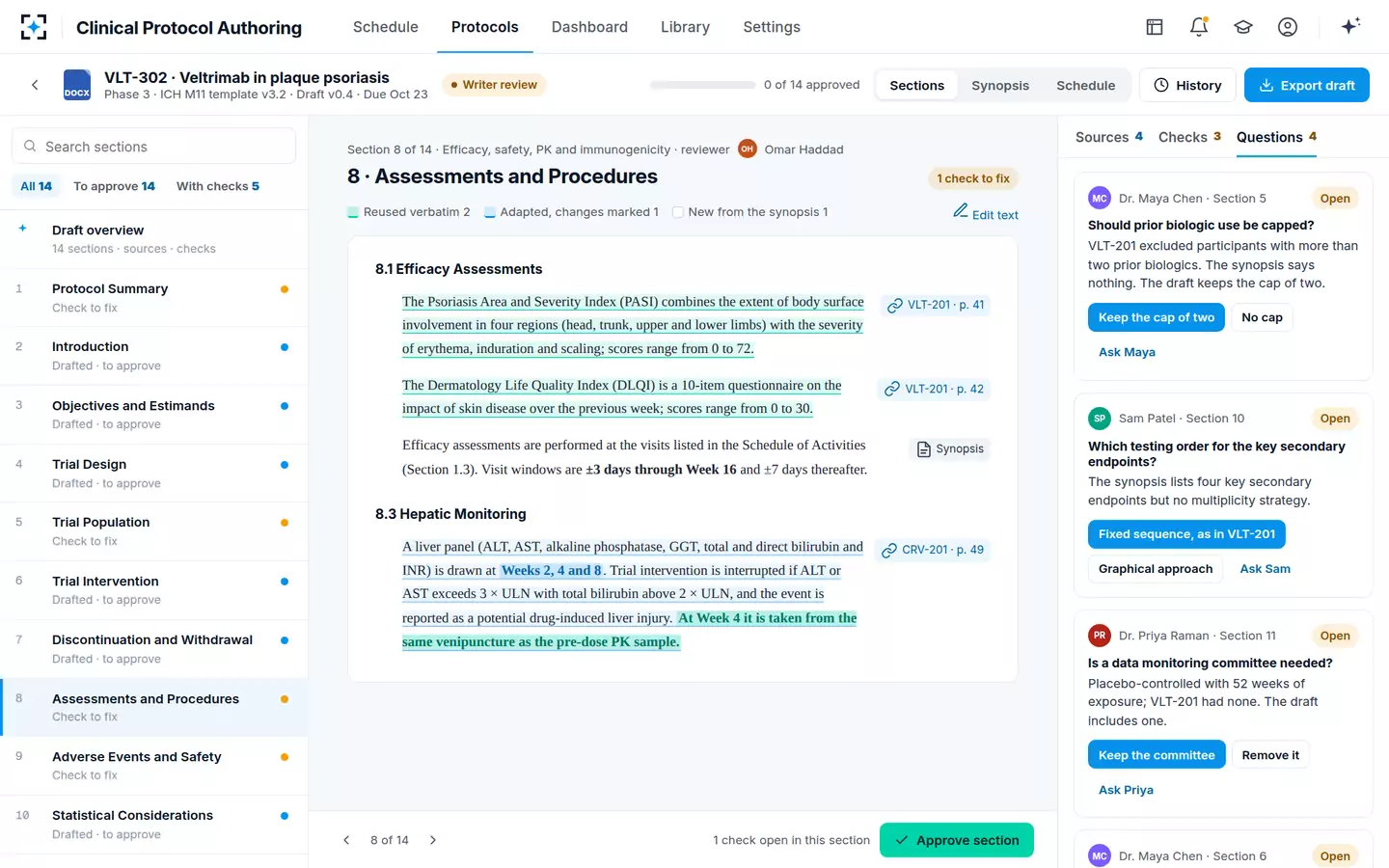
One decision belongs here and is often deferred: the testing order for key secondary endpoints. A trial with four key secondary endpoints and no multiplicity strategy has no basis for a confirmatory claim on any of them, and the choice between a fixed sequence and a graphical approach changes what section 10.10 says. In the sample draft it is an open question addressed to the statistician by name, with the two options and the earlier study's precedent attached, rather than a default silently inherited.
The decisions the synopsis leaves open, each addressed to one named person
The three places a reviewer checks for agreement
A reviewer with an hour spends it in three places, and a writer can run the same three passes first. Section 3 against section 1.1.1: does the plain-language sentence say the same thing as the table, including the timepoint. Section 3 against section 1.3: does every endpoint have a visit at which it is measured, and is each measurement actually ticked there. Section 3 against section 10: is the population-level summary the one the analysis computes, and is each intercurrent-event strategy reflected in the handling of data and of missing data.
Nine checks on objectives, endpoints and estimands before the draft goes to the statistician
- Every objective has an estimand table, and every table names its endpoint
The template requires the endpoint row at a minimum, for primary, secondary and exploratory objectives alike.
- Endpoint wording is quoted from the synopsis, not paraphrased
A paraphrase in section 3 becomes a different endpoint by the time it reaches section 10.
- Every endpoint timepoint appears as a visit in the schedule of activities, with the measurement ticked
The cheapest and most frequently failed check on an adapted schedule.
- The population in the estimand table matches the eligibility criteria in section 5
An inherited cap on prior therapy is a change of population, whether or not anyone wrote it down as one.
- A population-level summary is stated for each estimand
Difference in proportions, risk ratio, hazard ratio or mean difference — chosen before any data exist.
- Every intercurrent event a trial of this design will see has a named strategy
Discontinuation of intervention and use of prohibited rescue therapy are the two that nearly always apply.
- Each strategy is cross-referenced to its rationale in section 4
The template asks for the cross-reference; a strategy without a reason is a decision nobody can review.
- A multiplicity strategy exists if any secondary endpoint will be claimed
Four key secondary endpoints and no stated testing order leave none of them in a position to support a confirmatory claim.
- The plain-language summary in section 1.1.1 can be read aloud and still be true
If it cannot be written without a gap, the gap is the row the table is missing.
Where section 3 sits in the drafting order, and why it is settled before most of the prose, is set out in how to write a clinical trial protocol. The table that every endpoint timepoint has to be tested against is built in the schedule of activities, and what the template changed about where estimands live in the ICH M11 template. To see the three checked against each other on one draft, start from Clinical Protocol Authoring.
Questions people ask
What is an intercurrent event?
An event occurring after treatment starts that affects either the interpretation or the existence of the measurement associated with the clinical question — stopping the assigned treatment, starting an additional or alternative therapy, switching between treatments, or a terminal event such as death. ICH E9(R1) is explicit that these are not a flaw to be designed out: they happen in clinical practice as they do in trials, and their occurrence has to be considered when the question is defined.
Where do estimands go in the protocol?
In section 3 of the ICH M11 template, under each objective, as a table of estimand characteristics — population, treatment, endpoint, population-level summary and a row for each intercurrent event with its strategy. A plain-language summary of the primary and secondary objectives and their estimands also goes in the synopsis at section 1.1.1, and the corresponding analyses go in section 10, with a subsection per objective.
Do you need an estimand for a secondary objective?
The template asks for secondary objectives to be described using the same approach as primary ones, with a table for a precise estimand description. Exploratory objectives are treated more loosely — state the objective and generally its endpoints, and add a precise estimand where it helps. The practical test is whether a result will be claimed: anything that will support a claim needs a fully specified estimand, because a claim is a statement about a defined effect in a defined population.
How do you write an estimand in plain language?
Write one sentence that carries all the parts without naming them: in whom, given what regimen, measured how and when, compared in what way, and what is done about participants who stop or need rescue. The template asks for exactly this in the synopsis, "in natural, nontechnical (layperson) language", for an audience that includes trial participants. If a part of the sentence cannot be written, that part of the estimand is not settled yet.
What happens if the objective and the endpoint do not match?
The trial measures something other than what it set out to answer, and nobody finds out until the analysis or the review. The usual form is subtler than a contradiction: an objective about superiority with an analysis inherited from a non-inferiority study, or an estimand whose population includes people the eligibility criteria exclude. Both are fixed cheaply before approval and expensively afterwards, which is why a cross-check between sections 3, 5, 1.3 and 10 belongs in the drafting routine rather than in review.
Does ICH M11 require an estimand table?
For trials intended to estimate a treatment effect or test a hypothesis about one, yes: the template directs the writer to use the table to describe the associated estimands, and says the endpoint row is required at a minimum. For other trial types it asks instead for the information relevant to the clinical questions of interest, presenting at least the endpoints associated with each objective. ICH E6(R3) asks separately for "information on estimands, when defined".