A protocol review committee is the body that decides whether a study is scientifically worth running before anyone asks whether it is ethical to run it. That is the distinction most teams get wrong: the committee tests merit, priority and design, the ethics committee or IRB tests the protection of the people who will take part, and a third review — operational feasibility — usually has no committee at all. Reviewing a draft is hard because the work splits across six functions who each see one section well, and the question nobody is assigned is whether the sections agree. Botminds' Protocol Design Optimization reads every section of a draft against the sponsor's own past amendments and its design standards, then routes each finding to the named person who owns that area, so the draft arrives at the committee with the arguments already had.
Dr. Maya Chen, Priya Raman, Dr. Omar Haddad, Lena Ortiz, Dana Okafor and Dr. Sam Patel are characters in the solution's sample data, and the studies they are reviewing are fictional. The regulations, guidelines and research below are real and linked where they appear.
Who reviews a clinical trial protocol before it is final?
Three reviews, and they are not interchangeable. The first is scientific: does the question matter, is the design capable of answering it, and should this organisation spend its participants and its sites on this study rather than another? In industry that is a protocol review committee or a design review board; in an academic cancer centre it is a formal Protocol Review and Monitoring Committee. The second is ethical and legal: an institutional review board or ethics committee, whose criteria for approval are set out in regulation and which cannot approve a study until each one is satisfied. The third is operational: can sites find these participants, can a central laboratory turn this sample round inside this window, can an investigator run a six-hour visit on a Tuesday.
Inside a sponsor, the first and third of those are done by the same six functions commenting on the same document at the same time — clinical science, biostatistics, safety, clinical operations, medical writing and regulatory affairs — usually by email and tracked changes, with the protocol lead reconciling the result by hand. The committee then sees a reconciled draft and a summary of what changed. Everything that happens between the circulation and the committee is the part with no minutes.
The five seats that read a draft, and what each is actually looking for
Today
"Show me which sections the committee will send back — and why we think so." Collects comments from six functions and defends the draft at committee.
With agents
Opens each draft already read section by section, decides the findings she owns with the precedent beside them, and signs the disposition log.
Still theirs: the scientific question, and the final shape of the population
Today
"If the estimand is in the analysis plan, the agency will ask for it in the protocol." Finds the gap late, in someone else's draft.
With agents
Receives every estimand and sample-size finding with ICH E9(R1) and the benchmark studies cited, and raises what needs the committee's view.
Still theirs: the sample size, the analysis and what the endpoints can support
Today
"We added liver rules to an earlier study after three cases. I don't want to do that again." The lesson is carried by whoever was there.
With agents
Every safety finding comes to him, matched to the earlier finding and the amendment it caused — and none is downgraded below Medium.
Still theirs: every judgement about participant risk
Today
"Sites told us 28 days was not enough for a colonoscopy slot." The lesson lives in her head, not in the next draft.
With agents
Screening windows, shipping and visit hours are checked against site history before the draft is final, with the burden per visit on one chart.
Still theirs: the feasibility opinion and the country plan
Today
Reconciles the synopsis, the body and the schedule of activities by eye, against a committee date.
With agents
Receives the mismatches as findings — procedure by procedure, visit by visit — instead of hunting for them.
Still theirs: the document, its template and its voice
Is a protocol review committee the same as an IRB?
No, and the two tests barely overlap. An IRB is constituted under regulation and may only approve research when it has determined that a specific list of requirements is satisfied. The list opens with design: risks to subjects must be minimised "by using procedures which are consistent with sound research design and which do not unnecessarily expose subjects to risk", and, where appropriate, by using procedures already being performed on the subjects for diagnostic or treatment purposes. It continues with the balance of risk against anticipated benefit, with "Selection of subjects is equitable", with informed consent sought and documented, with adequate provision for monitoring the data collected to ensure safety where appropriate, and with provisions to protect privacy and confidentiality.
Read that list as a designer and two things stand out. The IRB does examine design, but only through the lens of risk to the people in front of it — a study that is scientifically pointless but safe can satisfy every criterion. And "equitable selection" is an eligibility question, which means a criterion written to make the data cleaner can be challenged on grounds the writer never considered. Neither body asks whether the schedule of activities agrees with the synopsis.
What an IRB must determine before it can approve, in the regulation's own order
- Risks to subjects are minimised
By procedures consistent with sound research design that do not unnecessarily expose subjects to risk, and, where appropriate, by using procedures already being performed for diagnosis or treatment.
- Risks are reasonable in relation to anticipated benefits
And to the importance of the knowledge expected to result. The board considers only risks and benefits arising from the research itself.
- Selection of subjects is equitable
Judged against the purposes of the research and its setting, with particular attention to research involving vulnerable populations.
- Informed consent will be sought, and documented
From each prospective subject or their legally authorised representative, to the extent required by the consent regulations.
- The plan provides for monitoring data to ensure safety
Where appropriate — which is where a safety monitoring section with no stopping rules becomes an approval question rather than a style question.
- Privacy and confidentiality are protected
Where appropriate, with adequate provisions to protect the privacy of subjects and the confidentiality of data.
What is a PRMC or PRMS, and what authority does it have?
In the academic world the scientific review is named, funded and audited, which makes it the clearest published model of what this seat is for. An NCI-designated cancer centre runs a Protocol Review and Monitoring System, whose committee the NCI's own data guide describes in one line: "The PRMC scientifically evaluates and prioritizes cancer clinical research protocols developed, initiated, or scientifically led by the NCI-Designated Cancer Center." Two verbs, and the second is the one industry committees most often lack. A body that evaluates can say a protocol is sound; a body that prioritises can say a sound protocol will compete for the same patients as a better one and should not open.
The system also defines a category of study by the review it received. An institutional study, in the data guide's categories, is one "authored or co-authored by Cancer Center investigators and undergoing scientific peer review solely by the Protocol Review and Monitoring System of the Cancer Center" — the review is the thing that makes it institutional, not the funding. For a sponsor designing its own board, that is the useful borrowing: write down which studies must pass through it, what it may decide, and what it must record, or it becomes a meeting that receives drafts.
What the ethics committee must find before it can approve
Everything in the list above, and it must find it on the document in front of it. That has a practical consequence for the sponsor side: a protection that exists in the team's intention but not in the protocol text does not exist. A monitoring plan that the medical monitor describes in the meeting but that the safety section does not carry is not a provision for monitoring. A visit window the clinical operations lead means flexibly is a fixed window to the board, to the site and to the deviation count later.
This is also where an avoidable amendment becomes expensive rather than embarrassing. A design flaw found by a reviewer before submission costs a redraft. The same flaw found after approval is a substantial amendment that goes back to every ethics committee that approved the original, and often back to the participants already enrolled — the arithmetic is worked through in what a protocol amendment costs.
Seat by seat: what a biostatistician looks for in a draft protocol
Four things, in roughly this order. Whether each stated objective has an endpoint that can actually carry it, and whether the primary endpoint is measured the same way everywhere in the document. Whether the estimand is written in the protocol rather than deferred — the five attributes, including a named strategy for every intercurrent event a participant in this population plausibly meets. Whether the sample size assumptions have a source, and whether that source is a study comparable enough to borrow from, which on a placebo response rate is a harder question than it looks. And whether the design has quietly made the analysis impossible: a stratification factor every participant will share, an interim analysis with no alpha spent on it, a secondary endpoint whose multiplicity nobody has planned for.
The last of those is the one that produces a surprise. In the sample draft VLT-305 the eligibility criterion requiring failure of at least two biologic classes clashes with the randomisation stratum "prior biologic exposure (yes or no)", because under that criterion every participant is a yes. Neither the criterion nor the stratum is wrong on its own. They were written by two seats, and the clash lives between them.
Seat by seat: what clinical operations looks for in a draft protocol
Whether a real person at a real site can do what the document says, within the time the document allows. That means screening windows measured against how long the slowest required procedure actually takes to book and report in each country, not against how long it takes in principle. It means courier and laboratory turnaround for anything time-critical, counted in working days with a public holiday in it. It means the total hours a participant spends on site per visit, and how many of those hours are invasive — a figure that is nobody's responsibility until a site refuses the study or a participant withdraws at week eight. And it means the country plan: whether the sites that have the patients are in the countries the regulatory strategy has chosen.
Clinical operations is also the seat with the least formal power, because its opinion is advice rather than an approval. That asymmetry is the reason the same feasibility failures return: the lesson is learned at the site, reported once, and never becomes a line in a design standard. Routing feasibility findings to a named owner, with the site history behind them, is what turns that advice into a decision somebody made on the record.
Which seat owns which section — and what falls between two seats
SectionSynopsis
Owns itMedical writing
Must also read itEveryone, because every other section is restated here
What falls betweenNobody owns agreement between the synopsis and the body: the synopsis is read first and reconciled last.
SectionObjectives and endpoints
Owns itClinical science
Must also read itBiostatistics, for whether each endpoint can carry the claim
What falls betweenThe estimand attributes sit between the two seats and are often deferred to the analysis plan.
SectionPopulation and eligibility
Owns itClinical science
Must also read itClinical operations, for whether the criteria describe anyone a site can find
What falls betweenThe clash between a criterion and a randomisation stratum belongs to neither seat by habit.
SectionIntervention and comparator
Owns itClinical science
Must also read itClinical pharmacology and the medical monitor
What falls betweenWashouts are written as caution and read by sites as exclusion.
SectionAssessments and schedule
Owns itClinical operations
Must also read itBiostatistics, for what the analysis needs; medical writing, for the table
What falls betweenTotal hours on site per visit is nobody's number until a site complains.
SectionSafety and stopping rules
Owns itThe medical monitor
Must also read itClinical science, pharmacovigilance
What falls betweenA risk known from an earlier study of the same product has to be carried across by a person who remembers it.
SectionStatistics
Owns itBiostatistics
Must also read itClinical science, for whether the question matches the design
What falls betweenAssumptions taken from a benchmark study are rarely challenged line by line.
SectionOperational feasibility
Owns itClinical operations
Must also read itCountry and site teams, if the schedule allows time to ask them
What falls betweenNobody signs the feasibility opinion, so it is advice until it becomes an amendment.
Should investigators and patients see the protocol before it is final?
ICH E8(R1) says yes, and says why in two sentences worth printing above a review calendar.
Clinical study design is best informed by input from a broad range of stakeholders, including patients and healthcare providers. It should be open to challenge by subject matter experts and stakeholders from outside, as well as within, the sponsor organisation.
ICH E8(R1), General Considerations for Clinical Studies, §3.3.3 (adopted 6 October 2021)
The same section says what that input is for. Investigators and prospective participants are the people who can tell a sponsor whether patients who meet the draft criteria can really be found, whether the visits and procedures are heavy enough to drive early dropout, and whether the endpoints and settings mean anything to the people being studied. Open to challenge is a governance statement, not a courtesy: it means the design review has to be capable of changing the design, which means it has to happen while the document is still soft. ICH E6(R3) repeats the point from the quality side — protocol development processes should draw in relevant interested parties, because their input can cut unnecessary complexity, make the trial more feasible and make meaningful outcomes more likely.
In practice sponsors do a version of this and then run out of time. The investigator advisory board meets early, on the concept; the eligibility criteria are written three months later; nobody goes back. The cheapest substitute, when the calendar will not allow a second round, is the sponsor's own feasibility history — what the sites already told you, on the last study, about exactly this window.
Who signs off a protocol on the sponsor side, and what the signature means
Several people sign, and they are signing different things. The protocol lead signs that the draft is complete and that every comment has a disposition. The biostatistician signs for the statistical section. The medical monitor or responsible physician signs for the medical content and the safety plan. The committee chair, or the development lead, approves the study. On the site side the principal investigator signs to agree to conduct the trial according to the protocol — which is why every later disagreement about what the protocol meant is a disagreement about what that signature covered.
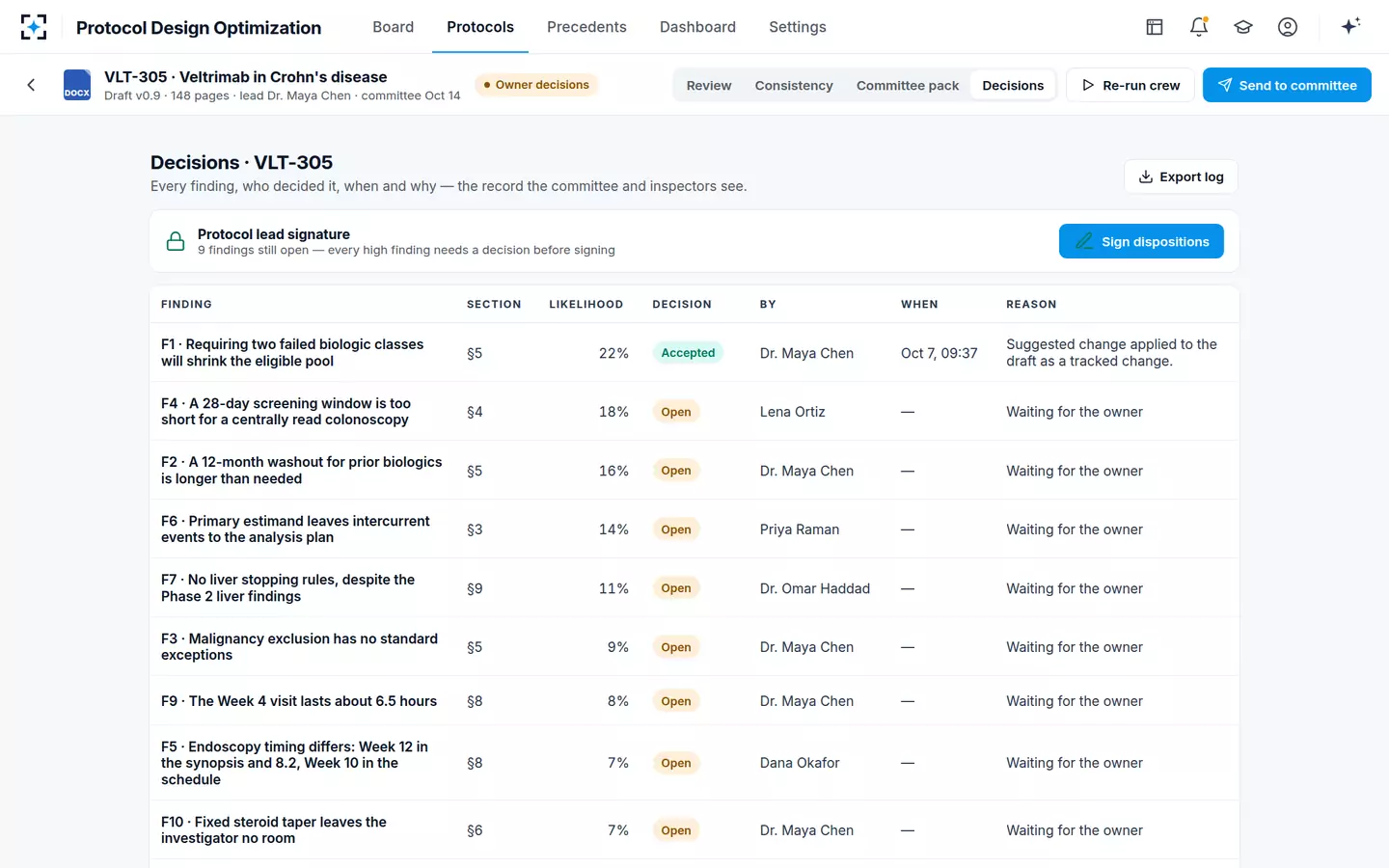
The signature that goes missing is the disposition. A comment that was raised, discussed and not taken leaves no trace in a tracked-changes file; six months later nobody can say whether a reviewer's objection to the washout was overruled or overlooked. In the solution, every finding ends in an explicit decision — accept, reject with a written reason, or raise to the committee — attributed to a named owner with a timestamp, and the protocol lead signs the disposition log with its meaning before the draft can go.
Each finding, its owner and its decision, as Protocol Design Optimization records them
Why 'not involving all the right people' is a documented root cause of amendments
It is not a figure of speech. A 2023 mixed-methods study in Trials examined 242 approved amendments from 53 clinical research studies sponsored by an NHS hospital trust in England and then interviewed eleven trial stakeholders about why they happened. The interviewees' own root causes were "'Rushing the initial application knowing an amendment will be needed later', 'Not involving all the right people to input' at the start of the trial, and 'Realising it's not feasible in practice when delivering the trial'." Missing regulatory checks after an onerous, error-prone application process were named too. None of those is a knowledge failure. All three are failures of who was in the room, and when.
The same study's conclusion reads like a specification for the review cycle: "Trials need to be critically reviewed by various stakeholders and have sufficient time allocated to planning and feasibility assessments to avoid some amendments." Two requirements, and sponsors reliably meet the first and miss the second. There are plenty of reviewers; there is rarely enough time between the last comment and the committee date for anyone to check the draft against what the organisation already learned.
A draft's path, and the decision that stays with a person at every step
Agent
Five reviewers read the draft in parallelEligibility, schedule and burden, endpoints and estimands, safety monitoring and operational feasibility — each section against the sponsor's past amendments, its design standards and ICH E6(R3), E8(R1) and E9(R1).
Never: edits the controlled document
Agent
A lead reviewer compares, merges and ranksChecks every endpoint and procedure across the synopsis, the body and the schedule table, merges duplicate findings, estimates each one's likelihood from the amendment archive and assigns the owner by area.
Never: decides a finding, or signs
A person decides
The owner of each area decidesAccepts the suggested wording, rejects it with a written reason, or raises it to the committee. Safety findings always go to the medical monitor; statistical ones to the biostatistician.
Never: has the decision taken for them
A person decides
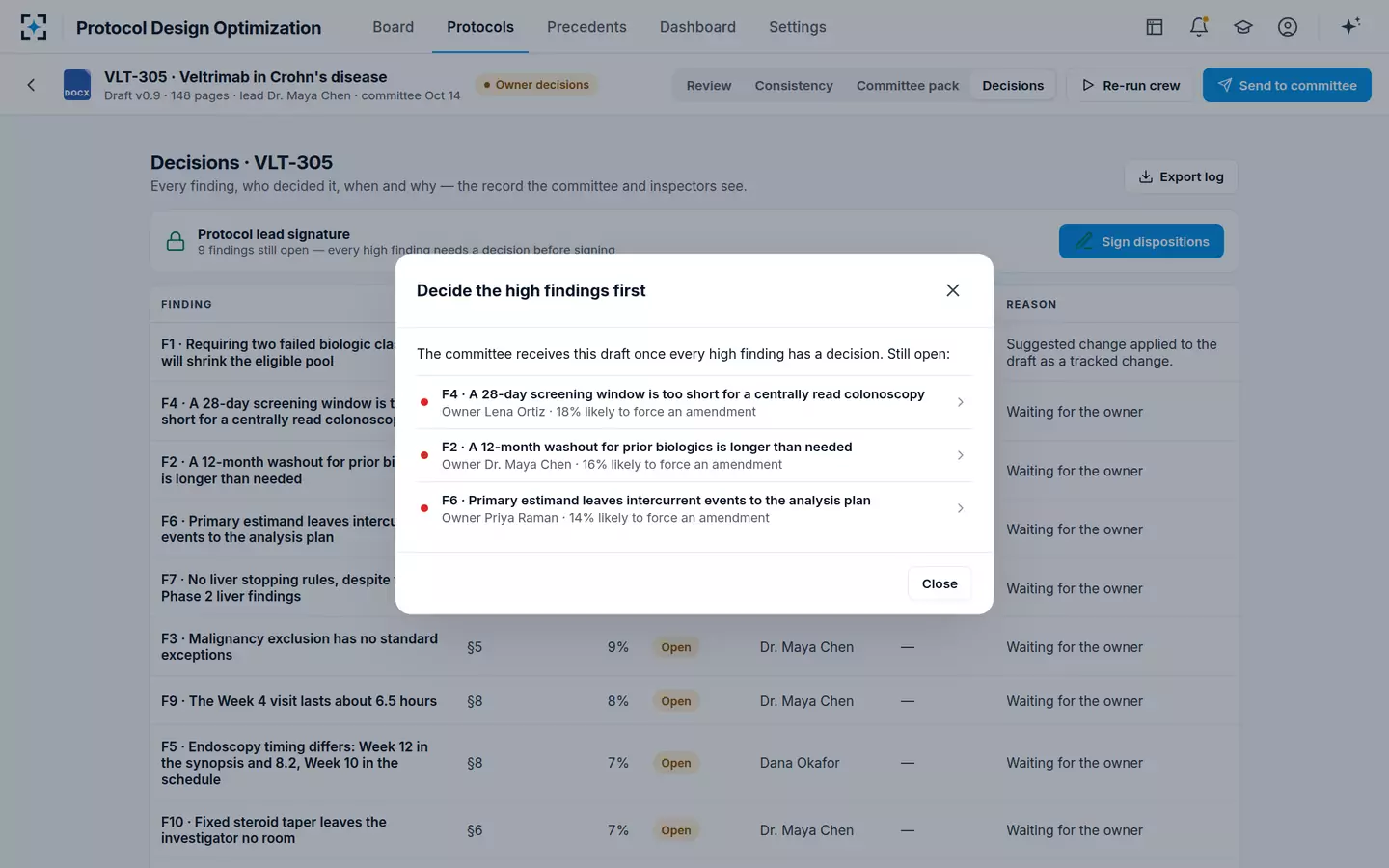
The protocol lead signs the disposition logEvery high finding must have a decision before the draft can be sent. The signature carries its meaning: "I confirm these dispositions as protocol lead."
Never: signs while a high finding is open, unless the sponsor turns that rule off
A person decides
The committee decides the protocolReceives the risk at draft and now, each decision with the precedent behind it, and only the questions the committee has to answer.
Never: is replaced by the review
High findings hold the draft back until someone has decided them
That is the whole argument for giving a draft review an owner per section rather than a mailing list. Six functions commenting is not the same as six functions deciding, and the sections that generate avoidable amendments — eligibility, windows, schedule, estimands, safety monitoring — are precisely the ones that sit between two seats. The criteria half of that problem is worked through in the criteria behind a screen failure rate, and the shape of the amendments themselves in why the same protocol amendments return. To see the routing and the disposition log on a draft of your own, start from Protocol Design Optimization.
Questions people ask
What is the difference between a protocol review committee and an IRB?
A protocol review committee asks whether the science is sound and worth doing; an IRB or ethics committee asks whether the people who take part are adequately protected, against a list of criteria set in regulation. An IRB may only approve research once it has determined that risks are minimised by procedures consistent with sound research design, that risks are reasonable against anticipated benefits, that selection of subjects is equitable, and that consent, monitoring and privacy provisions are in place. A study can clear one review and fail the other.
What authority does a protocol review and monitoring committee have?
In an NCI-designated cancer centre the PRMC both evaluates and prioritises protocols developed, initiated or scientifically led by the centre — so it can decline a scientifically sound study that would compete for the same patients as a better one, and it monitors accrual afterwards. Industry committees vary: some approve, some advise. The useful test is written down in the charter — which studies must pass through it, what it may decide, and what it has to record.
How long does protocol review take?
No regulation sets one for a sponsor's internal review, and the answer that matters is not the elapsed calendar but how much of it is available for changing the design. On the sample Phase 3 draft inside the solution, the estimated split from first circulation to committee is ten working days collecting comments from six functions, four checking the draft against past amendments and design standards, two reconciling the synopsis, body and schedule, five deciding comments and redrafting, and two writing the committee pack. The four spent checking are the ones that shrink first when a date moves.
Can a committee chair overrule a reviewer?
A chair can decide that a study proceeds over an objection; what the chair cannot do is make the objection disappear. The reviewable artefact is the disposition — who raised what, who decided it, on what basis, and when. A review whose rejections carry written reasons survives the question an inspector or a later amendment will ask; one whose objections vanish into a tracked-changes file does not.
Who is accountable when a design flaw gets through review?
The sponsor, in regulatory terms. Internally, the honest answer is usually that the flaw sat between two seats — a criterion that clashes with a stratification factor, a window that only the country teams could have priced — and that no single reviewer was asked for it. That is why the published root causes of avoidable amendments include "not involving all the right people to input" at the start of the trial, and why assigning each section a named owner does more than adding another reviewer.
Should patients and investigators see a draft protocol?
ICH E8(R1) says study design is best informed by input from a broad range of stakeholders, including patients and healthcare providers, and that it should be open to challenge from outside as well as inside the sponsor. Investigators and potential participants are specifically named as having insight into whether eligibility criteria can be met and whether the visits and procedures are too burdensome. The practical constraint is timing: the input has to arrive while the design can still change.