A summary of changes is the document that accompanies a protocol amendment and says what changed and why — section by section, old wording against new, with the rationale for each change. Every sponsor has hundreds of them, filed with the amendment they belong to and read by nobody afterwards. That is the waste: the summary of changes is the only place the organisation ever writes down why a protocol had to change, and it is filed as evidence rather than kept as knowledge. Botminds' Protocol Design Optimization classifies a sponsor's past summaries of changes by area, avoidability, direct cost and months lost, and reads each new draft against them, so the person writing an eligibility criterion sees the amendment the same criterion caused two studies ago.
The sample archive described here — 148 amendments from 41 past protocols, and study VLT-204's second amendment — is sample data on fictional studies inside the solution. The benchmark research is published work, linked where it appears.
What a summary of changes in a protocol amendment is, and what has to be in it
Two different documents go by the name, and conflating them is why archives end up useless. The first is the regulatory one. Under the IND rules, a protocol amendment for a change in protocol must carry a brief description of the change and a reference, by date and number, to the submission that contained the protocol being changed. Under the EU Regulation the application has to say what type of change is being made and justify it, and the modified documents themselves go in with it as new versions.
The second is the sponsor's own working document: a table with one row per change, giving the section, the previous text, the new text, and a rationale written for the reviewers who have to agree to it. It is longer, more candid and more useful than the regulatory version, because the rationale is written to persuade colleagues rather than to satisfy a filing. A well-written rationale names the cause, not just the change — not "criterion 3 has been broadened" but why the original was written that way and what happened as a result.
One summary of changes, read for the two sentences that matter
What the row says changed
“Inclusion criterion 3 was broadened.”
The change sentence. Necessary for the filing, useless for the next protocol: it names the edit, not the mistake.
What the rationale says caused it
The original criterion was not required by the target label, and investigators at 31 of 52 sites reported eligible patients being referred elsewhere.
The cause sentence. It names a design rule — do not write eligibility stricter than the label requires — that applies to every future protocol in this programme.
The two numbers worth keeping
Enrolment was 41% of plan at month 6, and 58% of screen failures were due to criterion 3.
Attribution. Without the second figure the amendment is an opinion about a criterion; with it, the criterion has a measured cost.
What it took to make the change
$162K direct · 4.1 months from decision to last approval · 52 ethics committee approvals · 64 participants re-consented
The price. Rarely recorded on the summary of changes itself, and usually recoverable from the study's own records in the weeks after.
Where a protocol's past amendments actually live
In four places, none of which is an index. The amendment packages themselves sit in the trial master file, by study. The regulatory submissions sit in the submission archive, by application. The approvals sit with regulatory affairs, by country. And the reasons — the real ones, as opposed to the filed ones — sit in the meeting minutes and email threads of the team that made the change, which are the first records to become unsearchable.
For a public trial the registry entry carries a version history, so an outsider can see that a protocol changed and sometimes when, but not why. For a sponsor's own studies the recoverable set is better than most teams assume: the summary of changes gives the what and usually the why, the submission dates give the clock, the finance system gives a fair approximation of the direct cost, and the site and ethics tracking give the approval count. Assembling those four is a one-time job per programme, not a standing process.
How to classify an archive: area, avoidability, cost, delay
A pile of past amendments becomes a predictor when every one carries the same handful of fields. The four that do the work are the area of the protocol that changed, whether the change was avoidable, what it cost directly, and how long it took from decision to last approval. Everything else is useful; those four are what make a new draft measurable against the archive.
The fields a usable amendment archive needs, per past amendment
| Field | What it records | Why the next draft needs it |
|---|---|---|
| Area of the protocol | The section that changed: objectives and endpoints, population, intervention, schedule of assessments, safety monitoring, statistics, operational. | It is how a new draft is matched: a finding in section 5 looks for past amendments in section 5. |
| The changed item | The specific provision — "inclusion criterion requiring prior biologic failure", not "eligibility". | Matching on the section is coarse; matching on the item is what makes a precedent persuasive. |
| Reason, as filed | The justification submitted with the amendment. | It is what a regulator saw, and it is the version a later inspection will read back to you. |
| Cause, as understood | What the team believes made the change necessary, written plainly. | This is the design rule for the next protocol. The longer it waits to be written down, the less of it survives. |
| Avoidable or not | Was the information that would have prevented this change available when the protocol was written? | It separates the archive into a backlog of design lessons and a record of things that simply happened. |
| Direct cost | What the change cost to implement: documents, submissions, fees, retraining, systems, materials. | It turns an argument about a criterion into an argument with a number on it. |
| Months to last approval | From the decision to amend to the final country or committee approving. | The delay, not the invoice, is usually the larger cost — and it scales with countries, not with the size of the change. |
| Participants re-consented | How many people already enrolled had to be asked again. | The burden the change placed on participants, and a good proxy for how disruptive it was at sites. |
| Studies that cite it | Which current drafts have a finding matched to this amendment. | It shows which lessons are still live, and which have been designed out. |
What an avoidable amendment looks like in the record
Avoidable does not mean careless. It means the information that would have prevented the change was already inside the organisation when the protocol was written. That test is answerable, and it is the only classification in the archive that requires a judgement rather than a lookup — which is why it should be made by a person and recorded with a reason.
Three patterns cover most of them. The first is a design choice contradicted by the sponsor's own earlier study: a risk described in the investigator's brochure with no monitoring in the draft, a window a site already said was too short. The regulator's own illustration of a substantial modification is this pattern — an exclusion criterion added because of a potential liver toxicity described in a section of the brochure, which is to say, described before the protocol was written. The second is a provision stricter than any external requirement: eligibility narrower than the target label, a washout longer than the standard of care. The third is an internal contradiction: a stratification factor every participant will share, a procedure at week 12 in the synopsis and week 10 in the schedule table. None of the three needed new information to find.
Can past amendments predict the next one?
Within one sponsor, yes, usefully — because design choices repeat within a programme, a therapy area and a template far more than they vary. The mechanism is not clever: count how often a given provision appears as the changed item across the archive, weight by how recent and how comparable the study was, and you have a likelihood for the same provision in a new draft. It is an estimate about a document, not a prediction about a trial.
How a likelihood is estimated from an archive, term by term
How often this choice has been changed
past amendments that changed this item ÷ past protocols that carried it
Matched on the item, not just the section — a 12-month washout, not "eligibility".
From the archive
Weighted for how recent
× recency weight
A change made under the current design standard says more than one made under the version before it.
From the archive
Weighted for how comparable
× comparability weight
Same phase, same therapy area, similar country footprint. An oncology precedent is weak evidence for an immunology draft.
From the archive
Less what your threshold removes
− findings below the minimum likelihood
Below the sponsor's threshold a finding goes to a watch list instead of to an owner. The default is 3%; 5% and 10% are the other settings.
Your setting
Two honest limits belong with that arithmetic. A sponsor's first archive is small, so early likelihoods are coarse and should be read as a ranking rather than a probability. And an archive cannot see a choice nobody has made before: a genuinely novel endpoint has no precedent and will always score low, which is precisely when a human reviewer matters most.
Which design variables predict that a protocol will be amended
Published research has already named them, which means a sponsor can check its archive against a known list rather than hunting blind. A study that collected design elements and performance outcomes from "187 protocols provided by 20 companies" tested ten design variables against eleven performance variables and found that design characteristics predicted amendment frequency even when controlling for phase and therapeutic area: "These predictors included the number of endpoints, eligibility criteria, procedures per visit, number of countries, and investigative sites."
The same study separated two of those as particularly load-bearing: "The number of countries and the number of sites were each positively correlated with amendment frequency, longer screening and study duration as well as study participant dropout rates." Footprint, in other words, is not neutral. Every extra country is another approval on the critical path of every future amendment, which is why a design decision made for enrolment reasons shows up years later as a change-control cost.
The uncomfortable part is that all five predictors have been growing. A companion benchmark study from the same research centre found that "The results show a continuing upward trend across all protocol design variables", with Phase 2 and Phase 3 protocols averaging "more endpoints, eligibility criteria, protocol pages; investigative sites; countries and datapoints collected" than before.
Growth in the design variables that predict amendment frequency
Reading those two findings together gives a sponsor something it can act on without waiting for its own archive to mature. The variables that predict amendments are the same ones that have been rising for a decade, and all of them are decisions made in a draft. ICH E8(R1) says the same thing as a design instruction: a study design should be workable in operation and free of complexity it does not need. The guideline's test for what is necessary is whether a factor is critical to the quality of this particular study, and it warns against burying those factors under minor issues such as long lists of secondary objectives, or data collection that serves neither participant protection nor the primary objectives.
Counting those variables on a draft is a related but different exercise from reading an archive, and our sibling guide on scoring a protocol's complexity works through how the counting is done and what the resulting score is and is not good for.
Reading the archive before the first draft, not after the committee
The one measured finding about the review cycle itself is uncomfortable, and it is worth printing where the review calendar is set.
The number of internal reviews prior to protocol finalization was also positively correlated with these same performance outcomes.
Smith, Bilke, Pretorius and Getz, Ther Innov Regul Sci, March 2022 (56(2):333–345)
More rounds of internal review correlated with more amendments, longer durations and higher dropout — not fewer. The study does not claim that reviewing causes amendments, and the obvious reading is that complicated protocols attract both. But it does demolish the assumption that adding another review round is the fix. What the archive offers instead is a different kind of review rather than more of the same: one round, against evidence the organisation already owns, early enough that the answer can change the document.
The practical sequence is to read the archive before the first draft rather than after the committee pack. At synopsis stage, pull every past amendment in the therapy area whose changed item is a provision this study will also have — the eligibility shape, the washout, the screening window, the primary endpoint's mode of measurement, the safety monitoring for this mechanism — and decide each one deliberately. A choice the archive warns about that the team makes anyway is fine, as long as somebody decided it and wrote down why.
The archive, classified: 148 amendments from 41 past protocols
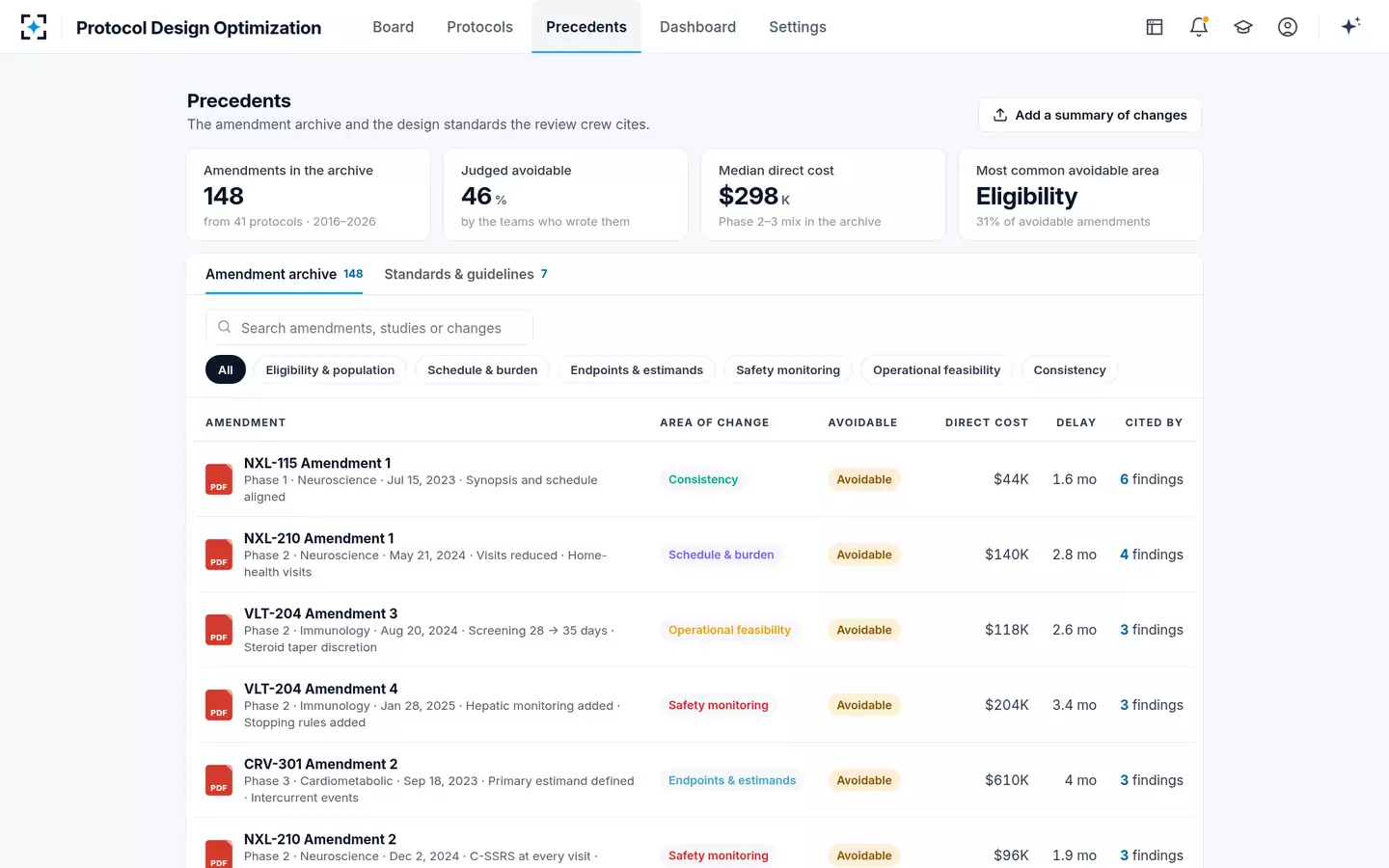
Who should read it, and what they should be looking for
Four people, with four different questions. The protocol lead, starting a new synopsis, asks which of this programme's past amendments touched a provision this study will also carry. The design-standards owner asks which causes recur often enough to become a rule — if three amendments in two years all broadened eligibility against the target label, that belongs in the standard, not in each reviewer's memory. The clinical operations lead asks what the sites and vendors have already told the organisation about windows and turnaround. And the medical monitor asks which safety provisions this product's earlier studies needed, and whether the current draft has them.
What none of them should be asked to do is read the archive end to end. Three hundred past summaries of changes is not a reading task; it is a matching task, which is why the match belongs to software and the decision to a person — the division set out in who reads a draft protocol.
The summary of changes a regulator receives, and the one an archive needs
The regulatory submission: To let an assessor see what changed and judge whether it is acceptable.
The archive record: To let the next protocol avoid the change.
The regulatory submission: In the EU, a description of the type of change with a justification. Under the IND rules, a brief description plus the date and number of the submission being changed.
The archive record: The same, plus the cause as the team understood it, in plain words.
The regulatory submission: An assessor, once, and an inspector later.
The archive record: The person writing the next protocol in this programme.
The regulatory submission: No. Neither rule asks for the cost of the change.
The archive record: It must. Without a cost the precedent is an anecdote.
The regulatory submission: Only indirectly, through submission and approval dates held in different systems.
The archive record: Months from decision to last approval, as one number.
The regulatory submission: Never — and a submission is the wrong place to volunteer it.
The archive record: Yes, as an explicit judgement with a reason, made by a person.
What the archive cannot tell you, and the three checks that stay human
An archive is a record of what went wrong before. It is silent on three things, and each of them is a reason a person stays in the loop. It cannot judge novelty: a first-in-class mechanism, a new endpoint, a decentralised element nobody has run has no precedent, and a low likelihood there means no evidence rather than low risk. It cannot weigh a deliberate trade: a sponsor that narrows eligibility knowing it will slow enrolment, because the signal matters more, has made a decision the archive can only disagree with. And it cannot see outside the organisation — a competitor's readout, a changed standard of care, a new guideline — which is where an amendment is genuinely unavoidable.
The later oncology benchmark is a caution about the whole enterprise: "Efforts to prevent avoidable protocol amendments in the industry have not been effective in oncology, where increasingly complex designs are reflected in difficult to predict cycle times, barriers to recruitment and retention and an increase in protocol amendments." Classifying an archive is not, on its own, prevention. It only pays when a named person decides each finding and the decision is recorded — which is what makes the next archive better than this one.
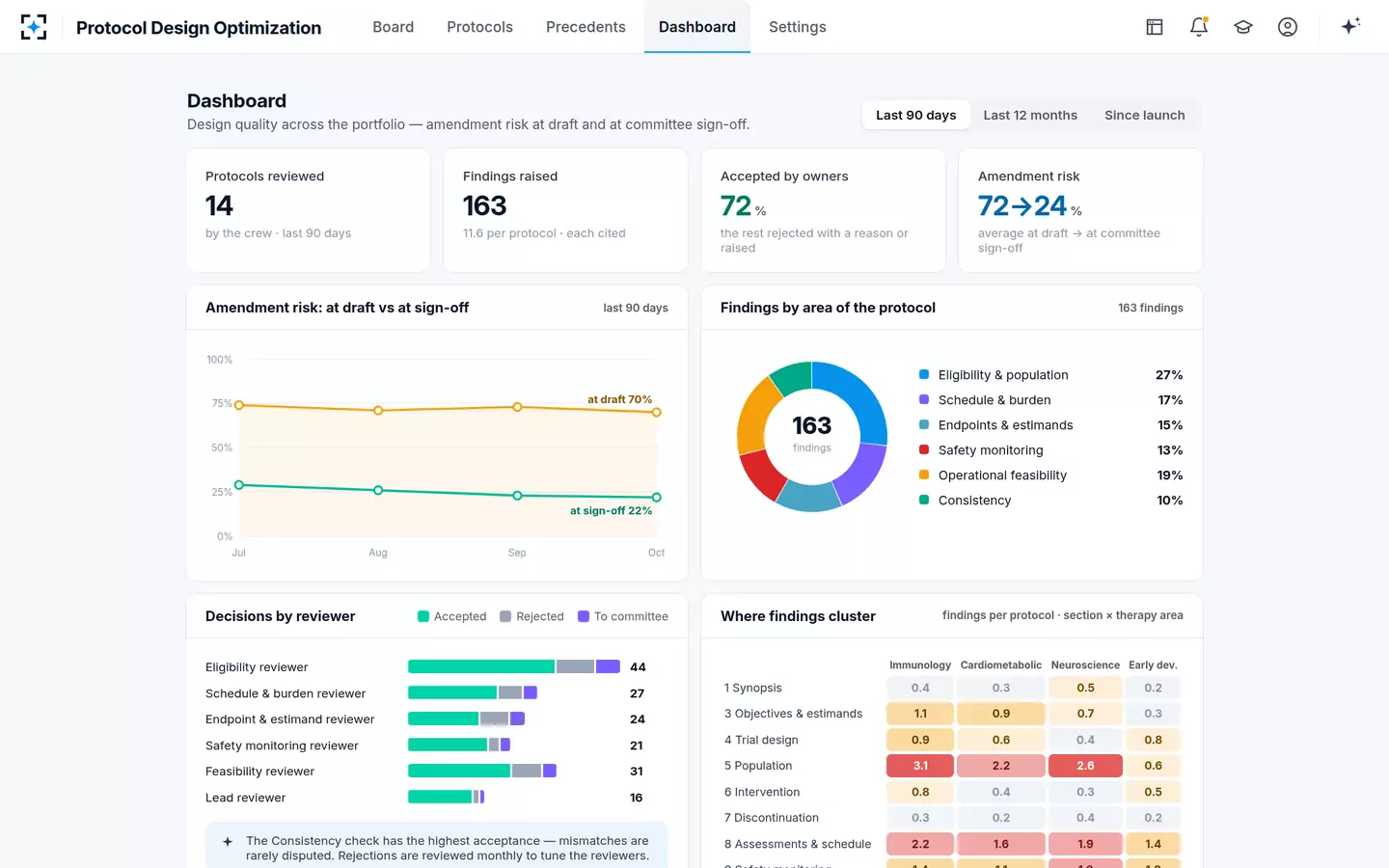
Where findings cluster, as Protocol Design Optimization reports it
Every draft and approved protocol, with the archive behind it
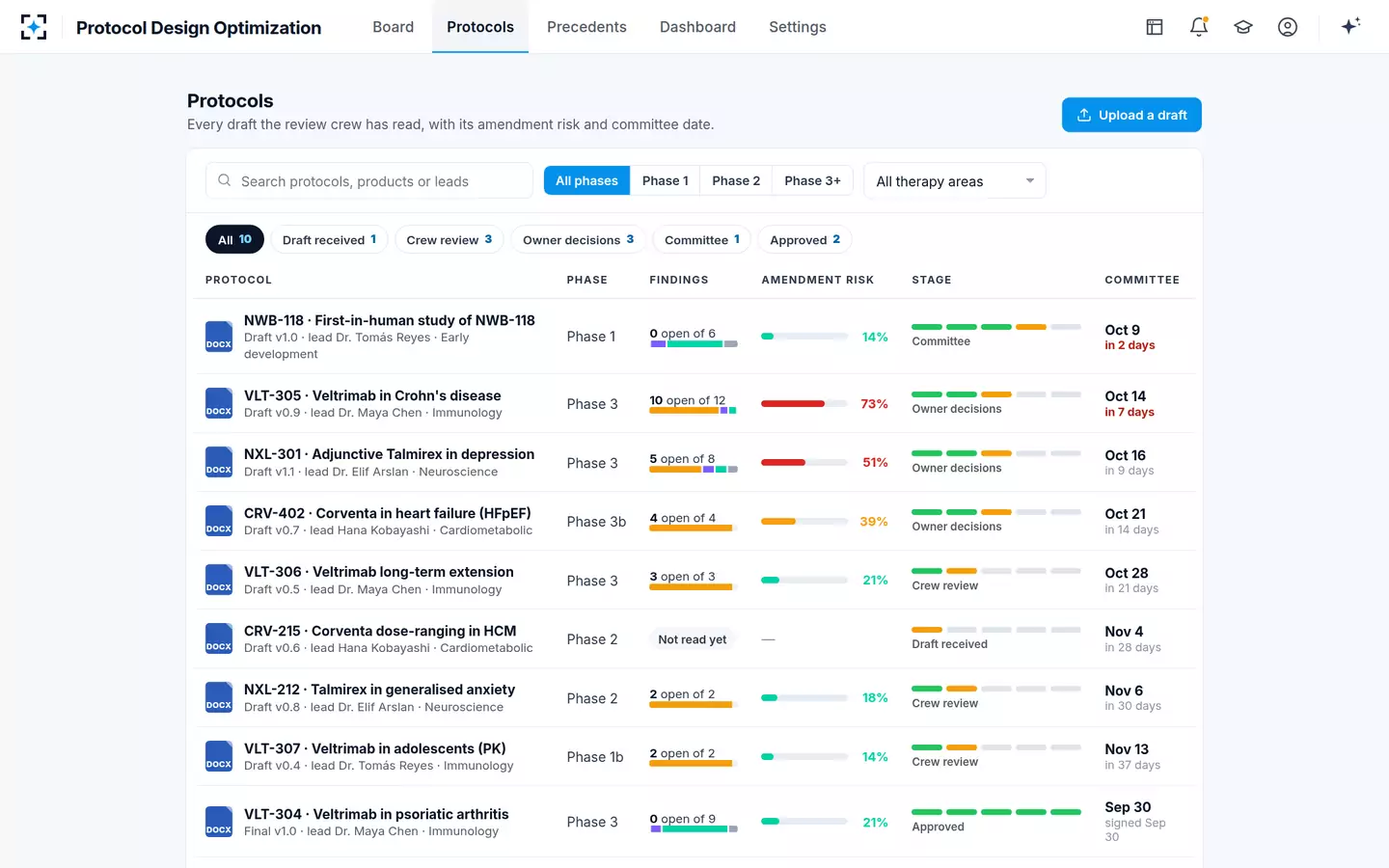
That loop is the whole point. An archive that only grows when somebody remembers to file something decays; one that is fed by the amendments the organisation makes anyway gets better every quarter. The counts and costs behind it are in the cost of protocol amendments, and the shape of the amendments themselves in why the same protocol amendments return. To see your own summaries of changes read this way, start from Protocol Design Optimization.
Questions people ask
What has to be in a summary of changes?
For the regulator: in the EU, a description of the type of change with a justification, submitted with the modified documents. Under the IND rules a change in protocol carries a brief description of the change and a reference, by date and number, to the submission that contained the protocol. For the sponsor's own use, add the cause as the team understood it, in plain words.
How do you classify protocol amendments by reason?
Separate the reason as filed from the cause as understood, and record both. The filed reason is what the regulator saw. The cause is what the team believes made the change necessary — an eligibility criterion stricter than the target label, a window no site could meet, a risk already described in the investigator's brochure. Then add one judgement: was the information that would have prevented this change available when the protocol was written?
Which design variables predict that a protocol will be amended?
A Tufts study of 187 protocols from 20 companies found that the number of endpoints, eligibility criteria, procedures per visit, countries and investigative sites predicted amendment frequency, even controlling for phase and therapeutic area. Countries and sites were also positively correlated with longer screening and study duration and with higher dropout. All five have been rising across the decade to 2020.
How long should you keep an amendment archive?
Record retention is set by the applicable regulations and by the sponsor's own policy, and that is a separate question from usefulness. For prediction, value decays with the design standard: an amendment made under a template and a standard you no longer use tells you about a process that no longer exists. Weighting by recency handles this better than deleting — keep everything, lean on the recent.
Can past amendments really predict the next one?
Within one sponsor's own programmes, well enough to rank findings — because design choices repeat within a therapy area and a template. The estimate is about a document, not a trial, and it has two blind spots: a small archive gives coarse numbers, and a genuinely novel design element has no precedent and will always score low. That is where the ranking has to be read as a prompt for a reviewer, not as a verdict.
What can an amendment archive not tell you?
Three things. Whether a novel design element is risky, because there is no precedent to match. Whether a deliberate trade-off was right — narrowing eligibility to protect a signal is a decision, not an error. And anything originating outside the organisation: a competitor's result, a change in standard of care, a new guideline. Those are where amendments are genuinely unavoidable, and they are the reason the archive informs a person rather than replacing one.