The screen failure rate in clinical trials is the share of people who start screening and are never randomised, and where it is published at all it is a single percentage per study — around 20% to 30% in one peer-reviewed review of genitourinary cancer trials. That number is nearly useless on its own, because the thing it measures is not a site's performance but a document's selectivity, and the document is written criterion by criterion. The hard part is attribution: knowing that 26% of screened participants failed tells a team nothing, while knowing that 58% of those failures came from one inclusion criterion tells them which line to rewrite. Botminds' Protocol Design Optimization does that attribution on the draft rather than on the running study, matching each eligibility criterion to the past amendments that changed a criterion like it, with the screen failures those studies recorded.
The draft criteria and past studies named below — VLT-305 and its inclusion criterion 3, VLT-204, VLT-302 and CRV-301 — are sample data on fictional studies inside the solution. The published rates come from a peer-reviewed review and are linked where they appear.
How screen failure rate is calculated, and the three ways it is quoted wrongly
The arithmetic is simple and the denominator is not. The review that supplies most of the published figures defines the numerator plainly: screen failures are "individuals who undergo screening but are not enrolled in a clinical trial", and they "incur significant costs without contributing valuable data to the study". What varies between protocols, and therefore between quoted rates, is who counts as having undergone screening.
Which screen failure rate: the denominator decides the question
Of everyone screened
(screened − randomised) ÷ screened
The usual published form. Answers: how many screening visits does one randomised participant cost?
Feasibility and budget
Of everyone consented
(consented − randomised) ÷ consented
Includes people who withdrew during screening, not only those found ineligible — which matters where screening is counted from a first assessment rather than from consent.
Site and recruitment planning
Of those assessed against the criteria
found ineligible ÷ assessed for eligibility
Excludes withdrawals and losses during screening. Answers: how selective is this protocol?
Protocol design
What none of the three tells you
which criterion
A rate without attribution cannot be acted on, because a protocol is not changed as a whole — it is changed one line at a time.
Why attribution matters
Three mistakes follow from not stating which one is meant. The first is comparing a rate that includes pre-screening with one that does not: a site that reviews two hundred charts to consent twenty people can report a flattering rate or an alarming one from the same week's work. The second is comparing across indications as though the number were a constant. The third, and the costliest, is treating the rate as a site metric. A site that screens carefully against a strict protocol will produce a low rate and a slow enrolment curve; a site that screens optimistically against the same protocol will produce a high rate and the same curve. The protocol set the limit in both cases.
What is a normal screen failure rate?
No regulator sets one, and the honest published answer is narrower than most quoted figures suggest. A review of 50 phase 2 and phase 3 trials in advanced genitourinary cancers conducted between 1999 and 2016 found that fewer than half reported a screen failure rate at all, and that among those that did, the rates clustered in a band.
Published mean screen failure rates, by tumour type, with their ranges
The review's own conclusion is the figure most often quoted from it: "Contemporary trials in genitourinary cancer reported screen failure rates of approximately 20% to 30%. Many trials did not report on the numbers of, and reasons for, screen failures." Both halves of that sentence matter. A 20% to 30% expectation in advanced genitourinary cancer is a planning anchor for advanced genitourinary cancer and for nothing else — and the fact that half the trials in that review did not report the number at all means published benchmarks for most indications are thin. A sponsor's own history, indication by indication, is the most reliable source it has, which is the same argument that applies to reading a sponsor's own amendment archive.
The related number a feasibility plan actually needs is not the failure rate but the enrolment rate it implies per site per month; our sibling guide on calculating a clinical trial recruitment rate takes that side of the arithmetic.
Why 'ineligibility' is not a reason: attributing failures to a criterion
The same review found the dominant stated cause — in prostate cancer outright, and alongside patient refusal in kidney and bladder cancer — and it is a tautology.
The main reason for screen failure was reported as ineligibility.
Wong et al., Clinical Genitourinary Cancer, 8 September 2017
Of course it was. A screen failure that is not a withdrawal or a death is by definition a failure to meet the criteria; recording "ineligible" records that the protocol was applied. It is the clinical research equivalent of answering "because of the rules". The review's call for "Greater standardization of definitions, methods, and reporting" is a call to record the next level down.
That next level is the criterion number. A screening log that records "exclusion 7" rather than "ineligible" converts an untreatable statistic into a design finding: one line, one owner, one possible rewrite, and a measurable consequence if it is rewritten. Three practical rules make the attribution usable. Record the first criterion that failed and, where the assessment continued, every criterion that failed, because a participant excluded on two grounds is not evidence against either one alone. Record the value that failed, not only that it failed — a haemoglobin of 9.4 against a 9.5 threshold is a different argument from one of 6.2. And distinguish a criterion that excluded someone from one that merely could not be assessed in time, because the second is a window problem wearing a criterion's clothes.
A worked attribution on one draft, criterion by criterion
Done on a running study, attribution produces a case for an amendment. Done on a draft, against the sponsor's own past amendments, it produces a rewrite that costs nothing. The table below is the second, on one sample Phase 3 draft.
Four provisions in one draft, and what each has already cost this sponsor
Inclusion 3 — failure of at least two biologic classes22%
What the criterion is guarding
A population that has exhausted the obvious alternatives, so the treatment effect is attributable
What the archive says happened last time
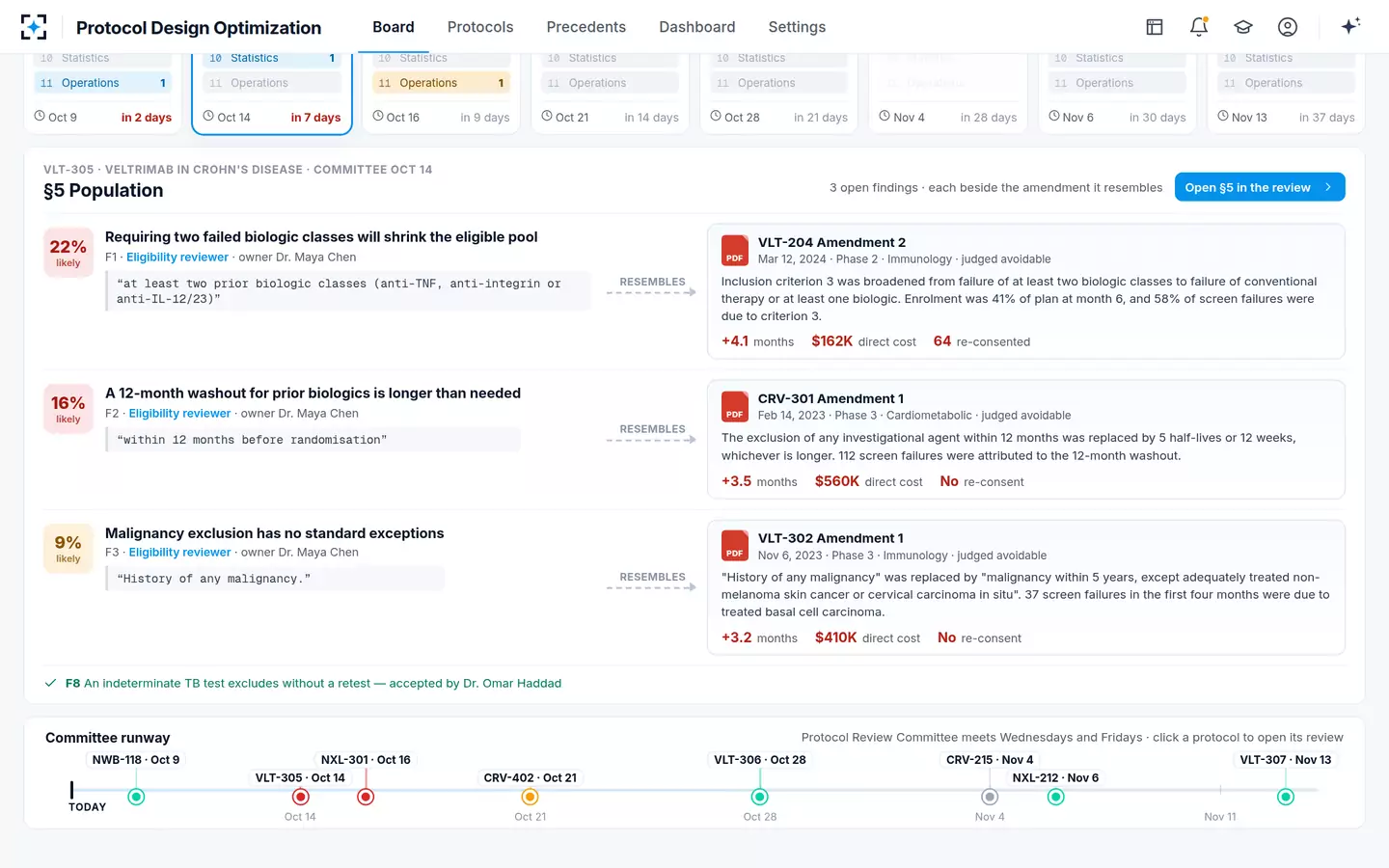
VLT-204 amendment 2 broadened the same criterion: enrolment 41% of plan at month 6, 58% of screen failures attributed to it. $162K direct, 4.1 months, 64 re-consented.
The rewrite proposed
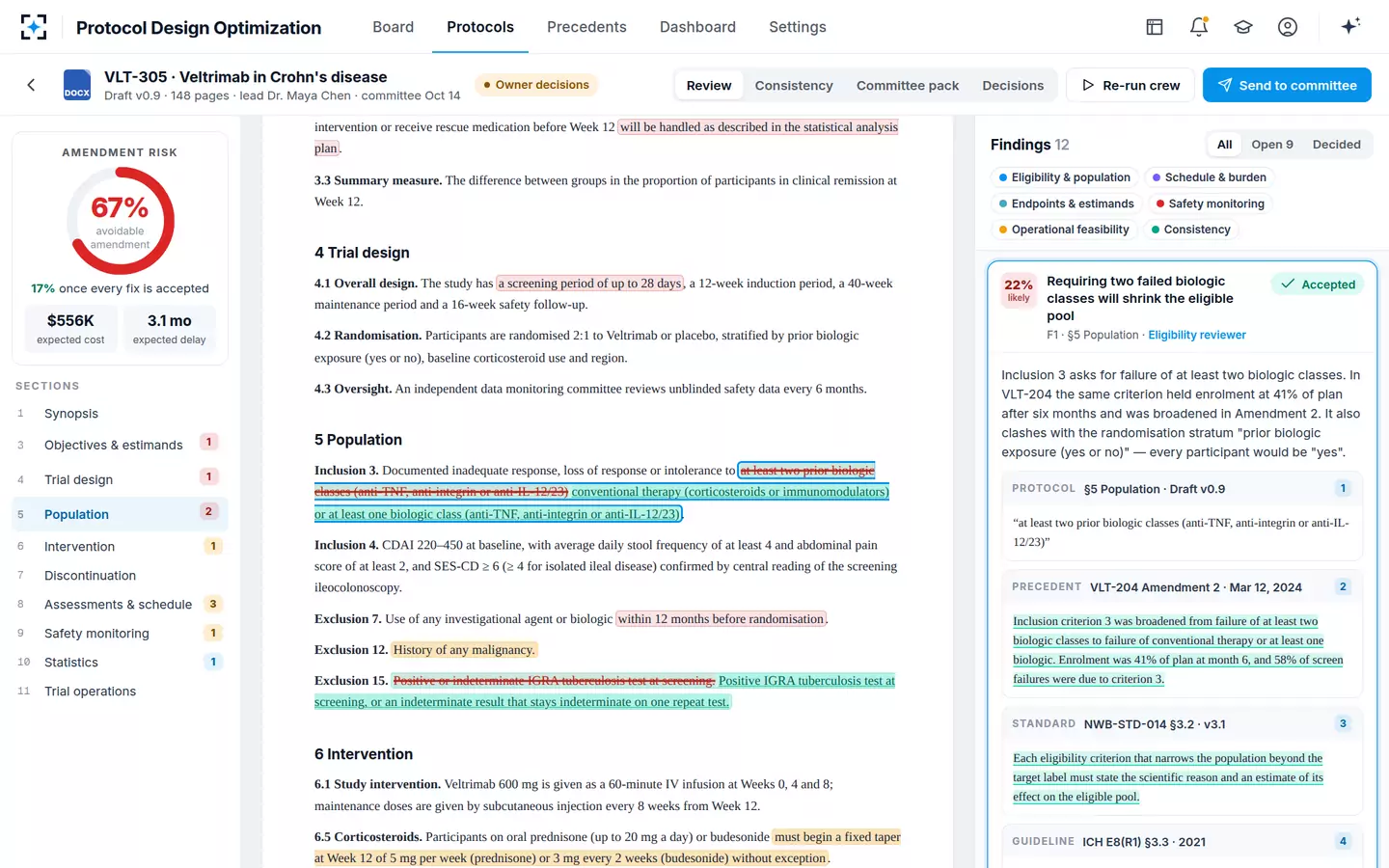
“Conventional therapy (corticosteroids or immunomodulators) or at least one biologic class” — the wording the target label supports.
Exclusion 7 — 12-month washoutHigh
What the criterion is guarding
Carry-over from a prior biologic confounding the primary endpoint
What the archive says happened last time
CRV-301 amendment 1 shortened a similar washout; it followed 112 screen failures on that study.
The rewrite proposed
Shorten to the standard the pharmacology supports, and state the carry-over assumption the length rests on.
Exclusion 12 — history of any malignancyMedium
What the criterion is guarding
Confounding mortality and safety signals from an unrelated cancer
What the archive says happened last time
VLT-302 amendment 1 carved out non-melanoma skin cancer; on that study 37 screen failures were treated basal cell carcinoma.
The rewrite proposed
Carve out adequately treated basal and squamous cell carcinoma and in-situ cervical carcinoma, with a disease-free interval for everything else.
Section 8 — 28-day screening window18%
What the criterion is guarding
Assessments staying current between consent and randomisation
What the archive says happened last time
Site feasibility history: centrally read colonoscopy slots and the read turnaround do not fit 28 days at a material share of sites.
The rewrite proposed
Extend the window for the centrally read assessment only, or allow a documented extension with a reason.
The first row carries a second finding that has nothing to do with enrolment. The criterion requiring failure of at least two biologic classes clashes with the randomisation stratum "prior biologic exposure (yes or no)", because under that criterion every participant is a yes. The stratification would do no work, and nobody would notice until the statistician built the randomisation schedule. That is the characteristic shape of an avoidable amendment: two correct decisions taken by two functions that produce one incorrect design.
The four criteria that fail the most, and what each is really guarding
Across indications the same four shapes recur, and each exists for a reason worth naming before it is loosened. Prior-therapy requirements guard attributability: a population that has exhausted the alternatives makes a treatment effect easier to interpret. Washouts guard against carry-over confounding the primary endpoint. Laboratory thresholds guard participant safety and the interpretability of safety signals. Malignancy and comorbidity exclusions guard against confounded mortality and safety analyses.
Each is also where strictness is cheapest to add and most expensive to live with. A prior-therapy criterion written one class stricter than the target label requires removes a population the label will eventually cover. A washout written to the longest half-life in the class removes every participant whose last dose was recent. A blanket malignancy exclusion removes people whose basal cell carcinoma was treated and cured years ago — which is exactly what the sample archive records happening on an earlier study, where 37 screen failures were treated basal cell carcinoma.
The same criterion as written, and as the evidence supports it
As written in the draft: Failure, intolerance or contraindication to at least two classes of biologic therapy.
As the target label and the archive support it: Failure of conventional therapy, or of at least one biologic class — the population the label describes.
As written in the draft: Removes participants who have failed one biologic, a group a site can readily find.
As the target label and the archive support it: Keeps them, and keeps the randomisation stratum meaningful.
As written in the draft: Twelve months from any prior biologic.
As the target label and the archive support it: The interval the pharmacology supports, with the carry-over assumption stated in the protocol.
As written in the draft: Excludes recently treated participants, who are often the ones actively seeking a trial.
As the target label and the archive support it: Keeps the confounding argument and loses the arbitrary margin on top of it.
As written in the draft: History of any malignancy.
As the target label and the archive support it: Excluding adequately treated basal or squamous cell carcinoma and in-situ cervical carcinoma, with a disease-free interval for the rest.
As written in the draft: Excludes people cured of a skin cancer a decade ago.
As the target label and the archive support it: Keeps the safety rationale and removes a population it was never aimed at.
What a screening window does to the rate
A screening window does not cause screen failures so much as convert one kind into another. Shorten it and participants who would have qualified fail because an assessment could not be scheduled, performed and reported in time; the screening log records a criterion, and the cause is the calendar. Lengthen it and results go stale, re-tests multiply, and participants drop out between consent and randomisation — which shows up as withdrawal rather than ineligibility and so disappears from the ineligibility count entirely.
The question to ask of any window is therefore not whether it is generous but whether the slowest required assessment fits inside it at the slowest participating site. On the sample draft that assessment is a centrally read ileocolonoscopy: the procedure has to be booked, performed, transmitted and read, and the site feasibility history says 28 days does not cover that chain at a material share of sites. The finding carries an 18% estimated chance of forcing an amendment, and the proposed fix is narrow — extend the window for the centrally read assessment only, rather than for everything.
FDA's draft guidance on protocol deviations makes the same point from the other end, naming eligibility among the things a quality-by-design approach should focus on: "Examples of critical-to-quality factors are procedures and processes that affect the protection of trial participants and/or the efficacy or safety analyses (e.g., accuracy in certain eligibility criteria, accuracy in the assessment of randomization integrity, accurate collection of specific endpoint procedures)." Accuracy in eligibility is a quality factor; a window that forces sites to choose between waiting and guessing puts it at risk.
Forecasting screen failures before the first site opens
Three sources, in order of usefulness. The sponsor's own history is first: the same or a similar criterion on a past study in the same indication, with the recorded attribution. Site and investigator feedback is second, and ICH E8(R1) is explicit that it should be sought — it names investigators and prospective participants as the people who know whether a population meeting the proposed criteria can actually be enrolled. Published literature is third and weakest, because most trials never report the number and those that do rarely report the reasons.
A workable forecast is built per criterion rather than per study: for each exclusion, the share of the target population it is expected to remove, with the basis written down — a registry figure, a past study's attribution, or an investigator's estimate, named as such. Summing those shares gives a crude upper bound rather than a prediction, because criteria overlap, but the exercise earns its keep before the arithmetic does. A criterion whose expected cost nobody can estimate is a criterion nobody has thought about.
A criterion in the draft, beside the amendment that broadened one like it
When broadening a criterion is the wrong answer
Often enough that it should never be the default. A criterion exists to protect someone or something, and loosening it transfers a cost rather than removing one. Broaden a laboratory threshold and the people added are the ones most likely to be harmed. Shorten a washout below what the pharmacology supports and the carry-over lands in the primary analysis. Widen a prior-therapy criterion and the population drifts away from the one the claim will be made about, so the result is easier to get and harder to use.
There is also a constraint from the other direction that designers forget. An ethics committee's criteria for approval include equitable selection of subjects, judged against the purposes of the research and the setting — so eligibility is reviewable on fairness grounds, not only on scientific ones. A criterion that narrows the population for the sponsor's convenience is exposed on both sides: it costs enrolment, and it may be challenged.
The useful discipline is to ask, of each criterion, what question it would stop the study answering if it were removed. A criterion with a clear answer stays. One whose answer is "it would make the data a bit tidier" is exactly the kind of provision that returns as an amendment once the enrolment curve flattens.
Six tests to run on an exclusion criterion before the draft is final
- Is it required by the target label or an external rule?
If the answer is no, say what evidence it rests on instead. A criterion stricter than anything external is carrying a cost nothing is paying for.
- What will it remove, and can anyone estimate how much?
A share of the target population, with its basis named — a registry figure, a past study's attribution, or an investigator's estimate. A criterion nobody can price is a criterion nobody has examined.
- Has this sponsor amended a criterion like it before?
If so, read what that amendment cost and why it was made. Writing the same criterion again is a decision, and it should be one somebody takes knowingly.
- Does it contradict anything else in the protocol?
A stratification factor every participant will share, an inclusion that the schedule cannot assess in time, a definition that differs between the synopsis and the body.
- Can a site assess it inside the screening window?
Check the slowest required assessment at the slowest site, including central reading and courier time. A criterion that cannot be assessed in time fails participants for a calendar reason.
- Would removing it stop the study answering its question?
If yes, keep it and write the reason in the protocol. If no, the criterion is a preference, and preferences are what amendments are made of.
What eligibility criteria are supposed to be based on
ICH E8(R1) answers this in one sentence, and the sentence is stricter than it first reads: eligibility criteria are to follow from what the study is trying to show, and the protocol is to record them properly. Reflective of the objectives, in the guideline's word — not of what would make the analysis tidiest, not of what the last protocol in the programme happened to say, and not of the most cautious reading of every risk. Well documented means the protocol itself should carry the reason, so that a reviewer, an investigator and an inspector can all see what a criterion is for.
That is also the practical defence against criteria accumulating. A criterion whose rationale is written down can be argued with; one inherited from a template cannot, because nobody remembers what it was protecting. The published research points the same way: a Tufts study of 187 protocols found the number of eligibility criteria among the design characteristics predictive of amendment frequency, alongside endpoints, procedures per visit, countries and sites. Criteria are not free, and the count itself is a risk factor — the design variables that predict amendment frequency are the ones a draft decides.
A rewritten criterion accepted, and what it moves
The seat that owns eligibility, and the seats that must also read it, are set out in who reads a draft protocol; what a criterion costs once it has to be changed is in the cost of protocol amendments. To see your own criteria read against your own past amendments, start from Protocol Design Optimization.
Questions people ask
How do you calculate screen failure rate in a clinical trial?
Divide the number of people who started screening but were never randomised by the number who started screening. The complication is the denominator: some teams count everyone consented, which includes people who withdrew during screening, and some count only those assessed against the criteria, which excludes them. Pre-screening by chart review or database query usually sits outside all of these. Quote the denominator with the rate or the number means nothing.
What counts as a screen failure?
An individual who undergoes screening and is not enrolled, in the definition used by the published review of genitourinary trials — which includes people found ineligible, people who withdrew consent during screening and people lost before randomisation. Treating all three as one number hides the most useful distinction, because only the first group is evidence about the protocol's criteria.
Which eligibility criteria cause the most screen failures?
Published trials rarely report it at that level — in the genitourinary review, the main reason given was simply "ineligibility". In practice four shapes recur: prior-therapy requirements, washout periods, laboratory thresholds and malignancy or comorbidity exclusions. Each exists for a defensible reason, and each is cheap to write one notch stricter than the evidence requires. The only way to know which one is costing you is to record the criterion number in the screening log.
Does a long screening window cause screen failures or hide them?
Both, in different directions. A short window converts schedulable participants into failures attributed to a criterion when the real cause was the calendar. A long window lets assessments go stale and participants drop out between consent and randomisation, which is recorded as withdrawal rather than ineligibility and so never appears in the ineligibility count. Test the window against the slowest required assessment at the slowest site, including central reading time.
How do you forecast screen failures before a trial opens?
Per criterion, not per study. For each exclusion, estimate the share of the target population it removes and write down the basis — your own past study's attribution, a registry figure, or an investigator's estimate, named as such. Summing the shares gives a rough upper bound because criteria overlap, but the value is in the exercise: a criterion nobody can price is one nobody has examined.
When is broadening a criterion the wrong answer?
Whenever the criterion is doing real work. Loosening a laboratory threshold admits the participants most likely to be harmed; shortening a washout below what the pharmacology supports puts carry-over into the primary analysis; widening a prior-therapy requirement moves the population away from the one the claim will be made about. The test is what question the study would stop being able to answer if the criterion were removed — and if the answer is "none", the criterion was never worth its enrolment cost.