AI-driven clinical trial design covers a wide range of things, from simulating a dose-response curve to proofreading a draft, and a buyer's first question is usually not whether it works but whether it is allowed. The regulators have now answered in enough detail to be useful. The FDA's January 2025 draft guidance applies to AI models whose output supports a regulatory decision on a drug's safety, effectiveness or quality, and explicitly excludes uses that are operational efficiencies and do not affect patient safety, drug quality or the reliability of a study's results. The EMA's 2024 reflection paper puts the responsibility squarely on the sponsor whatever the use. Between them they draw a line a procurement team can apply. Botminds' Protocol Design Optimization is built to sit on the near side of it: six reviewer agents read a draft protocol, cite the line and the evidence behind every finding, and hand each one to a named person to decide.
Nothing on this page is a claim of regulatory approval, clearance or qualification. The FDA draft guidance is non-binding, does not establish any rights for any person, and says in terms that it endorses no particular AI approach or technique; no product, including ours, can be endorsed by it. The screens below show sample data on fictional studies.
What has actually been published
Jan2025
FDA draft guidance on the use of AI to support regulatory decision-making for drug and biological products — draft, non-binding
Sep2024
EMA reflection paper on the use of AI in the medicinal product lifecycle, adopted 9 September
2factors
make up model risk in the FDA framework: model influence and decision consequence
Can AI design a clinical trial protocol?
A model can produce a document that looks like a protocol. But the question a sponsor is really asking is narrower: can the design decisions inside a protocol — the eligibility criteria, the endpoints, the estimand, the stopping rules, the schedule — be made by a model rather than by a person? The answer the regulators give is that they can be informed by one, and that the further the model's output moves toward deciding, the more evidence you will be asked for.
That framing is more useful than a yes or no, because it separates two jobs that get sold under one phrase. The first is drafting: turning a synopsis into prose, reusing language from an approved protocol, formatting to a template. The second is reviewing: reading a finished draft against the sponsor's own history and the guidelines, and saying what is likely to be sent back. This page is about the second. For the first, the companion guide on what AI may and may not draft in a protocol works through the evaluations.
The practical distinction is who is left holding the pen. A reviewer that proposes a change to a named person, shows the evidence, and never writes into the document is doing something a sponsor has done with human reviewers for decades. A system that edits a controlled document is doing something new, and the quality system has to catch up with it first.
Does the FDA allow AI in clinical trial design?
The FDA does not operate a permission list for software used inside a sponsor's own building, so "allow" is the wrong verb. What the draft guidance does is tell you when it will take an interest. Its scope, in §II, is AI whose output feeds a regulatory decision about a drug's safety, effectiveness or quality, and it then carves out two things explicitly: drug discovery, and operational-efficiency uses — internal workflows, resource allocation, drafting or writing a submission — that have no effect on patient safety, drug quality or the reliability of nonclinical or clinical results.
Read the condition at the end twice, because it is the whole sentence. The exclusion is not "drafting is fine". It is "drafting is outside this guidance where it does not affect patient safety, drug quality or the reliability of results". A tool that reformats a document and a tool that quietly changes which patients are eligible are both, in a loose sense, drafting. Only one of them is outside the guidance.
The guidance also gives the escape hatch for a genuinely unclear case: a sponsor unsure whether its use falls in scope is invited to talk to FDA early. For a protocol review tool that proposes and never decides, a sponsor may well conclude it sits in the carve-out — but that conclusion is the sponsor's to reach and to write down, not the supplier's to assert.
What the FDA AI guidance covers, and what it excludes
Inside its scope, the guidance sets out a risk-based credibility assessment framework in seven steps, and the sequence is worth knowing even if your use is outside, because it is how a reviewer will think about anything that drifts into scope later.
The risk-based credibility assessment framework described in this guidance is intended to help sponsors and other interested parties plan, gather, organize, and document information to establish the credibility of AI model outputs when the model is used to produce information or data intended to support regulatory decision-making.
FDA, Considerations for the Use of Artificial Intelligence To Support Regulatory Decision-Making for Drug and Biological Products, draft guidance, January 2025, §II
Step one defines the question of interest — the specific question the model's output will help answer. Step two defines the context of use — the precise role the model plays and how far that role reaches in answering the question. Step three assesses model risk. Step four develops a plan to establish credibility within that context of use; step five executes it; step six documents the results and any deviations from the plan; step seven decides whether the model is adequate for the context of use. The guidance then adds life cycle maintenance, because model performance can drift as the data it meets changes.
Two things follow for a buyer. First, credibility is always relative to a context of use — there is no such thing as a validated model in the abstract, only a model shown to be adequate for a stated job. Second, if a supplier cannot write down the context of use in one sentence, the sponsor cannot assess the risk, and the conversation has not started.
What the EMA reflection paper says about AI in trial design
The EMA's reflection paper is broader in scope and blunter about ownership. As a key principle, the clinical trial sponsor, the applicant or holder of the marketing authorisation, or the manufacturer must make sure every algorithm, model, dataset and data pipeline it uses is fit for purpose and meets the legal, ethical, technical, scientific and regulatory standards of EU law, GxP and EMA guidance (EMA/CHMP/CVMP/83833/2023). Then the point that should end any argument about the supplier's assurances being enough: the paper warns that those requirements can be stricter, in places, than ordinary data-science practice.
The paper's risk vocabulary is its own. "This paper uses the term 'high patient risk' for systems affecting patient safety, while the term 'high regulatory impact' is used for cases where impact on regulatory decision-making is substantial." The two are separate axes: a tool can be low patient risk and high regulatory impact, or the reverse, and the level of scrutiny follows whichever is higher.
On trials specifically, §2.3.3.1 asks for something a protocol team can act on directly: "additional information would need to be considered when applying AI/ML in a clinical trial setting where the impact on specific aspects such as the design and conduct of the trial, the use of decentralised elements and the intended use as a decision support software should be reflected in the specific protocol benefit-risk assessment." If an AI system materially shapes the design or the conduct, the benefit-risk assessment in the protocol is where that belongs — which is a documentation requirement a sponsor can meet if it plans for it from the first draft.
The two documents, side by side
FDA draft guidance, January 2025: Draft, issued for comment. Non-binding; it does not establish any rights and is not binding on FDA or the public.
EMA reflection paper, September 2024: A reflection paper, not a guideline. It describes current thinking and signals where future guidance will go.
FDA draft guidance, January 2025: AI models that produce information or data to support regulatory decision-making on safety, effectiveness or quality. Drug discovery and operational-efficiency uses that do not affect safety, quality or reliability are excluded.
EMA reflection paper, September 2024: The whole medicinal product lifecycle, from discovery through non-clinical and clinical development to pharmacovigilance.
FDA draft guidance, January 2025: Model risk, made of model influence and decision consequence, placed on a matrix.
EMA reflection paper, September 2024: High patient risk for systems affecting patient safety; high regulatory impact where the effect on regulatory decision-making is substantial.
FDA draft guidance, January 2025: A credibility assessment plan for the stated context of use, the results of executing it, and any deviations — with life cycle maintenance where performance can drift.
EMA reflection paper, September 2024: Evidence that algorithms, models, datasets and pipelines are fit for purpose; for high-risk or high-impact uses, model architecture, development logs, validation and testing records and training data may be requested at a trial application, a market authorisation or a GCP inspection.
FDA draft guidance, January 2025: Engage with FDA early about whether the use is in scope.
EMA reflection paper, September 2024: Early regulatory interaction is advised where the system could affect the benefit-risk balance of a product.
Context of use and model risk, in plain words
Context of use is the answer to "what exactly is this model being asked to do, and what happens to its output?" It is narrower than a product name. "Reads a draft protocol and proposes wording changes to a named owner, who accepts, rejects or escalates each one" is a context of use. "AI for protocol design" is not.
Model risk then has two components, and the guidance defines both in one sentence: model influence is how much the model's evidence counts against everything else informing the question, and decision consequence is how serious it would be if a wrong decision on that question led to harm (§IV.A.3).
Influence is about how much of the decision rests on the model. Consequence is about what happens if it is wrong. Neither is a property of the model alone — both depend on the process around it, which is why the same underlying technology can be low risk in one deployment and high risk in another. The grid below places four protocol-review jobs on those two axes.
Four protocol-review jobs on the model-risk matrix
Low influence · Low consequence
Totalling hours on site per visit and flagging the ones above your own standard
The output is an arithmetic prompt. A person reads the schedule and decides; a wrong flag costs a minute.
Low influence · High consequence
Suggesting wording for a hepatic stopping rule, beside the earlier study that prompted it
The consequence is serious, but the model is one input among several and the medical monitor decides. What this needs is the source shown beside the suggestion and the decision kept with its reason.
High influence · Low consequence
Ranking findings so the reviewers read the heaviest first
The ranking shapes attention, which is real influence. The protection is that nothing is dropped: a finding below the threshold goes to a watch list a person can open, not into silence.
High influence · High consequence
Deciding, without review, that an eligibility criterion may be narrowed — or that a safety signal needs no stopping rule
This is inside the FDA framework, not outside it: the model would be contributing evidence that affects participant safety and the reliability of the study. It needs a context of use, a model risk assessment and a credibility assessment plan. It is also not something this solution does.
The grid also explains why "is AI allowed in trial design?" has no single answer. Two sponsors can buy the same software and land in different cells, because one of them routes every finding to a named owner and the other lets the output flow into the draft unread.
May an AI tool edit the protocol document itself?
Technically, obviously. The question is whether it should, and the answer in a regulated environment is no — not because the edit would be wrong, but because the protocol is a controlled document whose authorship and version history are part of the evidence. An agent that writes into it makes every later question about who decided something harder to answer, at no benefit, since the same suggestion can be delivered to a person who applies it as a tracked change in one click.
That is the rule the solution is built on: the agents propose changes and never edit the controlled document. When an owner accepts a suggestion it goes in as a tracked change under their name, and statistical and safety suggestions always go to the biostatistician and the medical monitor rather than to whoever happens to be reviewing. ICH E6(R3) sets the standing requirement for the system around that: computerised systems in a trial must be fit for purpose, validated on a risk basis where appropriate, with the factors critical to their quality designed in so the trial data keep their integrity (Principle 9.3).
One draft through the review: who does what, and what no agent may do
Agent
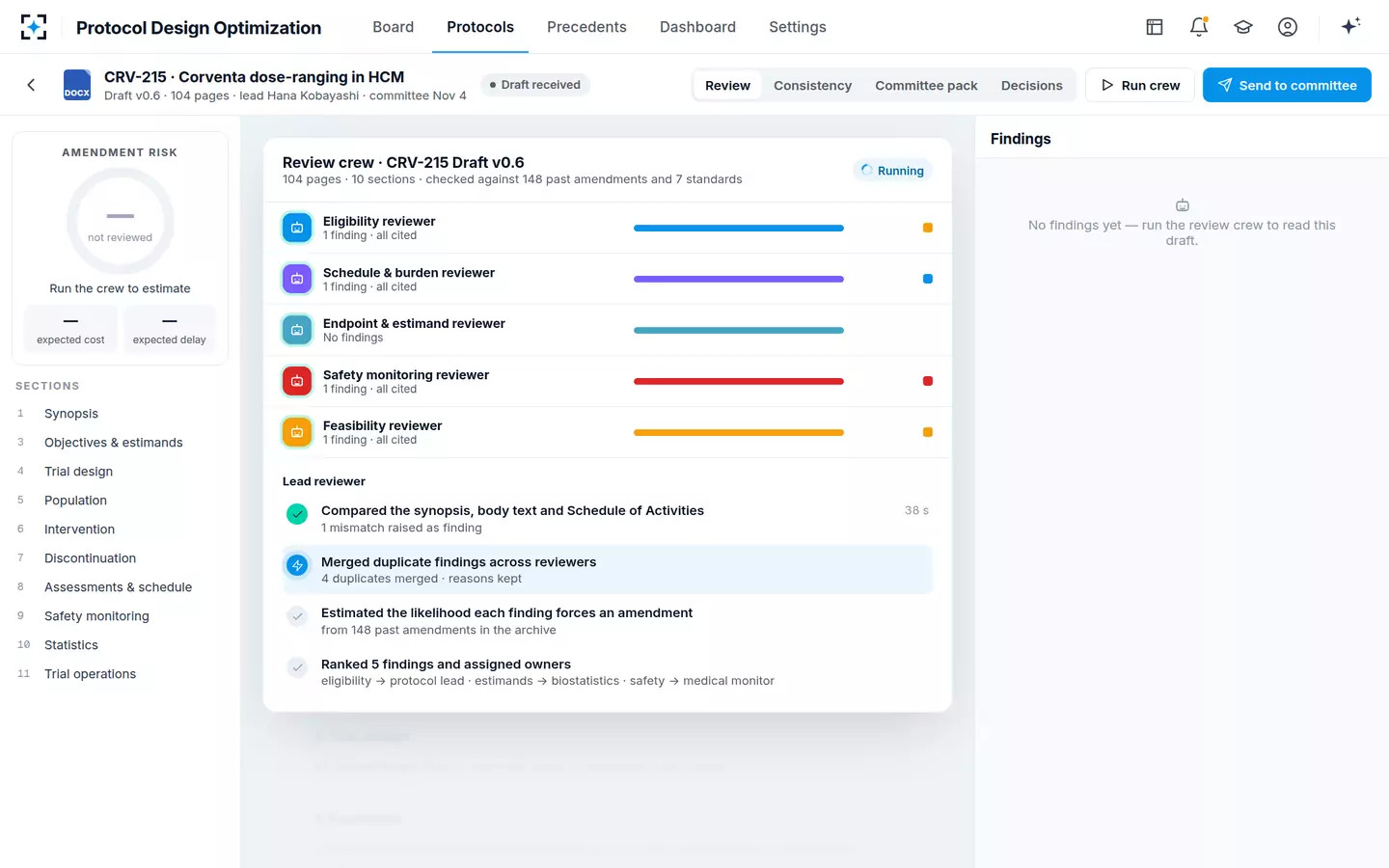
Five reviewer agentsRead the draft section by section against the sponsor's archive of past amendments, its design standards and ICH E6(R3), E8(R1) and E9(R1). Every finding cites a protocol line and at least one source.
Never: Never edits the controlled document, and never raises a finding without its line and its source.
Agent
Lead reviewerCompares the synopsis, the body text and the schedule of activities for every procedure and visit, merges duplicate findings, estimates each one's likelihood from the amendment archive, ranks them and assigns an owner by area.
Never: Ranks; never decides a finding and never signs.
A person decides
The owner of the areaAccepts, rejects with a written reason, or raises the finding to the committee. Statistical findings go to the biostatistician, safety findings to the medical monitor; a safety finding is never downgraded below medium.
A person decides
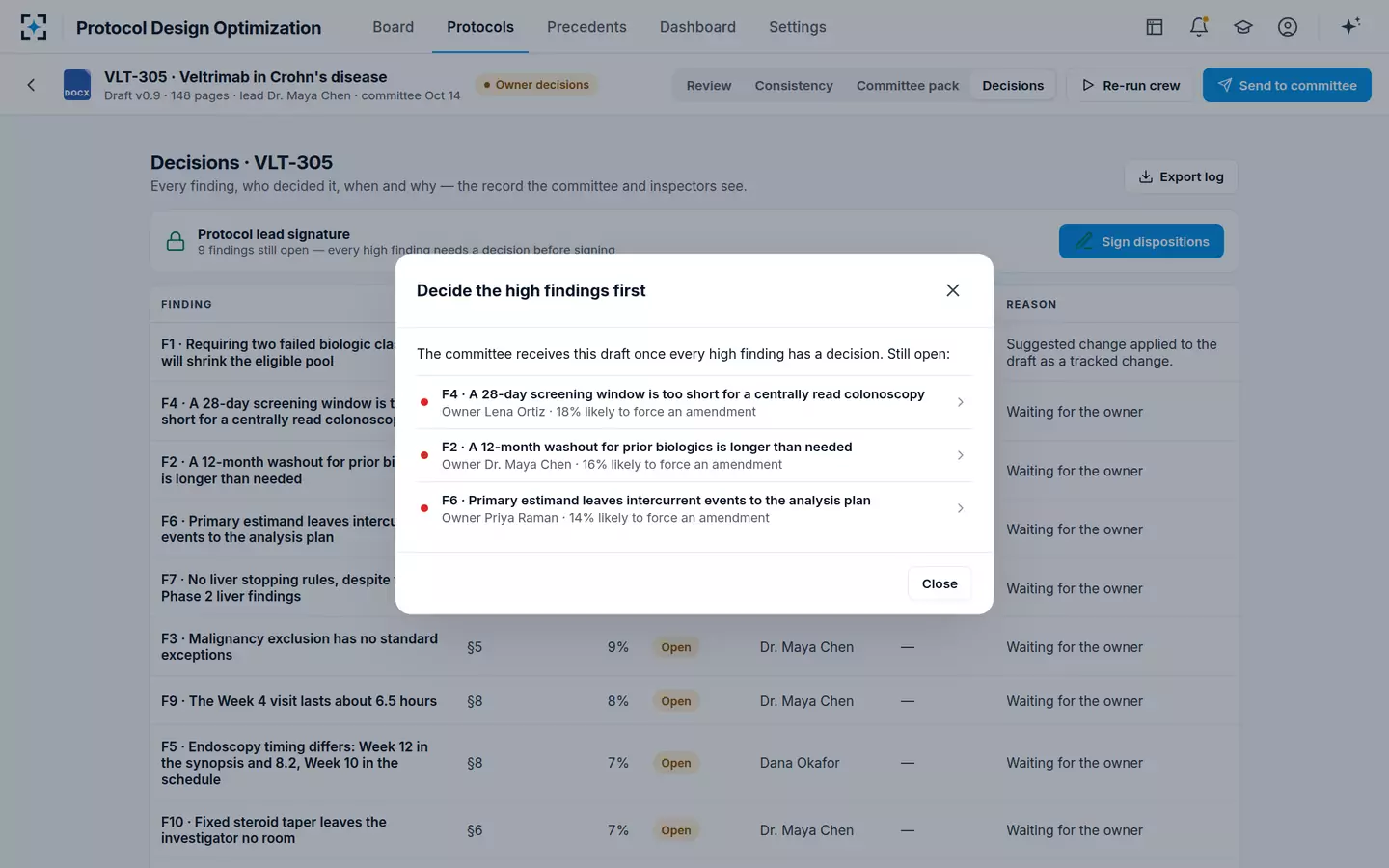
Protocol leadCannot send the draft while a high finding is open. Signs the disposition log with its stated meaning, name and time.
A person decides
Committee chairTakes the decision on the protocol itself, from a pack in which every statement links back to a finding and its sources.
Five reviewers on a new draft, and the lead reviewer that ranks but never decides
Who is responsible when an AI suggestion turns out wrong
The sponsor. The EMA says so in terms, and it is worth noticing that the duty covers every algorithm, model, dataset and pipeline the sponsor uses — not just the ones it built. Buying the tool does not move the duty, and a supplier's assurance is evidence the sponsor holds, not a transfer of responsibility.
That is less alarming than it sounds, provided the process is arranged so that no suggestion reaches the document without a person between it and the page. A wrong suggestion that an owner rejects, with the reason on the decision log, is a review working. A wrong suggestion applied silently is a quality event. The difference is entirely in the process design, which is why the questions worth asking a supplier are mostly about process rather than about models.
There is a quieter failure mode too: the finding that is never raised. A reviewer agent that silently drops anything below a likelihood threshold will produce a clean-looking review that has hidden its own gaps. The honest arrangement is a threshold that is a setting the sponsor controls, with everything below it visible on a watch list rather than discarded.
The draft that cannot be sent while a high finding is open
Does using AI on a protocol have to be disclosed to a regulator?
Neither document creates a general duty to disclose software a sponsor uses internally. But two passages point at circumstances where it becomes relevant, and both are worth reading before deciding the question is settled.
The EMA notes that where a use could be of high regulatory impact or high patient risk in a clinical trial, and the method has not been qualified for that context of use, the model architecture, development and validation logs, training data and a description of the data processing pipeline "would likely be considered parts of the clinical trial data or trial protocol dossier and thus may be requested for comprehensive assessment at the time of market authorisation, clinical trial application or GCP inspection." That is not disclosure in advance; it is production on request, which is harder to satisfy retroactively.
The FDA's position is the early-engagement one: if you are uncertain whether your use is in scope, ask. For a protocol review tool whose output is always a proposal to a named person, a sponsor may reasonably conclude no disclosure is required — and should record that reasoning in its own quality system. Recording the reasoning is the part that matters; an undocumented conclusion is indistinguishable from never having asked the question.
What to ask a vendor before AI touches a draft protocol
Six questions, and for each one the answer that should give you pause. These are written for the review case specifically; a drafting or a simulation tool needs a different list.
Six questions for a supplier, and the answers that should worry you
- Write the context of use in one sentence. What does the model do, and what happens to its output?
Worrying answer: a product description instead of a sentence. If the supplier cannot state the role and scope narrowly, you cannot assess the risk, and neither can your quality colleagues.
- Can it write into the protocol document?
Worrying answer: yes, or "it can, but you can turn that off". A controlled document edited by software makes every later authorship question harder, for no benefit over a tracked change applied by a person.
- What does every finding carry with it?
Worrying answer: a score, or a confidence percentage on its own. A finding should carry the protocol line it is about and at least one source a person can open and read — a past amendment, a standard, a guideline passage.
- What happens to a finding below the threshold?
Worrying answer: it is filtered out. Ask to see the watch list. A threshold is defensible; a silent one is not, because it hides the review's own gaps.
- Who can be the owner of a safety or statistical finding?
Worrying answer: whoever is reviewing. Routing should be a setting, and a safety finding should reach the medical monitor whatever else happens to it.
- What does the audit trail hold, and can an inspector follow it?
Worrying answer: model logs. What is needed is who decided each finding, when, why, which version of the draft it was against, and the signature with its stated meaning.
Underneath all six is a single test. ICH E6(R3) treats a well-designed protocol as the foundation for both protecting participants and producing reliable results (Principle 8.1). Any tool that touches that document should make the people responsible for it better informed and no less responsible. If a demonstration leaves you with a cleaner draft and less idea of who decided what, it has failed the test however impressive it looked.
To see the arrangement on a real draft — findings with their sources, owners who decide, a signature that will not come until the high findings have, see Protocol Design Optimization, or compare it with the other things sold under the same phrase in clinical trial design software, four approaches compared.
Questions people ask
Can AI design a clinical trial?
It can inform design decisions; it should not make them. The regulators' framing is about influence and consequence rather than capability: the more a model's output drives a decision that affects participants or the reliability of the results, the more evidence a sponsor will be asked to hold for it. A reviewer that proposes changes to a named person who decides sits at the low-influence end of that scale.
Does the FDA have guidance on AI in clinical trials?
Yes — a draft guidance issued in January 2025 on the use of AI to support regulatory decision-making for drug and biological products. It is non-binding, it does not endorse any specific AI approach, and it applies to models producing information to support decisions on safety, effectiveness or quality. It explicitly excludes drug discovery and operational-efficiency uses that do not affect patient safety, drug quality or the reliability of a study's results.
What is a context of use, and why does it matter to a buyer?
It is the specific role and scope of a model in addressing a particular question — in the guidance's words, the COU defines that role and scope. It matters because credibility is always assessed against a context of use, never in the abstract. A supplier who cannot write theirs in a sentence has not given you something you can take to your quality colleagues.
Who is responsible if an AI tool gets a protocol wrong?
The sponsor. The EMA reflection paper puts it on the clinical trial sponsor, applicant or manufacturer to ensure every algorithm, model, dataset and pipeline used is fit for purpose and in line with legal, ethical, technical, scientific and regulatory standards, and notes those requirements may be stricter than normal data-science practice. Buying the tool does not move the duty, which is why the process around it matters more than the model inside it.
Does an AI protocol review have to be disclosed to a regulator?
Neither the FDA draft guidance nor the EMA reflection paper creates a general disclosure duty for internal software. The EMA does say that for high patient risk or high regulatory impact uses not previously qualified, model architecture, development and validation logs and training data may be requested at a trial application, a marketing authorisation or a GCP inspection. The FDA asks sponsors who are unsure about scope to engage early. Record the reasoning either way.
Can an AI agent edit the protocol document itself?
It should not. The protocol is a controlled document, and its authorship and version history are part of the evidence an inspector reads. The workable arrangement is that an agent proposes a change with its source attached and a named owner applies it as a tracked change — which keeps the author human, the reason recorded, and the document the sponsor's own.