A protocol amendment in clinical research is a documented change to a study protocol that has already been submitted to a regulator and approved by an ethics committee — a new exclusion criterion, a visit moved by two weeks, a different primary endpoint, a stopping rule that should have been there. The writing is the easy part. The cost is that the change has to travel back through every approval the original protocol went through, in every country, and often back to the participants already enrolled. And most of it was foreseeable: the benchmark study of 836 protocols found 57% carried at least one substantial amendment, and judged 45% of those amendments avoidable. Botminds' Protocol Design Optimization reads each draft section by section against the sponsor's own archive of past amendments, its design standards and the ICH guidelines, and puts every finding beside the past amendment it resembles — what that one cost, how long it took, how many participants were asked to consent again — while the draft can still be changed.
The drafts, products, studies and people named here — VLT-305, Veltrimab, CRV-215, NWB-118, Dr. Maya Chen and her colleagues — are sample data on fictional studies, shown as the solution runs on them. Every research figure comes from a regulator, from ICH or from a peer-reviewed benchmark study, linked where it appears.
What the benchmark work says about amendments
57%
of protocols had at least one substantial amendment
Tufts CSDD, 836 phase I–IIB/IV protocols
45%
of those amendments were deemed avoidable
impact assessed on 136 randomly selected amendments
$535K
median direct cost to implement one Phase 3 substantial amendment
derived from 52 protocols; Phase 2 median $141,000
What a protocol amendment in clinical research is, in one paragraph
Under the IND rules, an amendment is the submission a sponsor makes when a protocol changes. The regulation names the trigger rather than the paperwork: an amendment is owed for any Phase 1 change that significantly affects subject safety, and any Phase 2 or 3 change that significantly affects safety, the scope of the investigation or the scientific quality of the study. Its own examples are an increase in dose or in exposure, a significant increase in the number of subjects, a significant change in design such as adding or dropping a control group, and adding a test that improves safety monitoring or dropping one that was there for safety.
Under the EU Clinical Trials Regulation the same change is called a modification, and the test is written as an impact: modifications are substantial when they are "likely to have a significant impact on: the safety or rights of the subjects and/or the reliability and robustness of the data generated in the clinical trial". Both frameworks leave the first judgement with the sponsor, and both make that judgement reviewable. Neither of them cares how many pages changed.
It is worth separating the amendment from the deviation at the outset, because teams use the words loosely and the consequences differ: an amendment changes the document before the conduct, a deviation is conduct that departed from the document. Our sibling guide on a protocol amendment against a protocol deviation works through that distinction and its reporting duties in full.
Which protocol sections are amended most often?
The regulators answer this question indirectly, by listing what they will treat as substantial. Annex IV of the EU Questions & Answers classifies changes to an ongoing trial, and its row for amendments to the trial protocol is a numbered list of the places design goes wrong. It names a change of primary or secondary endpoint; a new mode of measurement for the primary endpoint; a change in the definition of the end of the trial; a change in trial design such as removing an arm or adding an open-label extension that was not in the authorised protocol; a change of inclusion or exclusion criteria likely to have a significant impact on participants' rights and safety or on the scientific value of the trial, for example by changing the overall participant population; a reduction in the number of scheduled visits, including replacing a physical visit with a remote one; introducing or changing a diagnostic or monitoring procedure likely to affect safety, participant burden or scientific value, including increasing the number or volume of biological samples; adding, removing or withdrawing an independent safety or data monitoring board; a change of treatment modality including stopping rules; and any change in the absolute number of subjects not already specified in the authorised protocol.
Read that list as a protocol lead rather than as a regulatory affairs manager, and it collapses into five sections: the objectives and endpoints, the population, the schedule of assessments, the safety monitoring plan, and the statistical analysis. Those are the sections a sponsor's own archive of past amendments will also name — and they are the sections a draft review has time to get right, if the review happens before the document is authorised rather than after.
Substantial, non-substantial, administrative: the three words that decide the work
The classification decides everything downstream: whether a change waits for an assessment, whether an ethics committee sees it again, whether sites have to be retrained, whether participants are asked to consent again. The EU Regulation gives three classes, and the Q&A is explicit that the first call is the sponsor's: the sponsor assesses, case by case, whether a modification counts as substantial, and is told to ask the national contact point when in doubt. It is just as explicit about the consequence of getting it wrong — incorrect use of the non-substantial route can lead to corrective measures by a Member State, and a non-substantial change submitted alongside a substantial one is never assessed or approved, whatever the sponsor hoped.
The three classes of change under the EU Regulation, and the wording that decides each
Substantial modificationArt 2(2)(13)
The test
Likely to have a significant impact on the safety or rights of the subjects, or on the reliability and robustness of the data.
What it costs you
An application, assessed by the reporting Member State and every Member State concerned, with one decision each: authorised, authorised subject to conditions, or refused.
The Q&A's own examples
A change of inclusion or exclusion criteria likely to change the overall participant population. A change of primary or secondary endpoint. A new mode of measurement for the primary endpoint. Any increase or decrease in the number of participants not already in the authorised protocol.
Non-substantial, relevant to supervisionArt 81(9)
The test
Not substantial, but information the Member States need to oversee the trial. It cannot be used if the change triggers another that would need an application.
What it costs you
The information is kept permanently updated in the EU database — a notification, not an assessment.
The Q&A's own examples
A significant increase in the overall duration of the trial, provided exposure to the investigational product is not extended, the definition of the end of the trial is unchanged and the scheduled visit arrangements are unchanged.
Non-substantialoutside both
The test
No substantial impact on safety, rights, reliability or robustness, and not needed for oversight.
What it costs you
Not notified on its own. Listed and identified in the cover letter of the next substantial modification, with the documents attached then.
The Q&A's own examples
Correction of typographical errors and minor clarifications to the protocol. Adding or deleting an exploratory or tertiary endpoint recorded in the trial master file with no significant effect on conduct. An increase of under 10% in the duration of the trial.
One line in that table repays a second reading. A significant increase in the overall duration of a trial can be handled as a notification rather than an application — but only while three conditions hold: exposure to the investigational product is not extended, the definition of the end of the trial is unchanged, and the scheduled visit arrangements are unchanged. Break any one of them and the Q&A says the change "would be considered to be a substantial modification". That is the shape of most change-control arguments in practice: the class is not a property of the change, it is a property of the change plus everything else in the protocol.
How many protocols are amended, and how many amendments were avoidable
Two benchmark studies from the same research centre give the range. The 2016 study, across 836 phase I–IIB/IV protocols, put prevalence at 57% and found Phase 2 and Phase 3 protocols carrying a mean of 2.2 and 2.3 global amendments. The 2024 study, on 950 protocols and 2,188 amendments contributed by sixteen companies, split the figure by therapy area and found it far higher in both: "Compared to non-oncology, oncology protocols had a significantly higher prevalence (72.1% and 91.1%, respectively) and number (3.0 and 4.0, respectively) of protocol amendments."
Share of protocols carrying at least one amendment, in two benchmark datasets
The avoidability figure is the one that should decide where a sponsor spends its review effort. In the 2016 study, nearly half of substantial amendments were judged avoidable — not wrong in hindsight, but preventable at the time with information the sponsor already had. Eight years of industry attention separate the two studies, and the measured prevalence in the later one is higher, not lower — though they are different samples and the second is weighted towards oncology, so the comparison is suggestive rather than a trend. The guide on what a protocol amendment costs follows the money and the months behind those counts.
Do you really have to wait 30 days? What 21 CFR 312.30 actually says
No, and the thirty days people are thinking of belong to a different rule. The 30-day wait is in the IND rules at 21 CFR 312.40(b), which says an IND goes into effect "thirty days after FDA receives the IND, unless FDA notifies the sponsor that the investigations described in the IND are subject to a clinical hold", or earlier if FDA says so. That is the initial application, not a change to a protocol inside an IND already in effect.
For a protocol change, the regulation sets two conditions and no waiting period. The change may be made once the sponsor has submitted it to FDA for review and the IRB with responsibility for the study has approved it — and the regulation says, twice, that the order of the two does not matter. A sponsor that has filed the amendment and holds the IRB approval does not have to count days. What it does have to do is get the identification and content right: the submission must be prominently identified as a protocol amendment of the right kind, and a change in protocol must be accompanied by a brief description of the change and a reference, by date and number, to the submission that contained the protocol it changes.
The same protocol change, under the IND rules and under the EU Regulation
United States · 21 CFR 312.30: In Phase 1, a change with a significant effect on subject safety; in Phase 2 or 3, a significant effect on safety, on the scope of the study or on its scientific quality.
European Union · Regulation 536/2014: A modification "likely to have a significant impact on" subjects' safety or rights, or on the reliability and robustness of the data.
United States · 21 CFR 312.30: The sponsor, against the regulation's own examples; FDA reviews the amendment it receives.
European Union · Regulation 536/2014: The sponsor, case by case. "In case of doubt, sponsors are encouraged to contact the national contact point."
United States · 21 CFR 312.30: Once submitted to FDA for review and approved by the reviewing IRB, in whichever order. No waiting period for the change itself.
European Union · Regulation 536/2014: On authorisation of the substantial-modification application by each Member State concerned; a single decision per application in each.
United States · 21 CFR 312.30: A change to eliminate an apparent immediate hazard may be implemented at once, with FDA notified afterwards by amendment and the IRB notified under § 56.104(c).
European Union · Regulation 536/2014: Urgent safety measures to protect participants are taken first and notified to the Member States afterwards (Article 54 of the Regulation).
United States · 21 CFR 312.30: Prominent identification as a protocol amendment, plus a brief description of the change and the date and number of the submission that contained the protocol.
European Union · Regulation 536/2014: A description of the type of change "with a justification" — the Q&A's own example is a new exclusion criterion added because of a potential liver toxicity described in the investigator's brochure.
United States · 21 CFR 312.30: One agency, plus every reviewing IRB for the affected sites.
European Union · Regulation 536/2014: One application, assessed by the reporting Member State for Part I and by each Member State concerned for Part II — and the Q&A notes different Member States can reach different Part I decisions.
The one change you may implement immediately
There is exactly one exception written into the IND rules, and it is narrow on purpose: a change meant to remove an apparent immediate hazard to subjects can go in at once, as long as FDA then receives a protocol amendment and the reviewing IRB is told under § 56.104(c). Three conditions, all of them load-bearing. The hazard must be apparent and immediate, not probable and eventual. The change must be intended to eliminate it, not to tidy up around it. And the notifications still happen, after the fact rather than instead.
In practice this is the route a medical monitor takes at midnight after a second unexpected liver signal, when the next dose is due before any committee could sit. It is not the route for a criterion that is slowing enrolment, and it is not a shortcut for a change the team failed to make in time. A sponsor that finds itself using the immediate-hazard provision for anything other than an immediate hazard has a governance problem, not a regulatory one.
Where the avoidable amendments come from: six design choices
On the sample drafts inside the solution, the avoidable findings cluster in six places, and they are the same six on every draft: an inclusion criterion stricter than the target label requires; a washout longer than the standard of care supports; a screening window too short for a centrally read procedure to be scheduled and returned; an estimand that leaves intercurrent events to the statistical analysis plan; a product with earlier liver findings and no stopping or interruption rules; and a schedule of activities that disagrees with the synopsis about when a co-primary assessment happens. None of the six is a mistake of knowledge. Each is a choice made by one function, under time pressure, without the one piece of evidence that would have settled it — what happened the last time this sponsor made the same choice.
What Protocol Design Optimization puts beside a finding: the amendment it resembles
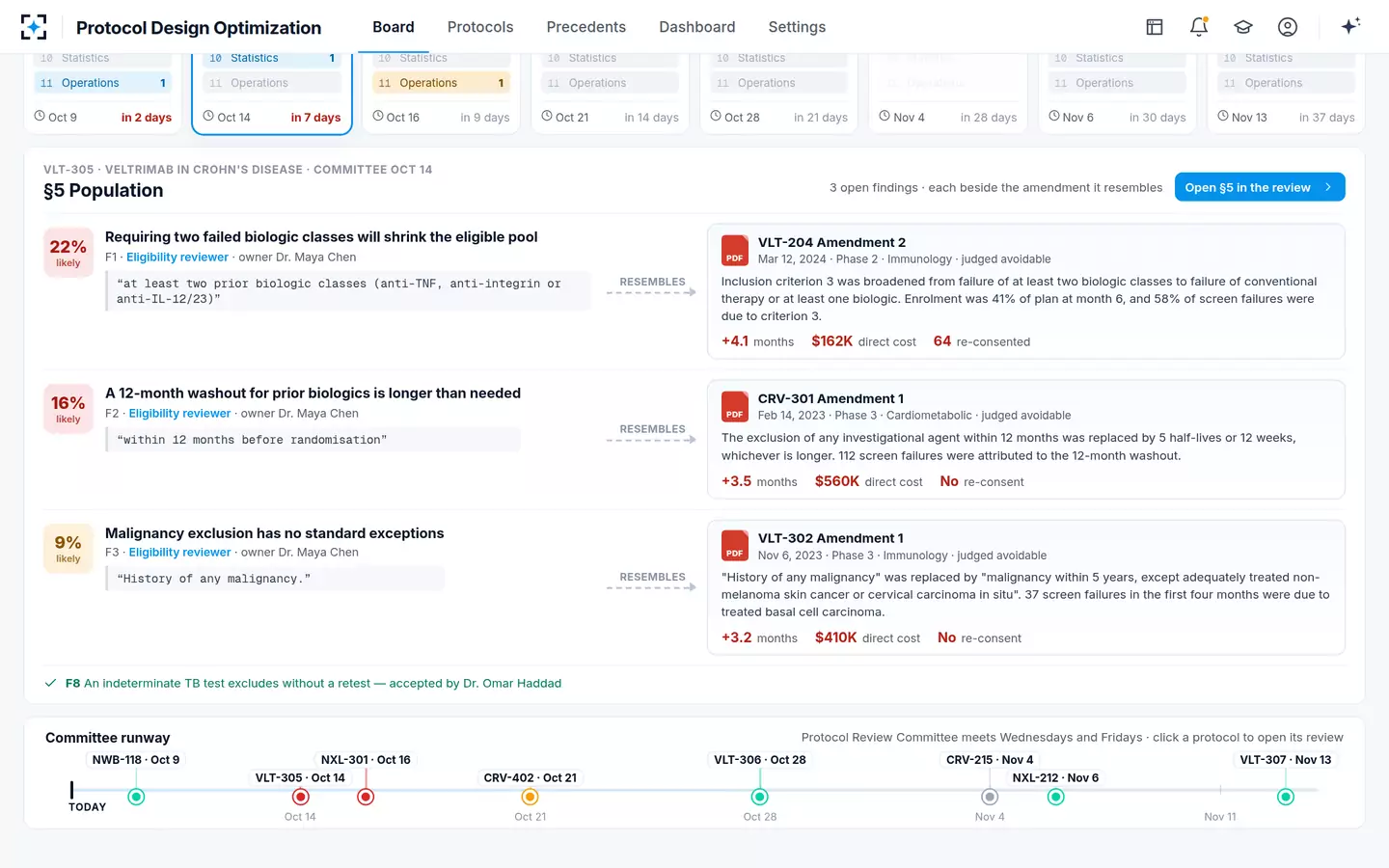
The panel's value is not the percentage. It is the second column. A reviewer arguing against inclusion criterion 3 on judgement is one voice among six; a reviewer who can show the amendment the same criterion caused two studies ago, with the months and the cost on it, is arguing from the sponsor's own record. The guide on what a summary of changes archive tells you sets out how that record is classified so it can be read this way, and the criteria behind a screen failure rate takes the eligibility half of it criterion by criterion.
Why the same amendments return across a sponsor's trials
Because the evidence that would prevent them is filed, not read. A summary of changes is written once, for a regulator, and then goes to the trial master file. The person who will make the same choice on the next protocol is in a different therapy area, eighteen months later, and has no reason to open another study's archive — and no index that would tell them which of the hundreds of past amendments touched the criterion they are about to write. The lesson exists; it exists as a document nobody is looking for.
A review cycle makes this worse rather than better, because it is organised by function and not by section. Six functions comment in parallel, each on what it knows, and the protocol lead reconciles the comments by hand against the synopsis and the schedule. Nothing in that cycle is responsible for the question "has this sponsor already paid for this design choice?" — which is why the published root causes of avoidable amendments are about people and timing rather than about expertise, as who reads a draft protocol, and what each one looks for sets out.
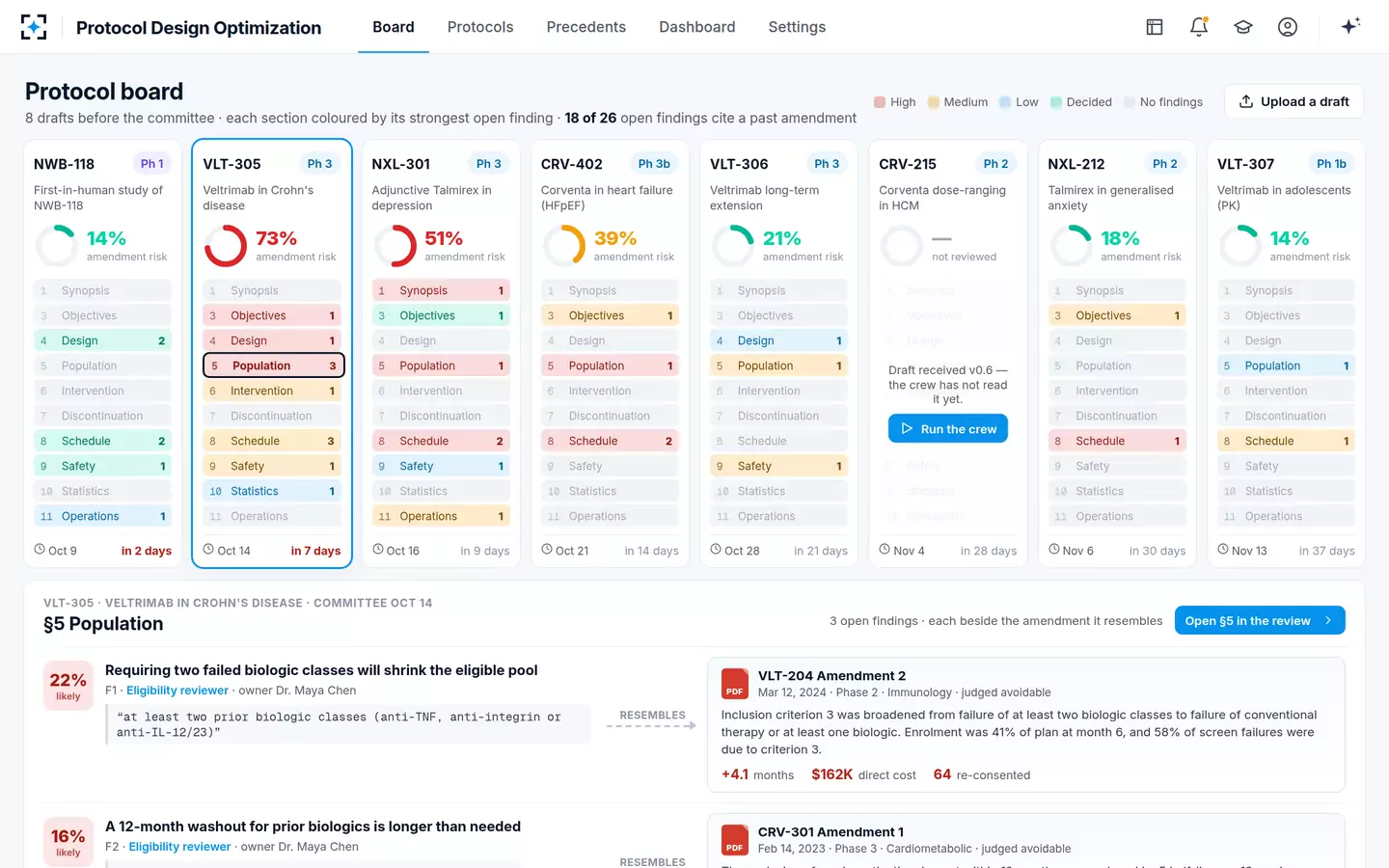
Eight drafts before the committee, as Protocol Design Optimization shows them
What quality by design is meant to do about it
ICH E8(R1) put the idea into guidance in 2021, and it is the clearest statement of why design review earns its place in the schedule rather than taking from it.
Successful application of the quality by design principles may minimise the need for modifications to the protocol and make adherence throughout the study more likely.
ICH E8(R1), General Considerations for Clinical Studies, §6.1.1 (adopted 6 October 2021)
E8(R1) asks a study team to identify the factors that are critical to the quality of a particular study and to design around those, rather than to spread review effort evenly across a document. ICH E6(R3), adopted in January 2025, adds the design move that follows from it: writing acceptable ranges into specific provisions builds adaptability into a protocol, and can cut deviations or, in some cases, remove the need for an amendment. A visit window written as a range is not sloppiness; it is a decision not to spend an amendment on arithmetic.
Neither guideline tells a sponsor how to know which of its own provisions will need adapting. That is the gap the archive fills. The solution's reviewers read a draft against the sponsor's past amendments, its own design standards and E6(R3), E8(R1) and E9(R1) together, raise a finding above a likelihood threshold the sponsor sets, route each one to the person who owns that area, and hold the draft back from the committee while a high finding is still undecided — then build the committee pack out of the decisions. To see it on a draft of your own, start from Protocol Design Optimization.
Questions people ask
What makes an amendment substantial rather than administrative?
Impact, not size. Under the EU Regulation a modification is substantial when it is likely to have a significant impact on subjects' safety or rights, or on the reliability and robustness of the data; a change that affects neither, and that Member States do not need for oversight, is non-substantial and is simply listed in the cover letter of the next substantial-modification application. Under the IND rules the equivalent trigger is a change that significantly affects subject safety, the scope of the investigation or the scientific quality of the study. Correcting a typographical error is administrative in both.
Can a protocol change be made immediately if a participant is at risk?
Yes, in the narrow case the regulation names: a change aimed at removing an apparent immediate hazard to participants can be made at once, with FDA told afterwards by protocol amendment and the reviewing IRB told under 21 CFR 56.104(c). The hazard has to be apparent and immediate and the change has to be aimed at removing it; the notifications are deferred, not waived.
Does an amendment always need ethics committee approval again?
A substantial change does. Under the IND rules a protocol change may only be implemented once the reviewing IRB has approved it, in either order with the FDA submission. In the EU, an application for a substantial modification is assessed by the reporting Member State for Part I and by each Member State concerned for Part II, which is where the ethics assessment sits. A change that is genuinely non-substantial does not go through that assessment — but the sponsor carries the risk of having classified it.
Does every country have to approve the same amendment?
In the EU it is one application with one decision per Member State concerned, and the Q&A is explicit that different Member States can reach different decisions on a Part I modification. Outside that system each regulator and each ethics committee runs its own clock, which is why a global amendment's cost is dominated by the slowest approval rather than the average one.
Why do the same amendments keep coming back across a sponsor's trials?
Because the record of the last one is a document in a trial master file rather than an input to the next draft. Nearly half of substantial amendments in the 2016 benchmark study were judged avoidable, and the avoidable ones cluster in a short list of design choices — eligibility, washouts, windows, schedule, estimands, safety monitoring. A sponsor that classifies its past summaries of changes by area, avoidability, cost and delay can put the relevant one in front of the person writing the new criterion; one that does not relies on who happens to remember.
Is an amendment the same thing as a protocol deviation?
No. An amendment changes the protocol prospectively, through an approval route; a deviation is conduct that did not follow the protocol as approved, and it is handled through reporting and corrective action. The two are related in one direction: ICH E6(R3) notes that building acceptable ranges into protocol provisions can reduce the number of deviations, and in some cases remove the need for an amendment at all.