Estimands and intercurrent events belong in the same sentence: an estimand is a precise statement of the treatment effect a trial is trying to measure, intercurrent events are what happens to participants after treatment starts that can change that measurement, and ICH E9(R1) asks for the primary estimand — with a strategy for each event — in the protocol rather than in the statistical analysis plan. The reason is practical rather than bureaucratic: the choice you make about each intercurrent event — a participant stopping treatment, starting a rescue medicine, dying — decides which population is targeted, how long people are followed, what the case report form has to capture after someone stops the drug, and how many participants you need. A draft that says the strategies "will be handled as described in the statistical analysis plan" has left the trial's question open, and closing it later usually costs an amendment. Botminds' Protocol Design Optimization reads section 3 of every draft against ICH E9(R1), flags any intercurrent event without a stated strategy, and sends the finding to the biostatistician who owns it.
The screens and study figures on this page are sample data from the solution, on fictional studies and people. This guide is about the framework and what the protocol owes it; for how objectives, endpoints and estimands are drafted to agree with one another in the first place, see the companion guide on objectives, endpoints and estimands.
The framework, in three numbers
2019
ICH E9(R1), the addendum that introduced the estimand framework, adopted 20 November
5strategies
named in §A.3.2 for addressing an intercurrent event, and a protocol may use different ones for different events
5attributes
described in §A.3.3 — treatment, population, variable, how any remaining intercurrent events are handled, and a population-level summary
What an estimand is, in the guideline's own words
ICH E9(R1) defines an estimand as a precise description of the treatment effect that answers the clinical question behind one trial objective (§A.3). The word doing the work is precise. An objective — to demonstrate the superiority of the drug over placebo in disease remission at Week 12 — is a sentence of intent that a dozen different trials could claim. The estimand turns it into a question with exactly one answer, by saying which patients, which measurement, which treatments compared, how the comparison is summarised, and what happens to a participant who stops taking the drug in Week 5.
That last clause is where the framework earns its keep. Before the addendum, the convention was to name a population — full analysis set, per-protocol set — and leave the rest to the analysis. Two trials could share an objective, an endpoint and a population label, and estimate different things. The addendum's contribution was to make the difference visible by naming it, and to move the naming forward into the document that gets approved by ethics committees and agencies.
What intercurrent events are, and the examples that actually come up
"Intercurrent events are events occurring after treatment initiation that affect either the interpretation or the existence of the measurements associated with the clinical question of interest" (ICH E9(R1) §A.3.1). Two participants can be given the same drug and record the same score, but if one of them also took a steroid course in between, the two scores do not mean the same thing.
In practice the list is short and repeats across therapy areas: discontinuation of the assigned treatment, use of an additional or alternative therapy, switching between the treatments being compared, change to background medicine, and terminal events such as death when they are not part of the variable itself. The guideline adds that an event can be defined more finely than its name — discontinuation due to toxicity and discontinuation due to lack of efficacy can take different strategies, and if they do, the reason has to be defined in advance and recorded accurately during the trial.
One distinction saves a lot of argument later. Withdrawal of consent is not an intercurrent event; neither is administrative censoring, nor any other reason data went missing. The guideline is explicit that "neither study withdrawal nor other reasons for missing data are in themselves intercurrent events", though someone who withdraws may well have experienced one first. Missing data is a problem for the estimator. An intercurrent event is a feature of the question.
What the protocol must state, and what the analysis plan may carry
The division is set out in §A.6, and it is cleaner than most drafts treat it. "A trial protocol should define and specify explicitly a primary estimand that corresponds to the primary trial objective." Estimands for secondary objectives likely to support regulatory decisions are to be defined and specified explicitly as well. The main estimator aligned with the primary estimand, the primary analysis and a suitable sensitivity analysis are pre-specified jointly, in the protocol and in the analysis plan.
So the protocol owes the question, and the analysis plan owes the method of answering it. The guideline also gives back something writers often do not realise they have: "while it is to the benefit of the sponsor to have clarity on what is being estimated, it is not a regulatory requirement to document an estimand for each exploratory objective." A draft does not need twenty estimand tables. It needs one that is right, and the key secondary ones.
The same trial, written two ways
The estimand stated in section 3: Sites know which measurements are still wanted after a participant stops the drug, and the case report form has somewhere to put them.
Deferred to the statistical analysis plan: Post-discontinuation collection is settled late, unevenly across sites, and some of it is never collected at all.
The estimand stated in section 3: Calculated for the effect the estimand describes, with the impact of the chosen strategies inside the effect size and the variance.
Deferred to the statistical analysis plan: Calculated for an effect nobody has defined, usually by borrowing an effect size from a trial whose estimand was different.
The estimand stated in section 3: Written to fit the target population and the medicines the strategy implies are allowed or prohibited.
Deferred to the statistical analysis plan: Written first. The estimand is later bent to fit criteria that were chosen for other reasons.
The estimand stated in section 3: The question the trial answers can be read off one page of the protocol.
Deferred to the statistical analysis plan: The question has to be reconstructed, and the agency asks for it in the protocol — after first participant in.
The estimand stated in section 3: The change is visible, argued, and carried by a protocol amendment with a stated reason.
Deferred to the statistical analysis plan: The change can happen inside an analysis-plan revision, with nothing in the controlled document to show that it did.
The five strategies for intercurrent events, and what each asks you to collect
Section A.3.2 names five strategies, and the choice between them is a clinical conversation with an operational bill attached. The guideline is clear that a protocol need not pick one for everything: different events can, and often will, take different strategies. A single trial may use a composite strategy for stopping because of toxicity, a treatment policy strategy for a change in background medicine, and a while-on-treatment strategy for a symptom score.
The table below is deliberately not a definitions list. What separates these five in a protocol is not what they mean but what each one obliges the study to do for the next two years.
Five strategies, and the bill each one sends to the protocol
Treatment policy
An event it suitsA participant starts rescue medication at Week 6.
The question it producesWhat happens when this treatment is prescribed, whatever the participant then does.
What it asks the protocol to arrangeThe heaviest data obligation of the five. The variable must still be measured after the event, for everyone, to the end of the planned follow-up — so the protocol has to keep people in the study after they stop the drug, and the schedule and consent must say so. The guideline notes this strategy cannot be used for terminal events, because the measurement no longer exists.
Hypothetical
An event it suitsA participant takes an additional therapy that would not be available outside the trial.
The question it producesWhat would have happened in a stated scenario in which the event did not occur.
What it asks the protocol to arrangeLittle extra collection, and a large writing obligation: the scenario has to be named precisely. The guideline warns that a loosely worded scenario about a patient not taking extra medication leaves a reader unsure whether the medicine was unavailable or simply not needed.
Composite variable
An event it suitsA participant stops the drug because of toxicity.
The question it producesWhat happens when the treatment has to work and be tolerated at the same time.
What it asks the protocol to arrangeRequires the event itself to be captured cleanly enough to become part of the outcome — the reason for stopping, its date, and its grading — which is a case-report-form decision, not an analysis one. It is the usual answer for death, which the guideline calls the most salient example of the need for this strategy.
While on treatment
An event it suitsA participant with a terminal illness stops a symptomatic treatment.
The question it producesWhat the treatment does for as long as it is taken.
What it asks the protocol to arrangeNeeds repeated measurement with reliable timing, because the analysis uses the values up to the event rather than a value at a fixed week. Particular care is required when the event occurs more often on one arm than the other.
Principal stratum
An event it suitsA toxicity prevents some participants from continuing the test treatment.
The question it producesWhat happens in the subgroup defined by whether the event would occur.
What it asks the protocol to arrangeNeeds whatever predicts membership of the stratum to be measured at baseline, because the stratum is defined by a potential event, not an observed one. The guideline is explicit that this is not the same as analysing the people who actually experienced the event.
Read the last column down and a pattern appears: the strategy that sounds least demanding to a reader of section 3 is often the most demanding to the person writing section 8. Treatment policy is the easiest to defend and the hardest to run, because it asks sites to keep measuring people who have stopped the drug — which means the consent, the schedule and the retention plan all have to be built for it from the start, not patched afterwards.
Estimand, estimator, estimate: the three words people swap
The glossary settles this in three lines, and it is worth having them straight before a meeting rather than during one. The estimand is the question: a precise description of the treatment effect reflecting the clinical question posed by the trial objective. The estimator is the method: "a method of analysis to compute an estimate of the estimand using clinical trial data." The estimate is the number that comes out: "a numerical value computed by an estimator."
The order matters because it is the order the work has to be done in, and reversing it is exactly the failure the framework was written to prevent. Choosing a familiar analysis first and then describing whatever it happens to estimate is how a trial ends up with a defensible method answering a question nobody set out to ask. A 2022 paper on industry's first two years with the framework, in Therapeutic Innovation & Regulatory Science, makes the point from the other side: "whilst much of the focus of implementing ICH E9(R1) to date has been on defining estimands, we highlight some of the important aspects relating to the choice of statistical analysis methods and sensitivity analyses to ensure estimands can be estimated robustly with minimal bias" (Ther Innov Regul Sci, July 2022). Defining the question well is necessary; it is not sufficient.
ICH E9(R1) builds the same caution into the protocol stage: "it should be agreed that reliable estimation is possible before the choice of estimand is finalised." An estimand that cannot be estimated from the data the protocol will produce is a drafting error, not a statistical one, and it is cheapest to find before the committee meets.
Is intention-to-treat an estimand? Why the question is badly posed
Intention-to-treat is a principle about analysis populations, not a description of a treatment effect, so on its own it does not answer the question an estimand answers. What it corresponds to is narrower and more useful to know: where the treatment policy strategy is applied to whether a participant continues treatment and to changes in other treatments, the guideline says the intercurrent event "is considered to be part of the treatments being compared", and that this "reflects the comparison described in the ICH E9 Glossary (under ITT Principle) as the effect of a treatment policy."
So intention-to-treat sits inside the framework as one strategy applied to some events, not as a substitute for stating the estimand. Writing "the analysis will follow the intention-to-treat principle" in section 3 tells a reader how participants will be grouped. It does not tell them what happens to the measurement after someone starts a rescue medicine, which is the thing that changes the answer.
The practical test: can you say, for each named intercurrent event, which of the five strategies applies? If the answer is "intention-to-treat", the section is not finished.
What the estimand does to your sample size
"A precise description of the treatment effects of interest should inform sample size calculations" (ICH E9(R1) §A.4). This is not a formality. The effect size a trial powers for depends on how the strategies handle the events, because the strategies change what is being averaged. A treatment policy estimand includes the outcomes of participants who stopped the drug and took something else, which usually shrinks the observed difference between arms; a while-on-treatment estimand excludes the period after the event, which usually does not.
Two traps follow from that. The first is borrowing an effect size from an earlier trial without checking which estimand produced it — the guideline warns that particular care is needed with historical studies that "implicitly or explicitly, have reported estimated treatment effects or variability based on a different estimand". A 30% response rate from a trial that analysed completers is not a 30% response rate for a treatment policy estimand in your trial.
The second runs the other way, and saves participants. Where all participants contribute information to the analysis, and the impact of the strategies is already inside the targeted effect size and expected variance, the guideline says "it is not usually necessary to additionally inflate the calculated sample size by the expected proportion of subject withdrawals from the trial." Teams that both power for a treatment policy estimand and add a dropout inflation factor are paying for the same adjustment twice, in people.
The estimand also reaches into the design directly. Section A.4 says the choices it informs include "determining the inclusion and exclusion criteria that identify the target population, the treatments, including the medications that are allowed and those that are prohibited in the protocol, and other aspects of patient management and data collection." That is sections 5, 6 and 8 of the protocol, written by three different people, all downstream of a decision made in section 3.
From the objective to the primary estimand, and the protocol section each decision lands in
A person decides
Clinical scientistStates the objective in section 3.1 — the clinical question in one sentence, before any attribute is fixed.
A person decides
Clinical scientist with the biostatisticianFixes the population, the treatments compared, the variable and the week it is measured. Lands in section 3.2, constrains the eligibility criteria in section 5 and the permitted and prohibited medicines in section 6, and must match the schedule of activities exactly.
A person decides
Clinical scientist, biostatistician and medical monitorNames each intercurrent event and chooses a strategy for it. Lands in section 3.2, and decides what section 8 must collect after a participant stops treatment.
A person decides
BiostatisticianChooses the population-level summary and checks the effect can be reliably estimated. Lands in section 3.3, and sets the sample size in section 10.
Agent
Endpoint and estimand reviewerReads the finished section back against ICH E9(R1) and the sponsor's design standard, and flags any intercurrent event with no stated strategy and any assumption with no benchmark behind it.
Never: Never sets the sample size, changes the analysis, or decides a statistical question — the finding goes to the biostatistician who owns the area.
What it costs to change the estimand after the trial starts
Changes to the estimand during the trial can be problematic and can reduce the credibility of the trial.
ICH E9(R1), Addendum on Estimands and Sensitivity Analysis, §A.6, adopted 20 November 2019
Credibility is the word to notice. The guideline is not saying the change is forbidden; it is saying that a trial which redefines its own question while the data are arriving will be read differently afterwards, however good the reason. And because the estimand belongs to the protocol, the mechanism is explicit: "a change to the estimand should usually be reflected through amendment to the protocol."
That is the full bill for a deferred decision. A substantial amendment goes back to every ethics committee and every competent authority involved, re-consent is considered, sites may pause, and the change itself stays on the record as something the sponsor got wrong first time. On the sample study on this page, the sibling protocol that deferred its strategies the same way had the agency ask for them after first participant in; the amendment that followed took four months and about $610,000 in direct cost. The decision it corrected would have taken an afternoon with the statistician in the room.
The guideline also leaves room for the honest case. Where an intercurrent event genuinely was not foreseen at the design stage and appears during conduct, the discussion should cover "not only the choices made for the analysis, but the effect on the estimand" and on the interpretation of the results. Unforeseen is a defensible position. Unaddressed is not.
The finding, the protocol line it is about, and the owner it goes to
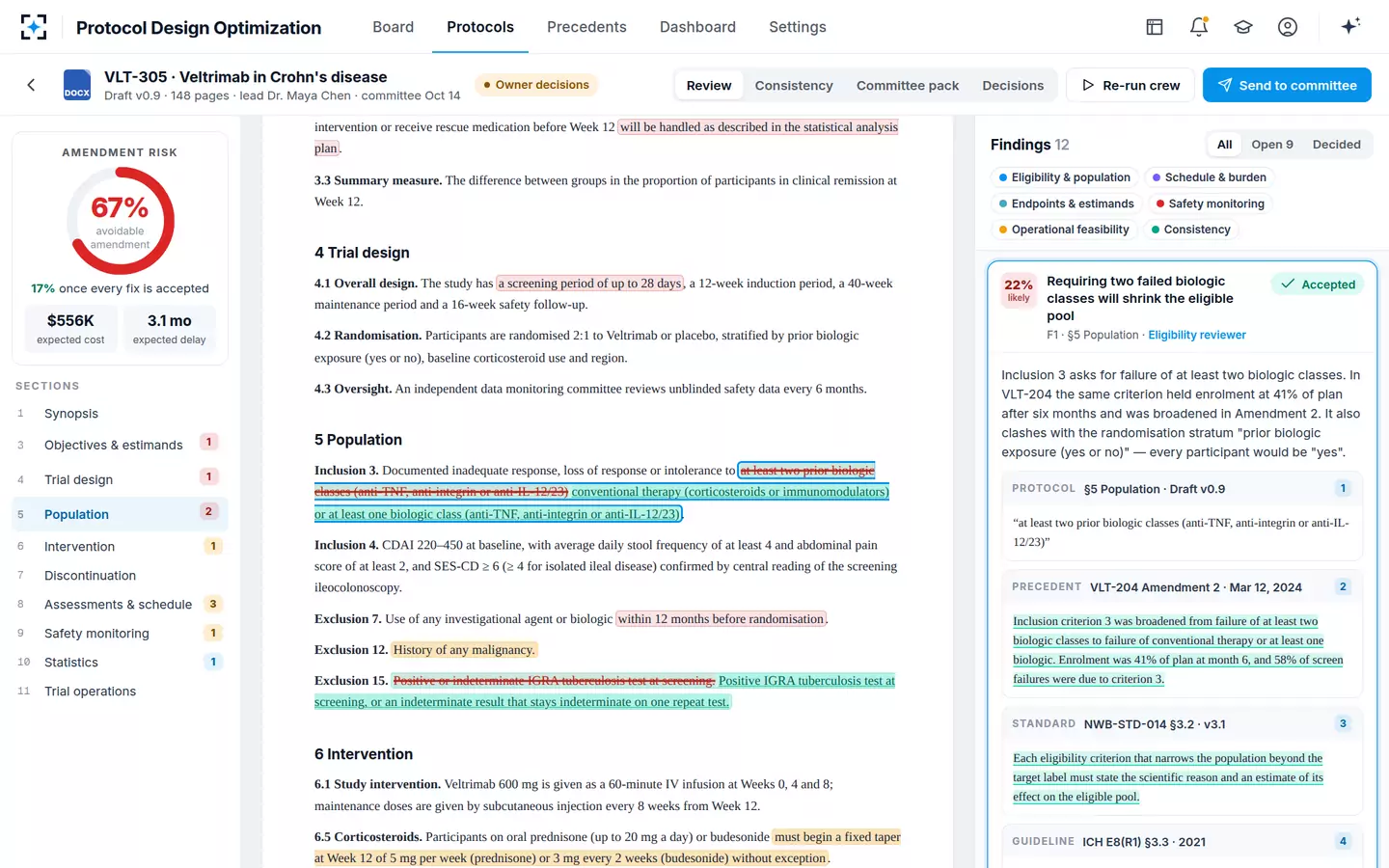
Writing the estimand with the statistician, section by section
The framework is usually introduced as a statistical topic, which is why so many drafts arrive with section 3 half-written and a note promising the rest. In practice the clinical scientist owns most of the content and the statistician owns the feasibility of estimating it, and the two have to be in the room at the same time — once, and early.
A workable sequence: write the objective in one sentence; list every intercurrent event that could plausibly occur in this population on this drug, using the earlier studies and the investigator brochure rather than imagination; for each event, agree the strategy and write the sentence; then let the statistician say what each choice does to the sample size and to the data that must be collected after the event. Finish by reading section 5, section 6 and the schedule of activities back against the decisions, because that is where the strategy either lands or quietly fails to.
The guideline asks for this at "the initial stages of planning any clinical trial", which in most sponsors is earlier than the first full draft. Leaving it to the review cycle means the people who can change the design have already moved on to the next study. ICH E6(R3) points the same way from the quality side, directing readers of its protocol appendix to ICH E8(R1), ICH E9 and ICH E9(R1) together rather than separately (ICH E6(R3), Appendix B).
Six questions to answer before section 3 is called finished
- What exactly is being compared?
Name the treatment conditions, including whether a background therapy is part of the treatment or an intercurrent event in its own right. The answer changes section 6.
- Which patients is the question about?
The whole randomised population, a subgroup defined at baseline, or a principal stratum defined by a potential event. If it is the third, say what predicts membership and check it is measured.
- What is measured, and when?
The variable and its week, in wording that matches the schedule of activities exactly. A paraphrase here becomes a different endpoint by the time it reaches the analysis section.
- What happens to each intercurrent event?
One strategy per event, written out. Different events may take different strategies, and discontinuation for toxicity may differ from discontinuation for lack of efficacy — but if it does, the reason has to be collected.
- How is the comparison summarised?
The population-level summary — a difference in proportions, a hazard ratio, a mean change — stated rather than implied by the analysis method.
- Can this actually be estimated from what the protocol will collect?
The guideline asks for agreement that reliable estimation is possible before the estimand is finalised. If a treatment policy strategy needs measurements after discontinuation, the schedule and the consent have to allow them.
What the committee receives when the question has been settled
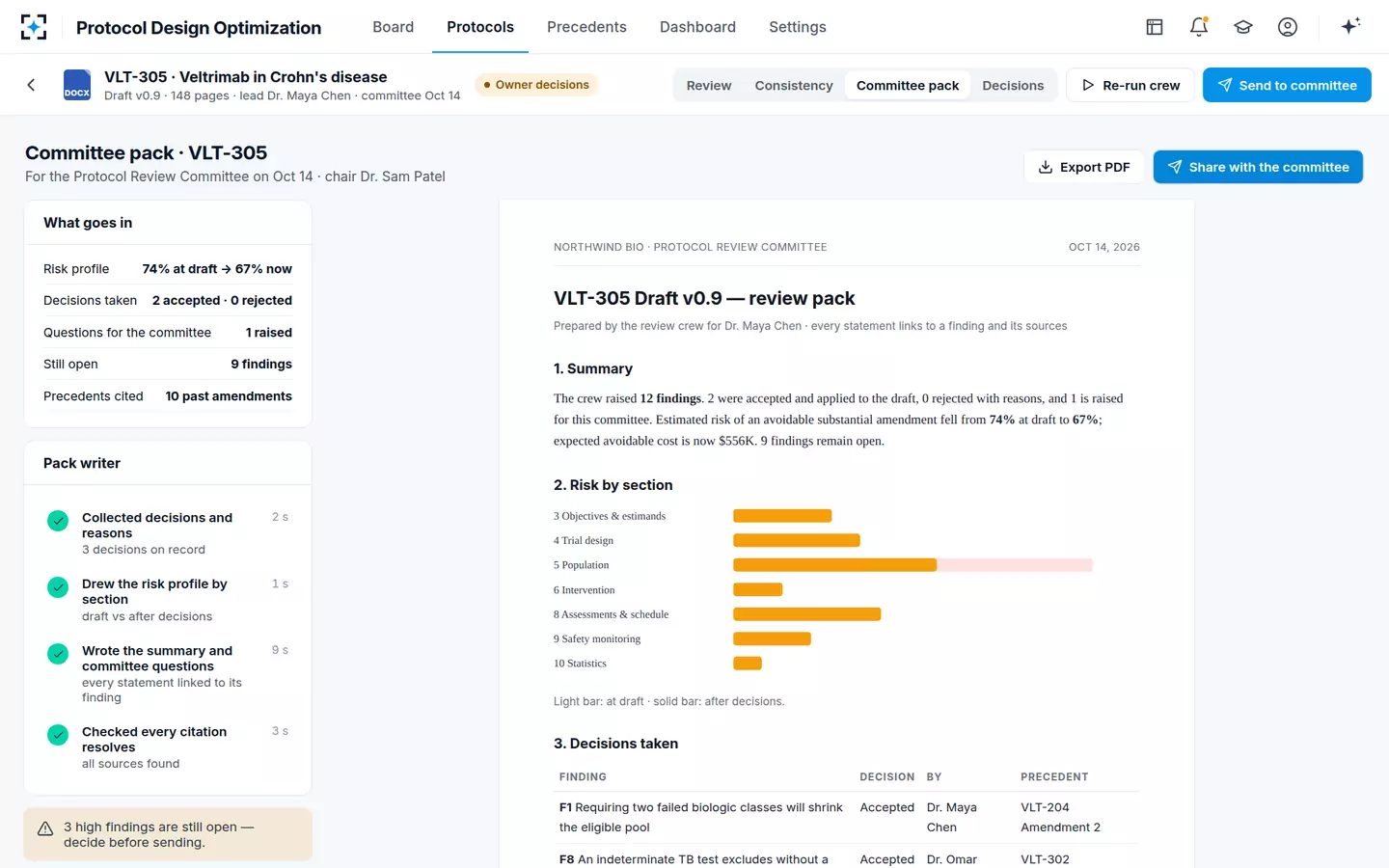
A settled estimand is a short section and a short argument at committee. An unsettled one is a placeholder sentence that looks harmless on page 24 and reappears as a substantial amendment nine months later. For the checklist this section belongs to, see the protocol review checklist; for what the same deferral costs when it is found late, see the cost of protocol amendments.
Questions people ask
What does an estimand have to state in a protocol?
The exact treatment effect the trial is after, answering the clinical question behind its objective. Written into the protocol, it fixes the treatments compared, the patients the question is about, the variable measured, how each intercurrent event is handled, and how the comparison is summarised. Fixing all of those is what turns an objective that a dozen trials could claim into a question with one answer.
Where should the estimand go in the protocol?
In the protocol itself, with the objectives. ICH E9(R1) §A.6 asks that a trial protocol "define and specify explicitly a primary estimand that corresponds to the primary trial objective", and that estimands for secondary objectives likely to support regulatory decisions be specified too. The estimator, the primary analysis and the sensitivity analysis are pre-specified across the protocol and the analysis plan; the question itself does not wait for the analysis plan.
Can a protocol use different strategies for different intercurrent events?
Yes, and most should. The guideline says plainly that one strategy need not cover every intercurrent event, and expects different events to take different strategies. A trial can treat discontinuation for toxicity as a composite outcome, a change of background medicine under treatment policy, and death under a while-on-treatment framing, provided each choice is stated and the data needed for it is collected.
Does the estimand change the sample size?
It should. The effect size being powered for depends on how the strategies handle the events, so an effect size borrowed from a trial with a different estimand can be badly wrong. The guideline also notes that where everyone contributes information and the strategies are already reflected in the targeted effect and variance, it is not usually necessary to inflate the sample size again for expected withdrawals.
What happens if you change the estimand during the trial?
ICH E9(R1) warns that changes during the trial "can be problematic and can reduce the credibility of the trial", and that a change should usually be made through a protocol amendment. That means ethics and agency approvals again, possible re-consent, and a visible record that the question moved. Events genuinely unforeseen at design can be addressed, but the discussion has to cover the effect on the estimand and on the interpretation, not just on the analysis.
Who owns the estimand — the statistician or the clinical scientist?
Both, and the split is reliable: the clinical scientist owns the question, the statistician owns whether it can be answered with the data the protocol will produce. In practice the decision that needs both in the room is the strategy for each intercurrent event, because it is a clinical judgement with an immediate consequence for the sample size and for what section 8 has to collect after someone stops treatment.