The point of PRIIPs KIDs is to give a retail investor in the EU the same short document, at most three sides of A4 in a fixed order, for every packaged investment product they might buy, whether a fund, a structured note or a unit-linked insurance policy, so that its risk, possible returns and costs can be compared before they commit. The Regulation behind it, Regulation (EU) No 1286/2014, makes the document a condition of sale: a product may not be made available to retail investors until its manufacturer has drawn up and published a KID, and the seller must hand it over before the investor is bound. That is why investors meet the KID mostly as an absence, a fund their broker will not sell them, and why managers meet it as a cost: one document per share class, in every language, kept current and accurate on pain of damages and fines. Botminds' PRIIPs KID Production exists for that cost: agents draft and check every KID against the fund data, and named people approve and sign.
Product examples come from a fictional sample range, Quillfield Global Funds SICAV, as it runs through the solution. The law is quoted from the consolidated Regulation on EUR-Lex.
Where a full KID reissue's business days go: most of the time is language and checking
By hand · about 25 business days
- Data file and missing data · 8%
- English masters · 12%
- Translation and post-edit · 24%
- Language review and figure checks · 32%
- Fixing mismatches · 12%
- Sign-off and publication · 12%
With the solution · 11 business days, a target
- Data file · 5%
- English masters · 5%
- Translation and post-edit · 27%
- Language review · 45%
- Fixing mismatches · 9%
- Sign-off and publication · 9%
What is the point of a PRIIPs KID? The two problems it was written to solve
The KID answers two failures of disclosure that research and regulators had described for years: investors do not read long documents, and they cannot compare products whose documents all look different. A peer-reviewed analysis of the Regulation puts it in exactly those terms. The PRIIPs Regulation "purports to deal with two important concerns in the field of investor protection: (i) investors do not read, understand, or digest extensive and/or technical information; and (ii) they hardly compare the products and services of different financial institutions" (Colaert, Journal of Financial Regulation, 2016).
The Regulation's tools follow from the diagnosis. A short document, a prescribed order and title, plain language, a risk scale from 1 to 7, scenarios in money, and costs for the same €10,000 example in every KID, so a reader can set two side by side. The document must say what the product is, what it could cost, how risky it is and what happens if the manufacturer cannot pay; and it must say it before the sale, as "pre-contractual information" (Art. 6(1)).
The Regulation is "the first piece of 'horizontal' or 'cross-sectoral' legislation in the history of EU financial regulation—covering banking, investment, and insurance products, instead of limiting its scope of application to one of these sectors."
Veerle A. Colaert, Journal of Financial Regulation 2(2), 2016
No KID, no sale: why some funds cannot be offered to EU retail investors
The KID is a condition of sale before it is a document. The manufacturer must write it and post it on its website before the product is offered to any retail investor (Art. 5(1)), and the person advising on or selling it must provide the KID "in good time before those retail investors are bound by any contract or offer relating to that PRIIP" (Art. 13(1)). A broker or bank that cannot hand over a KID cannot sell the product to a retail client.
This is the reason EU retail investors are often unable to buy funds listed elsewhere, including many US exchange-traded funds. A fund whose manager has not produced a PRIIPs KID, because it is not marketed in the EU and its home rules do not require one, cannot be made available to EU retail investors by anyone, and investment firms block the purchase rather than breach the Regulation. The fix is not on the investor's side. Only the manufacturer can produce the document, in a language each market accepts, and keep it reviewed.
The rule bites on retail investors only. The Regulation's "retail investor" is a MiFID retail client, or an insurance customer who would not be a professional client (Art. 4(6)), so a professional client is outside it; whether an individual can be treated as professional is a matter of the MiFID criteria, not of preference.
What does a missing or wrong KID cost the manager?
The costs fall in four places, and only one of them is visible in the budget. The table sets them out with the provision that creates each.
Four costs of a missing or wrong KID, and where each comes from
| Cost | How it arises | Where it is written |
|---|---|---|
| Distribution lost | No KID, or a KID not in an accepted language, means no sale to retail investors in that market | Regulation, Arts. 5(1), 7 and 13(1) |
| Damages | An investor who relied on a misleading or inaccurate KID, or translation, and lost money may claim damages; the liability cannot be limited by contract | Regulation, Art. 11 |
| Supervisory orders | Prohibition or suspension of marketing, an order to withdraw the KID and publish a new one, a public warning | Regulation, Art. 24(2)(a)–(d) |
| Fines | A ceiling for company fines of no less than €5 million or 3% of turnover, or double the gain made or loss avoided | Regulation, Art. 24(2)(e)–(f) |
The fourth cost, the work itself, is the one a manager controls. Every share class needs a KID, every market language needs a version, and every version must be reviewed at least every 12 months and whenever something significant changes (Delegated Regulation, Art. 15). For the sample range that is 4,212 documents in one reissue. The split above is where the time goes, and it is mostly in language and checking, not in drafting.
Does anyone actually read the KID?
Fewer people than the Regulation hoped, according to the regulators who now run it. The FCA, explaining why it is replacing the UK version, wrote that "Consumers do not usually read these documents, and we do not believe they help consumers make investment decisions enough. In our behavioural testing, most participants said Key Information Documents (KIDs) were not engaging" (FCA PS25/20, 1.15). The academic critique saw the risk from the start: the same 2016 analysis framed the problem the KID addresses as "information overload and rational ignorance", which a shorter document eases but does not cure.
Being read is not the only test, though. A KID is also the document a distributor checks before selling, a supervisor checks when it reviews a product, and a court reads when an investor sues. EU supervisors asked in 2022 said, for example, that performance information in marketing material often took "different forms to the KID", and that for one supervisor "the KID performance scenarios are generally not sufficiently highlighted" (ESAs, advice on the PRIIPs Regulation, JC 2022 20). The KID is the fixed point against which everything else said about the product is measured, which is a function it serves whether or not the investor reads every line.
A KID is checked line by line even when it is not read line by line
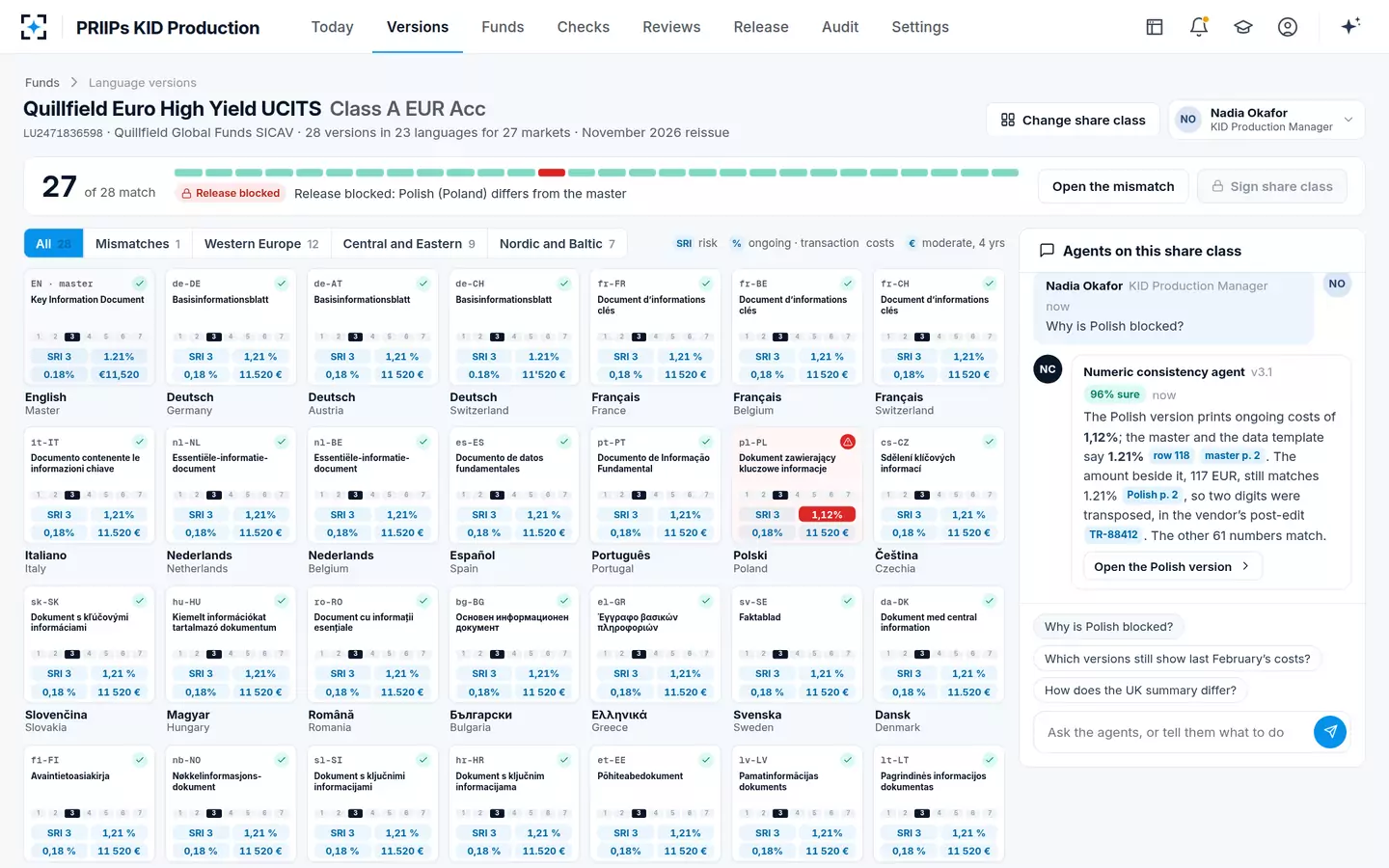
What the KID gets right: one format for funds, insurance and structured products
Its strongest feature is the one that makes it hard to produce: the same template for very different products. A retail investor offered a unit-linked policy by an insurer, a structured note by a bank and a UCITS by a platform sees the same sections, the same 1–7 scale and the same €10,000 cost example. ESMA uses KID data for that reason; its annual market report on retail products draws its cost information "primarily from the PRIIPs KIDs" (ESMA, Costs and Performance of EU Retail Investment Products, 2025 report).
Comparability also explains the KID's most criticised features. A single method for risk, scenarios and costs across products as different as a money market fund and an autocallable note was always going to produce odd results somewhere, and the history of the rules is largely a history of repairing them: new scenario methods and a floor under transaction costs from 2023, and another round of changes in the retail investment strategy agreed in December 2025 but not yet law. How the scenarios are calculated and what the deal would change follows that story.
Why the KID is criticised, and what is changing in the EU and the UK
The criticism comes from both sides of the Channel and lands on the same parts. The UK concluded that prescribed templates and performance scenarios did more harm than good: it removed scenarios from UK KIDs at the end of 2022 and, under the Consumer Composite Investments regime, replaces the KID with a product summary whose design is left to the manufacturer, required from 8 June 2027. The EU kept the template and changed the methods, and its pending reform would move the KID towards digital delivery and forward-looking scenarios.
What the KID was for, what critics say, and what each regime is doing about it
Comparable risk
One 1–7 scale squeezes very different products together.
Kept; manufacturers may raise the score since 2023.
A 1–10 score from ten years of volatility.
Realistic returns
Model-based scenarios were over-optimistic after good years.
Scenarios from ranked past windows since 2023; forward-looking ones in the pending reform.
Scenarios removed in 2022; ten years of past performance instead.
Comparable costs
Aggregated figures confuse one-off and annual costs; negative transaction costs.
A floor under transaction costs; costs explained line by line.
The ongoing charge in percent and pounds as the headline; explicit transaction costs only.
A document people read
Rigid, legalistic, rarely read.
Digital delivery in the pending reform.
No set template; design left to the manufacturer.
Selling to EU retail investors from outside the EU: what a manager must produce
A manager that wants EU retail distribution takes on the whole KID cycle, not one document. The checklist below is the minimum, and the language part alone usually means one version per market; the country-by-country rules are in the KID language requirements guide.
Before a fund is offered to EU retail investors
- A KID for every share class offered
Or a representative class chosen fairly and recorded (Delegated Regulation, Art. 14b).
- In a language each market accepts
A faithful translation of the original, per Article 7 and each country's rules.
- Published on the manufacturer's website
Before the product is made available, and again after every revision.
- Risk, scenarios and costs on the EU methods
Five years of prices for the risk class, ten for the scenarios, three years of trades for transaction costs.
- A review at least every 12 months
And whenever a change significantly affects the KID, including a five-point move in the moderate scenario.
- Data for distributors
The figures in a form distributors and insurers can load, kept consistent with the published KID.
- A complaints route in each market
Steps, a website, and a current postal and email address.
Where PRIIPs KID Production fits
The solution takes on the cost a manager controls: the work of producing and checking every version. Its agents draft each English master from the fund data, recompute the risk indicator and scenarios as a second opinion, write each market version with the approved terms and locked regulatory phrases, and read every rendered page back against the data, so that a wrong figure blocks its share class instead of reaching an investor. People keep the decisions: a reviewer for each language, product governance for risk classes and reissue plans, and the head of product compliance for each share class. Every action is on an audit trail that a supervisor or a court can follow.
Every action in PRIIPs KID Production, on a trail that can be shown to a supervisor
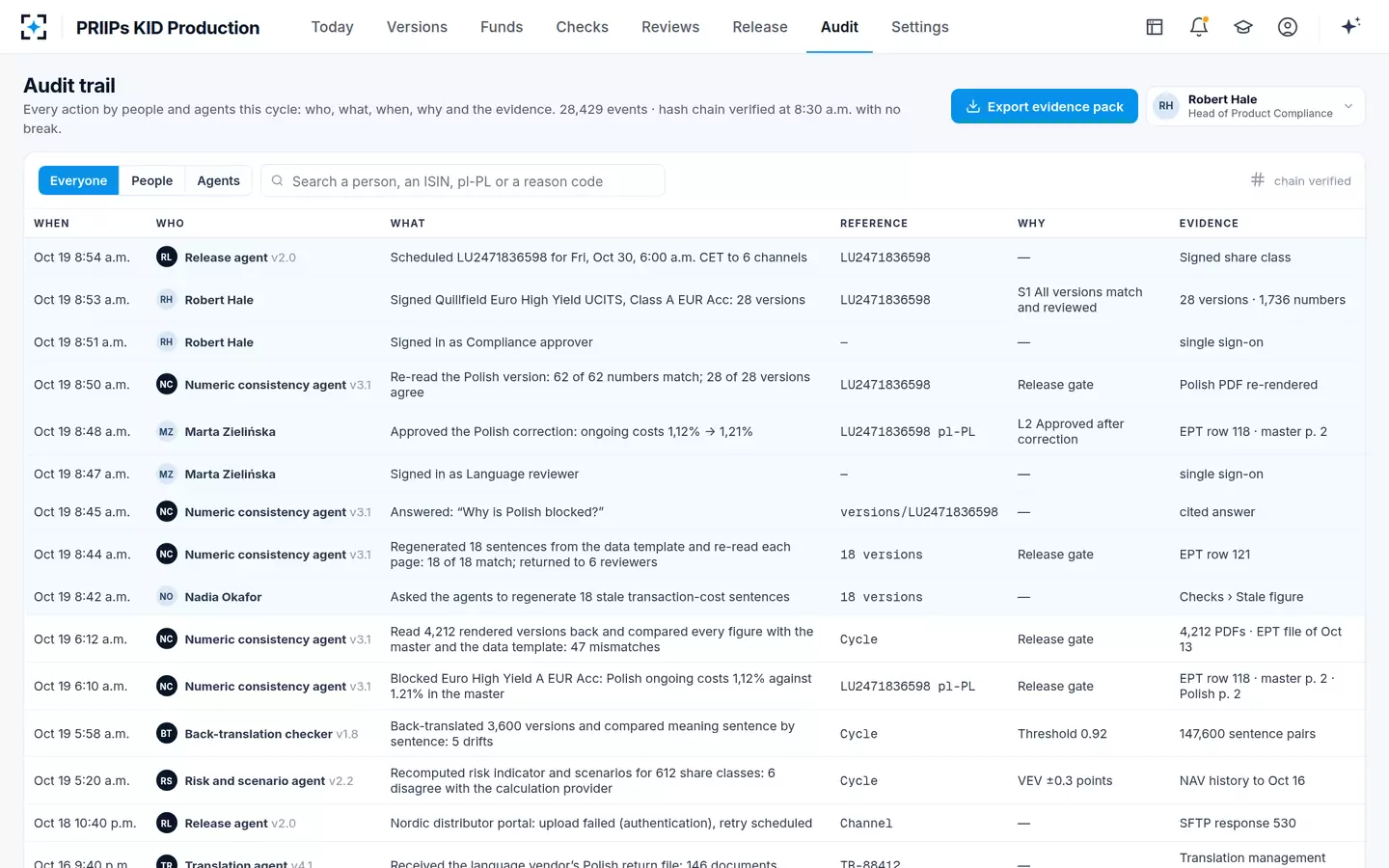
What it does not change is the law's allocation of responsibility: the manufacturer still answers for every KID. Who answers for each figure sets that out, and the PRIIPs KID Production page shows the full cycle.
Questions people ask
Why does my broker say a PRIIPs KID is missing?
Because the fund's manager has not published a KID that the broker can give you, and without one the broker may not sell the product to a retail client in the EU. The broker cannot produce the KID itself; only the manufacturer can, so the block lasts until the manager does.
Why can't I buy US ETFs in Europe?
Because a fund without a PRIIPs KID cannot be made available to EU retail investors (which is why US managers launch European versions, as in launching a UCITS ETF on an ICAV platform), and a US-registered ETF whose manager does not market it in the EU has no reason to produce one: US rules do not require it. EU investment firms therefore block the purchase for retail clients, while EU-domiciled UCITS ETFs tracking similar indices carry KIDs and can be bought.
Do UCITS ETFs have a PRIIPs KID?
Yes. Since 1 January 2023 every UCITS sold to EU retail investors, ETFs included, needs a PRIIPs KID; before that, UCITS used the UCITS key investor information document under an exemption that ended on 31 December 2022.
Is a KID the same as a fund factsheet?
No. The KID is pre-contractual information required by law, in a fixed format, and must be kept separate from marketing material; a factsheet is marketing material with its own rules. Whether a factsheet is required at all is a separate question.
What does KID mean on an investment?
Key information document: the short standard document that tells a retail investor what the product is, its risk on a scale of 1 to 7, what it might return in four scenarios, what it costs and how long to hold it. It must be provided before the investor is bound.
Can a professional client buy a fund without a KID?
The KID requirement applies to products made available to retail investors, defined by reference to MiFID's retail client, so it does not apply to sales to professional clients. Whether an individual can be treated as a professional client depends on the MiFID criteria and the firm's assessment.