There is no prescribed CCI product summary template. The FCA's Consumer Composite Investments rules, published in policy statement PS25/20 on 8 December 2025, set the content a UK product summary must carry and leave its design to the manufacturer: a short document in English titled "product summary", with a risk and return score on a scale of 1 to 10 based on ten years of volatility, the ongoing charges figure as the headline cost in percent and in pounds, explicit transaction costs and one-off charges shown separately, and up to ten years of past performance. It replaces the UK PRIIPs KID and the UCITS KIID for funds, investment trusts and insurance-based investments sold to UK retail investors; manufacturers may switch from 6 April 2026 and must by 8 June 2027. For a fund sold in the EU and the UK, the hard part is producing two documents with different scores, costs and performance from one data set without letting them drift apart. Botminds' PRIIPs KID Production drafts the UK product summary from the same data as the EU KID and explains every difference.
The rule text is quoted from FCA PS25/20, which contains the final instrument. Product examples come from a fictional sample range, Quillfield Global Funds SICAV, as it runs through the solution.
Three dates decide the UK switch: rules published, regime commenced, full go-live
- Familiarisefrom 8 Dec 2025
- Optional: a product summary may replace the KID or KIIDfrom 6 Apr 2026
- Requiredfrom 8 Jun 2027
Is there a CCI product summary template? No, and the FCA meant it that way
The FCA prescribes content, not layout. Its reason is a judgement on the old documents: "PRIIPs and UCITS disclosures currently require firms to explain their products using rigidly prescribed document templates. They often contain excessive amounts of information, are unengaging, and typically rely on legalistic financial jargon" (FCA PS25/20, 1.15). In place of a template, "Manufacturers will have considerable freedom over the design of product summaries", with standardised requirements "only for the content which we think must be included, to ensure consumers can compare information that is calculated to common standards on costs, risk and return and past performance" (1.17).
Consultation respondents asked for a template anyway: prescribed headings, a fixed order and a page limit, among other suggestions (3.10). The final rules did not impose one. The legal minimum is in DISC 3.1.2R: "a short and concise document in English, titled 'product summary', setting out appropriate information about the essential characteristics of the consumer composite investment, conveying as a minimum the core information disclosures", clearly separate from marketing materials and understandable without cross-references to other documents.
For a manufacturer that means the template is now its own design decision, and a decision it has to defend: the summary must be likely to be understood by retail investors and must equip them to make "effective, timely, and properly informed" decisions (DISC 3.1.2R), measured against the Consumer Duty. A reasonable practice is to design one house template, test it, and generate every share class's summary from data into it.
What must a CCI product summary contain?
It must carry the core information disclosures that DISC 4 to DISC 7 define: general product information, risk and return, costs and charges, and performance. PS25/20 lists what distributors must, at a minimum, highlight to investors from it: "A brief explanation of the product", "The ongoing costs figure of the product, and other costs relevant to the product (for example, one-off costs)" and "The risk and return score of the product and a brief explanation of the product's risk and return profile, including any required warnings for the product" (PS25/20, chapter 3).
The content of a UK product summary, and the rule behind each part
| Content | What the rules require | Where |
|---|---|---|
| Title and language | A short and concise document in English, titled "product summary"; separate from marketing material | DISC 3.1.2R |
| What the product is | A brief explanation of the product and its essential characteristics | DISC 4; PS25/20 chapter 3 |
| Risk and return | A score from 1 to 10 from ten years of standard deviation, a narrative, and required warnings | DISC 5; PS25/20 chapter 5 |
| Costs | The ongoing charges figure as the headline, as a percentage and in pounds; one-off costs separately; explicit transaction costs as a number, separately | DISC 6; PS25/20 chapter 4 |
| Past performance | A line graph of up to ten years from an initial £10,000, monthly data points, with a prominent statement on its limits | DISC 7; PS25/20 chapter 6 |
| Upkeep | Core information reviewed at least once in every 12-month period; revised summary and changes sent to distributors | DISC 3.2.2R–3.2.3R |
The risk and return score: 1 to 10, from ten years of volatility
The UK score replaces the EU's 1–7 risk indicator with a ten-point scale built on plain standard deviation. The FCA moved the window from its proposed five years to ten: "We have changed the calculation of the standard deviation of returns to be over 10 years instead of 5" (PS25/20, chapter 5), and products with less than ten years of returns must simulate the rest from the history of their underlying assets or an appropriate benchmark. It is called a risk and return score deliberately, to "reflect the potentially higher return from taking higher risk over the long term".
Standard deviation bands for the CCI risk and return score
| Score | Standard deviation of returns, ten years |
|---|---|
| 1 | below 0.5% |
| 2 | 0.5% to below 2% |
| 3 | 2% to below 5% |
| 4 | 5% to below 9% |
| 5 | 9% to below 12% |
| 6 | 12% to below 16% |
| 7 | 16% to below 20% |
| 8 | 20% to below 30% |
| 9 | 30% to below 50% |
| 10 | 50% and above |
The score can be adjusted, mostly upwards. Manufacturers must raise it where the number understates the risks, for example for credit risk, and products that invest in illiquid assets or impose a delay or cost on getting money out must "add at least +1 to their risk and return score". Lowering it is narrow: "Firms will only be allowed to adjust the score downwards where there is at least 90% capital guarantee or where the initial score is not representative of overall risks of the investment." For funds that sit on a band boundary, the FCA has added guidance that moving between two bands during the year "would not require an update to the product summary outside of the yearly review".
Costs in the product summary: the ongoing charge, in percent and in pounds
The UK abandoned the EU's aggregated cost figure. The final rules make the ongoing charges figure (OCF) the main cost number, disclosed "both as a percentage, and as a pounds-and-pence number" (PS25/20, chapter 4). One-off costs are shown prominently but separately, so they are not read as an annual charge, and transaction costs are not included in the ongoing charges figure.
Transaction costs survive as their own number, explicit costs only. The FCA requires "a numerical disclosure of explicit transaction costs, presented separately to ongoing costs", leaves the presentation to the firm, and treats the bid-ask spread as an implicit cost that is left out. For a fund that also has an EU KID, the arrival-price figure there and the explicit-only figure here will differ; the PRIIPs transaction cost methodology explains where the EU number comes from.
Past performance replaces scenarios: ten years on a line from £10,000
The product summary shows what happened, not what might. The FCA removed performance scenarios from UK PRIIPs KIDs at the end of 2022, having concluded that for most products they displayed misleading information (FCA PS22/2), and the CCI rules do not bring them back. Instead, manufacturers show a line graph of up to ten years of past performance from an initial £10,000, which distributors may replace with the investor's own amount, using monthly data points after consultation feedback, with "a prominent statement to explain that the performance shown may not be representative of performance in the longer term" (PS25/20, chapter 6).
How does the UK product summary differ from the EU PRIIPs KID?
Almost every number is calculated differently, so one fund's two documents disagree by design. The sample share class below shows how far apart they land, and why a reader who sees both needs an explanation.
One fund, two documents: the EU PRIIPs KID and the UK CCI product summary
EU PRIIPs KID: 1–7 indicator from a VaR-equivalent volatility over five years, plus credit risk. Sample: 3 of 7.
UK CCI product summary: 1–10 score from the standard deviation of ten years of returns. Sample: 4 of 10, from 7.6% a year.
EU PRIIPs KID: Four performance scenarios at one year and the holding period.
UK CCI product summary: Up to ten years of past performance as a line from £10,000.
EU PRIIPs KID: Total costs and annual cost impact, in euros and percent, including transaction costs.
UK CCI product summary: Ongoing charges figure in percent and pounds. Sample: 0.71%, £71 a year on £10,000.
EU PRIIPs KID: Explicit and implicit, by the arrival-price method. Sample: 0.18%.
UK CCI product summary: Explicit only, shown separately. Sample: 0.04%.
EU PRIIPs KID: A prescribed template of at most three sides of A4.
UK CCI product summary: No set template or page limit; short, concise, in English.
EU PRIIPs KID: The languages each market accepts.
UK CCI product summary: English.
EU PRIIPs KID: Exchanged through industry data files.
UK CCI product summary: A machine-readable file of the core information is required.
PRIIPs KID Production drafts the UK product summary from the EU KID's data and explains each difference
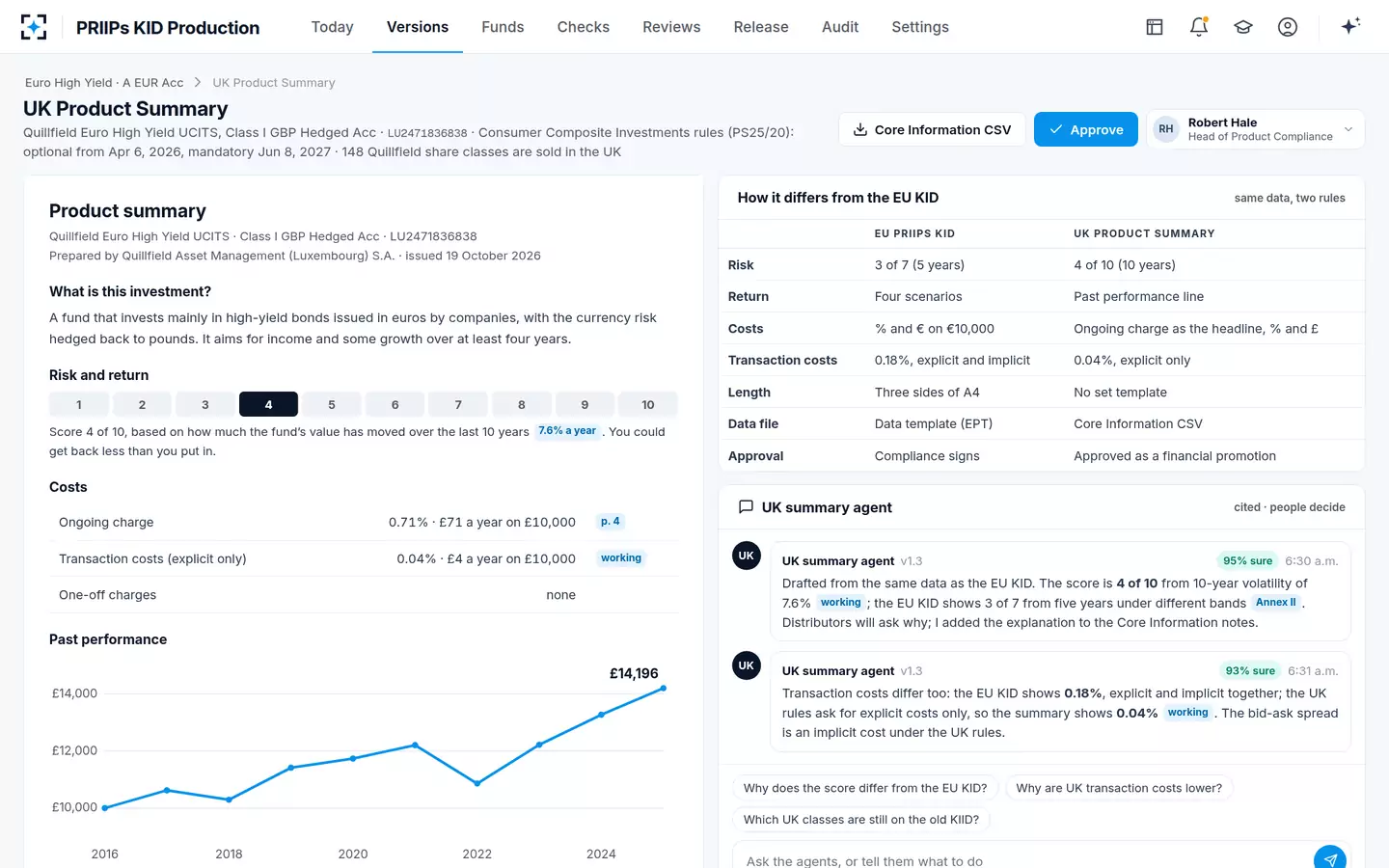
The machine-readable file and the distributor's part
Behind every product summary sits a file. Manufacturers must make the core information available to distributors in machine-readable form, review it "regularly and at least once in every 12-month period", and after each review send distributors the revised information with "a reasonable summary of material changes", or confirmation that nothing changed, together with the updated summary (DISC 3.2.2R–3.2.3R). Distributors deliver the manufacturer's summary to consumers, unamended, in a durable medium at or shortly after the point of sale, and must highlight the key information listed above.
The FCA also states which part of the regime starts early: "The only part of the CCI regime that will turn on before 8 June 2027 is the ability to produce and make available a product summary." The file obligations, and the distributors' new duties, begin at full go-live. A manufacturer that switches early therefore does so for its product documents only, and distributors must be able to carry the new summary alongside old KIDs and KIIDs for other funds in the meantime.
The UK switch in four numbers
12.5M
UK adults hold a consumer composite investment, by the FCA's estimate
18months
implementation period, from 8 December 2025 to 8 June 2027
10years
of returns behind the risk and return score, and of past performance shown
1–10
the UK score, against the EU's 1–7 indicator
Switch early or wait for June 2027? A readiness checklist for UK-sold funds
Switching early is allowed and the FCA has said it does not want to stand in the way: "Given the widespread dissatisfaction firms have reported with the PRIIPs KID we do not want to prevent firms from transitioning to a product summary when they are able to" (PS25/20, chapter 8). For UK UCITS the path is direct; the FCA confirmed that their managers "will not need to transition to a PRIIPs KID at any point". What decides the timing is readiness: the ten-year calculation, the cost figures and the file to distributors all have to work before the first summary is published.
Ready to publish UK product summaries? Check these first
- Ten years of monthly returns per share class
Own history, or simulated from the underlying assets or a benchmark where it is shorter.
- The score and every adjustment, documented
Upward for credit or liquidity risk; downward only with at least 90% capital protection or an unrepresentative initial score.
- The OCF in pounds as well as percent
On £10,000 by default, with one-off costs shown separately and not annualised.
- Explicit transaction costs on their own
Without the implicit costs the EU KID includes; mark-ups and mark-downs count as explicit.
- A house design, tested on readers
No template is prescribed; the summary must be likely to be understood by retail investors.
- The machine-readable file and the change summary
Distributors receive the core information, a summary of material changes and the updated product summary after each review.
- A reconciliation to the EU KID
Where a fund has both, explain each difference before distributors or investors ask.
What to look for in software for the switch, and where PRIIPs KID Production fits
Software that only fills a layout will not get a range through the switch; the work is in the numbers. The questions below separate a document generator from a tool that can be trusted with two regimes at once.
Questions to ask any tool that will produce UK product summaries
| Question | Why it matters |
|---|---|
| Does it calculate the 1–10 score from ten years of returns, or only print a supplied one? | The score is new; a supplied figure has to come from somewhere, and that somewhere needs checking. |
| Can it explain, per share class, why the UK score differs from the EU indicator? | Distributors and investors will see both and ask; the explanation should come from the calculation, not a template sentence. |
| Does it keep explicit and implicit transaction costs apart? | The UK figure is explicit only; one number used for both documents is wrong in one of them. |
| Does it produce the machine-readable file from the same data as the summary? | Two outputs from two sources will drift. |
| Who approves each summary, and is that recorded? | The product summary stays within the financial promotion rules in COBS 4; a named person should approve it. |
| Can it run alongside the EU KID cycle? | A fund sold in both markets has two documents with one data set and one review calendar. |
PRIIPs KID Production's UK summary agent drafts the product summary and the core information file from the same data as the EU KID and explains each difference, as in the sample share class above; it never publishes, and compliance approves each summary. The rest of the solution, from the data checks to the release, is the same cycle that produces the EU KIDs, so one review calendar covers both. What it does not replace is the manufacturer's own design decision: the house template is yours. A pilot on your own share classes is the quickest way to test both documents on real data; the EU language rules, which the UK summary escapes, are set out in the KID language guide. The full cycle is on the PRIIPs KID Production page.
Questions people ask
When is the UK CCI deadline?
8 June 2027, when the regime goes fully live and product summaries are required for consumer composite investments sold to UK retail investors. Since 6 April 2026 manufacturers may already produce a product summary instead of their current KID or KIID.
What is FCA PS25/20?
It is the FCA's policy statement of December 2025 with the final rules for the Consumer Composite Investments regime, which replaces the retained UK PRIIPs rules and the UCITS key investor information for retail investment products. It contains the DISC sourcebook rules on the product summary and the 18-month transition.
What counts as a consumer composite investment?
The FCA's overview of the regime lists structured products, open-ended funds, contracts for difference, closed-ended investment funds and insurance-based investment products: broadly what the UK PRIIPs and UCITS disclosure rules covered. It estimates that 12.5 million UK adults hold one.
Does an EU fund sold in the UK need a product summary?
Yes, once the regime is fully live, if it is sold to UK retail investors as a consumer composite investment, including funds marketed under the Overseas Funds Regime. PS25/20 makes the early-switch option available to those manufacturers too, so an EU fund can move to a product summary before June 2027.
Is the product summary a financial promotion?
The FCA's transitional rule TP 2.8 disapplies the financial promotion rules in COBS 4 from disclosure documents "other than a product summary", so the product summary stays within them. Firms should approve it accordingly and keep the record of each version.
How long can a CCI product summary be?
The rules set no page limit. DISC 3.1.2R requires a short and concise document, and respondents who asked for a fixed page limit did not get one; the test is whether retail investors are likely to understand it and can make informed decisions from it.