A PRIIPs KID example shows what the template in Annex I of Delegated Regulation (EU) 2017/653 turns into for a real share class: a purpose statement and product details, then seven titled sections, from "What is this product?" to "Other relevant information", with a summary risk indicator from 1 to 7, four performance scenarios at one year and at the recommended holding period, and two cost tables based on €10,000, all within three sides of A4. The example below is a fictional bond-fund share class, and every number in it comes from a row of the fund's data file. The hard part is not drafting one such document but producing hundreds of them, in every language, with every figure still right after translation. Botminds' PRIIPs KID Production does that work with eight agents, each with a task it may perform and a list of things it may never touch, while named people approve each language and sign each share class.
The KID and the cycle described here are sample data on a fictional fund range, Quillfield Global Funds SICAV, as it runs through the solution. Rule references are to the consolidated texts on EUR-Lex.
Who builds one KID in PRIIPs KID Production: eight agents, three kinds of decision, each with a never
Agent
Change monitorSees the prospectus update, the board fee resolution, new data and the 12-month clock, and proposes which share classes and versions to reissue, with a reason for each.
Never: starts a reissue without product governance approval
A person decides
Product governance approves the planConfirms the reissue plan and decides any change of risk class.
Agent
Drafting agentBuilds the English master from the fund data file, the product master and the prospectus, and checks it against the template and three sides of A4.
Never: invents or rounds a figure; every figure comes from a data row
Agent
Risk and scenario agentRecomputes the risk indicator, scenarios and costs over time from NAV history and cost data, and runs the Article 15(2) review tests.
Never: overrides the calculation provider's figure
Agent
Translation agentWrites each market version from the master with the approved term base, locked regulatory phrases and the market's mandatory text; routes to the language vendor where policy requires a human post-edit.
Never: changes a number or edits an approved version
Agent
Back-translation checkerTranslates every version back to English on a second model from a different provider and compares meaning sentence by sentence.
Never: edits; it flags drift with the sentence pair
Agent
Numeric consistency agentReads every rendered page, normalises the market's number format and proves each figure against the master and its data row.
Never: clears its own flag or releases
A person decides
Each language's reviewer approvesApproves, edits or rejects the version with a reason code; nothing publishes until each approves.
A person decides
Product compliance signs the share classSigns once every version matches the master and every reviewer has approved.
Agent
Release agentPublishes signed share classes to the website, distributor platforms and data feeds, and verifies each published file.
Never: publishes a share class with an open mismatch
What does a PRIIPs KID look like? One example, section by section
A KID looks the same for every product because its order and section titles are fixed. Annex I requires manufacturers to "comply with the section order and titles set out in the template", which "does not fix parameters regarding the length of individual sections and the placing of page breaks" but is subject to the three-page maximum (Delegated Regulation, Annex I). The example below lists, for each section, what the sample share class's KID says.
A PRIIPs KID example: the sample share class's document, section by section
Key Information Document
Purpose and product
The prescribed purpose statement. Quillfield Euro High Yield UCITS, Class A EUR Acc, LU2471836598, a sub-fund of Quillfield Global Funds SICAV; manufacturer Quillfield Asset Management (Luxembourg) S.A., its website, telephone and home regulator; date of production.
What is this product?
Type: a UCITS share class, accumulating. Objectives: income and some growth from euro high-yield corporate bonds. Intended retail investor, term, depositary, where to get the prospectus and reports, in which languages, free of charge.
What are the risks and what could I get in return?
Summary risk indicator 3 out of 7, recommended holding period 4 years, the prescribed narrative and warnings. Scenarios for €10,000 at 1 and 4 years: stress €6,720 and €6,950; unfavourable €8,640 and €9,410; moderate €10,310 and €11,520; favourable €11,980 and €12,840.
What happens if the manufacturer is unable to pay out?
Whether a loss is covered by an investor compensation or guarantee scheme, and what it covers.
What are the costs?
Costs over time: €434 total and 4.3% annual cost impact if you exit after 1 year; €871 and 2.1% a year after 4 years. Composition: entry 3.00% (€300), exit none, management and other costs 1.21% (€117), transaction costs 0.18% (€17), no performance fee.
How long should I hold it and can I take money out early?
Recommended holding period 4 years; how and when shares can be redeemed, and any cost of leaving early.
How can I complain?
Steps to complain, a website, and an up-to-date postal and email address; in the sample reissue, a new complaints address in every version.
Other relevant information
Where past performance is published and for how many years; where the previous performance scenario calculations are published monthly.
Three things in the example are not obvious from the template. The UCITS-specific lines in "What is this product?", the depositary and where to obtain the prospectus "stating in which language or languages those documents are available", were added for funds in 2023 and must appear for every member state where the fund is marketed (Art. 2(7)). The costs section is calculated, not copied: the €434 is the entry charge plus a year of ongoing and transaction costs on what remains invested. And "Other relevant information" now points to a monthly record of previous scenario calculations, so the scenario figures have a public history.
Where each number in the example comes from
Every figure in the sample KID points to one row of the fund data file, and that is the property the agents protect. The master's 22 key figures each point to their row; the reader of the Polish or Finnish version never sees those links, but the reviewer does.
Figures in the sample KID, their data rows and the rule that defines them
| Figure in the KID | Sample value | Data row | Defined by |
|---|---|---|---|
| Summary risk indicator | 3 out of 7 | Row 22 | Annex II (market and credit risk) |
| Recommended holding period | 4 years | Row 24 | Art. 6 of the Delegated Regulation; Annex III |
| Moderate scenario, 4 years | €11,520 | Row 50 | Annex IV, point 7(d) |
| Stress scenario, 1 year | €6,720 | Row 41 | Annex IV, points 18–20 |
| Total costs, 1 year | €434 | Row 104 | Annex VI, points 61 and 90; Annex VII |
| Annual cost impact, 4 years | 2.1% | Row 107 | Annex VI, point 70 |
| Entry costs | 3.00% | Row 112 | Annex VI, point 3 |
| Management fees and other costs | 1.21% | Row 118 | Annex VI, points 4–5 and 67 |
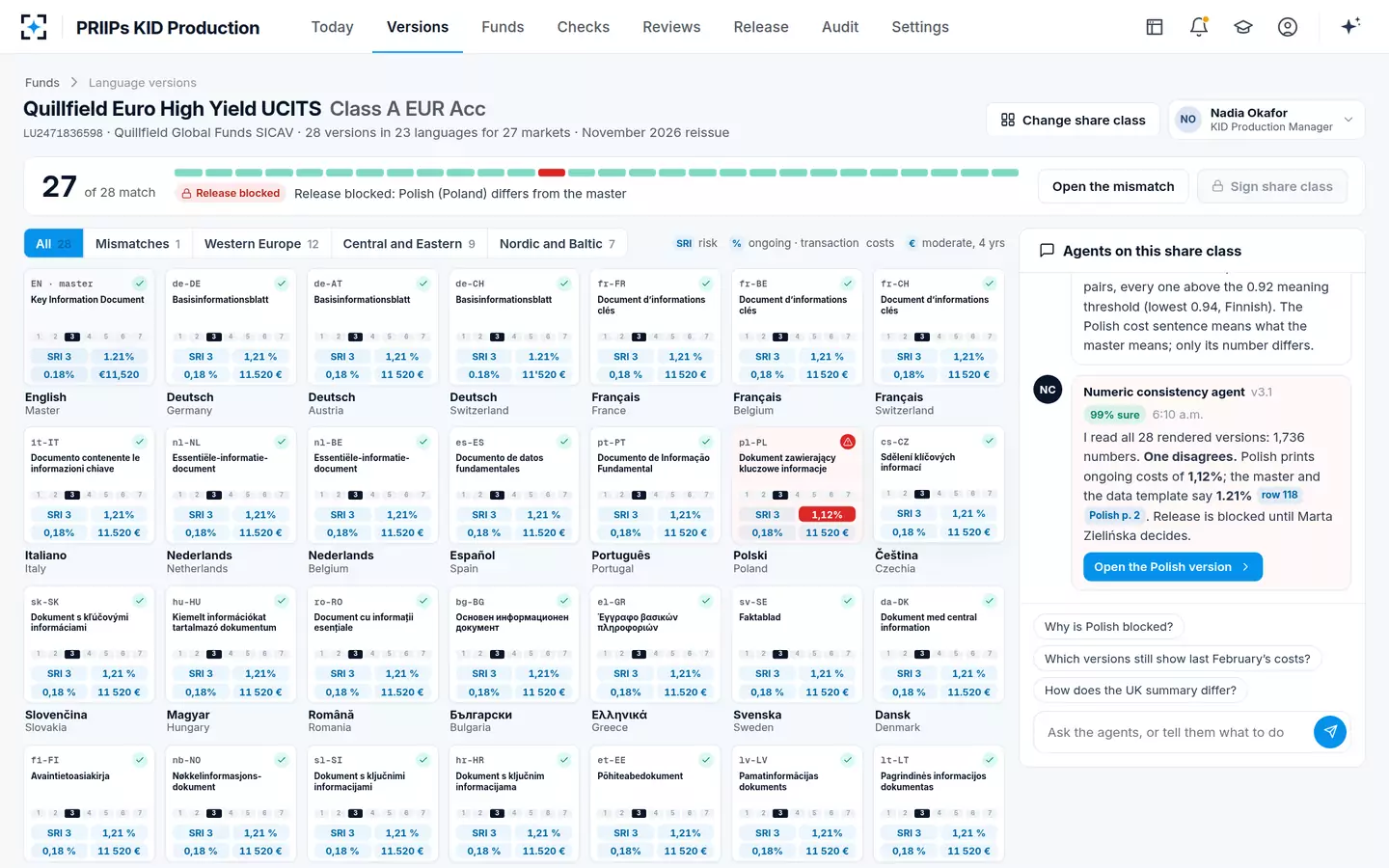
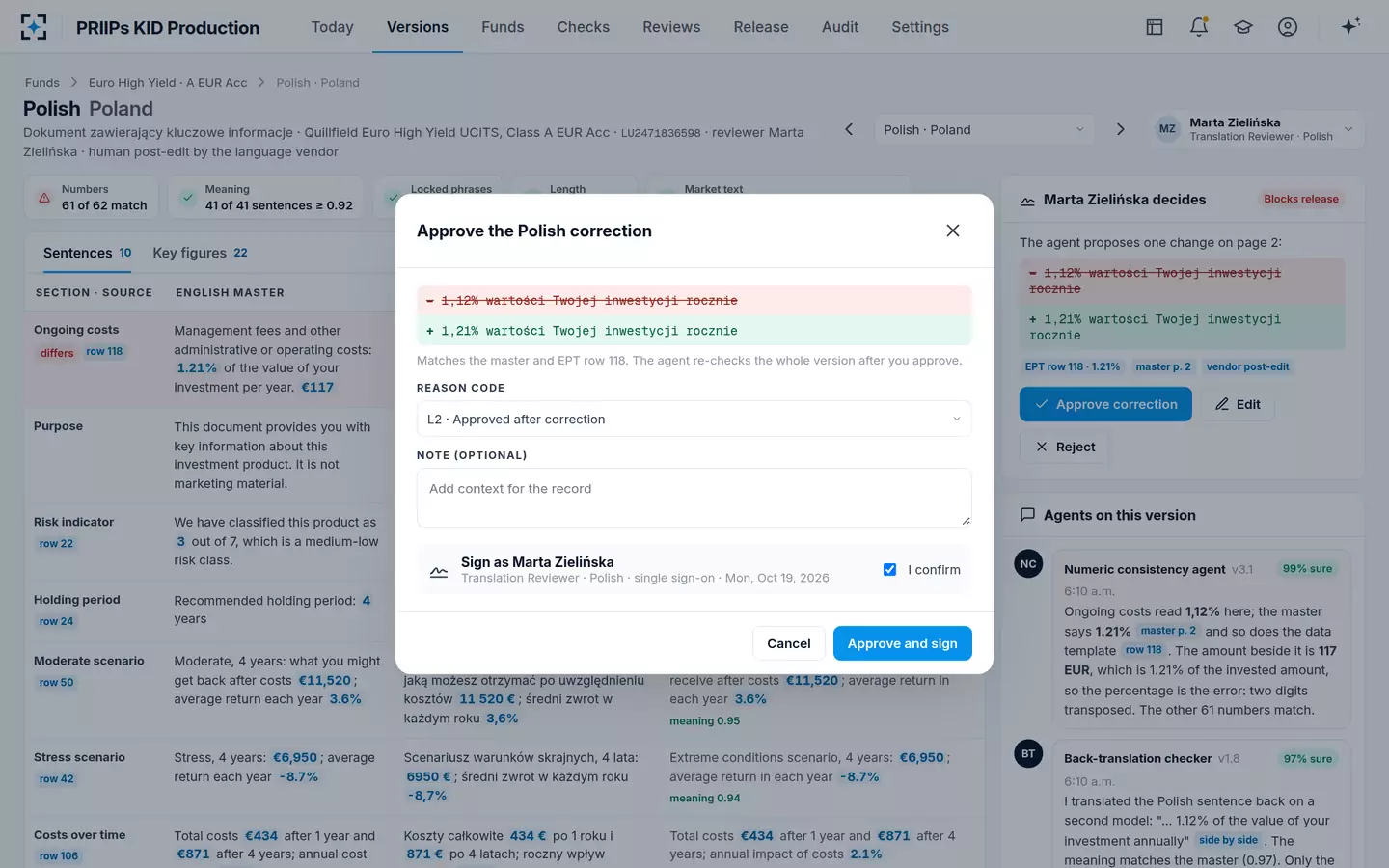
Row 118 is the one the sample cycle turned on. After the September fee review, ongoing costs fell from 1.30% to 1.21%. The English master printed 1.21% and, beside it, the amount of €117 a year; the Polish version, after the language vendor's post-edit, printed 1,12%. The amount next to it still matched 1.21%, which is how the agent could say which of the two was wrong.
Drafting the English master from the data file
The Drafting agent's job is assembly, not authorship. It builds each master from the fund data file, the product master and the prospectus, puts the figures where the template requires them, uses the prescribed narratives word for word and checks the result against the three-page limit. In the sample cycle it built 598 masters on the day after the data arrived and held 14 share classes whose data was incomplete, rather than drafting around the gaps.
Its limit is the core of the design: it never invents or rounds a figure, and every figure comes from a data row. A drafting model that can write fluent text can also write a plausible number; the only defence is a rule that it may not, and a second agent that checks.
Recomputing risk and scenarios: a second opinion, never an override
The Risk and scenario agent recalculates what the calculation provider supplied: the VaR-equivalent volatility and market risk class, the performance scenarios and the costs over time, from NAV history and cost data. In the sample cycle it agreed with the provider on 606 of 612 share classes. For one, Emerging Markets Local Debt, it found a volatility of 12.3% against 11.8% supplied, because the provider had used weekly returns for a month with missing daily prices, and 12% is the line between risk classes 3 and 4.
It did not change the KID. A class change would reissue 41 versions, and the decision belongs to product governance, which sees both figures and the working. The agent's limit, never to override the provider, is what lets a manufacturer use a second calculation without creating a second source of truth. The summary risk indicator calculation works the case through in full.
Reading every language version back
Translation is where a correct master becomes a wrong KID, so every rendered version is read back. The Numeric consistency agent extracts every number from each page, converts the market's format ("1,21 %" in France, "11'520 €" in Switzerland) and proves each figure against the master and its data row; the Back-translation checker turns each version back into English on a different provider's model and scores the meaning of every sentence against the master, with 0.92 as the sample range's threshold. In the sample cycle that read-back found 47 mismatches across 4,212 versions overnight.
One share class, 28 versions in 23 languages: 27 of 28 match
Can AI produce a PRIIPs KID? What supervisors expect of the tools
AI can draft and check a KID; it cannot carry the responsibility for one. The Regulation puts liability for a misleading or inaccurate KID, including any translation, on the manufacturer and forbids limiting it by contract (Art. 11). ESMA's public statement of May 2024 on AI in investment services makes the parallel point for firms using AI tools: decisions stay the responsibility of the firm's management body whether a person or a tool takes them, information produced with AI must be checked for accuracy before and after it reaches clients, and staff must not over-rely on the output (ESMA, Public Statement on AI and investment services).
The technical standards supply the operational test. A manufacturer must "establish and maintain adequate processes throughout the life of the PRIIP" to identify without undue delay anything that could affect the accuracy, fairness or clarity of the KID (Art. 15(3)). An agent that reads every version every cycle is such a process; an agent that publishes what it drafts is not, because nothing checks it. The limits on translation tools in particular are set out in the guide to AI translation tools for fund documents.
The limits: what no agent may do
Every agent prepares, checks or proposes, and none decides. The matrix below shows, for each agent and each person, which of the decisive actions they may take. The empty cells are the design.
Who may do what in PRIIPs KID Production: the limits on each agent and each person
| Who | Write text | Change a figure | Clear a flag | Approve a language | Decide a risk class | Sign or publish |
|---|---|---|---|---|---|---|
| Drafting agent | Yes, from data rows | No | No | No | No | No |
| Translation agent | Yes, from the master | Proposes a correction | No | No | No | No |
| Back-translation checker | No | No | No | No | No | No |
| Numeric consistency agent | No | No | No, not its own | No | No | No |
| Risk and scenario agent | No | No | No | No | Proposes, with working | No |
| Release agent | No | No | No | No | No | Publishes signed classes only |
| Language reviewer | Edits own language | Approves a correction | Yes, with a reason | Own language only | No | No |
| Product governance | No | No | Risk flags, with a reason | No | Yes | No |
| Head of product compliance | No | No | No | No | No | Signs each share class |
Who signs off a PRIIPs KID?
The law does not name a signatory; the manufacturer decides, and should decide per share class. In the sample range, each language version is approved by its own reviewer, product governance decides risk-class changes and reissue plans, and the head of product compliance signs each share class once every version matches. The Polish correction shows the chain: the agent proposed changing 1,12% to 1,21%; the KID production manager could see it but not approve it; the Polish reviewer approved it with reason code L2; the agent then re-rendered the page and re-read all 62 numbers; and only then could compliance sign.
The language reviewer, not the agent, approves the correction
The design target, to be measured in a pilot, is that no version is released with a figure that disagrees with its master or the fund data. A seeded-error test on cost disclosures is one way to measure it, and PRIIPs KID Production shows the full cycle.
Questions people ask
Is there an official PRIIPs KID template?
Yes. Annex I of Delegated Regulation (EU) 2017/653 fixes the section order and titles, and Annexes III, V and VII prescribe the risk, performance and cost presentations and their narratives. The template does not fix the length of each section or where pages break, only the three-page maximum.
What does KID stand for in investing?
Key information document: the pre-contractual disclosure the PRIIPs Regulation requires for packaged retail and insurance-based investment products sold to retail investors in the EU. It is not marketing material and must be kept separate from it.
Can one KID cover several share classes?
Yes, in two ways. Classes may be combined in one KID if the result still meets the length, language and presentation rules, and one class may represent others if that is fair, clear and not misleading to their investors, with a record of the choice (Delegated Regulation, Art. 14b).
Who signs off a KID?
The Regulation makes the manufacturer responsible and leaves the internal sign-off to it. A common split is a reviewer per language for each version, product governance for risk and scenario decisions, and a head of product compliance for the share class as a whole.
Can a KID be produced automatically from data?
Its figures can and should be: every figure comes from a calculation or a data row. What cannot be automated is the responsibility, which stays with the manufacturer under Article 11, and the decisions that rest on judgement, such as a risk-class change or the approval of a translation.
How long does it take to produce a range's KIDs?
It depends on the number of share classes, languages and review steps. The design target for the sample range of 4,212 versions is 11 business days from the data file to signature; that is a target to be measured in a pilot, not a measured result.