The EU PRIIPs KID template is Annex I of Delegated Regulation (EU) 2017/653: it fixes the title "Key Information Document", the purpose statement, the product details and seven titled sections in a set order, within a maximum of three sides of A4, and Annexes III, V and VII prescribe the risk, performance and cost presentations and the narratives that go with them. Every compliant KID therefore looks alike, and a template can be filled in by anyone. What the template cannot show is whether your figures, risk classes, scenarios and costs come out right in every language of every share class after a reissue, which is where KID errors actually occur. That is a question for a pilot on your own data: your last reissue, every share class and every language, measured against pass marks agreed before it starts. Botminds' PRIIPs KID Production is built to be piloted that way, on a sample of your own data file and published KIDs.
The roles, settings and figures below come from a fictional sample range, Quillfield Global Funds SICAV, as it runs through the solution; the pilot design and pass marks are our proposals, to adapt to your own procedure.
Who sits on a KID pilot, and what each one signs off
Today
Runs reissues by deadline and finds errors when distributors report them.
With agents
Leads the pilot week, owns the scorecard and the comparison with the last real reissue.
Still theirs: Signs off that the pilot ran as planned
Today
Sends the data file and answers questions about missing fields.
With agents
Supplies last cycle's file unchanged and confirms the source of every disputed figure.
Still theirs: Signs off the data used
Today
Approves risk-class changes when the provider reports them.
With agents
Reviews every recomputed risk class and scenario that disagrees with the provider, and decides.
Still theirs: Signs off the risk and scenario results
Today
Read whole PDFs in their language.
With agents
Review only the lines the checks flag, plus a planted-error sample they do not know about.
Still theirs: Sign off their own language
Today
Signs share classes on the strength of a sample.
With agents
Agrees the pass marks before the pilot and judges the result against them.
Still theirs: Signs off the pilot result
What is the EU PRIIPs KID template, and what does it leave open?
The template is a fixed skeleton with prescribed wording in key places. Annex I fixes the order and titles of the sections and the three-page maximum, but not how long each section is or where the pages break (Delegated Regulation, Annex I). Article 9 makes its use mandatory: "PRIIP manufacturers shall present the key information document by means of the template laid down in Annex I." Annex III gives the risk indicator's format and its prescribed narrative elements, Annex V the scenario tables and their narratives, Annex VII the two cost tables and their wording.
What is left to the manufacturer is mostly design and content within each section: the description of the product, the explanation of its risks, the space each section takes, the layout. Two rules from the Regulation limit the design. Colours must not reduce comprehensibility "if the key information document is printed or photocopied in black and white", and corporate branding "shall not distract the retail investor from the information contained in the document or obscure the text" (Art. 6(5)–(6)). Since 2023, funds also have their own additions in Chapter IIa: one KID per share class or a documented representative class, and specific content for compartments, funds of funds and feeder UCITS.
What a template cannot tell you about your KIDs
A template guarantees a KID looks right; it cannot tell you whether it is right. In the sample range's reissue, every one of the 4,212 versions followed the template, and reading them back against the data still found 47 that disagreed: 18 stale figures, 11 number formats, 9 transposed digits, 5 changes of meaning and 4 risk indicators. None of those is visible from the template, because each is a correct-looking number in the correct place.
Three other questions are invisible from a template too. Whether the risk class and scenarios still hold this month, since both are recalculations from price history. Whether a review is due, since a five-point move in the moderate scenario triggers one. And whether each language version says what the master says. A template-filling tool, however good, answers none of them, which is why a template is the wrong thing to buy and the wrong thing to test.
The pass marks to agree before a KID pilot starts
A pilot without pass marks agreed in advance becomes a demonstration. The table proposes the measures and pass marks for a one-week pilot; the head of product compliance should sign them off before any data is loaded, so the result is judged on the terms set, not on the impression it leaves.
Proposed pass marks for a pilot on your last reissue
| Measure | How it is measured | Proposed pass mark |
|---|---|---|
| Figures checked | Share of numbers on every rendered version, in every language, compared with the master and the data file | All of them, not a sample |
| Planted errors caught | Errors seeded in a copy of the rendered KIDs, unknown to the reviewers, by type | Every planted figure error flagged before sign-off |
| Real errors found | Mismatches in your last published reissue, confirmed by your own reviewers | Each one traced to a cause and a source row |
| Risk and scenario agreement | Recomputed risk class and scenarios against your calculation provider | Every disagreement explained, and decided by product governance |
| False alarms | Flags your reviewers overturn, with the time they took | Agreed ceiling, set from your current review effort |
| Elapsed time | Business days from data file to signature for the pilot scope | Measured against your last real cycle for the same scope |
One pilot week, day by day
A pilot that runs on last cycle's data can be done in a working week, because nothing it produces is published. The plan below is the shape of one, as a KID production manager would run it on a scope of a few dozen share classes in all their languages.
A one-week KID pilot on your own share classes
- LoadDay 1
- Draft, recomputeDay 2
- Read backDay 3
- Review, scoreDay 4
- ScorecardDay 5
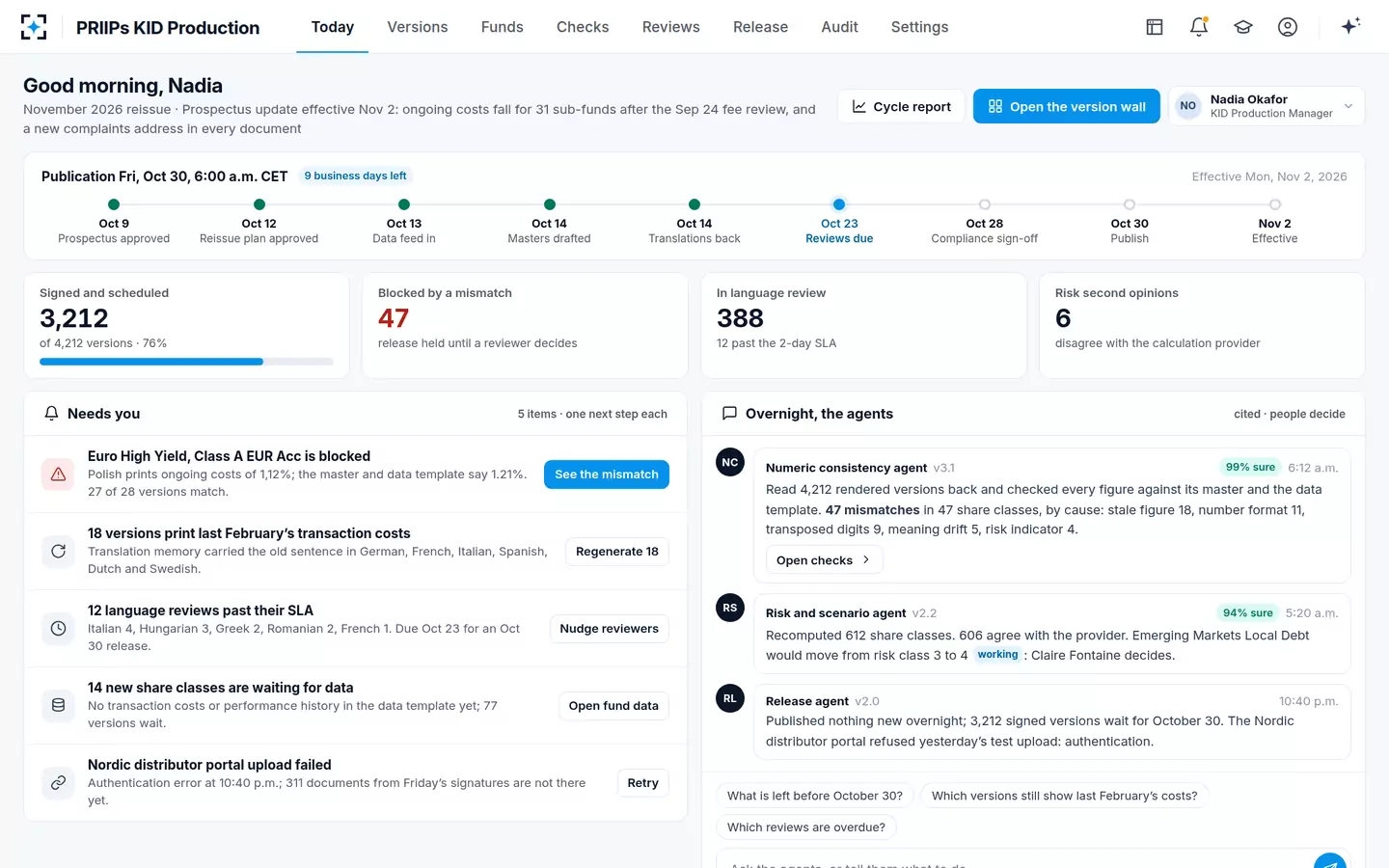
Monday is the only day that depends on other teams: the data file as the administrator delivered it last cycle, the KIDs as they were published, the prospectus and the fee resolutions that drove the reissue. By Tuesday evening the drafting and recomputation are done, and the first disagreements with the calculation provider are on product governance's list. Wednesday's read-back is where a real reissue usually produces its surprises: in the sample range's case, 18 transaction-cost sentences that translation memory had carried over from February. Thursday belongs to the reviewers, who see only what was flagged, plus whatever their own sample turns up. Friday is the scorecard.
What the KID production manager sees on the morning of day 4
What to bring to a KID pilot
Inputs for a pilot on your last reissue
- The fund data file as delivered
Last cycle's file from the administrator, one line per share class, unedited.
- The KIDs as published
Every language version of the pilot share classes, as investors received them.
- Prospectus, fee resolutions and the product master
The documents the reissue was meant to reflect, and the share class and market list.
- The registration matrix
Which share class is sold where, in which languages, with which paying agent and complaints text.
- NAV history and cost data
Daily prices for five to ten years and the trade and cost data behind the cost figures.
- Translation memory and the term base
So the pilot reproduces your real language process, including its stale sentences.
- Your KID procedure
Who approves what, your tolerances and your current review effort, to set the pass marks.
How to measure the pilot: coverage, recall and days
Three numbers decide a KID pilot. Coverage is the share of figures actually compared with their source: a sampling review covers the share of pages it reads; the solution is designed to cover all of them. Recall is the share of planted errors caught before sign-off, measured by type; how to design the planted-error test for KID costs is set out in its own guide. Days is elapsed time from the data file to signature for the pilot scope, against your last real cycle.
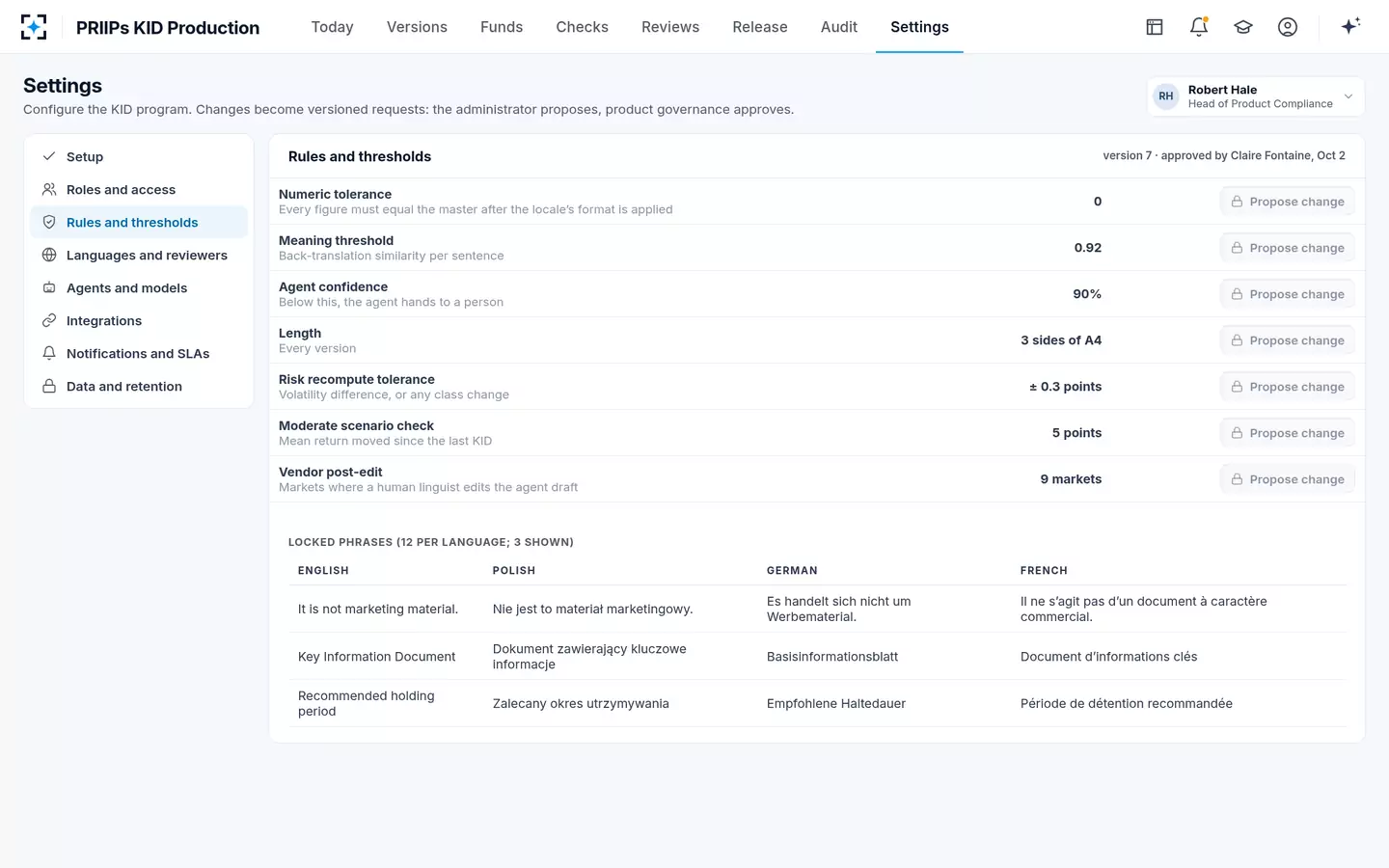
Two more are worth recording without a pass mark. The number of real errors the pilot finds in your published reissue tells you what your current process let through. And the number of flags your reviewers overturn tells you whether the checks are tuned for your documents. The settings that drive both are versioned in the solution and visible to everyone on the pilot.
The thresholds a PRIIPs KID Production pilot runs on, as versioned settings
Questions to ask any KID software before you buy
Most KID software is judged on its template; the questions below judge it on its numbers. They apply to any vendor, including us.
Questions for any PRIIPs KID tool, and the answer to look for
| Question | A good answer |
|---|---|
| Does it check the rendered document, or only the data that went in? | It reads every number on every rendered version, in the market's format, and compares it with the source. |
| Can every figure be traced to its source row? | Yes, from any language version, without asking the vendor. |
| Does it recompute the risk class and scenarios, or print what it is given? | It recomputes as a second opinion and sends disagreements to a person, never overriding the provider. |
| How does it handle translation memory and post-edits? | Figures are never taken from memory; any sentence with a figure is rebuilt from the data. |
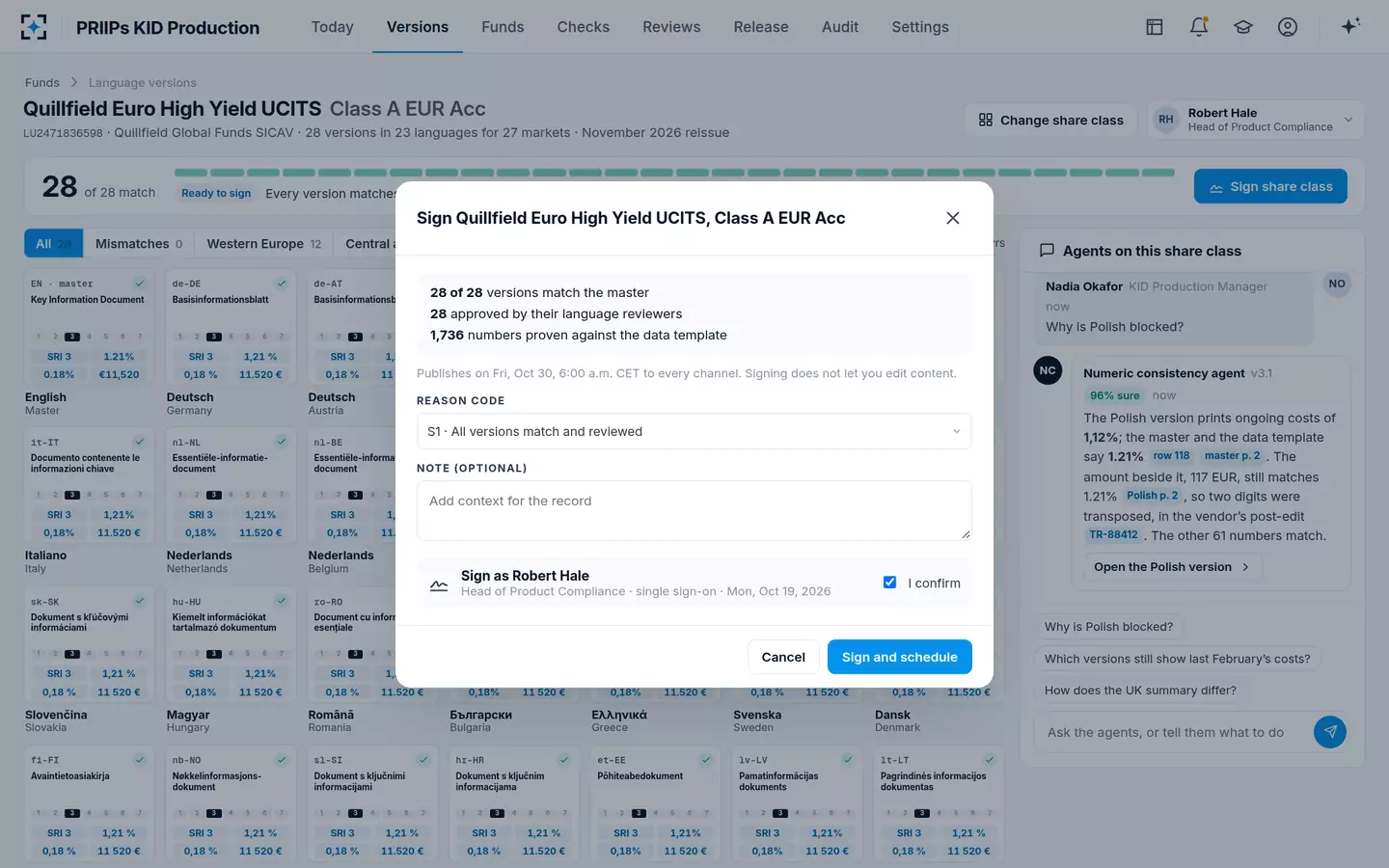
| Who can approve, sign and publish? | Named people only; the tool cannot release a share class with an open mismatch. |
| Will it run a pilot on our last reissue with pass marks agreed in advance? | Yes, on your data, with results you can check against your own published KIDs. |
Where PRIIPs KID Production fits, and where it does not
The solution takes the whole cycle from the data file to the published share class: drafting the masters, recomputing risk, scenarios and costs as a second opinion, writing each language with your term base and locked phrases, reading every version back, routing each flag to the person who decides it, and publishing only signed share classes. It also drafts the UK product summary from the same data.
It does not replace your calculation provider, whose figures it checks but never overrides; your fund administrator, who still produces the data file; your language vendor, where your policy requires a human post-edit; or your people, who approve every language and sign every share class. If your data file is incomplete, the solution holds the share class and names the missing fields; how ready your data file is is the first thing a pilot reveals. The full cycle is on the PRIIPs KID Production page.
The pilot's last step: compliance signs only a share class whose versions all match
Questions people ask
Where is the official EU PRIIPs KID template?
In Annex I of Commission Delegated Regulation (EU) 2017/653, read with Annexes II to VII for the methods and presentations; the consolidated text on EUR-Lex includes the 2021 amendments that apply from 1 January 2023. The ESAs' Q&A and flow diagrams explain how to apply it but are not binding.
Is there a UK PRIIPs KID template?
The UK retained its own version of the PRIIPs technical standards, amended in 2022 to replace performance scenarios with a narrative on what drives performance (FCA PS22/2). It is being replaced by the CCI product summary, which has no prescribed template, and is required from 8 June 2027.
Is the UCITS KID template different from the PRIIPs one?
Since 1 January 2023 a UCITS sold to EU retail investors uses the PRIIPs KID template, with fund-specific additions in Chapter IIa of the Delegated Regulation for share classes, compartments, funds of funds and feeder UCITS. The old UCITS KIID template no longer applies to them in the EU.
Can a KID carry our logo and brand colours?
Yes, within limits. Article 6 of the Regulation says colours must not reduce comprehensibility when the KID is printed in black and white, and branding or a logo must not distract from the information or obscure the text.
What are the PRIIPs KID template guidelines?
There are no separate guidelines with legal force; the template and its rules are in the Delegated Regulation. The ESAs publish non-binding material on applying them, including a consolidated Q&A, last updated on 5 December 2025 (JC 2023 22), and flow diagrams for the risk and scenario calculations (JC 2017 49).
How long should a KID software pilot take?
About a working week for a scope of a few dozen share classes in all their languages, if it runs on last cycle's data and nothing is published. Agreeing the pass marks and gathering the inputs usually take longer than the pilot itself.