The PRIIPs KID requirements come from Regulation (EU) No 1286/2014 and its technical standards, Delegated Regulation (EU) 2017/653 as amended by Delegated Regulation (EU) 2021/2268: before a packaged product is made available to retail investors in the EU, its manufacturer must draw up and publish a key information document of no more than three sides of A4, in a fixed order of sections, with a summary risk indicator on a scale of 1 to 7, four performance scenarios and two cost tables, in a language each market accepts, and must review it at least every 12 months. Every one of those duties lands on the manufacturer, and a fund range multiplies them: a separate KID for every share class, in every language, each one a document an investor can sue on. Botminds' PRIIPs KID Production exists for that multiplication. Its agents draft each KID from the fund data, recompute the risk indicator and scenarios, and read every language version back against the data, while named people approve each language and sign each share class.
The examples below come from a fictional fund range, Quillfield Global Funds SICAV, as it runs through the solution: 612 share classes sold in 27 markets, which makes 4,212 live documents. The regulatory text is quoted from the consolidated versions on EUR-Lex and linked where it appears.
The PRIIPs KID requirements in four numbers
3sides
of A4 at most, when printed, for the whole document (Regulation, Art. 6(4))
7
titled sections after the purpose statement and product details, in a fixed order (Delegated Regulation, Annex I)
12months
the longest a KID may go without review, and sooner after any significant change (Delegated Regulation, Art. 15)
2023
the year UCITS share classes moved from the UCITS KIID to the PRIIPs KID (Regulation, Art. 32, as amended)
What are the PRIIPs KID requirements? Six duties in the Regulation
The Regulation sets six duties, and five of them belong to the manufacturer. The first is to exist in time: "Before a PRIIP is made available to retail investors, the PRIIP manufacturer shall draw up for that product a key information document in accordance with the requirements of this Regulation and shall publish the document on its website" (Art. 5(1)). The second is quality. Article 6 makes the KID pre-contractual information that must be accurate and not misleading, consistent with the prospectus and the terms of the product, stand-alone and separate from marketing material, and no longer than three sides of A4.
The third is language, which Article 7 ties to the markets where the product is distributed; the country-by-country rules have their own guide in the fund document translation series. The fourth is the order and content of the sections in Article 8, which the technical standards turn into a template. The fifth is upkeep: "The PRIIP manufacturer shall review the information contained in the key information document regularly and shall revise the document where the review indicates that changes need to be made" (Art. 10(1)). The sixth falls on the person who advises on or sells the product, who must hand the KID to the investor in good time before the investor is bound (Art. 13), free of charge and in a medium the investor has chosen (Art. 14).
Six duties, six articles, and who answers for each
| Duty | Where it is written | Who answers | What the evidence looks like |
|---|---|---|---|
| Draw up and publish before sale | Regulation, Art. 5(1) | Manufacturer | A published KID per share class, dated before the class is offered |
| Accurate, consistent, stand-alone, three sides of A4 | Regulation, Art. 6 | Manufacturer | Every figure traced to its source; length checked on the rendered page |
| The right language for each market | Regulation, Art. 7 | Manufacturer | A version per market language, each a faithful translation of the original |
| The prescribed sections, in order | Regulation, Art. 8; Delegated Regulation, Annex I | Manufacturer | The template followed, narratives as prescribed |
| Review and revise | Regulation, Art. 10; Delegated Regulation, Arts. 15–16 | Manufacturer | A review at least every 12 months and on every significant change, with its outcome |
| Provide in good time | Regulation, Arts. 13–14 | Person advising on or selling the product | The KID delivered before the investor is bound, on paper or another chosen medium |
Who is the PRIIP manufacturer, and what stays with the distributor?
The manufacturer is whoever makes the product, and also whoever changes it. Article 4(4) defines a PRIIP manufacturer as "any entity that manufactures PRIIPs" and "any entity that makes changes to an existing PRIIP including, but not limited to, altering its risk and reward profile or the costs associated with an investment in a PRIIP." For a UCITS that means the management company; for a platform that repackages a fund with its own charges, it can mean the platform as well.
The split of labour is clean on paper. The manufacturer writes, publishes, reviews and answers for the document; the seller delivers it. The seller cannot fix a wrong figure, and the manufacturer cannot excuse one by pointing at the seller. Liability follows the same line. An investor who lost money relying on a KID that was misleading, wrong or out of line with the fund's legal documents may claim damages from the manufacturer under national law (Art. 11), and the Regulation adds that those obligations "shall not be limited or waived by contractual clauses" (Art. 11(5)). A manufacturer cannot contract the KID's accuracy away to its administrator, its calculation provider or its language vendor.
That is why the question "who answers for this figure?" has two answers in every fund house. The legal answer is always the manufacturer. The working answer is a named person inside it, and it is the second answer that decides whether a stale figure is caught.
The KID section by section, and the person who answers for each figure
A KID has one legal owner and at least five working ones. The table below is one way to write the second set down: for each section of the template, where its content comes from, the role that answers for it, and the check that role should be able to show at the next review.
Who answers for each PRIIPs KID section: source, owner and the check
Product, purpose, manufacturer, date
Content comes fromProduct master, prospectus
Answers for itFund data analyst
What they can showISIN, share class name and manufacturer match the prospectus; date of the document current
What is this product?
Content comes fromProspectus objectives, depositary, registration matrix
Answers for itProduct governance
What they can showObjectives and target market say what the prospectus says; depositary and document-language line present for every market
Risk: summary risk indicator
Content comes fromNAV history, calculation provider
Answers for itProduct governance (risk class)
What they can showMarket and credit risk class recomputed; any class change decided by a named person
Performance scenarios
Content comes fromNAV or benchmark history
Answers for itProduct governance
What they can showFour scenarios on the current data; moderate scenario compared with the last KID
What happens if the manufacturer is unable to pay out?
Content comes fromLegal, compensation scheme
Answers for itProduct compliance
What they can showScheme named, or its absence stated
What are the costs?
Content comes fromFund accounting, trade data, fee resolutions
Answers for itFund data analyst, product compliance
What they can showTotals and composition re-add; transaction costs on the three-year method; fee changes reflected
Holding period, complaints, other information
Content comes fromProduct governance, complaints function
Answers for itProduct compliance
What they can showRecommended holding period consistent across sections; postal and email complaint addresses current
Every language version
Content comes fromThe signed English master
Answers for itOne named reviewer per language
What they can showEvery figure equals the master in the market's number format; meaning reviewed
The share class as published
Content comes fromAll of the above
Answers for itHead of product compliance
What they can showSigned only when every version matches; published to the website and every channel
Two rows deserve a second look. The risk class is not a data field anyone may change. If market or credit risk moves enough to change the class, that is a decision with consequences: every language version of every affected share class is reissued. In the sample range, one recalculation that crossed a class line would have reissued 41 versions, so the solution routes it to product governance with the working, rather than letting a provider's number or an agent's number win by default.
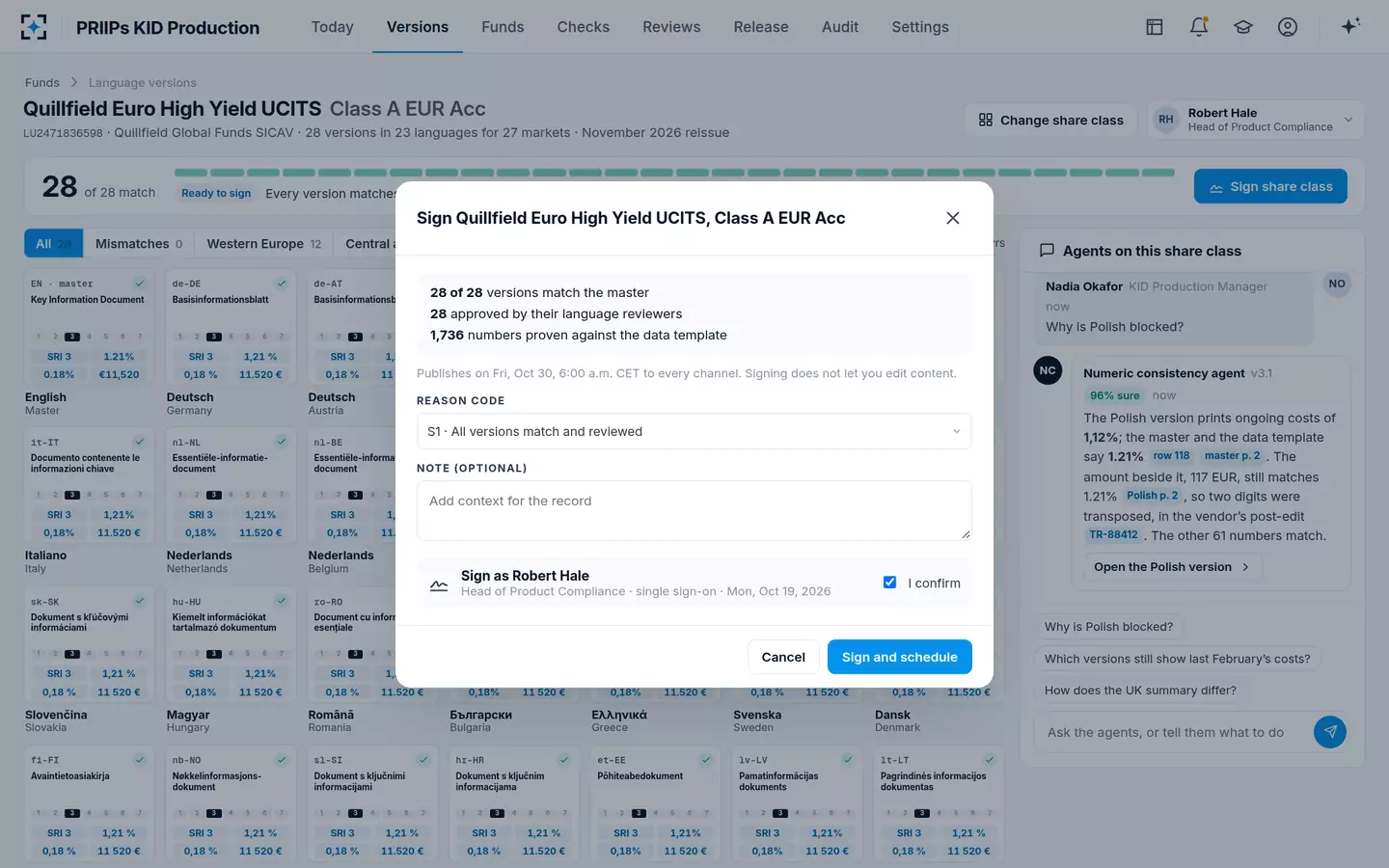
The last two rows are where most ranges are weakest. A language reviewer approves the meaning of a sentence; nobody is usually named for the figures inside it once the vendor has post-edited the file. The sample range's procedure makes each language reviewer answer for both, and the head of product compliance signs a share class only when every version agrees with the master.
Does every share class need its own KID? Since 2023, yes
Every UCITS share class sold to EU retail investors has needed a PRIIPs KID since 1 January 2023, when the UCITS exemption in Article 32 ended on 31 December 2022. The technical standards then require a KID "for each class of units or shares" (Delegated Regulation, Art. 14b(1)), with two ways to reduce the count. Classes may be combined into one document if the result still meets the length, language and presentation rules, and one class may represent others if the choice is fair, clear and not misleading to investors in those other classes.
The representative class is a decision with an audit trail. The manufacturer must keep a record of which classes are represented and why (Art. 14b(5)), and the European Supervisory Authorities' answer on the point is direct: "Where charging structures differ between classes, the share class with the highest total costs is the most appropriate representative share class to avoid the risk of understating costs" (ESAs, PRIIPs KID Q&A, JC 2023 22). A range that picked its cheapest class as the representative has a cost figure some investors will never see in their own statements.
The arithmetic is why KID production is an operations problem. The sample range's 612 share classes in 27 markets need 4,212 language versions, each reissued after every fee, risk or prospectus change. Multiply one wrong sentence by translation memory and it is wrong in a dozen languages at once.
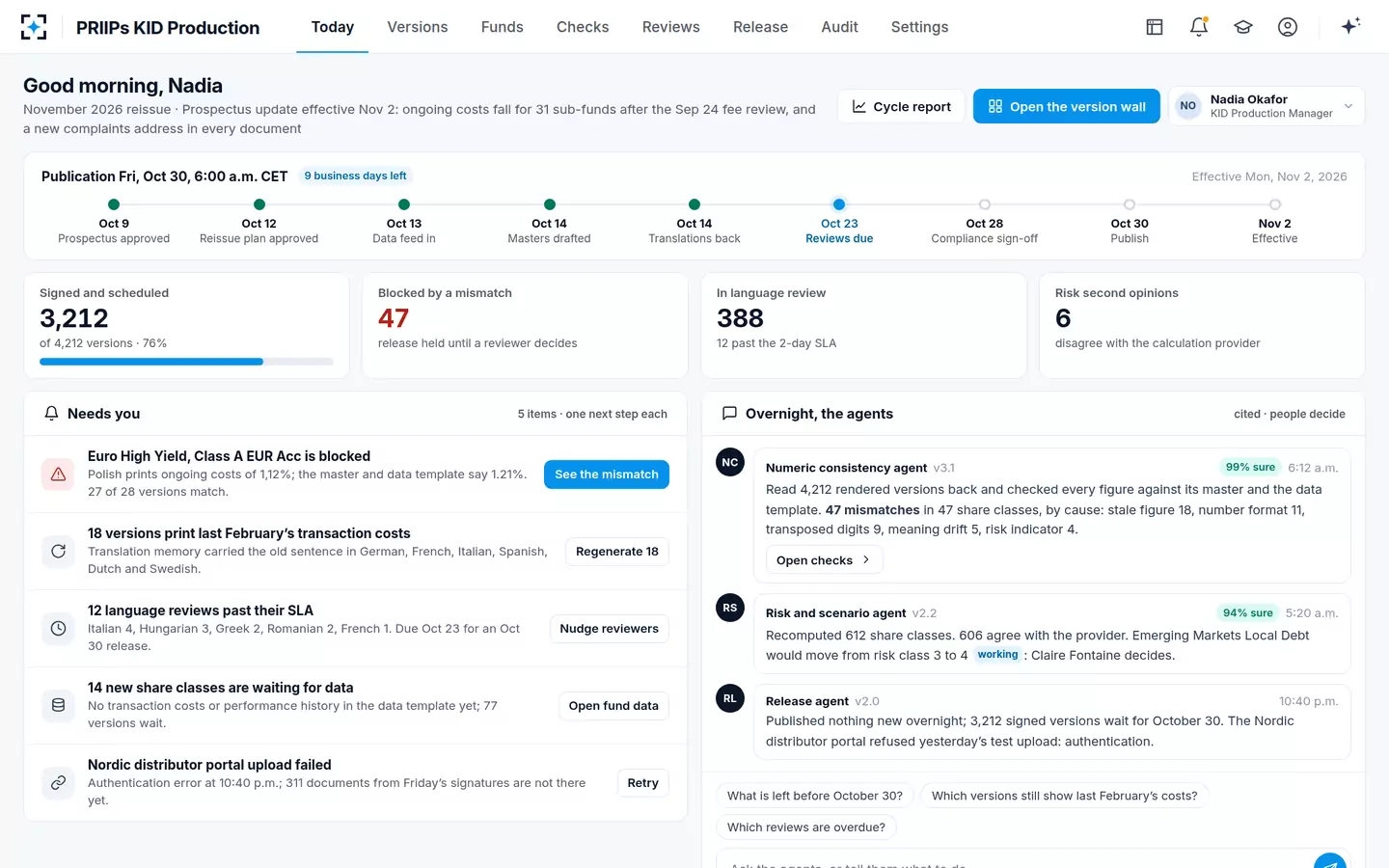
One reissue in PRIIPs KID Production: signed, blocked, in review
How often must a PRIIPs KID be reviewed? Twelve months, and three triggers
A KID must be reviewed "every time there is a change that significantly affects or is likely to significantly affect the information contained in the key information document and, at least, every 12 months following the date of the initial publication" (Delegated Regulation, Art. 15(1)). The calendar date is the floor. The triggers are what keep a review team busy.
Article 15(2) names what each review must test, beyond the general question of whether the document is still accurate and compliant. Has the market or credit risk changed enough to move the share class to a different risk class? Has the mean return of the moderate performance scenario, expressed as an annual percentage, "changed by more than five percentage points"? And, since the 2021 amendments, where scenarios rest on a benchmark or proxy, is it still consistent with the product's objectives? Article 15(3) then requires processes that spot such changes "without undue delay", and Article 16 requires the revised KID to be published on the manufacturer's website.
One review, from trigger to published KID: who acts at each step
Agent
Change monitorWatches the 12-month clock, prospectus updates, board fee resolutions, new registrations and differences in the fund data file, and proposes which versions to reissue and why.
Never: starts a reissue on its own
A person decides
Product governance approves the planConfirms the trigger, the share classes and the reason for each version, and decides any risk-class change.
Agent
Risk and scenario agentRecomputes the risk class and moderate scenario and runs the Article 15(2) tests against the last KID.
Never: overrides the calculation provider
Agent
Drafting, translation and checking agentsRebuild only the affected sections, write each language from the master and read every rendered page back against the data.
Never: release a version that disagrees
A person decides
Language reviewers approve each versionOne named reviewer per language approves, edits or rejects, with a reason code.
A person decides
Product compliance signs the share classSigns once every version matches; the revised KID is then published to the website and every channel.
The five-point test on the moderate scenario is the trigger most often missed, because it is a calculation, not an event. Nobody sends a memo when a fund's rolling returns move. A range that recalculates scenarios monthly, as the standards require of the figures themselves, has the information; what it needs is a rule that compares each month's moderate scenario with the one printed in the live KID. How the four scenarios are calculated explains why that number moves.
What does a KID breach cost? Liability, orders and fines
A breach costs in three currencies: damages to investors, orders against the product and fines. The civil route is Article 11, which lets an investor who relied on a misleading or inaccurate KID claim damages under national law, including where the error is in a translation. The administrative route is Article 24, which covers infringements of the KID's drafting, form, language, review and delivery rules. Regulators must be able to prohibit or suspend the marketing of a product, order a non-compliant KID withdrawn and a new one published, issue a public warning, and fine a company up to a ceiling that must reach at least €5 million or 3% of its annual turnover, or double whatever profit it made or loss it avoided (Art. 24(2)).
Supervisors have said what they find when they look. Asked by the European Supervisory Authorities in 2022, national regulators listed, among other failings, "mistakes in the SRI calculation or presentation", "inconsistencies in the scenario values", "use of wrong cost categories, higher commission charged than indicated, inadequate disclosure of penalties for early exit, or no cost tables" and "Lack of appropriate contact details for complaints" (ESAs, advice on the PRIIPs Regulation, JC 2022 20). Each item on that list maps to a row in the owner table above, which is the practical argument for writing the table down.
Where KID production breaks: the hand-offs between data, drafting, language and sign-off
Most KID errors are not drafting errors; they happen where one team hands to the next. The data team checks the fund data file going in. The drafting team builds an English master from it. A language vendor's translation memory offers last year's sentence. A reviewer reads a sample of PDFs. In the sample range, the overnight read-back of all 4,212 rendered versions found 47 that disagreed with their master or the data: 18 stale figures, 11 number formats, 9 transposed digits, 5 changes of meaning and 4 risk indicators. In 18 versions the transaction-cost sentence still matched the February 2026 KID, because translation memory had offered the old sentence and it had been accepted.
Five people carry a reissue; each answers for a different part of the document
Today
Runs the cycle and hears from a distributor when a document is wrong; cannot read thousands of PDFs.
With agents
Opens only the versions that disagree, grouped by cause, and fixes a cause in one decision.
Still theirs: The cycle plan and its deadlines
Today
Finds out a field was missing when a document is already late.
With agents
Sees the data file validated on arrival, with incomplete share classes held and the missing fields named.
Still theirs: The data file and its corrections
Today
Learns of a risk-class change from the document, not before it.
With agents
Decides each risk-class change and reissue plan with the working in front of them.
Still theirs: Risk class, scenarios, reissue plans
Today
Reads whole PDFs to find the line that matters.
With agents
Sees the changed line beside the English master, a back-translation and the data row.
Still theirs: Approval of every version in their language
Today
Signs share classes on the strength of a sample.
With agents
Signs once every version matches, with the count of figures checked in front of them.
Still theirs: The signature on each share class
UK PRIIPs KID requirements: the regime that ends on 8 June 2027
The UK kept its own copy of the PRIIPs rules after it left the EU and is now replacing them. The FCA's Consumer Composite Investments regime commenced on 6 April 2026, lets manufacturers switch to a product summary from that date, and becomes mandatory at its full go-live on 8 June 2027 (FCA PS25/20). Until a manufacturer switches, the UK PRIIPs KID, or for UK UCITS the UCITS KIID, remains the document. What the product summary must contain, and how it differs from the EU KID, is covered in its own guide.
What PRIIPs KID Production does with the requirements, and what it leaves to people
The solution turns the owner table into checks that run on every version, not on a sample. The Drafting agent builds each English master from the fund data file and checks it against the template and the three-page limit, holding any share class whose data is incomplete. The Numeric consistency agent reads every rendered page in every language, normalises the market's number format and proves each figure against the master and its data row. The Risk and scenario agent recomputes the risk class and scenarios as a second opinion, and the Change monitor watches the triggers that start a review.
What it does not do is as important. No agent approves a language, decides a risk class, signs a share class or publishes with an open mismatch; those stay with the people the table names. The design goal, a target to be measured in a pilot on your own data, is that no version is released with a figure that disagrees with its master or the fund data.
Compliance signs only what every version agrees on
A PRIIPs KID requirements checklist for the next review
- Name an owner for every section
The manufacturer answers in law; a named person answers in practice. Write both down.
- Check the representative-class choices
Write down which classes each KID represents and why; the ESAs point to the class with the highest total costs.
- Run the Article 15(2) tests every month
Risk class, moderate scenario against the live KID, and the benchmark or proxy behind the scenarios.
- Read the rendered versions, not only the data
Errors enter after the data check: in translation memory, post-edits and number formats.
- Keep previous versions retrievable
Article 14(5) entitles an investor to earlier versions of a revised KID on request.
- Confirm the complaints and contact details
Supervisors list missing complaint details among the failings they find.
The requirements are the same for every fund house; how many people it takes to meet them is not. One KID built by the agents, section by section, shows the division of work in detail, and PRIIPs KID Production shows the whole cycle.
Questions people ask
What is a PRIIPs KID?
A key information document is the short, standardised disclosure that the PRIIPs Regulation requires for packaged retail and insurance-based investment products, including investment funds, structured products and unit-linked insurance, before they are made available to retail investors in the EU. It runs to at most three sides of A4 and follows a fixed template with a 1–7 risk indicator, performance scenarios and cost tables.
Who is responsible for the content of a KID?
The PRIIP manufacturer, which includes any entity that changes an existing product's risk or costs (Art. 4(4)). The manufacturer draws up, publishes, reviews and answers for the KID; the person selling the product must deliver it in good time but does not answer for its content.
Can a KID refer to the prospectus instead of repeating it?
Within limits. Article 6(2) allows cross-references to other documents, including a prospectus, only where they relate to information the KID must contain, and never to marketing material. Article 17a of the technical standards adds that all information fundamental to understanding the investment must still be in the KID itself and cross-references kept to a minimum.
Does a revised KID have to be sent to existing investors?
The revised KID must be published on the manufacturer's website (Delegated Regulation, Art. 16(3)). For an investor who buys again under standing instructions, the seller must provide the KID for the first transaction after a revision (Regulation, Art. 13(4)), and any investor may ask for earlier versions (Art. 14(5)).
Do UCITS still use the UCITS KIID anywhere?
Not for EU retail investors: since 1 January 2023 a UCITS sold to them needs a PRIIPs KID. In the UK, UCITS schemes kept the UCITS KIID, and the FCA has confirmed that their managers will never have to adopt the PRIIPs KID; they move straight to the CCI product summary by 8 June 2027.
What happens if a KID figure is wrong?
An investor who relied on it and lost money can claim damages from the manufacturer under national law, and the Regulation forbids limiting that liability by contract. A regulator can order the KID withdrawn and republished, suspend the product's marketing and fine the company, with maximum fines of at least €5 million or 3% of annual turnover.