The PRIIPs transaction cost methodology is set out in Annex VI of Delegated Regulation (EU) 2017/653, as amended by Delegated Regulation (EU) 2021/2268: a fund's transaction costs are the annual average of three years of trading, each purchase and sale measured as the gap between its net execution price and its "arrival price", the mid-market price when the order was passed to a broker, summed and divided by the fund's average net assets. Since 1 January 2023 the result may never be lower than the fund's explicit costs, such as commissions and taxes, and new or thinly traded funds use a standardised estimate built from half the bid-ask spread. The work is hard because the inputs live in the order management system, not in the fund accounts, and because one stale sentence can carry an old figure into a dozen languages. Botminds' PRIIPs KID Production checks that the figure printed in every KID version is the one the calculation produced.
The worked figures come from a fictional sample range, Quillfield Global Funds SICAV, as it runs through the solution; the rule text is quoted from the consolidated Delegated Regulation on EUR-Lex.
Where €434 of first-year costs goes in one sample KID: transaction costs are the smallest line, and the hardest to evidence
What is the PRIIPs transaction cost methodology? Three years, every trade, one percentage
The method is a full-population measure, not a sample. "Transaction costs shall be calculated on an annualised basis, based on an average of the transaction costs incurred by the PRIIP over the previous three years where the average is calculated from all transactions" (Annex VI, point 7). Point 8 then adds the costs of all individual transactions in the fund's base currency and divides the sum "by the average net assets of the PRIIP over the same period". The ESAs' Q&A confirms that the "specified period" means the three years of point 7 (JC 2023 22).
Two features follow from that design. The figure is backward-looking: a manager who cut turnover last quarter still shows three years of the old strategy. And it is per fund, then per share class only where classes differ, because the trading happens at the portfolio. The costs are part of the recurring costs in the KID's "Composition of costs" table, shown separately from management fees since the 2021 amendments, and they feed the totals in the "Costs over time" table.
The transaction cost figure, term by term
Each purchase
(net execution price − arrival price) × units bought
Net execution price includes all charges, commissions, taxes and anti-dilution levies paid from the fund (point 13).
Order management and execution data
Each sale
(arrival price − net execution price) × units sold
The same measure, signed so that selling below the arrival price is a cost (point 12(b)).
Order management and execution data
Anti-dilution benefit
levies received + (issue or cancel price − mid) × net units
May be deducted, but never below the explicit costs (point 11).
Transfer agent and fund accounting
Transaction cost figure
Σ costs over 3 years ÷ average net assets, annualised
Floored at the explicit costs over the same period (points 8a and 11b).
Calculation provider, checked by product governance
How is the arrival price set? One rule and a cascade of fallbacks
The rule is the mid-market price when the order leaves the desk. "The arrival price shall be determined as the mid-market price of the investment at the time when the order to transact is transmitted to another person" (Annex VI, point 14). For a purchase, the arrival price is subtracted from the net realised execution price and the result multiplied by the units bought; for a sale, the order is reversed (point 12). The difference captures everything that happened between the decision and the fill: commission, spread, market impact and delay.
Point 14, as amended, then sets out what to use when that price is missing, in a fixed order. Each fallback is less precise than the one before, and each should be evidenced in the calculation file, because a reviewer cannot tell from the KID which one was used.
Which arrival price to use: the cascade in Annex VI
| Situation | Arrival price to use | Where it is written |
|---|---|---|
| Order transmitted to a broker, intraday price available | Mid-market price at the moment of transmission | Point 14 |
| Order executed on a later day than it was transmitted | Opening price on the day of the transaction, or the previous close | Point 14 |
| No price at the moment of transmission | Most recent price; then a justifiable independent price; then the day's open; then the previous close | Point 14 |
| Time of transmission not known accurately | A justifiable independent price; then the day's open; then the previous close | Point 15 |
| Order executed without being transmitted | Mid-market price when the trade was executed | Point 14 |
| Order entered into an auction | Mid-price immediately before the auction | Point 18 |
| Order to execute at a set time | Price at that time, even if the order was sent earlier | Point 18 |
| OTC trade with competing quotes | Mid-point of best bid and best offer; if they cross, the best price on the relevant side | Point 18a(a) |
| OTC trade without both quotes | Half the bid-offer spread times the units, from live quotes or comparable trades | Point 18a(b) |
The ESAs have answered the questions practitioners ask most. A limit order gets no special treatment: the arrival price is not the limit (Q&A on transaction costs, question 7). For an IPO or another offering of primary securities, the offer price is the arrival price (question 10). For an instrument in a foreign currency, the cost is calculated in that currency and converted at the day's rate (question 5). And where a fund trades the same instrument several times in one day, the ESAs warn that falling back on opening or closing prices "will not be accurate, since this would be the same for both the purchase and sale" (question 3).
Why could PRIIPs transaction costs be negative, and what changed in 2023?
They could be negative because the arrival-price method measures market movement as well as cost. A fund that buys in a rising market pays more than the arrival price and records a cost; one that buys while the price is falling can fill below it and record a gain. Over many trades the moves are meant to cancel out. The ESAs defended the method on exactly that ground: "Slippage uses the aggregation of many transactions to eliminate the impact of market movements" (ESAs, final report on the draft amending standards, JC 2020 66). For funds that trade little, or in one direction during a trend, they do not cancel, and some KIDs printed transaction costs below zero.
The revised methodology "should also eliminate the potential occurrence of negative transaction costs to avoid the risk of confusing retail investors."
Delegated Regulation (EU) 2021/2268, recital 5
The fix was a floor. Since 1 January 2023, "A minimum of explicit transaction costs, as referred to in point 11a of this Annex, shall be disclosed" (point 8a), averaged over the same three years (point 11b). The floor applies to the fund's total, not to each trade, and the ESAs kept it despite most respondents opposing it, because of "feedback received that consumers find it difficult to comprehend the concept of negative transaction costs" (JC 2020 66). A transaction cost figure below the explicit costs in a current KID is therefore an error, whatever the slippage calculation says.
What are PRIIPs implicit costs, and how do explicit costs differ?
Explicit costs are the ones on an invoice; implicit costs are the ones in the price. Point 11a lists explicit costs as costs paid out of investors' money "in order to acquire or dispose of the underlying assets of the PRIIP, such as but not limited to commissions paid to brokers or other intermediaries, stamp duty or market taxes, contract fees and execution fees for OTC derivatives". Everything else the arrival-price measure picks up, spread and market impact, is implicit: there is no line in the accounts for it, only the gap between two prices.
The UK has gone the other way for its new regime. The FCA's product summary rules ask for explicit transaction costs as a number of their own, shown apart from ongoing costs (the UK product summary guide sets out the template), and the FCA states that it sees "the bid-ask spread as an implicit transaction cost, as it is the result of market mechanisms rather than explicit cost paid by the CCI" (FCA PS25/20). For a fund sold in both, the same trades produce two figures.
One fund's trading, two published transaction cost figures
EU PRIIPs KID: Explicit and implicit costs, by the arrival-price method over three years
UK CCI product summary: Explicit transaction costs only; implicit costs, including the bid-ask spread, are left out
EU PRIIPs KID: Never below the explicit costs (points 8a, 11b)
UK CCI product summary: Explicit costs are the figure
EU PRIIPs KID: Composition of costs, as a percentage and a euro amount; included in the totals
UK CCI product summary: Separately from the ongoing charges figure, presented as the firm thinks clearest
EU PRIIPs KID: 0.18% a year
UK CCI product summary: 0.04% a year
Swing pricing and anti-dilution levies: what a fund may net off
A fund whose pricing protects existing holders from dilution may deduct that benefit from its transaction costs, within limits. Point 11 allows two deductions: any anti-dilution levy paid to the fund, and the benefit of issuing or cancelling units at a price other than mid, calculated as the difference from mid multiplied by the net units issued or cancelled. The benefit counts only where the fund itself receives it.
The 2021 amendments added the limit that matters: the benefit may be taken into account "only to the extent that the benefit does not take the total transaction costs below explicit transaction costs" (point 11(c)). For a swing-priced fund with heavy flows, that sentence often decides the printed figure, so the calculation file should show the gross figure, the anti-dilution deduction and whether the floor bit.
New funds, few trades and illiquid assets: when an estimate replaces the measure
A fund younger than three years cannot average three years. Point 21 lets it combine actual costs for "the highest multiple of six months" it has operated with a standardised estimate for the rest, built by multiplying estimated turnover in each asset class by a cost per trade. For government and corporate bonds that cost is half the average bid-ask spread of reference indices, sampled on the tenth business day of each month over the last year; for shares and listed derivatives, explicit costs plus half the spread, or comparable information. The ESAs' example: at the first annual review a new fund uses six months of actual data and 30 months of estimate, at the second 18 and 18 (Q&A on transaction costs, question 2).
The 2021 amendments extended the estimate to established funds that do not trade enough for the arrival-price method to work: a very low number of transactions over three years, a very low traded value relative to net assets, or transaction costs that are insignificant next to total costs (point 23a). Assets other than securities follow their own rules. For property and other non-financial assets, the cost is the actual charges, commissions and taxes, depreciated where the accounting policy does so (point 20a); for other illiquid assets, the arrival price is the last independent valuation adjusted for market movement (point 19), and the estimate "must not be less than the amount of actual identifiable costs" (point 20).
Where the transaction cost figure appears in the KID, and why it moves the totals
The figure appears once in its own row and again inside every total. In the "Composition of costs" table it is shown as a percentage of the investment a year and as an amount, with the prescribed description that it is an estimate of the costs of buying and selling the underlying investments, which "will vary depending on how much we buy and sell" (Annex VII). In the "Costs over time" table it is part of the total costs and of the annual cost impact, the reduction in yield calculated as the difference between the internal rate of return with and without costs (Annex VI, point 70).
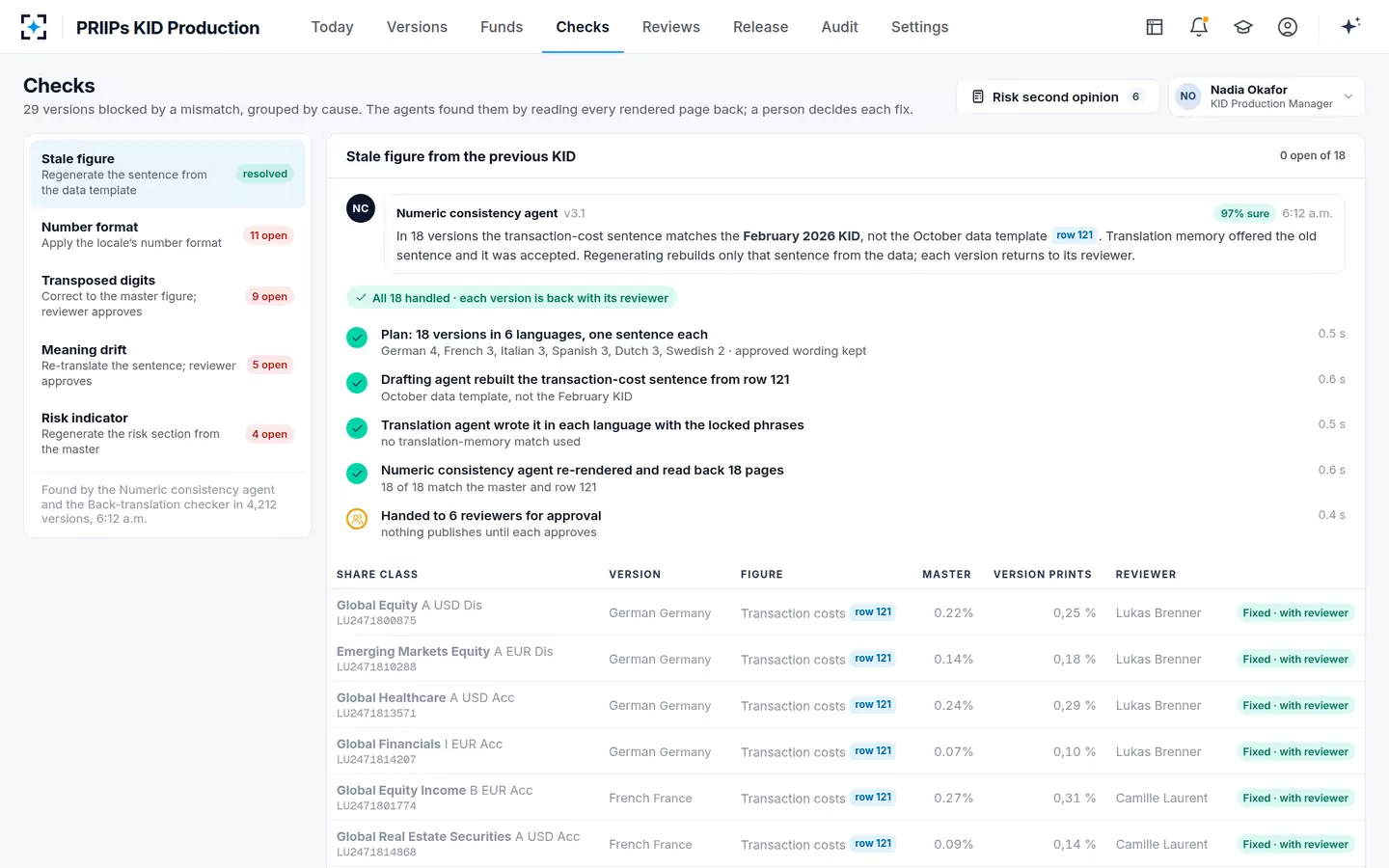
That double appearance is what makes a stale figure dangerous. In the sample range's reissue, the October data file carried new transaction cost figures, but in 18 versions across six languages, German, French, Italian, Spanish, Dutch and Swedish, the transaction-cost sentence still matched the February 2026 KID, because translation memory had offered the old sentence and the linguist had accepted it. The totals were new; the line above them was old. A reader adding up the table would find it did not add up.
PRIIPs KID Production finds eighteen stale transaction-cost sentences and fixes them by cause
How to evidence each input, and where PRIIPs KID Production checks it
A transaction cost figure is only as good as the file behind it, and most of that file sits outside the KID team. The checks below can be run at each annual cost calculation, which point 79 requires at least once a year, and again whenever a reissue changes the cost section.
Evidence a reviewer should be able to open for every transaction cost figure
- Three years of trades, all of them
Point 7 averages all transactions; a sample or a missing quarter changes the figure.
- The arrival price used for each trade, and why
Which step of the point 14 cascade applied, with the timestamp of transmission where one exists.
- The explicit costs on their own
Commissions, taxes and execution fees over the same three years: the floor under the printed figure.
- The anti-dilution deduction, gross and net
Point 11(c) caps it at the explicit costs; show whether the cap applied.
- The basis for any estimate
Fund age, turnover estimate and the reference spreads for point 21, or the point 23a condition relied on.
- The same figure in every version
Read back from each rendered language version, not from the data file, after translation.
PRIIPs KID Production does not replace the calculation provider. Its Risk and scenario agent recomputes costs over time from the cost data as a second opinion and sends any disagreement to product governance; its Numeric consistency agent reads every rendered version and proves each figure, including the transaction cost line and the totals that contain it, against the master and the data row. The other half of the cost section is covered in a test of how well your checks catch cost errors, and the data file it comes from in the guide to the European PRIIPs Template. To see the whole reissue, start from PRIIPs KID Production.
Questions people ask
What are implicit costs in a PRIIPs KID?
Implicit costs are the part of transaction costs that has no invoice: the bid-ask spread and the market impact of a trade, captured by comparing the execution price with the arrival price. Explicit costs are the commissions, taxes and fees paid to execute the trade. Since 2023 the transaction cost figure in an EU KID may not be lower than the explicit costs alone.
What is reduction in yield in a PRIIPs KID?
Reduction in yield is how the KID turns total costs into a yearly rate: the difference between the investment's annual internal rate of return without costs and with them (Annex VI, point 70). The KID labels it "annual cost impact". For one-year figures a 0% net performance is assumed; for longer holding periods the moderate scenario's performance is used.
Is the limit price the arrival price for a limit order?
No. The ESAs' Q&A says the Annex does not treat limit orders differently, so the arrival price is still the mid-market price when the order was transmitted, with the same fallbacks as any other order.
How does a fund launched last year calculate transaction costs?
It combines its actual costs for the longest multiple of six months it has operated with a standardised estimate for the rest of the three years, based on its estimated turnover in each asset class and half the reference bid-ask spread. The estimate must be consistent with the investment policy in year one and with actual turnover after that.
Why is the UK transaction cost figure lower than the EU one for the same fund?
Because the UK product summary shows explicit transaction costs only, and the FCA treats the bid-ask spread as an implicit cost. The EU KID adds implicit costs measured by the arrival-price method, so for the same trades its figure is usually higher.
How often must PRIIPs transaction costs be recalculated?
The cost figures must be calculated at least once a year (Annex VI, point 79), on the three-year average of point 7, and the KID itself must be reviewed at least every 12 months and after any significant change. A material change in trading, such as a new strategy, can justify an estimate until reliable figures exist (point 81).