The European PRIIPs Template (EPT) is the industry's standard data file for PRIIPs: one line per share class, carrying the figures a key information document needs, from the summary risk indicator and the four performance scenarios to every cost line, so that a fund's manager or administrator can pass them to whoever builds the KID or, for insurers' multi-option products, to whoever builds the insurer's own document. It is a format, not a regulation: the obligations sit in Regulation (EU) No 1286/2014 and Delegated Regulation (EU) 2017/653, and the file is how their outputs travel. That makes the file the first test of whether KID drafting can be automated. If a field is missing, stale or inconsistent with its neighbours, an automated draft will print the error in every language. Botminds' PRIIPs KID Production reads the file on arrival, checks it field by field against the previous KID, holds any share class whose line is incomplete and pins every figure in every KID to its row.
The examples come from a fictional sample range, Quillfield Global Funds SICAV, whose administrator delivers an EPT version 2.1 file, as it runs through the solution. The rules each field serves are quoted from the consolidated Delegated Regulation on EUR-Lex.
Ten fields that decide whether automated KID drafting is safe: a readiness scorecard
- Identifiers that match the prospectus
ISIN, share class name, currency, fund and umbrella, exactly as the KID must state them (Delegated Regulation, Art. 1).
- A reference date for every calculated figure
Risk, scenarios and costs each carry the date they were calculated, so a stale value can be told from a current one.
- Category and recommended holding period
The PRIIP category decides the method; the holding period sets the columns of the scenario and cost tables.
- Market risk and credit risk classes, not only the SRI
With the VaR-equivalent volatility behind the market class, so the indicator can be checked (Annex II).
- Scenario values at every holding period shown
Stress, unfavourable, moderate and favourable, in money and as yearly returns, with the period each occurred in (Annexes IV–V).
- Total costs and annual cost impact per holding period
The "Costs over time" figures, consistent with the moderate scenario used to compute them (Annex VI, points 70–71).
- Every composition line, including the zeros
Entry, exit, management and other costs, transaction costs, performance fees: a blank is not a zero (Annex VII).
- Explicit transaction costs on their own
Needed to check the floor under the transaction cost figure and, for UK classes, the product summary (Annex VI, point 8a).
- Amounts and percentages that agree
Each cost in euros on €10,000 and in percent, so one can be checked against the other.
- Where past performance and previous scenarios are published
The links and the number of years that "Other relevant information" must state (Art. 8(3)).
What is the European PRIIPs Template (EPT)?
The EPT is a data exchange format that the fund industry built so that one fund's KID figures could be passed in a standard shape to many recipients. Its most demanding users are insurers. An insurer offering a unit-linked policy with dozens of underlying funds must produce its own KID or a generic KID with a specific information document for each fund option (Delegated Regulation, Arts. 10 and 14), and for each option it needs the fund's risk indicator, scenarios and costs. The costs of underlying funds also flow into the investing product's own figures: where a product invests in a UCITS or AIF, the underlying's "most recently available summary cost indicator figure shall be used" (Annex VI, point 5(l)(i)).
Regulation is now moving towards data of its own. In their 2022 advice the European Supervisory Authorities recommended "that it should be required under the PRIIPs Regulation for the KID to be prepared in a machine readable form" (ESAs, advice on the PRIIPs Regulation, JC 2022 20). The European single access point brings part of that into law: from 10 January 2028 a manufacturer publishing a KID must submit it at the same time to a collection body for the access point, "in a data extractable format" or, where Union law requires, a machine-readable one, with its legal entity identifier (Regulation, Art. 29a). The UK's new regime requires a machine-readable file for its product summaries (FCA PS25/20). None of these replaces the EPT, which carries the inputs between firms; they add an output that must agree with it.
Is the EPT a regulatory requirement?
No. The KID is required; the EPT is not. Article 5(1) of the Regulation obliges the manufacturer to draw up and publish a KID before the product is made available to retail investors (PRIIPs Regulation), and the Delegated Regulation sets every figure it must contain. How those figures move between administrator, manufacturer, KID producer, distributor and insurer is left to the market, and the EPT is the format most of the fund market uses.
That distinction matters for accountability. A manufacturer whose KID prints a wrong figure from the EPT has published a wrong KID; where the file came from is not a defence. The quality of the file is therefore a manufacturer's problem even when an administrator or a third-party calculator produces it.
Every KID figure starts as a data field
Most of the KID is a rendering of the file. The table maps the KID's calculated content to the kind of field that carries it and the rule that defines it, so a gap in the file can be read as a gap in the KID.
From the data file to the KID: what each field becomes
In the data file: Market risk class with its VEV; credit risk class; summary risk indicator; any upward adjustment
In the KID: The 1–7 indicator, highlighted, with its narrative and warnings (Annexes II–III)
In the data file: Recommended holding period in years; PRIIP category
In the KID: The holding period under the indicator and in the scenario and cost table columns
In the data file: Four scenario values at one year and at the holding period, yearly returns, the period each occurred, benchmark if used
In the KID: The scenario table and Element E's "This type of scenario occurred" sentences (Annexes IV–V)
In the data file: Total costs and annual cost impact at each exit point
In the KID: Table 1 of the cost section (Annex VII)
In the data file: Entry, exit, management and other, transaction and incidental costs, in percent and amount
In the KID: Table 2, with its prescribed descriptions (Annex VII)
In the data file: Links to past performance and to previous scenario calculations; years of past performance
In the KID: "Other relevant information" (Art. 8(3) of the Delegated Regulation)
What is not in the file is just as instructive. The product description, the objectives, the target market, the depositary and the complaints details come from the prospectus, the product master and the registration matrix. A KID process that treats the data file as the whole input will draft the numbers correctly and the words from last year.
A good line and a bad line in the same file
The difference between a file that can be drafted from and one that cannot is rarely a missing column; it is a line whose values do not agree with each other. The two lines below have the same fields; only one can be trusted.
Two share classes in one data file: one ready, one not
Ready
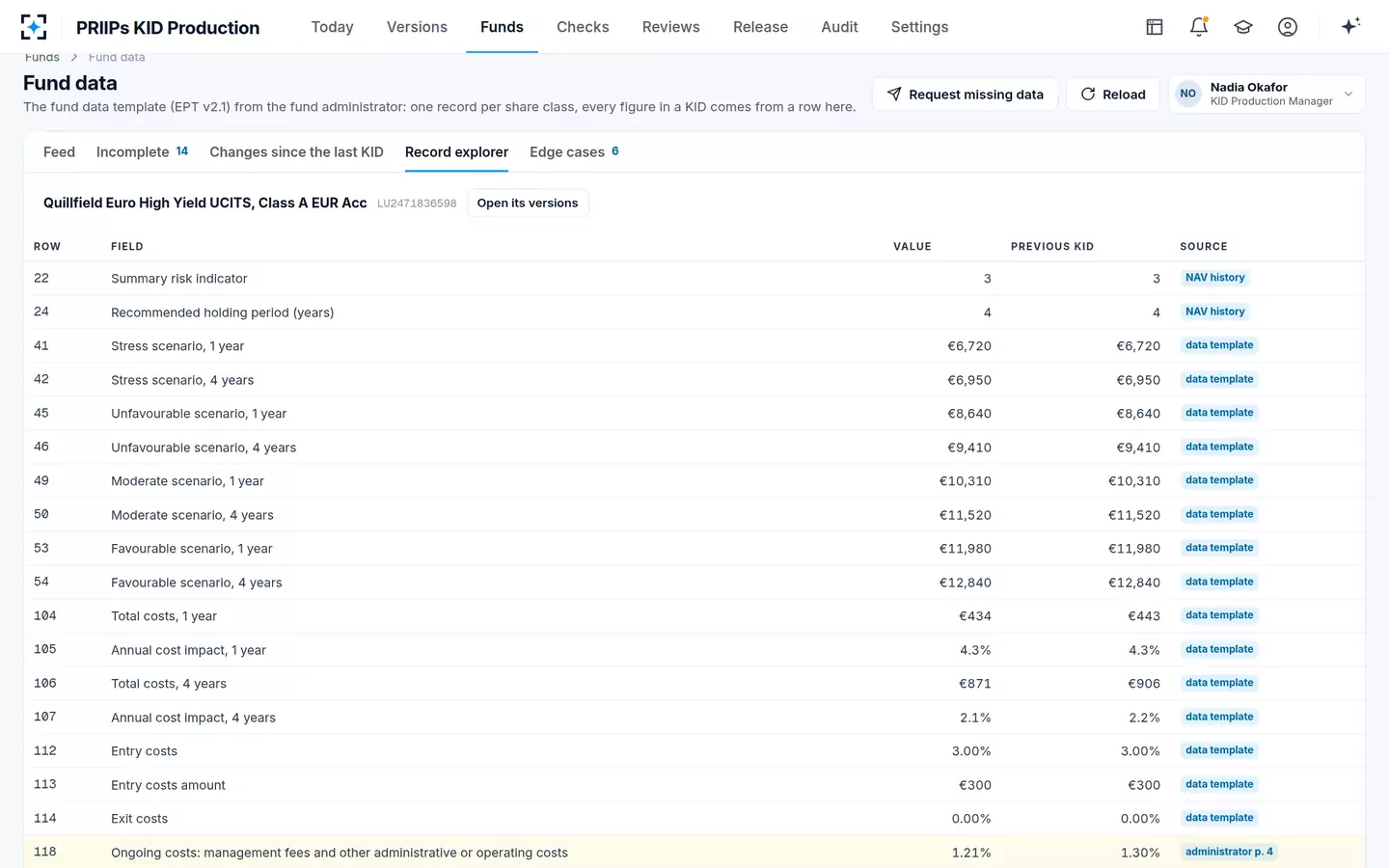
Euro High Yield, Class A EUR Acc
- Risk indicator 3, holding period 4 years, reference date this cycle
- Moderate scenario €11,520 at 4 years and 3.6% a year: consistent
- Ongoing costs 1.21%, changed from 1.30% after the fee review, with its source
- Total costs €434 at 1 year, equal to the composition lines
- Exit costs 0.00%, stated, not blank
Not ready
A constructed example
- Risk indicator present, market and credit risk classes blank
- Scenario values dated last cycle, costs dated this cycle
- Transaction costs below the explicit costs on the same line
- Total costs that do not equal the sum of the composition lines
- Performance fee blank: none, or missing?
Dates and versions: the fields nobody checks
A KID can be compliant on the day it is calculated and wrong a month later, so the dates in the file carry as much weight as the figures. Scenarios must be recalculated "at least on a monthly basis" (Annex IV, point 11), cost figures at least once a year (Annex VI, point 79), the market risk class monitored against a four-month rule (Annex II, point 53), and the KID reviewed at least every 12 months (Art. 15). A file in which each figure carries its own calculation date lets a reviewer, or an agent, see that last month's scenario has been paired with this month's costs.
The document date matters too. The KID must show "the date of the document" at the top (Regulation, Art. 8(3)(a)), and an investor may ask for earlier versions of a revised KID (Art. 14(5)). Keeping each delivered file, and knowing which file each published version was drawn from, is how a manufacturer answers the question "what did the KID say on 1 March, and why?"
The data file on arrival in PRIIPs KID Production: every field beside the previous KID
EPT vs EMT: two files, two jobs
The two templates travel together and answer different laws. The EPT carries what the PRIIPs KID needs: risk indicator, scenarios and PRIIPs cost figures. The European MiFID Template (EMT) carries what a distributor needs under MiFID II: the target market and the cost and charges information for its own client disclosures. A distributor usually wants both for the same share class, and the two must not contradict each other where they overlap, such as ongoing costs.
For a KID producer, the EPT is the input that matters, and the overlap is a free consistency check: an ongoing cost figure that differs between the two files for the same share class is a question to put to the administrator before either reaches a document.
When the file arrives incomplete: hold the share class, name the field, ask once
An incomplete line should stop its share class, not the cycle and not the draft. In the sample range's November reissue, the administrator's file arrived at 6:05 p.m. on 13 October with 612 lines, of which 598 were complete. The next day the drafting agent built 598 English masters and held 14 share classes, whose new classes had no transaction costs or performance history yet; the fund data analyst saw the 14 by missing field and sent one request to the administrator.
One file on arrival in the sample reissue
612
share class lines in the administrator's file
598
complete: drafted the next day
14
held, each with its missing fields named
22
key figures per master, each pinned to its row
The alternative, drafting around a gap, is how a KID ends up with a blank where a cost should be, or with last cycle's figure in place of the missing one. A process should treat a missing field as a reason to hold, and should record who was asked for it and when.
Scoring your data's readiness for automated KID drafting
Use the ten-field scorecard at the top of this guide on your last delivered file, for every share class, not a sample. The result usually falls into one of three bands, and each band has a different next step.
What the readiness score means, and what to do next
| Result | What it usually means | Next step |
|---|---|---|
| All ten fields at 2 for every share class | The file is complete, dated and internally consistent | Automated drafting with every figure checked against the file and the rendered versions |
| Some fields at 1 | Values present but not checked, usually dates and amount-percentage pairs | Add arrival checks on those fields before drafting from them |
| Any of the first nine at 0 | Missing risk detail, scenarios, cost lines or dates | Hold the affected share classes and agree the missing fields with the administrator |
What to ask of a tool that reads the EPT, and where PRIIPs KID Production fits
A tool that imports the file is not the same as one that checks it. Ask whether it compares each line with the previous KID and shows what changed and why; whether it checks lines for internal consistency, totals against composition, amounts against percentages, transaction costs against explicit costs; whether it holds an incomplete share class instead of drafting around it; and whether every figure in every language version can be traced back to its row. Ask, too, what it does with figures it cannot verify from the file alone, such as a risk class: a good answer is a recalculation from NAV history that a person reviews, not a silent acceptance.
PRIIPs KID Production does each of those things on the sample range: the file is validated on arrival, incomplete share classes are held with the missing fields named, the drafting agent never invents or rounds a figure, the risk and scenario agent recomputes from NAV history as a second opinion, and the numeric consistency agent proves each printed figure against its row. It does not produce the EPT; your administrator or calculation provider still does, and the ESAs' Q&A explains how many of its figures are calculated (JC 2023 22). The same data also feeds the transaction cost line and the UK product summary; PRIIPs KID Production shows the whole cycle.
Questions people ask
What is an EPT file in PRIIPs?
It is a European PRIIPs Template file: a standard data file, usually a spreadsheet or CSV with one line per share class, carrying the figures a PRIIPs KID needs, such as the risk indicator, performance scenarios and costs. Fund managers and administrators send it to KID producers, distributors and insurers.
Who produces the EPT?
Usually the fund's manager, its administrator or a calculation provider working for it. The manufacturer remains responsible for the KID built from it, whoever produced the file.
What is the difference between the EPT and the EMT?
The EPT carries PRIIPs KID figures; the European MiFID Template carries the target market and cost information distributors need under MiFID II. Both are industry formats, and where they overlap, such as ongoing costs, they should agree.
Is the EPT required by the PRIIPs Regulation?
No. The Regulation and its technical standards require the KID and define its figures; the EPT is the market's format for exchanging them. A KID can be produced without one, but most fund KIDs and insurers' multi-option KIDs depend on it.
How often should the EPT be updated?
Whenever a figure in the KID would change: scenarios are recalculated at least monthly, cost figures at least once a year, the risk class is monitored monthly under a four-month rule, and the KID is reviewed at least every 12 months. Each figure should carry its own calculation date.
What happens to a KID when an EPT field is missing?
It cannot be completed correctly, so its share class should be held until the field arrives. In the sample range, 14 of 612 share classes were held on arrival with their missing fields named, and the other 598 were drafted the next day.