An ETF platform ICAV is an existing Irish umbrella fund, usually an Irish Collective Asset-management Vehicle authorised as a UCITS, whose board, management company and service providers host sub-funds for outside managers; a manager joins it by adding a sub-fund, while launching an own umbrella means authorising a new ICAV, appointing or becoming its management company and contracting every provider. The Central Bank of Ireland's published service standards set the comment clock on both routes: 10 working days for initial comments on a fast-track application such as a non-complex sub-fund, 20 for a non-fast-track one such as a new umbrella. In 2025 the Central Bank authorised 654 UCITS, and its funds authorisation work took 91 calendar days on average. Botminds' Fund Launch Management has a playbook for an Irish or Luxembourg UCITS sub-fund, so either route runs as dated steps with owners, from the board's approval to first NAV.
The regulator figures below come from the Central Bank of Ireland, the CSSF, the AMF and ESMA, on their own pages. Product examples come from fictional sample data in the solution.
Two ways to an Irish UCITS ETF, row by row
Sub-fund of a platform ICAV: A new sub-fund of an authorised umbrella: fast track if non-complex or a clone
Your own umbrella ICAV: A new umbrella and its first sub-funds: non-fast track unless a clone umbrella
Sub-fund of a platform ICAV: 10 working days (fast track)
Your own umbrella ICAV: 20 working days (non-fast track)
Sub-fund of a platform ICAV: The platform's, already in place; you are investment manager
Your own umbrella ICAV: Yours to appoint, or a third-party management company you contract
Sub-fund of a platform ICAV: The platform's contracts
Your own umbrella ICAV: You select and contract each one
Sub-fund of a platform ICAV: Per sub-fund approved
Your own umbrella ICAV: €5,000 for a standalone fund; by sub-fund count for an umbrella, capped at €23,000 above 10 sub-funds in one application
Sub-fund of a platform ICAV: Platform board approves you and your changes; leaving means moving the sub-fund
Your own umbrella ICAV: Your board, your timetable; you carry the fixed costs from the first sub-fund
ETF platform ICAV or own umbrella: the short answer
Choose the platform when speed to a first fund and avoiding fixed costs matter more than control; choose an own umbrella when you expect several sub-funds and want your own board and management company. The regulatory difference is narrower than the commercial one: both routes end in a UCITS the Central Bank authorises, and both must meet the same rules for UCITS ETFs.
The clock difference is real but modest at the comment stage. The Central Bank's service standards give initial comments in 10 working days for "clone umbrella, clone sub-fund and non-complex sub-fund" applications and 20 working days for "umbrellas other clones and complex sub-funds," with subsequent comments in five and ten (Central Bank of Ireland). A complex strategy is non-fast track even on a platform, so the platform's advantage is largest for plain strategies.
The bigger difference is what has to exist before the application. On a platform, the umbrella, its board, its management company and its depositary are already approved. On an own umbrella, the UCITS Directive's conditions apply to all of them: a UCITS cannot be authorised if "the management company is not authorised for the management of UCITS in its home Member State," and the authority must also approve the choice of depositary and the fund's instruments (Directive 2009/65/EC, Article 5).
What is an ICAV fund structure?
An ICAV is the Irish Collective Asset-management Vehicle, a corporate fund vehicle created by the ICAV Act 2015 and registered with the Central Bank, which runs a separate process for "ICAV Registration and Post Registration" and lists the Act among the legislation under which it authorises alternative investment funds (Central Bank of Ireland). An ICAV can be a single fund or an umbrella with segregated sub-funds, and it can be authorised as a UCITS or as an alternative investment fund.
For an ETF sponsor the umbrella form is the point. Sub-funds share one board, one management company, one depositary and one set of service agreements, so each new sub-fund is an addition to an existing approval, not a new one. That is what makes a platform possible, and it is also what makes an own umbrella cheaper per fund as it grows.
ICAV ETF: what makes a UCITS an ETF
A UCITS ETF is a UCITS whose units trade on an exchange, and ESMA's guidelines require it to say so. "A UCITS ETF should use the identifier 'UCITS ETF' which identifies it as an exchange-traded fund," used "in its name, fund rules or instrument of incorporation, prospectus, key investor information document and marketing communications," in all EU languages (ESMA Guidelines on ETFs and other UCITS issues, ESMA/2014/937).
The disclosure model is different from the US one. Where Rule 6c-11 makes a US ETF publish its full holdings before every open (Rule 6c-11(c)(1)), ESMA's guidelines require a UCITS ETF to "disclose clearly in its prospectus, key investor information document and marketing communications the policy regarding portfolio transparency and where information on the portfolio may be obtained." An actively managed UCITS ETF must say that it is actively managed and how it will meet its investment policy, and units bought on the secondary market that cannot be redeemed with the fund carry a prescribed warning that investors "may pay more than the current net asset value when buying units / shares and may receive less than the current net asset value when selling them."
Funds authorisation at the Central Bank of Ireland: the process and its clocks
The Central Bank assesses an application within its service standards and comments; the applicant answers; further rounds follow until the application is complete; then the fund is authorised. Its 2025 report adds a point launch planners should note: "As Funds Authorisation relates to the authorisation of products rather than firms, applicants do not approach the Central Bank prior to submitting an application" (Central Bank of Ireland, Authorisations and Gatekeeping Report 2025). The first contact is the application, so it has to be complete.
The Central Bank's comment clocks, and its 2025 average
- Initial comments10 wd
- Subsequent comments5 wd
- Initial comments20 wd
- Subsequent comments10 wd
- Average processing time91 cd ≈ 65 wd
How long does the Central Bank of Ireland take? 91 days on average in 2025
On the Central Bank's own figures, funds authorisation took 91 calendar days on average in 2025, "a slight increase on 2024 (88 days)," with 98 in 2023 (Authorisations and Gatekeeping Report 2025). The same report says the processing time "can vary depending on complexity and if they are atypical," and that in some cases "a level of iteration is required to finalise the application."
Irish fund authorisations in 2025, on the Central Bank's own figures
654
UCITS authorised in 2025, with 26 retail investor AIFs and six retail ELTIFs: 40% more than in 2024
91days
average calendar days to process a funds authorisation in 2025 (88 in 2024)
€23,000
cap on the Additional Supervisory Levy for an umbrella application with more than 10 sub-funds; €5,000 for a standalone fund
The volume is the other half of the story. The Central Bank authorised "654 Undertakings for Collective Investment in Transferable Securities ('UCITS'), 26 Retail Investor Alternative Investment Funds ('RIAIFs') and six Retail European Long-term Investment Funds ('ELTIFs')" in 2025, 40% more than in 2024, and listed "passively managed Exchange-Traded Funds ('ETFs'), actively managed ETFs" among the applications it received. Every one of those applications needed a depositary, an administrator and a management company to be ready at the same time, which is where a platform's existing contracts earn their fee.
The European outer limit is in the Directive itself: the management company or investment company "shall be informed, within two months of the submission of a complete application, whether or not authorisation of the UCITS has been granted" (Directive 2009/65/EC, Article 5(4)). The operative words are "complete application"; the time before an application is complete belongs to the applicant.
UCI approval at the CSSF, and the AMF's one month: the same choice elsewhere
Luxembourg and France run the same platform-or-own decision with their own clocks, and each regulator states them on its own pages. The differences are in what the clock measures.
Three regulators' own words on the clock for a new fund or sub-fund
| Regulator | What it commits to | What its own page warns |
|---|---|---|
| Central Bank of Ireland | Initial comments in 10 working days (fast track) or 20 (non-fast track); subsequent comments in 5 or 10 | Processing time varies with complexity; iteration may be needed |
| CSSF, Luxembourg: new sub-fund | Acknowledges receipt within two working days; "seeks to contact the applicant within 10 working days" with questions | For a new fund, final documents within one month of the end-of-examination letter is reasonable; two months is the maximum |
| CSSF, Luxembourg: initial authorisations | Publishes processing-time statistics in working days, from receipt to decision | "Processing time does not mean time to market" |
| AMF, France | Approval of a new UCITS in one month (about 23 working days); 8 working days for creation by analogy with an existing fund | The clock stops while the AMF waits for information it requested |
The CSSF's approval of a new sub-fund runs on a questionnaire for each sub-fund, and the regulator "seeks to contact the applicant within 10 working days after receiving the application file for feedback" (CSSF). Its published statistics on initial authorisations come with a caution every launch planner should pin up: "Processing time does not mean time to market, as the latter includes upfront preparation and post authorisation work" (CSSF, processing time of initial authorisations).
The AMF's instruction sets "1 mois (Soit environ 23 jours ouvrés)" for the creation of a UCITS and eight working days for a "création par analogie," a fund modelled on an existing one (AMF, Instruction DOC-2011-19). The analogy route is France's version of a clone: the platform advantage again, written into the procedure.
What a UCITS ETF launch costs, and what platforms do not publish
The regulator's charges are public and small. The Central Bank's Additional Supervisory Levy is €5,000 for a standalone fund; an umbrella is levied by the number of sub-funds, and "where the number of sub-funds received in a single application for authorisation of an Umbrella fund exceeds 10, the amount to be charged will not exceed €23,000," with further sub-funds levied as they are approved (Central Bank of Ireland).
The rest is not public. Platform fees, management company fees, depositary and administration fees and the cost of an own board are quoted privately, so no regulator or independent study publishes what a UCITS ETF costs to launch or run. The method on white label ETF cost works the same way here: list the components each route bundles, get the same items quoted by every provider, and price a month of delay alongside.
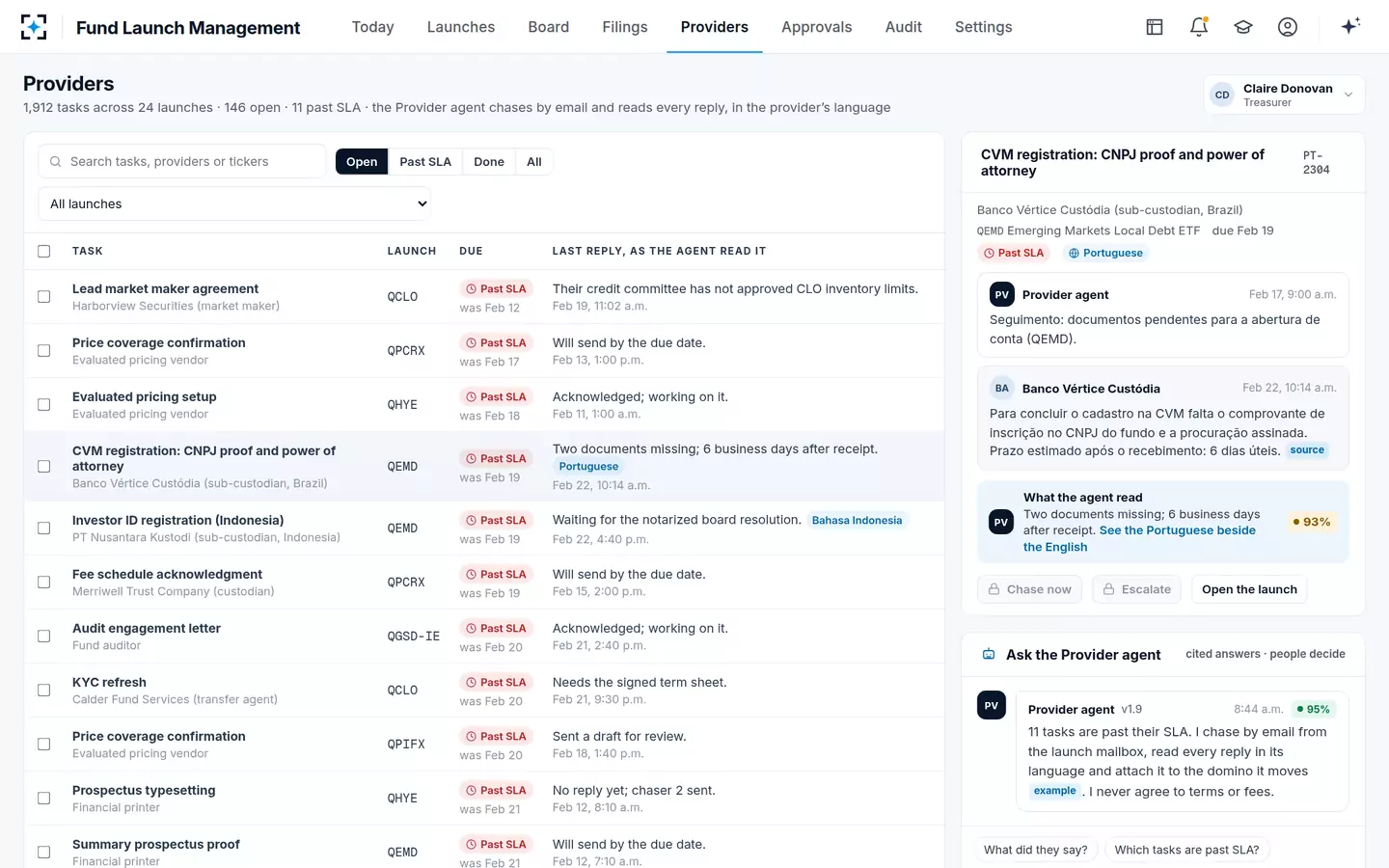
Fund Launch Management: providers in other markets, in their own language
Launching a UCITS ETF as a US manager: what changes
A US manager going to Europe changes more than the regulator. The fund needs a key information document under PRIIPs, required for UCITS since January 1, 2023, which the PRIIPs KID requirements guide covers; the EU's Retail Investment Strategy, which would change those documents, was agreed provisionally on December 18, 2025, with final votes expected in the fourth quarter of 2026 (European Commission call for advice to ESMA); it has not been published in the Official Journal, so its KID changes are not in force. A fund sold to UK retail investors faces the FCA's consumer composite investments regime, for which the FCA has set June 8, 2027 as the full go-live date (FCA PS25/20).
The operating model changes too. The board is in Ireland, the management company carries the regulatory responsibility, and the investment manager is a delegate. Distribution works on the passport: a UCITS authorised in one member state "may be marketed throughout the EU, without further authorisation," in the Central Bank's words (Central Bank of Ireland), but each host market brings its own notification, language and documents; cross-border distribution of funds, in seven numbers sets out that side. A US sponsor used to its own board and a 75-day filing clock should plan for a regulator it cannot pre-clear with and a decision-maker, the management company, that is not itself.
Before you choose: what to settle for a UCITS ETF route
- Fast track or not
Is the strategy non-complex, or a clone of an approved sub-fund? If not, plan for 20 working days of first comments on either route.
- Management company
The platform's, a third party's, or your own authorised one: the Directive will not authorise a UCITS without one, unless it is a self-managed investment company.
- The "UCITS ETF" identifier and transparency policy
In the name, instruments, prospectus, KID and marketing; with where portfolio information is published.
- Market makers and authorized participants on European exchanges
Different firms and listing venues from the US launch.
- KID now, CCI for UK retail by June 8, 2027
And the EU Retail Investment Strategy once it is in the Official Journal.
- Exit terms on a platform
What moving the sub-fund to your own umbrella later requires, and who pays.
Where Fund Launch Management fits on either route
The solution's playbooks include an Irish or Luxembourg UCITS sub-fund alongside the US fund types. On a platform, the Launch Conductor plans the sponsor's side, the term sheet, the investment management agreement, the seed and the market makers, around the platform's dates, and the Provider agent chases the platform and its providers. On an own umbrella it plans the whole sequence, with the Board agent drafting board papers and the Registration agent drafting the prospectus supplement and comment responses for counsel; in the sample, a supplement answering Central Bank comments sits in counsel's queue with the US filings.
Records stay where the fund is: in the sample settings, UCITS sub-fund records are kept in the EU. People keep the decisions on both routes, as they do in the US launches: a launch project manager proposes, the Head of Product approves, counsel signs and the treasurer co-signs seed moves. For the US side of the same choice, see white label ETF cost and how to launch an ETF in the US; the solution is at Fund Launch Management.
Questions people ask
What is an ETF platform ICAV?
An existing Irish ICAV umbrella, authorised as a UCITS, that hosts ETF sub-funds for outside managers under its own board, management company and service providers. The manager usually acts as investment manager of its sub-fund, and the Central Bank reviews the new sub-fund rather than a new umbrella.
How long does Central Bank of Ireland fund authorisation take?
The Central Bank's service standards give initial comments in 10 working days for fast-track applications and 20 for non-fast-track ones. Its 2025 report put the average processing time for funds authorisation at 91 calendar days, against 88 in 2024 and 98 in 2023.
How long does the CSSF take to approve a new sub-fund?
The CSSF acknowledges an application within two working days and seeks to contact the applicant with questions within 10 working days; it does not publish a fixed approval period. Its statistics on initial authorisations come with the warning that processing time does not mean time to market.
Does a UCITS ETF have to publish its holdings daily?
ESMA's guidelines require a UCITS ETF to disclose its portfolio transparency policy and where portfolio information can be found, not daily full holdings. That differs from a US ETF under Rule 6c-11, which must publish full holdings before each day's open.
Can a UCITS ETF be actively managed?
Yes. ESMA's guidelines define an actively managed UCITS ETF as one whose manager has discretion over the portfolio, and require it to say so clearly and explain how it will meet its investment policy, including any intention to outperform an index. The Central Bank's 2025 report lists actively managed ETFs among the applications it received.