A white label ETF costs what the platform charges for renting its trust, board, compliance program and service-provider contracts, usually a fee tied to the fund's assets with minimums, plus the costs that stay with the sponsor whatever route it takes: seed capital, the investment team, the market maker and authorized participants, and the months before the fund earns anything. Platforms do not publish their prices, so no regulator or independent study can tell you the white label ETF cost for your fund; what the public record does give is the inputs, from the SEC's own hour and cost estimates to the arithmetic of a month's delay. Botminds' Fund Launch Management sits inside either route, planning each launch, drafting filings and board materials for counsel and the board, and chasing the outside parties, so it changes the hours a launch takes, not who owns the trust.
This page sets out the three options side by side, the public inputs, and the questions to put to any provider. Sample figures come from a fictional launch in the solution, Quillfield Short Duration Muni ETF; regulatory figures come from the SEC, linked where they appear.
The hours the SEC estimates for the filings a new ETF makes
White label ETF meaning: whose fund is it?
A white label ETF is a series of someone else's trust. The platform owns the trust, appoints its board and officers, runs its compliance program and holds the contracts with the administrator, custodian, transfer agent and distributor; the sponsor brings the strategy and the brand and becomes the fund's adviser or sub-adviser. The fund carries the sponsor's name, but legally it is a series of the platform's registrant.
That distinction matters in three places. The platform's board, not the sponsor, approves the advisory contract under section 15(c) and can decline to renew it. The platform's chief compliance officer reports to that board under Rule 38a-1, which requires a fund to adopt compliance policies, review them every year and have its compliance officer give the board a written report at least once a year (17 CFR 270.38a-1). And leaving the platform later means moving the fund into another trust, a reorganization with its own board findings and shareholder questions, which the Rule 17a-8 guide covers.
The structure exists because scale matters in this business. In 2019 the SEC counted 81 ETF sponsors with about 1,978 ETFs; the median sponsor ran six funds, and "the top five sponsors operate a combined 965 ETFs, whereas the bottom half of sponsors operate only a combined 118 ETFs" (SEC, Exchange-Traded Funds, 84 FR 57162). A sponsor with one or two funds carries a trust's fixed costs across very few assets, and that is the cost a platform spreads.
How much does it cost to start an ETF? The public inputs
The public record does not give a price, but it gives most of the inputs. Some are hours, some are dollars, and one large cost, the order the SEC used to require, has gone.
Before Rule 6c-11, a sponsor's first ETF needed an exemptive order: SEC staff put the direct cost of a typical application at about $100,000, mostly legal fees, and the median wait for unleveraged ETFs at 213 days (84 FR 57162). Since December 2019 a transparent ETF that meets the rule's conditions needs neither, which removed one of the strongest reasons to rent someone else's order and trust.
What remains is mostly people and providers. Registration on Form N-1A carries an SEC estimate of 297.7 burden hours per response; a closed-end fund on Form N-2, 344; a listing on Form 8-A, three. The SEC priced its own website-disclosure estimate using hourly rates such as $365 for a compliance attorney and $331 for a senior programmer in 2019 (84 FR 57162, Table 11). Multiply hours by your own rates and the filings are the small part; the board, the compliance program and the service-provider minimums are the large part, and those are exactly what a platform bundles.
Three routes to a new ETF, component by component
Trust, board and officers
A · White-label trustThe platform's: its board approves you as adviser or sub-adviser
B · Own trustYours to form and staff, with at least 40% independent trustees
C · Own trust with agentsYours; agents draft the board materials, people vote
Chief compliance officer and program
A · White-label trustThe trust's CCO and Rule 38a-1 program
B · Own trustYours to appoint and run
C · Own trust with agentsYours; agents keep the evidence each control produces
Registration and filings
A · White-label trustPlatform counsel files a 485(a) series; you review
B · Own trustInitial Form N-1A, then 485(a) for each new series
C · Own trust with agentsSame filings; agents draft from the last filing, counsel signs
Service providers
A · White-label trustPlatform's administrator, custodian, transfer agent, distributor
B · Own trustYou select and contract each one
C · Own trust with agentsYou contract; agents chase setups and read replies
Lead market maker and authorized participants
A · White-label trustOften through the platform's relationships
B · Own trustYou recruit and sign
C · Own trust with agentsYou sign; agents track agreements and the creation test
Launch project management
A · White-label trustShared between your team and the platform's
B · Own trustYour team
C · Own trust with agentsYour team, with agents planning and re-planning
Seed capital
A · White-label trustYours or a seed provider's, on the platform's minimums
B · Own trustYours or a seed provider's
C · Own trust with agentsSame; two signatures on every move
Price
A · White-label trustA platform fee, often tied to assets, plus minimums; not published
B · Own trustFixed people and provider costs you carry from the first fund
C · Own trust with agentsRoute B's fixed costs, less the hours agents take
How much does it cost to run an ETF after launch?
Running costs split the same way. On a platform they are mostly the platform fee and the sponsor's own investment team; in an own trust they are the board's fees, the compliance officer and program, the administrator, custodian and transfer agent, audit, legal, the exchange's listing fees and the website and data work the rules require. The SEC's estimate for the website alone was 19.25 internal hours a year per ETF plus $1,000 of external cost, with a once-in-a-lifetime premium-or-discount statement it expected every ETF to need (84 FR 57162).
The board is the cost a sponsor cannot shrink below a floor. The statute caps interested persons at 60% of a fund's board (15 U.S.C. 80a-10(a)), and exemptive rules commonly expect a majority of independent directors, so an own trust pays independent trustees from its first fund. The administrator's fees, and what oversight of the administrator costs on top, are worked through in fund administration fees.
The fund pays many of these as expenses, not the sponsor; but a new fund's expenses, spread over a small seed, would make its expense ratio uncompetitive, so sponsors commonly cap them and absorb the difference. In the sample, the board approved a 0.24% expense cap on November 9. Under Form N-1A, a fee table can show such a waiver only if it will reduce expenses for at least one year from the registration statement's effective date (SEC Form N-1A), so the cap is a cost the sponsor commits to before the fund has a single outside investor.
What does a month of launch delay cost?
A month late is a month of fees that never arrive, on seed money that is already committed. The product's own estimate makes it concrete: a $50 million launch at a 50 basis point fee earns about $21,000 a month, so every month it reaches first NAV late is roughly $21,000 the sponsor does not get back.
Pricing one month of delay
Fees forgone per month
Assets at launch × annual fee ÷ 12
$50,000,000 × 0.50% ÷ 12 ≈ $20,833: the estimate in Fund Launch Management's product notes.
Expense cap absorbed
(Expenses − cap) × assets, while the cap runs
Unchanged by delay, but it starts later, so the sponsor pays it for longer before assets grow.
Seed carried
Seed × the sponsor's cost of capital ÷ 12, per month committed and idle
Your own treasury rate; the sample's seed is $25.0 million.
Fixed launch costs
People, counsel and provider fees already spent
Not saved by the delay; spread over a later start.
The arithmetic is why the cheapest route can be the expensive one. A platform that is slower to set up a new series, or an own trust whose team finds out about a late custodian step on the weekly call, can lose more in a month than the difference in fees across a year.
Where agents change the numbers, and where they do not
Agents change the hours of launch work, not the fixed structure. They do not replace a board, a chief compliance officer, counsel, a custodian or an authorized participant; the law assigns those roles to people and regulated firms. What they replace is the coordination: the status call, the tracker, the chasing, the drafting from the last filing and the reconciling of reject files.
Where a launch project manager's week goes, by hand and with agents
By hand · 36 hours a week
- Chasing providers by email · 33%
- Status call and tracker · 22%
- Working out what a late step knocks over · 14%
- Collecting evidence for each step · 11%
- Re-planning and getting it signed · 11%
- Committee report · 8%
With the solution · 9 hours a week
- Chasing providers by email · 33%
- Status call and tracker · 17%
- Working out what a late step knocks over · 11%
- Collecting evidence for each step · 11%
- Re-planning and getting it signed · 22%
- Committee report · 6%
That estimate is the product's own, and a buyer should test it on a launch in flight rather than take it on trust. What it shows is the shape of the change: the absolute hours fall, and the share spent re-planning and getting decisions signed rises, because that is the part only a person can do. In route A the saving accrues partly to the platform; in routes B and C it accrues to the sponsor, which is where it can tip the economics of running an own trust.
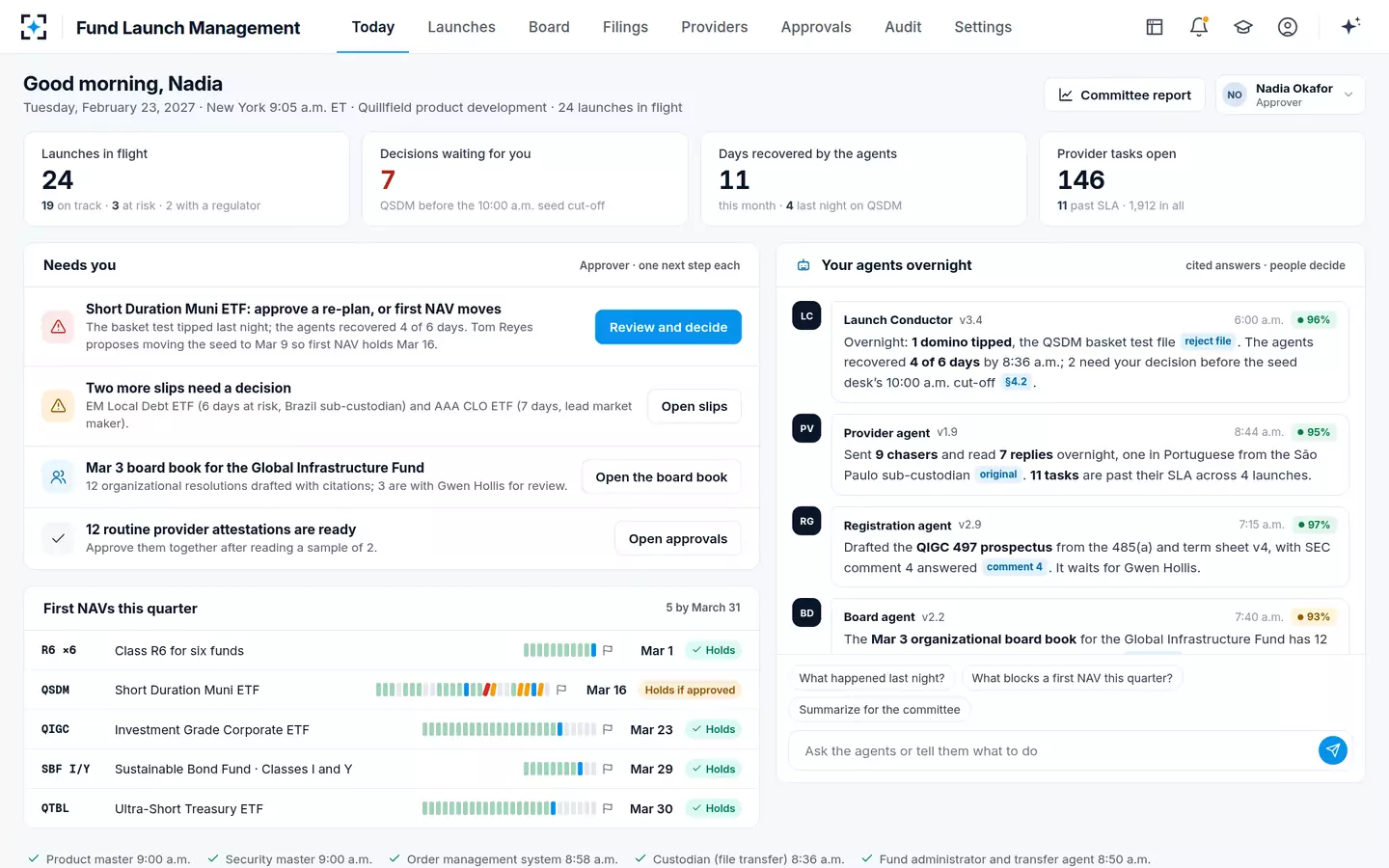
Fund Launch Management: 24 launches, one morning
White label ETF providers: what to ask for in a quote
Because prices are not published, the comparison is only as good as the questions. Ask every platform, and price your own trust against, the same list, and ask for the answers in writing.
Costs a white label quote often leaves out
- Minimum fees and how long they run
A fee tied to assets is cheap at scale and expensive at $25 million.
- Who pays for the lead market maker and authorized participants
And whether the platform's relationships come with conditions.
- Seed requirements and the seed exit
The sample's seed exits only above $150 million of assets, over 12 months, with the portfolio manager.
- Expense cap commitments
At least a year under Form N-1A's fee table rules, often longer by agreement.
- Time to file a new series, and to effectiveness
The 75-day clock is fixed; the platform's queue before it is not.
- What leaving costs
Moving a fund to another trust is a reorganization with board findings and possibly a shareholder vote.
- Who owns the data and the launch record
Board materials, filings, basket records and the audit trail, if you leave.
Then put the answers into the same model as your own-trust option, with the month-of-delay line included. If the own-trust route is close, the deciding factor is usually how many launches a year the sponsor expects, because the board and compliance program are fixed and the launch work is not. Fund launch services or agents lists what a sponsor must bring to any route, and the Irish UCITS equivalent of this choice is in ETF platform ICAV or your own umbrella.
Where Fund Launch Management fits in each route
In route A, the solution runs the sponsor's side of the launch: its term sheet, its seed, its portfolio manager's basket, its market maker and authorized participants, and the questions it sends the platform, each as a dependency with a date. In routes B and C it runs the whole launch: the Board agent drafts resolutions and the board book from the precedent library, the Registration agent drafts N-1A sections from the last filing for counsel to sign, the Listing agent prepares the Form 8-A, and the Basket and Provider agents handle the custodian and the outside parties.
In all three, people keep the decisions. A launch project manager proposes plans and re-plans, the Head of Product approves them, counsel alone signs filings and the treasurer co-signs every seed move. The design target is that no launch misses first NAV because of a dependency nobody saw. Every filing and seed move is signed by a second person with its evidence. The solution is at Fund Launch Management, and how to launch an ETF in the US sets out the steps every route shares.
Questions people ask
How much does a white label ETF cost?
Platforms do not publish prices, and no regulator or independent study collects them. A quote usually combines an asset-based fee with minimums; compare it with your own trust's fixed costs (board, compliance officer, administrator, counsel) and with the fees each month of delay forgoes, about $21,000 a month on a $50 million fund at 50 basis points.
Who is the issuer of a white label ETF?
The platform's trust is the registrant and issuer; the fund is one of its series. The sponsor is usually the adviser or a sub-adviser under a contract the platform's board approves under section 15(c), and the platform's compliance officer reports to that board.
Do you still need an exemptive order to launch an ETF?
Not for a transparent ETF that meets Rule 6c-11, effective December 23, 2019. Before the rule the SEC estimated a typical application cost about $100,000 and took a median 213 days for unleveraged ETFs; non-transparent active ETFs still need their own relief.
Is it cheaper to launch an ETF in your own trust?
Per fund, usually only at scale. An own trust carries a board with independent trustees, a compliance officer and provider minimums from its first fund; a platform spreads those across many sponsors. The answer turns on how many funds you expect to launch and how much you value control of the board relationship.
Can agents replace a white label platform?
No. Agents do not provide a trust, a board, a compliance officer or counsel. They take the coordination and drafting work out of a launch, which lowers the cost of running your own trust but does not remove its fixed parts.