To launch an ETF in the US, a sponsor needs an investment adviser, a registered open-end trust with a board, and a new series added to that trust: the board approves the series and its advisory contract, counsel files a post-effective amendment under Rule 485(a) that goes effective 75 days later, the fund relies on Rule 6c-11 instead of an exemptive order, and the shares are listed on an exchange and registered on Form 8-A. Around that legal spine sit the steps that usually decide the date: the custodian, administrator and transfer agent, the lead market maker and authorized participants, the basket files, the seed money and the website disclosures the rule requires from day one. Botminds' Fund Launch Management plans that whole path from the product committee to first NAV, watches every outside step, and shows what a late one knocks over the night it slips.
The dates below come from a fictional sample launch as it runs through the solution, Quillfield Short Duration Muni ETF, a new actively managed series in an existing trust. The rules and counts come from the SEC and its EDGAR data, linked where they appear.
The SEC's 75 days are when the operational work has to happen
- Committee to filing36 d
- 485(a) clock75 d
- Effective to first NAV28 d
- Before providers start72 d
- Providers, listing, pricing46 d
- Basket, creation test, seed14 d
- Dry run to first NAV7 d
How to launch an ETF in the US: the steps in order
An ETF launch in an existing trust runs in roughly ten steps, and only three of them are fixed by rule. The rest are contracts, files and tests with outside parties, and the order matters because each one feeds the next.
From the product committee to first NAV: who acts at each step
A person decides
Product committeeApproves the term sheet: strategy, fee, share class, seed, target first NAV.
A person decides
Board of the trustApproves the new series, the advisory contract under section 15(c), fees and any expense cap, and the service agreements.
A person decides
Fund counselFiles the Rule 485(a) amendment adding the series; answers SEC staff comments; files the final prospectus under Rule 497.
Agent
Service providersCustodian, administrator, transfer agent and distributor accounts and setups; pricing coverage for every holding.
Never: agree terms or fees for the sponsor
Agent
Exchange and listingTicker, CUSIP, listing application, clearing eligibility, then Form 8-A once the exchange certifies.
Agent
Basket and creation testBasket files built and tested with the custodian; an authorized participant runs a creation test.
Never: change the basket a portfolio manager set
A person decides
Seed and first NAVTreasury funds the seed creation; NAV dry runs; Rule 6c-11 website live before the first open.
The order is not arbitrary. The board vote comes before the filing because the prospectus describes contracts the board has approved. The listing and clearing steps come before the basket test because an authorized participant cannot create shares that cannot settle. And the seed comes last among the money steps because, in an ETF, new shares are issued only as creation units to authorized participants: the seed is an authorized participant's creation like any other (Rule 6c-11(a)).
Can anyone launch an ETF? What must exist before day one
Not anyone, but more firms than before 2019. An ETF is a registered investment company, so it needs an investment adviser under a written contract, a board of directors or trustees, and a registration statement. What changed in 2019 is that a sponsor no longer needs its own exemptive order to operate an ordinary transparent ETF.
Before Rule 6c-11, every ETF sponsor applied for an order. The SEC counted more than 300 such orders granted over a quarter of a century, put the direct cost of a typical application, mostly legal fees, at about $100,000, and found that for unleveraged ETFs between January 2007 and early April 2019 "the median processing time from the filing of an initial application to the issuance of an order was 213 days" (SEC, Exchange-Traded Funds, 84 FR 57162). The rule, effective December 23, 2019, removed that step for funds that meet its conditions.
The board is the part new sponsors underestimate. The statute caps interested persons at 60% of a fund board (section 10(a)), and the advisory contract must be approved by a majority of the independent directors voting in person at a meeting called for the purpose (section 15(c)). A sponsor without its own trust usually launches as a series of someone else's, which is the white label ETF route, priced on its own page.
Two kinds of ETF still need more than the rule. Leveraged and inverse ETFs must comply with the derivatives rule as well, and actively managed ETFs that do not publish their holdings daily cannot use it at all: "Because these non-transparent ETFs do not provide daily portfolio transparency, they would not meet the conditions of rule 6c-11," the SEC wrote, and they operate under their own exemptive orders (84 FR 57162).
The board's two meetings: approving the series, then the arrangements
The first board meeting approves what the fund is; the second, in many trusts, approves how it will trade. In the sample launch the board approved the series, the advisory contract and the fees on November 9, twelve days after the product committee, and approved the lead market maker, the authorized participants and the basket policies on February 17.
The first meeting needs a full section 15(c) record: the adviser furnishes, and the independent directors evaluate, the information reasonably necessary to judge the contract's terms. For a new fund there is no performance to show, so the record leans on the fee and expense cap, the adviser's services and its costs. That record is the same one the board will renew each year, and it is kept for six years under Rule 31a-2.
The second meeting is where Rule 6c-11's conditions land. The fund must have written policies and procedures for how its baskets are built and accepted, and if it will use custom baskets, those procedures must set detailed parameters and name the titles or roles of the adviser's employees who review each one (Rule 6c-11(c)(3)). A launch that schedules this meeting after the first creation test has the order backwards.
How long does it take to launch an ETF? The 75-day clock
For a new series of an existing trust, the regulatory floor is 75 days from filing. Under Rule 485(a)(2), an amendment that adds a series takes effect 75 days after filing, or on a later date the registrant picks, up to 95 days after filing; the SEC may declare it effective earlier (17 CFR 230.485). Add the board and drafting time before the filing and the operational tail after effectiveness, and the sample launch took 139 days from product committee to first NAV.
A sponsor with no trust at all files an initial registration on Form N-1A instead, which goes effective under section 8 of the Securities Act rather than on Rule 485's automatic schedule, so its date depends on the staff's review. Few do: in our count of the SEC's EDGAR form indexes, 27 initial N-1A registrations were filed in 2025, against 1,446 filings under Rule 485(a). That second number counts every 485(a) amendment, including material changes to existing funds, not only new series, but the ratio shows where new funds are born: inside existing trusts.
The 75 days are not idle. Staff comments arrive, and counsel answers them and files the changes; a sponsor that needs more time can push the effective date with a Rule 485(b) amendment designating a new date, by up to 30 days at a time. The 485a filing and its evidence file works through what each of those steps should leave behind.
Where new US funds and listings show up in EDGAR
1,446
filings under Rule 485(a) in 2025, up from 1,059 in 2024; 1,365 in the first nine months of 2026
27
initial Form N-1A registrations in 2025: new trusts are rare
1,636
Form 8-A registrations under section 12(b) in 2025, up from 905 in 2023
Service providers, the exchange and the basket: where launches slip
Launches rarely slip at the SEC; they slip at the providers, because the SEC's clock is fixed and theirs are not. In the sample, the custodian account opened on January 8, the administrator and transfer agent were set up by January 22, the lead market maker signed on February 5 and pricing covered all 212 holdings by February 23. Every one of those dates was someone else's.
The listing has its own sequence. The ticker and CUSIP are reserved early, the listing application goes in, and the shares are registered under the Exchange Act on Form 8-A, which the SEC estimates at three burden hours. The form is quick to write but not quick to make effective: for a class concurrently registered under the Securities Act, it becomes effective "upon the latest of the filing of the Form 8-A with the Commission, receipt by the Commission of certification from the national securities exchange listed on this form or effectiveness of the Securities Act registration statement" (SEC Form 8-A, General Instruction A.(c)). The exchange's certification is the dependency.
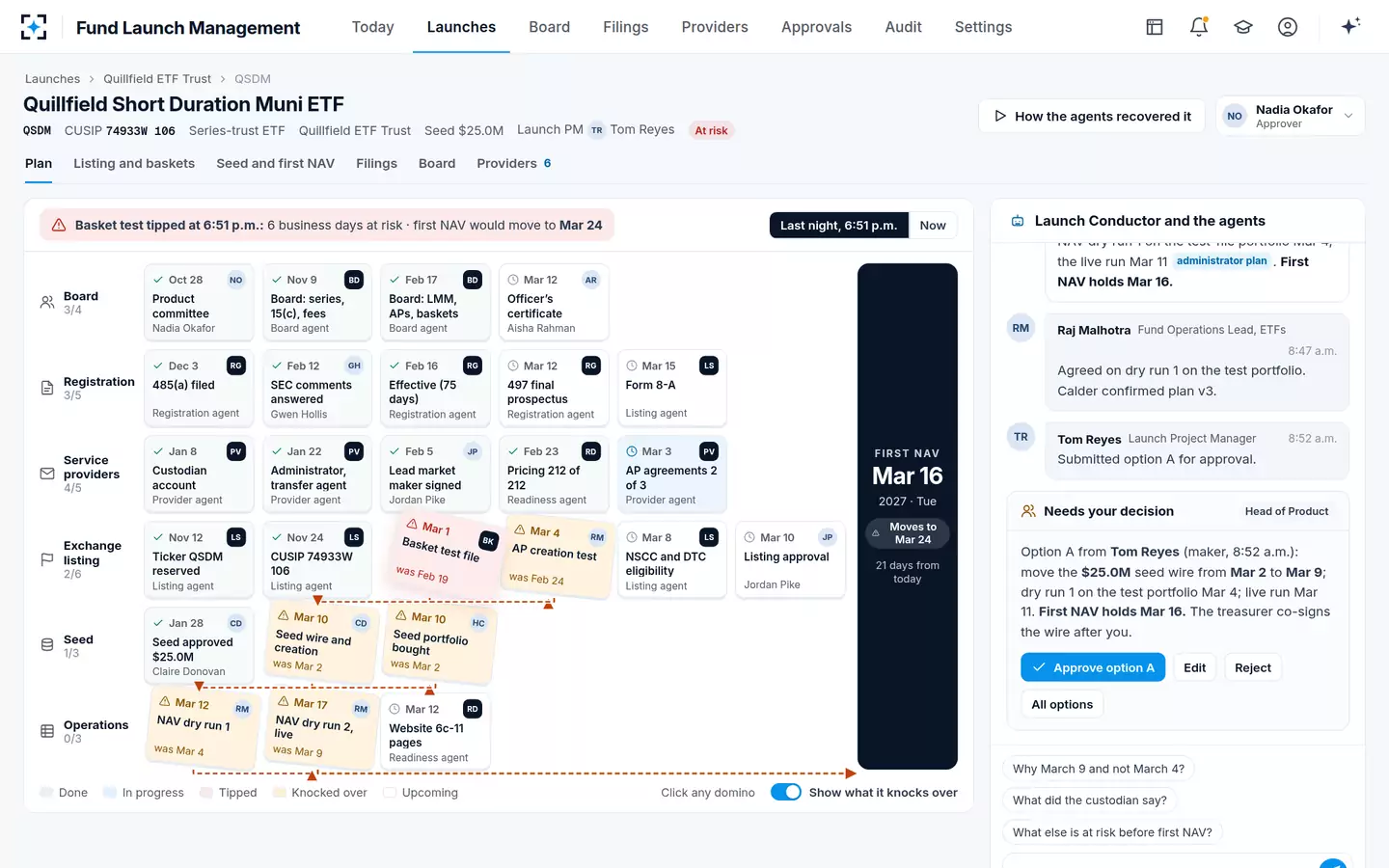
The basket is where the sample launch broke. The custodian rejected 3 of 58 lines in basket test file 2 as "security not found": three new-issue municipal bonds the sponsor had set up in its own security master but never asked the custodian to set up. That one rejection put the authorized participant's creation test, the seed wire and both NAV dry runs at risk, six business days in all. Who an ETF launch waits on maps each of those outside parties.
Fund Launch Management: one ETF launch as dominoes to first NAV
Seed money, NAV dry runs and the day-one website
The last two weeks are the most crowded, because three money and data steps meet. The seed buys the first creation units; the administrator runs NAV on a test portfolio and then the live one; and the website must carry the disclosures Rule 6c-11 requires before the first open.
The sample's seed is $25.0 million, 20 creation units of 50,000 shares at $25.00, and its timing is set by the sponsor's treasury policy: seed funds on Tuesdays only, with three business days' notice after a passed creation test. That is why a basket failure on a Monday evening threatened a date three weeks away. In Fund Launch Management a seed move needs the Head of Product's approval and the treasurer's second signature.
The website is the step most often treated as marketing. It is a condition of the exemption: each business day, before the primary listing exchange opens, the fund must show its holdings with ticker, CUSIP, description, quantity and weight, along with the prior day's NAV, market price and premium or discount and its median bid-ask spread (Rule 6c-11(c)(1)). The Rule 6c-11 website requirements sets out each item and how to test it before launch.
An ETF launch checklist that shows dependencies, not just status
- Term sheet approved by the product committee
Strategy, fee, cap, seed amount and target first NAV in one document the board and counsel draft from.
- Board: series, advisory contract, fees, service agreements
With the section 15(c) materials kept for six years.
- 485(a) filed; effective date known
75 days for a new series, or a designated later date up to 95.
- Custodian, administrator, transfer agent and distributor set up
Including every security in the first basket at the custodian, not just in your own security master.
- Lead market maker signed; at least two authorized participants ready
Know which one runs the creation test.
- Board: basket policies, custom basket parameters, reviewers named
Rule 6c-11(c)(3), before the first creation.
- Basket test files accepted; creation test passed
Every reject line reconciled before the retest.
- Ticker, CUSIP, listing approval, clearing eligibility, Form 8-A
Form 8-A goes effective only after the exchange certifies.
- Seed funded under treasury policy; NAV dry runs on test and live portfolios
Two signatures on the wire.
- Website disclosures live and checked before the first open
Holdings, NAV, premium or discount, median spread.
Launching an active ETF: what changes
Launching a transparent active ETF follows the same path as an index fund, with two differences that land on the basket. There is no index provider's file to copy, so the portfolio manager's holdings are the basket's source; and active managers are more likely to want custom baskets, which Rule 6c-11 allows only under written parameters the board has seen and a named reviewer applies.
The sample is an active municipal bond ETF, and its failure is typical of active fixed income: new issues bought before launch had settled only days earlier and existed in the sponsor's systems but not the custodian's. An index fund would have had the same bonds only if the index had added them. A launch plan for an active fund should therefore set up every planned holding at the custodian as a dated step, not as an assumption.
Why sponsors launch, and what the research says about new ETFs
The research is a reminder that a launch is a bet, not just a project. Larger fund families and those with more launch experience open more funds, "consistent with the presence of scale and scope economies," in Khorana and Servaes' study of US fund openings (Review of Financial Studies, 1999). And for one fast-growing category the results are sobering: "over their first 5 years, specialized ETFs lose about 30%" on a risk-adjusted basis, according to Ben-David, Franzoni, Kim and Moussawi (Review of Financial Studies, 2023). What a closure then costs the people who bought in is set out in ETF closure risk.
Form 8-A registrations on exchanges, by year (all issuers)
Neither finding argues against launching. Both argue for knowing early which launches will reach first NAV on time and which are drifting, because a late launch spends the same fixed costs and starts earning later. On the sample's own estimate, a $50 million launch at 50 basis points earns about $21,000 a month in fees; every month it reaches first NAV late is a month of that gone.
How Fund Launch Management runs the steps
The solution starts from the fund type. The Launch Conductor builds the critical path from the sponsor's own playbook for a series-trust ETF, an ETF share class, a new share class, a standalone fund, a UCITS sub-fund or an interval fund, and a launch project manager submits it for the Head of Product to approve. Seven agents then work behind the steps.
The Board agent drafts resolutions and the board book from the precedent library and the term sheet, with every term cited; it never records a vote. The Registration agent drafts N-1A sections and comment responses from the filing as effective; only fund counsel signs, and the filing agent submits after. The Listing agent prepares the ticker, CUSIP, listing application and Form 8-A. The Basket agent builds and runs the basket test files. The Provider agent chases every outside party. The Readiness agent checks pricing coverage, NAV dry runs and the Rule 6c-11 website, and re-checks the other agents' fixes from independent sources.
When a step slips, the Conductor tips it and shows what it knocks over, in business days, and proposes options with their first NAV dates; nothing moves until a person approves. The design targets are no launch missing first NAV because of a dependency nobody saw, and every plan, filing and seed move signed by a second person. For the sponsor deciding how to staff its launches in the first place, fund launch services or agents lists what you bring either way, and the solution is at Fund Launch Management.
Questions people ask
How long does it take to launch an ETF?
For a new series of an existing trust, the SEC filing alone takes at least 75 days under Rule 485(a)(2), unless the SEC accelerates it. Board approval and drafting come before it and the basket, seed and NAV dry runs after it; the fictional sample launch took 139 calendar days from product committee to first NAV.
How do you launch an ETF without your own trust?
Most sponsors without a trust launch a new series in an existing one, whose board approves them as adviser or sub-adviser and whose counsel files the 485(a). The alternative is an initial Form N-1A for a new trust; in our count of EDGAR, only 27 were filed in 2025.
Does a new ETF still need an exemptive order?
Not if it meets Rule 6c-11's conditions, effective December 23, 2019. Before the rule, the SEC put the median wait for an order at 213 days. Non-transparent active ETFs and some other structures still need their own relief, and leveraged or inverse ETFs must also comply with the derivatives rule.
What is Form 8-A for an ETF?
It registers the ETF's shares under section 12(b) of the Exchange Act so they can trade on the exchange. The SEC estimates three hours to complete it, but it becomes effective only on the latest of its filing, the exchange's certification and the effectiveness of the Securities Act registration.
Who can be the seed investor in a new ETF?
The sponsor, an affiliate or an outside investor, but the money always enters as creation units issued to an authorized participant, because that is how Rule 6c-11 defines the way an ETF issues shares. In-kind seed from the adviser or its affiliates raises affiliated-transaction questions the rule does not resolve.
Can an ETF launch without a lead market maker?
The SEC's ETF rule does not require one; the listing exchange's rules govern market makers. In practice a new fund needs a dealer quoting its shares from the first trading day, so the agreement belongs on the critical path.