The ETF basket creation process turns a portfolio manager's basket into new ETF shares: the fund publishes a file of securities and cash that make up one creation unit, its custodian must recognise and be able to settle every line, an authorized participant delivers that basket plus or minus a cash balancing amount, and the fund issues the creation unit in return. Redemption runs the same way in reverse. For a new ETF, the process has to work once in test before it works for real, because the seed money itself enters as the first creation. Botminds' Fund Launch Management gives that build-and-test work to one agent, the Basket agent, which builds the basket and test files, runs them with the custodian, reads each reject file and reconciles it against the security master, while the basket's composition stays with the portfolio manager.
The account below follows one night in a fictional sample launch, Quillfield Short Duration Muni ETF, seen through its fund operations lead for ETFs. The rule text comes from Rule 6c-11 and the SEC's 2019 adopting release.
The Basket agent's job, step by step, with what it may never do
Agent
Build the basket fileFrom the portfolio manager's basket, the creation unit size and the administrator's prices; every line cited to its source.
Never: add, remove or resize a line
Agent
Build and send the test filesIn the custodian's format, through the custodian file transfer.
Agent
Read the reject fileLine by line, against the security master, the official statements and the custodian's own codes.
Agent
Find the causeNot set up, undeliverable quantity, identifier mismatch, stale price; states its confidence and asks a person below its threshold.
A person decides
Portfolio managerDecides any change to the basket, including cash in lieu of a security.
Agent
RetestRuns the next test file once the cause is fixed; records the result as evidence on the basket step.
Never: mark the step done without an accepted file
A person decides
Authorized participant and operations leadRun the creation test on the accepted file; the seed follows under treasury policy.
ETF creation and redemption process, explained
New ETF shares come into existence only in creation units, issued to authorized participants in exchange for a basket and, where needed, cash. Rule 6c-11 builds this into its definition of an ETF: a fund that "issues (and redeems) creation units to (and from) authorized participants in exchange for a basket and a cash balancing amount if any" (Rule 6c-11(a)).
Everyone else trades the shares on the exchange. The creation and redemption process is what keeps those market prices close to NAV: when shares trade rich, an authorized participant can deliver the cheaper basket and sell the new shares; when they trade cheap, it can buy shares and redeem them for the basket. The SEC's release describes authorized participants doing this both for their own account and on behalf of market makers and institutional investors, for a processing fee (SEC, Exchange-Traded Funds, 84 FR 57162).
Delivering securities rather than cash is the in-kind creation and redemption the ETF structure is known for. The fund does not have to sell holdings to meet a redemption, and it can hand appreciated securities to a redeeming authorized participant; the tax effect of that is a subject for the tax benefit of an ETF share class and the fund's tax counsel, not for the basket file. For the basket file, in-kind means every line must be something the custodian can receive and the authorized participant can deliver.
Creation unit size: what one unit is, and why it matters to the seed
A creation unit is "a specified number of exchange-traded fund shares that the exchange-traded fund will issue to (or redeem from) an authorized participant" for a basket and any cash (Rule 6c-11(a)). The rule leaves the number to the fund; it is set in the prospectus and the participant agreements.
The sample's creation unit is 50,000 shares, so at the launch price of $25.00 one unit is $1,250,000 and the $25.0 million seed buys 20 of them. The unit size also sets the basket's granularity. A $1.25 million basket of municipal bonds can carry only a sample of a 212-bond portfolio in deliverable sizes: $25,000 par of one bond, $20,000 of another. That is why the basket is designed by the portfolio manager rather than computed by scaling the portfolio down.
What happens when a basket test file fails? One night, logged
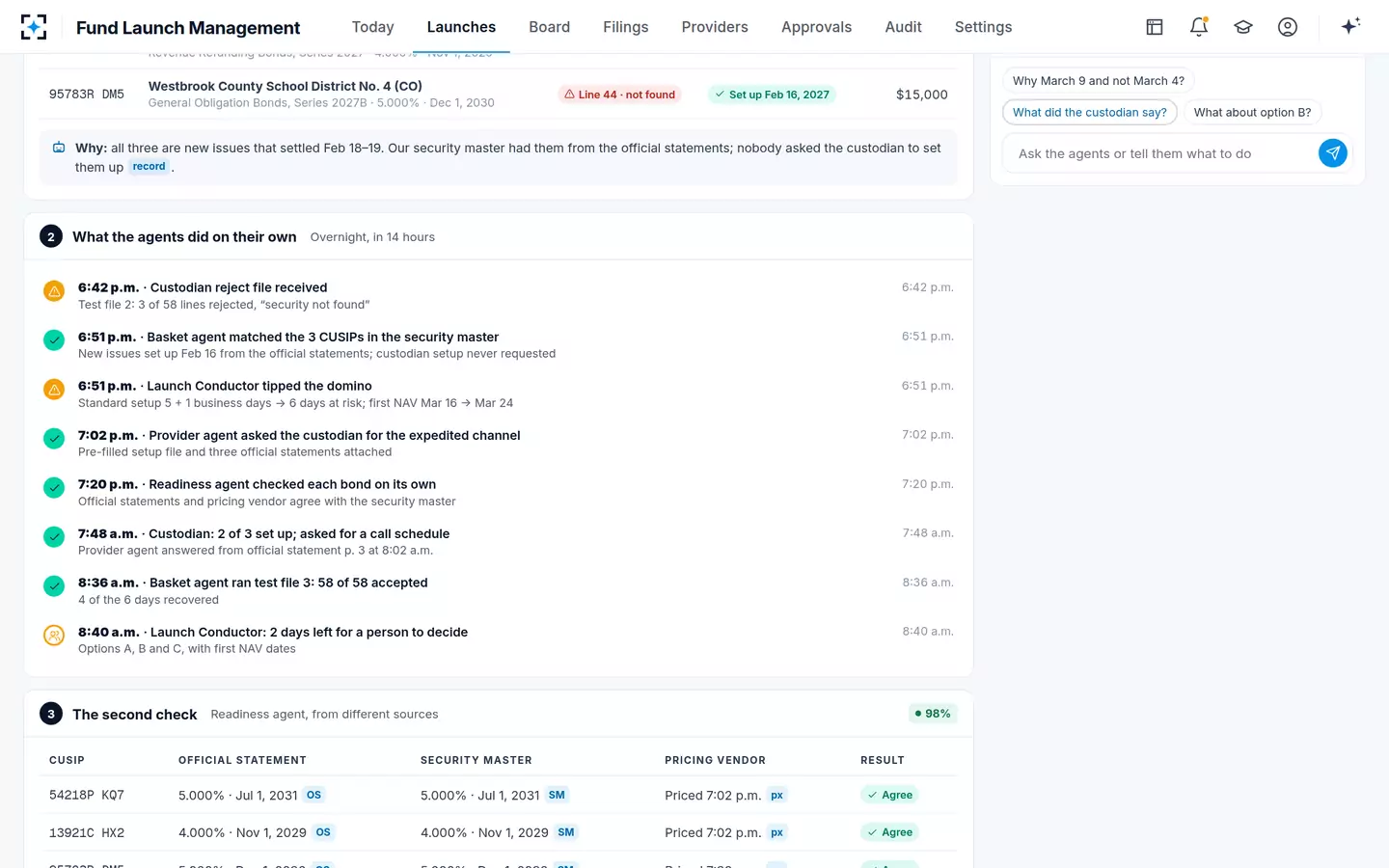
When the custodian rejects a test file, every step that needs an accepted basket waits: the authorized participant's creation test, the seed creation and the NAV dry runs on the seeded portfolio. In the sample, the reject file arrived at 6:42 p.m. on Monday, February 22, three weeks before first NAV.
One rejected basket, from reject file to retest: fourteen hours, logged
6:42 p.m.
Custodian
Reject file for basket test file 2: 3 of 58 lines, "security not found"
6:51 p.m.
Basket agent
Matches all three identifiers in the security master: new issues set up February 16 from the official statements; custodian setup never requested
6:51 p.m.
Launch Conductor
Tips the basket step: standard setup of 5 + 1 business days puts 6 at risk; first NAV would move from March 16 to March 24
7:02 p.m.
Provider agent
Asks the custodian's ETF team for the expedited channel, with a pre-filled setup file and the three official statements
7:20 p.m.
Readiness agent
Checks each bond on its own: official statement, security master and pricing vendor agree
7:48 a.m.
Custodian
Two of three set up; asks for the third bond's call schedule
8:02 a.m.
Provider agent
Answers from official statement page 3: callable on or after December 1, 2029 at par
8:36 a.m.
Basket agent
Runs test file 3: 58 of 58 lines accepted; four of six days recovered
8:40 a.m.
Launch Conductor
Two days still at risk: three options, with first NAV dates, to the Head of Product
The sample's operations lead for ETFs, Raj Malhotra, describes the old version of this night in one sentence: "A basket file fails on one CUSIP and the seed date is gone." Each retest round with the custodian used to cost days because the reject file arrived after hours, the security master and the custodian's file lived in different systems, and the person who knew the bonds were new issues was not the person reading the reject file. In the sample, by the time he started his day the cause was diagnosed, the custodian had been asked, a second check was done and the retest had passed.
The sample night in numbers
3 of 58
lines rejected in test file 2: new issues never set up at the custodian
6days
business days at risk when the basket step tipped
4days
recovered by 8:36 a.m., when test file 3 passed 58 of 58
Why the agent never changes the basket
The basket's composition is an investment decision and, under Rule 6c-11, a compliance one. The fund must have written policies for constructing and accepting baskets, and for custom baskets they must set "detailed parameters" and name the titles or roles of the adviser's employees "required to review each custom basket for compliance with those parameters" (Rule 6c-11(c)(3)). An agent that swapped a rejected bond for cash would be creating a custom basket outside the people the policy names.
So the Basket agent's limits are written into its role: it never changes basket composition, and cash in lieu needs the portfolio manager. In the sample, the cash-in-lieu option was still put to the Head of Product, as option B, with its consequences laid out: it would change the seed basket, which the portfolio manager decides, and the authorized participant needed two business days to load a custom basket, so it would not have held the original seed date anyway.
Fund Launch Management: what the agents did on their own, overnight
A second agent checks the fix, from different sources
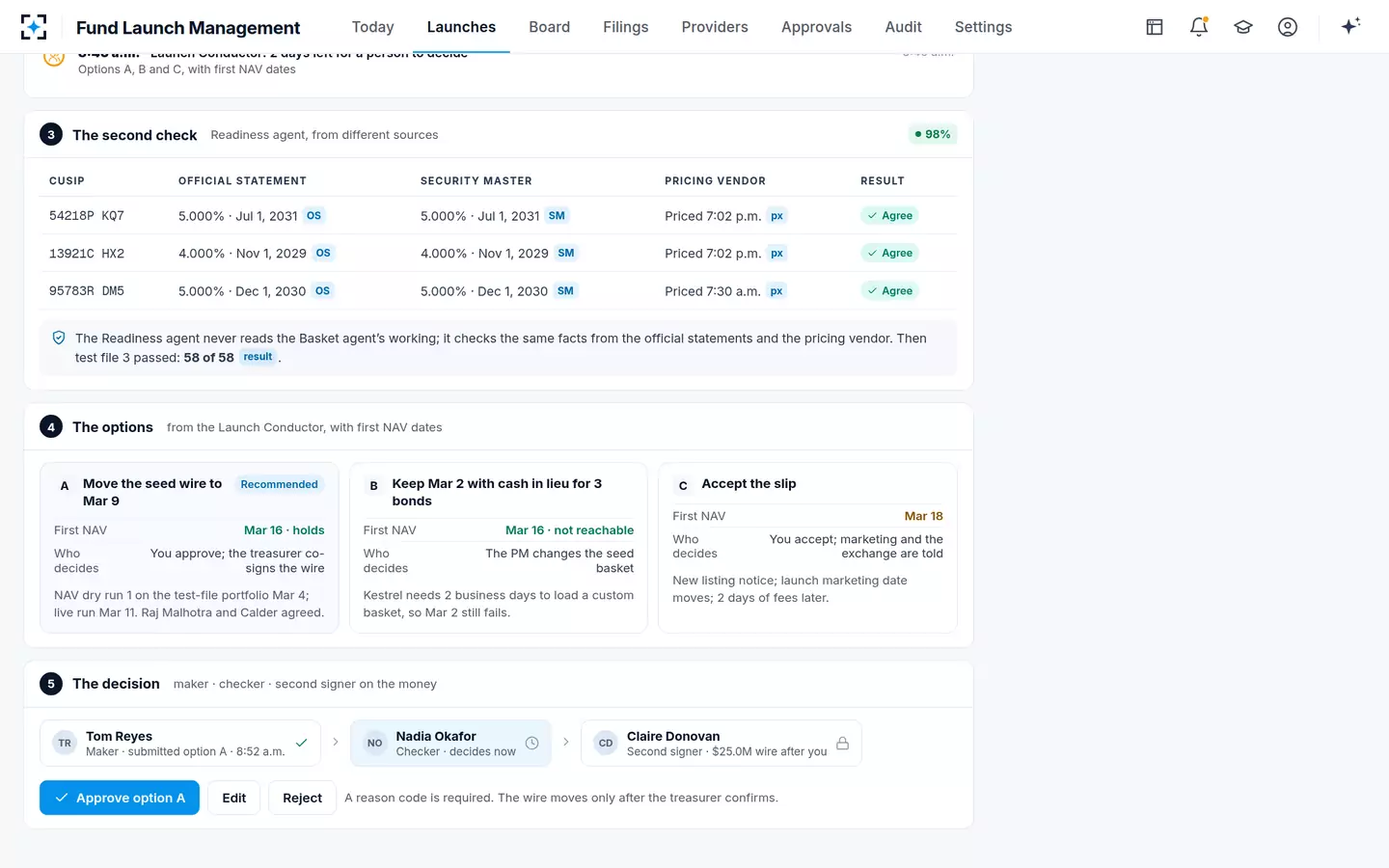
A fix that the same agent proposes and verifies is not checked. In the solution, the Readiness agent re-checks every other agent's fix from independent sources and never reads the other agent's working. In the sample it checked each of the three bonds against its official statement and the evaluated pricing vendor at 7:20 p.m., before the custodian had replied, and found coupon, maturity and identifier in agreement with the security master.
That separation is the same one a fund already uses between people. The portfolio manager sets the basket, fund operations builds and sends it, and someone else confirms the prices. The design makes the agents keep it: the agent that builds the file cannot also be the one that says the file is right.
Build and check, kept apart
Basket agent: Builds the basket and test files; reads reject files; reconciles each line to the security master
Readiness agent: Checks seed and first-NAV readiness; re-checks other agents' fixes
Basket agent: Portfolio manager's basket, security master, custodian reject files, administrator prices
Readiness agent: Official statements, the evaluated pricing vendor, the administrator's dry runs, the website file
Basket agent: Changes basket composition; cash in lieu needs the portfolio manager
Readiness agent: Declares go-live; reads the other agent's working
Basket agent: Its confidence is below 95%
Readiness agent: Its confidence is below 95%
Who approves a custom basket, and who approves the re-plan?
A custom basket is reviewed by the people the fund's policy names, by title or role; that is the rule. A re-plan of the launch is approved by whoever the sponsor's own controls name; in the sample, a launch project manager proposes and the Head of Product approves with a reason code, and any seed movement needs the fund treasurer's second signature.
The sample's approval followed that chain. Option A, recommended: keep first NAV on March 16 by moving the seed wire from March 2 to March 9 and running the first NAV dry run on the test-file portfolio on March 4. The launch project manager submitted it as maker; the Head of Product approved it at 9:07 a.m. with reason code "Re-plan within float"; the treasurer confirmed the wire at 9:08 a.m. The agents did not move a date.
Fund Launch Management: the second check, the options and the decision
Evaluating an agent for the basket process: what to ask
Any tool that touches the basket should be judged on what it refuses to do as much as on what it does. The SEC's examination priorities for fiscal 2027 note that registrants are adopting what the SEC calls "super intelligence" tools, and say the staff will look at whether firms continue to meet their existing, technology-neutral obligations (SEC, FY2027 Examination Priorities). For a basket, those obligations are the rule's: written basket policies, named custom-basket reviewers, and records of every basket exchanged.
Questions for any basket automation, before a launch relies on it
- Does it read your custodian's actual reject files?
Line numbers, reason codes and formats, not a summary someone retypes.
- Can it see the security master and the custodian side by side?
The sample's failure was visible only with both.
- Is basket composition outside its permissions?
Including cash in lieu, which makes a custom basket.
- Is the check done by something other than the builder?
From different sources, without reading the builder's working.
- Does it say how sure it is, and stop below a threshold?
With the threshold a setting someone approves.
- Is every step logged with its time and source, and can it be replayed?
So the next launch learns from this one, and an examiner can follow it.
- Does it keep the basket records Rule 6c-11(d) requires?
Holdings, custom flag, cash balancing amount, authorized participant, five years.
What changes in the next launch
A slip that is only fixed will happen again. In the sample, once first NAV held, the Launch Conductor proposed a change to the series-trust ETF playbook: lengthen the custodian setup step for new-issue municipal bonds from three to six business days, so the next municipal launch asks a week earlier. It went to the Head of Product as a change request, because playbooks are settings a person approves.
That is where a basket agent pays back beyond one night: each reject file becomes a rule about when to ask, not just a fixed line. The portfolio composition file, field by field lists the other failure types to plan for, and the 485a filing and its evidence file applies the same idea of evidence on every step to the registration side. The solution is at Fund Launch Management.
Questions people ask
What is an in-kind creation?
An authorized participant delivers the securities in the fund's basket, plus or minus a cash balancing amount, and receives a creation unit of new ETF shares; an in-kind redemption returns securities instead of cash. Rule 6c-11 defines the ETF around this exchange of creation units for a basket.
How big is an ETF creation unit?
Whatever the fund specifies in its prospectus and participant agreements; Rule 6c-11 defines it only as "a specified number" of shares. The fictional sample fund uses 50,000 shares, $1.25 million at its $25.00 launch price.
Can an ETF's basket be all cash?
Yes, subject to the fund's basket policies. The SEC's 2019 release notes that an ETF may substitute cash for some or all of its holdings in the basket; a substitution that makes the basket non-representative is a custom basket and needs the custom-basket procedures and named reviewers.
Who builds an ETF's basket each day?
The portfolio manager decides what is in it; fund operations or a service provider builds the file, prices it with the administrator's sources and sends it out. In Fund Launch Management the Basket agent builds and tests the file and never changes its composition.
How long does a custodian take to set up a new security?
It depends on the custodian and the market; the sample's playbook assumed three business days for new-issue municipal bonds and, after this launch, proposed six. Sub-custodians in other markets take longer, which is why the sample's service levels allow 10 business days for them.