The benefits of an ETF share class come from one mechanism: the ETF class meets redemptions by delivering securities in kind, so the fund realizes fewer capital gains, trades less and may hold less cash, and every class of the fund shares in that. The SEC's orders let a US mutual fund add such a class only if its board, including the independent directors, finds the plan "in the best interests of each Mutual Fund Class and the ETF Class individually and of the Fund as a whole", before launch and at least annually after. That makes the benefit something an adviser has to estimate before launch and show afterwards, net of the cost that the mutual fund classes' cash redemptions can push onto the ETF class. Botminds' ETF Share Class Relief measures both from fund accounting's lot records and the transfer agent's class flows, and puts them in the adviser's reports to the board.
This guide is for independent directors, the adviser's product and tax teams and the fund chief compliance officer. The SEC material is quoted from the notice of the first ETF-class application, IC-35770, whose terms the order of 17 November 2025 adopted; the research figures are their authors'. Fund examples come from a fictional sample, Quillfield Funds Trust, as it runs through the solution. Nothing here is tax advice.
The tax benefit the ETF class is meant to bring, in the researchers' numbers
1.05%
a year of after-tax return for long-term investors, ETFs over active mutual funds, since 2012
~10×
the share of mutual funds distributing capital gains, against the share of ETFs
2.11–3.72%
a year that US equity ETFs would distribute if they paid out like index or active mutual funds
What are the benefits of an ETF share class?
The benefits of an ETF share class are lower realized gains, lower portfolio transaction costs, a new distribution channel and a way for mutual fund holders to move into an ETF without the fund selling anything. The applicants for the first order listed them. For the mutual fund classes: "In-kind transactions through the ETF Class in connection with creations and redemptions may contribute to lower portfolio transaction costs and greater tax efficiency and could allow a Fund to reduce some portfolio management costs"; the ETF class "would represent an additional distribution channel for a Fund that could lead to additional asset growth and economies of scale"; and the exchange privilege "could allow mutual fund shareholders to exchange Mutual Fund Shares for ETF Shares without adverse consequences to the Fund" (SEC, IC-35770).
The benefits run the other way too. The applicants argued that "Investor cash flows through a Mutual Fund Class can be used for efficient portfolio rebalancing", and that those flows "may allow for greater Basket flexibility, which could promote arbitrage efficiency and smaller spreads on the trading of ETF Shares". For an existing fund, the ETF class gives investors who prefer ETFs access "to established Fund investment strategies", with their track records. Each of these is a claim the board's finding has to test, class by class.
The benefits the applicants claimed, who receives each, and how to measure it
| Benefit | Received by | What the board can measure |
|---|---|---|
| Fewer realized gains from in-kind redemptions | Every class, in proportion to net assets | Realized gains with and without the ETF class's in-kind flows |
| Lower portfolio transaction costs | Every class | Commissions, spreads and market impact on trades the in-kind flows replaced |
| Less cash held for redemptions | Every class | Cash as a share of net assets, against the board threshold |
| A new distribution channel and scale | Every class, through expense ratios | ETF-class assets raised, and any change in per-class expenses |
| Exchange privilege without portfolio sales | The fund, and holders who switch | Exchanges counted apart from cash redemptions |
| Mutual fund flows for rebalancing and basket flexibility | The ETF class | Spreads and premiums or discounts on ETF-class trading |
Why the tax benefit is the one that matters
The tax benefit is usually the largest because it comes straight from the tax code. When an ETF's authorized participant redeems, the fund usually hands over a basket of securities, and section 852(b)(6) says section 311(b) "shall not apply to any distribution by a regulated investment company ... if such distribution is in redemption of its stock upon the demand of the shareholder" (26 U.S.C. 852(b)(6)). The fund recognizes no gain on appreciated securities it delivers. A mutual fund that sells to raise cash for a redemption realizes the gain and must distribute it to every remaining holder.
The SEC described the same mechanism when it adopted the ETF rule in 2019: ETFs "may offer certain tax efficiencies compared to other pooled investment vehicles because redemptions from ETFs are often made in kind", avoiding "the need for the ETF to sell assets and potentially realize capital gains that are distributed to its shareholders" (84 FR 57162). The gains are deferred, not erased: they stay in each holder's own shares and are taxed on sale.
How a redemption works in each class, and what it leaves behind for the fund
Mutual fund class: Any shareholder, any business day
ETF class: Authorized participants, in creation units
Mutual fund class: Usually cash, raised by selling securities or held as cash
ETF class: Usually a basket of securities, in kind
Mutual fund class: On securities sold to raise the cash
ETF class: None on securities distributed in kind (section 852(b)(6))
Mutual fund class: Every class, through the year's distribution
ETF class: Each holder, when they sell their own shares
How much is the tax benefit worth?
For standalone ETFs the best estimate is about a percentage point a year of after-tax return for long-term investors, larger in some strategies. Writing about their peer-reviewed paper, the authors report that "the ETFs' annual tax savings relative to active mutual funds represent 1.05%, on average, since 2012", that the advantage "is even greater" in strategies with higher capital gain realizations "such as small-cap and growth", and that the fraction of mutual funds distributing capital gains has been about ten times the fraction of ETFs (authors' summary; Review of Financial Studies, 2025).
Compounded, a point a year is large. The table is plain arithmetic on the study's average, not a forecast for any fund: the same $100,000 growing at 6.00% a year after tax, and at 7.05%.
What 1.05 points a year of after-tax return is worth on $100,000
| Horizon | At 6.00% a year | At 7.05% a year | Difference |
|---|---|---|---|
| 10 years | $179,085 | $197,636 | $18,552 |
| 20 years | $320,714 | $390,601 | $69,888 |
| 30 years | $574,349 | $771,970 | $197,620 |
That figure is the ceiling a board should hold an ETF class to, not the expectation. An ETF class shares its portfolio with mutual fund classes that still redeem in cash, so the fund-level gain the class avoids can be partly or wholly spent on the gains the other classes force. The research measures standalone ETFs; nobody can measure a given dual-class fund except from its own flows and lots.
Does the benefit reach each class? The cost the order was written to catch
Not automatically. Realized gains are shared by every class in proportion to net assets, whichever class's flows caused them, so the ETF class's holders receive part of every distribution the mutual fund classes' cash redemptions force. The SEC flagged the point when it adopted the ETF rule in 2019, and repeated it in the notice: an ETF class dealing in kind and a mutual fund class dealing in cash "may give rise to differing costs to the portfolio", so that "certain costs may result from transactions through one class, but all fund shareholders generally would bear the costs", among them "distributable capital gains associated with portfolio transactions" (IC-35770).
One sample distribution: who caused it, and who received it
On the sample, the ETF class's holders received $26.6 million of a distribution their own class did almost nothing to cause, $20.7 million of it traceable to cash redemptions in the mutual fund classes, and $50.7 million of the fund's gains came from one intermediary's redemption alone. That is the cross-subsidy the order's thresholds exist to expose. The counterfactual matters as much as the attribution: had that redemption been paid in kind, as the fund's policy allowed, the distribution would have been about 1.06% of net assets, inside the threshold. How the threshold is set and watched is the subject of mutual fund capital gains distributions: the ETF share class threshold.
What must the board find, and when?
The board must find the multiple class plan in the best interests of each mutual fund class, the ETF class and the fund as a whole before launch, and again "periodically, but in no case less frequently than annually" (IC-35770). Each finding rests on a written adviser report, and between them the board watches numerical thresholds it approved.
The four points at which the board weighs the benefit
| When | What the adviser gives the board | What the board decides |
|---|---|---|
| Before launch | Initial adviser report: reasonably expected benefits and costs to each class and the fund; how transition costs will be managed; whether the strategy suits the structure; other conflicts, including cross-subsidization | The initial best-interests finding |
| At launch | Recommended thresholds for transaction costs, cash and capital gains distributions, with the calculation method and the measurement period | Approves the thresholds and the monitoring process |
| When a threshold is exceeded | Notice within 30 days of the period's end: the adviser's assessment of causes and any recommended remedy | Whether to act, and how |
| At least annually | Ongoing adviser report: observed benefits or cost savings; observed material conflicts or negative consequences; anything the board asks for | The annual best-interests finding |
The words change between the two reports, and the change is the measurement problem. Before launch the adviser discusses "reasonably expected" benefits, which "may be based on reasonable assumptions and good faith estimates", using "historical data for existing Funds, if applicable". After launch the ongoing report discusses "any observed benefits or cost savings to the Fund resulting from the Multi-Class ETF Fund structure". An estimate becomes an observation, and the board will compare them.
How to measure the benefit for the board: three effects and a counterfactual
Measure the benefit as three separate effects, never as one net number: the gains the ETF class's in-kind redemptions avoided, the gains the mutual fund classes' cash redemptions still realized, and the one-time cost of the transition. A board that sees only the net cannot tell a fund where both effects are small from one where both are large and cancelling.
The observed tax benefit of an ETF class, in three terms
Gains avoided in kind
Embedded gain on lots delivered in ETF-class redemptions
What the fund would have realized had it sold those lots for cash.
Fund accounting lots, ETF-class baskets
Gains forced in cash
Gain realized on sales to meet mutual-fund-class redemptions
Shared by every class, including the ETF class.
Transfer agent class flows, trade blotter
Transition cost
Trading, launch and servicing costs of adding the class
One-time in the first year, recurring where servicing differs by class.
Adviser's initial report
The counterfactual is what makes the numbers persuasive. For each period, recompute realized gains as if the largest cash redemptions had been met in kind, where the fund's redemption policy allows it, and as if the ETF class's in-kind redemptions had been paid in cash. The first tells the board how much of a distribution was avoidable; the second tells it how much the ETF class is saving the fund. Both use lot-level data fund accounting already holds, and both should be computed on the same method every year, because the board will compare this year's observation with last year's estimate.
Which funds benefit most from an ETF share class?
Funds with large embedded gains, heavy intermediary flows in their mutual fund classes and portfolios that can be delivered in kind stand to benefit most, and also have the most to lose if the mutual fund classes keep forcing cash sales. The researchers find the ETF tax advantage larger in styles "characterized by higher capital gain realizations, such as small-cap and growth strategies", and their counterfactual distribution yields differ by style: 2.11% a year if equity ETFs distributed like index mutual funds, 3.72% if like active ones (authors' summary).
Deliverability is the factor most often missed. The SEC's 2019 release notes that ETFs, "particularly fixed-income ETFs, that do not have basket flexibility may satisfy redemption requests entirely in cash" (84 FR 57162), and an ETF class that redeems in cash brings little tax benefit at all. Non-US equities can be delivered in kind but at a cost. In the sample, the Japan Equity Fund's initial adviser report takes its expected benefit from the Tokyo sub-adviser's own estimate.
An initial adviser report pins its expected tax benefit to the sub-adviser's own page
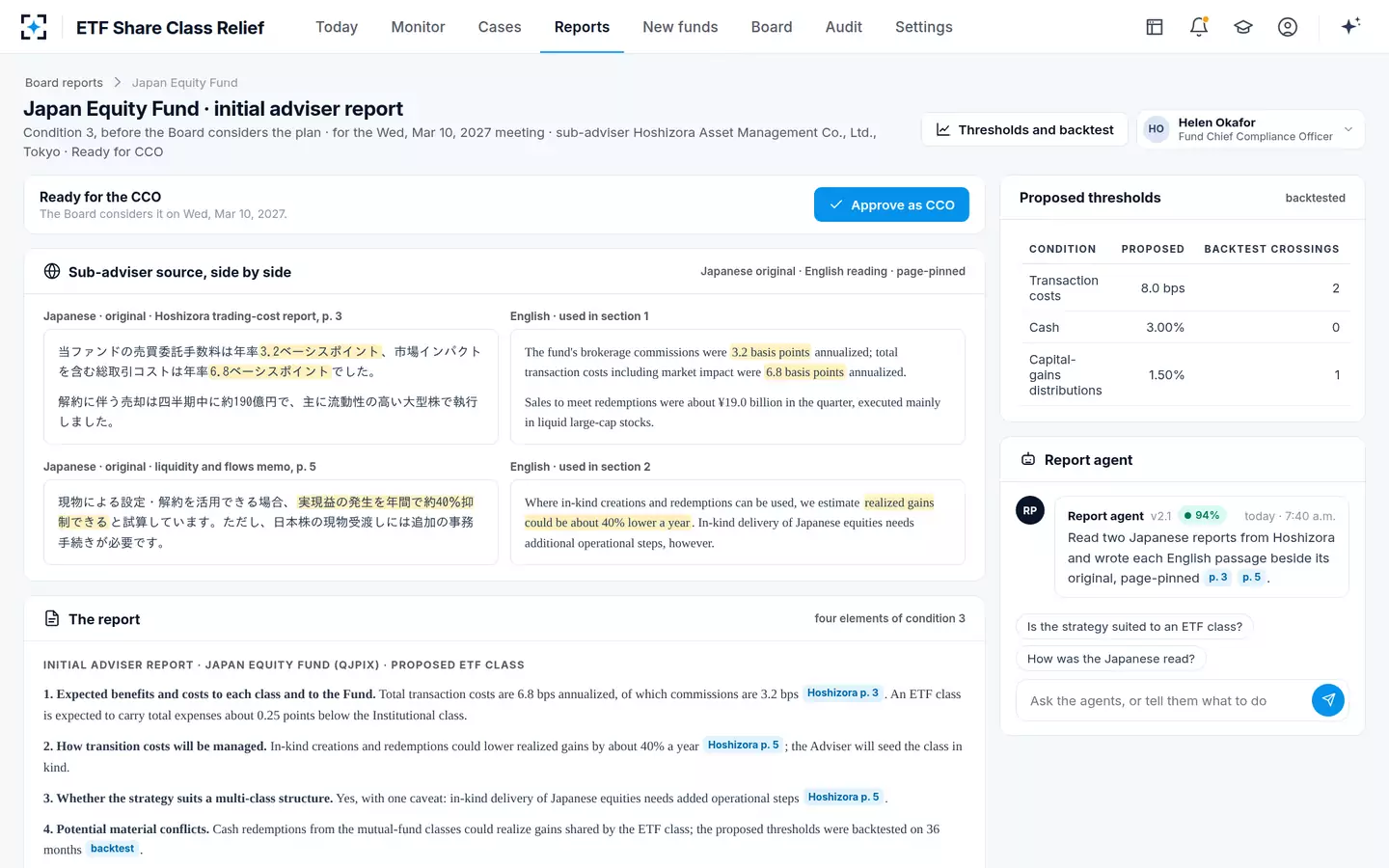
A board should treat an estimate like that as a hypothesis to be tested, which is why the solution backtests each proposed threshold on 36 months of the fund's own history before launch, and why the ongoing report should restate the original estimate beside the observed figure. The launch sequence, from initial report to first trade, is set out in ETF share class application: from filing to the first ETF-class trade.
Where the benefit does not apply, and what could change it
The ETF class's tax benefit applies to capital gains the fund would otherwise distribute, and nowhere else. Dividends and interest the portfolio earns are distributed to every class alike, so an income fund gains little. Holders in accounts that are not taxed each year gain nothing from deferral while the money stays there, which matters for a fund whose ETF class is sold mainly into retirement platforms. And an ETF class that redeems in cash, for lack of a deliverable basket, gives up most of the advantage.
The advantage also rests on law and practice that could change. Section 852(b)(6) is a statute Congress could amend, and the researchers describe "the controversial application of tax-free heartbeat trades", paired creations and redemptions used to flush out appreciated lots, as a practice policymakers may want to study. A board's finding is annual for a reason: the benefit it found last year has to be found again this year, on the same method, in whatever legal setting then applies.
How ETF Share Class Relief puts the benefit and the cost on one page
ETF Share Class Relief reads fund accounting's lot records, the transfer agent's class flows and the trade blotter, attributes each distribution to the flows and decisions behind it, class by class, and runs the in-kind counterfactual. The Report agent drafts the ongoing adviser report from that history, so the board reads observed benefit and observed cost side by side, each figure cited to its source. People decide: the fund CCO and the treasurer both approve each board notice, and the person who prepared it cannot approve it.
One distribution split by class, with the in-kind counterfactual
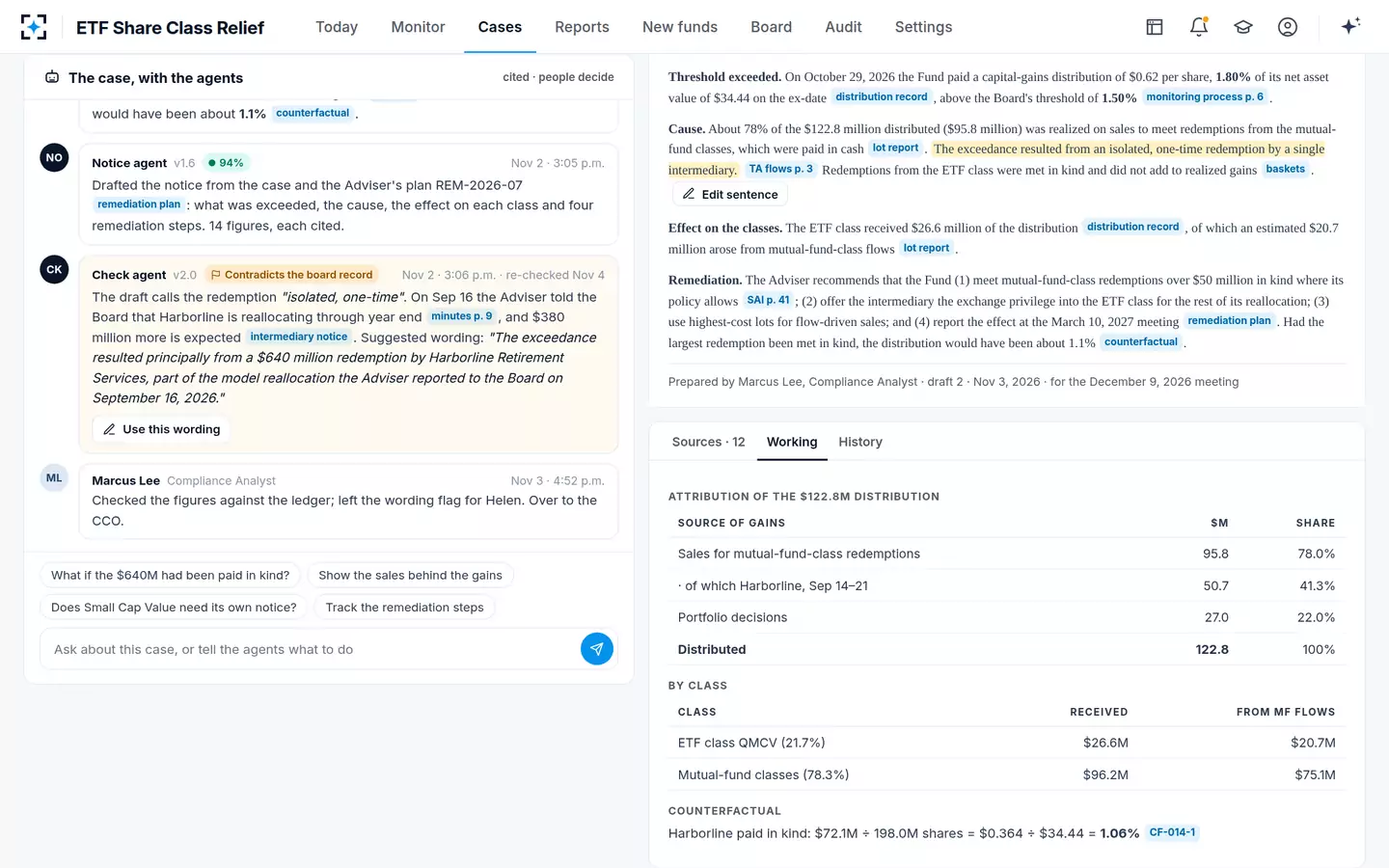
The same history feeds the monitor between reports, with each fund's ETF-class share and its three thresholds watched daily. The conditions behind those reports are tested one by one in ETF share class exemptive relief: each condition, tested and recorded, and the solution is on the ETF Share Class Relief page.
Questions people ask
What are the main benefits of an ETF share class?
Lower realized capital gains and transaction costs from in-kind creations and redemptions, a new distribution channel that can add scale, and an exchange privilege that lets mutual fund holders move to the ETF class without the fund selling securities. The first applicants also claimed benefits for the ETF class from the mutual fund classes' cash flows, such as rebalancing and basket flexibility.
Are ETF share classes as tax efficient as standalone ETFs?
Not necessarily. The ETF class shares a portfolio with mutual fund classes whose cash redemptions can realize gains every class must receive. The SEC's orders require a board-approved threshold for capital gains distributions, and a notice within 30 days of any period in which it is exceeded, so the board can see when that happens.
What does the board have to find before adding an ETF class?
That the multiple class plan is in the best interests of each mutual fund class, the ETF class and the fund as a whole. The finding is made by the board including its independent directors, on an initial adviser report, and repeated at least annually on an ongoing adviser report.
Can the adviser use estimates in the initial report?
Yes. The notice says information "reasonably expected" or "reasonably estimated" may rest on "reasonable assumptions and good faith estimates by the Advisor", based on historical data for existing funds where available. The ongoing report then discusses observed benefits, so the estimate is tested a year later.
What happens if the ETF class turns out not to benefit a class?
The adviser recommends a remedy and the board decides. The notice's examples run from more in-kind transactions, credit lines, tax-lot management and fee changes to enhanced disclosure, and as a last resort discontinuing a class or converting it into another class of the same fund.
Which funds gain least from an ETF share class?
Funds whose returns are mostly income, funds held mainly in tax-deferred accounts, and funds whose portfolios cannot be delivered in kind. The SEC noted in 2019 that fixed-income ETFs without basket flexibility may meet redemptions entirely in cash, giving up most of the tax advantage.