An ETF share class conversion is a move of fund holdings from a mutual fund class into the same fund's ETF class, either at the holder's request under an "Exchange Privilege" the SEC's ETF share class orders allow, or by the fund itself under a conversion feature or, as a last resort, a conversion of a whole class. For the sponsor it is a product decision with five working parts: exchange terms at relative net asset value, a tax position the prospectus can state, intermediaries and a transfer agent ready to process it, the disclosure the orders require, and monitoring that counts exchanges apart from cash redemptions so the board's thresholds stay honest. Done well, it moves assets into the ETF class "without adverse consequences to the Fund", in the first applicants' words, because no securities are sold. Botminds' ETF Share Class Relief reads class flows from the transfer agent's records so each exchange is attributed correctly in the board's monitoring.
This guide is for the sponsor's product, operations and tax teams and the fund's chief compliance officer. The SEC material is quoted from the notice of the first application, IC-35770, whose terms the order of 17 November 2025 adopted; tax text comes from the Internal Revenue Code and IRS Publication 550. Fund examples come from the solution's fictional sample, Quillfield Funds Trust. Nothing here is tax or legal advice.
One holder-requested exchange into the ETF class, step by step
A person decides
Holder, through an intermediaryAsks to exchange mutual fund class shares for the ETF class. The ETF shares will sit in a brokerage account, so the intermediary must be able to hold a listed class.
Agent
Transfer agent checksTests the request against the fund's exchange terms, including any blackout around dividend dates that stops one holder collecting a dividend from both classes.
Never: Exchanges at any basis other than relative NAV
Agent
Fund issues new ETF sharesAt the two classes' relative net asset values; the ETF shares are newly issued, not bought on the exchange. No portfolio securities are sold.
Agent
Records and reportingMoves net assets between classes in fund accounting, carries the holder's basis and holding period as the fund's tax position says, and flags the flow as an exchange, not a redemption.
A person decides
Fund CCO and boardSee exchanges counted separately in class-flow reports and the monitoring of the order's thresholds.
What is an ETF share class conversion, and who decides to offer it?
The sponsor and the fund's board decide; nothing in the orders requires a conversion route. The notice says a fund "may offer an 'Exchange Privilege' that would permit shareholders in a Mutual Fund Class to exchange Mutual Fund Shares for ETF Shares", and condition 1 lets an ETF-class fund operate under Rule 6c-11 while also offering one (SEC, IC-35770). Three different events travel under the word "conversion", and the sponsor's documents should keep them apart.
Three ways holdings move into the ETF class, and who starts each
| Kind | Who starts it | Rule or condition | Terms |
|---|---|---|---|
| Exchange privilege | The holder, through an intermediary | IC-35770; section 11(a) | At relative net asset value; new ETF shares issued; optional for the fund to offer |
| Conversion feature | The fund, automatically | Rule 18f-3(f) | At relative NAV with no sales load, fee or other charge; after a set period, or on losing eligibility with prior notice |
| Conversion of an entire class | The board, as a remedy | IC-35770, example (vi) of remedial actions | "As otherwise permitted under the Act", after a threshold is exceeded and the adviser recommends it |
The exchange privilege is the one most sponsors will build, because it is how existing holders who prefer ETFs reach the new class. The applicants gave it two purposes: moving holders "without adverse consequences to the Fund", and helping build the ETF class's holder base, since "Tax-free exchanges of shares from the Mutual Fund Class for shares of the ETF Class also may accelerate the development of an ETF shareholder base".
Is an ETF share class conversion a taxable event? What the sponsor must be able to say
The tax code points to a non-taxable answer for a pure class exchange within one fund, and the sponsor's job is to state that position in the prospectus, with its conditions, rather than leave each holder to infer it. Three provisions frame it. Section 851(g) treats each fund of a regulated investment company "as a separate corporation", where a fund is "a segregated portfolio of assets" (26 U.S.C. 851(g)), and both classes own the same portfolio. Section 1036 provides that "No gain or loss shall be recognized if common stock in a corporation is exchanged solely for common stock in the same corporation" (26 U.S.C. 1036). And the IRS describes the opposite case: "Any exchange of shares in one fund for shares in another fund is a taxable exchange" (IRS Publication 550).
Tax-free exchanges of shares from the Mutual Fund Class for shares of the ETF Class also may accelerate the development of an ETF shareholder base.
Applicants, notice of application IC-35770
That sentence is the applicants' belief about a benefit, not an SEC ruling on tax, and the sponsor's tax counsel owns the position. Two details decide whether the clean answer holds. Section 1036 covers exchanges made "solely" for stock, and IRS guidance is that if, in an otherwise non-taxable trade, a holder receives "money or other property in addition to stock, then your gain on the trade, if any, is taxed, but only up to the amount of the money or other property". If the sponsor's design pays any part of an exchange in cash, that part needs its own disclosure. And the holder's basis and holding period must carry across, which is a reporting job for the transfer agent and the intermediaries.
The exchange the sponsor offers, against the switch a holder could make alone
Into the same fund's ETF class: A different class of the same portfolio
Into a different ETF, even in the same family: Shares of a separate fund with its own portfolio
Into the same fund's ETF class: Exchange at relative net asset values; new ETF shares issued
Into a different ETF, even in the same family: Redeem or sell, then buy
Into the same fund's ETF class: An exchange within one fund; section 1036 is the provision at issue
Into a different ETF, even in the same family: "A taxable exchange" in the IRS's words
Into the same fund's ETF class: None: net assets move between classes, no securities are sold
Into a different ETF, even in the same family: A cash redemption that may force sales and realize gains for every remaining holder
The last row is the sponsor's business case. A holder who redeems to buy a copycat ETF elsewhere takes cash out of the portfolio, and the sales to pay for it realize gains every remaining holder receives. A holder who exchanges into the ETF class takes nothing out. A sponsor that adds an ETF class but no exchange privilege leaves its ETF-minded holders only the first route.
The operating steps: who has to be ready before the first exchange
Five parties have to be ready before the first exchange: the transfer agent, the intermediaries, fund accounting, the tax reporting team and compliance. Most of the work is in the hand-offs between them, because a mutual fund holding usually sits on the transfer agent's books or an intermediary's omnibus account, and an ETF holding sits in a brokerage account through the depository.
Who does what for an ETF class exchange privilege
| Party | What it must do | What goes wrong if it does not |
|---|---|---|
| Fund and board | Set the exchange terms at relative NAV under section 11(a); approve any blackout around dividend dates | An exchange on any other basis is unlawful without SEC approval |
| Transfer agent | Accept and validate requests; issue new ETF shares; record exchanges as exchanges | Exchanges show up as outflows from the mutual fund classes in the board's flow reports |
| Intermediaries | Hold a listed class for the holder; carry basis and holding period; explain dividend reinvestment | Holders without a brokerage account cannot receive ETF shares |
| Fund accounting | Move net assets between classes; keep per-class expenses and distributions right | Class shares of each distribution are wrong |
| Tax and compliance | Write the tax position; check prospectus and website disclosure; watch the thresholds | A disclosure gap the orders name expressly |
Two details from the notice belong in the transfer agent's specification. "ETF Shares issued to a shareholder as part of the Exchange Privilege will be newly issued ETF Shares, and not ETF Shares purchased in the secondary market", so the exchange does not depend on a seller. And the fund "will impose restrictions on exchanges around the dates of dividend payments if necessary to prevent a shareholder from collecting a dividend from both the Mutual Fund Class and the ETF Class as a result of an exchange of shares", which matters because the classes' record dates differ: the notice expects the mutual fund record date one business day before the ex-dividend date, and the ETF record date on it. The other operating differences, from dividend timing to servicing, are set out in ETF share class operational considerations.
Why does the conversion only run one way?
Because ETF shares are not individually redeemable with the fund. The exchange privilege "would not permit shareholders of ETF Shares to exchange such shares for Mutual Fund Shares, except in situations where the ETF Class is terminated or where the Multi-Class ETF Fund merges into a Fund with no ETF Class" (IC-35770). An ETF-class holder who wants out sells on the exchange; only authorized participants redeem with the fund, in creation units.
For the sponsor this is a communications duty as much as a rule. A holder who moves to the ETF class gives up redemption at net asset value with the fund and takes on a broker, a bid-ask spread and a market price that can sit above or below net asset value. Moving back is a sale and a purchase, with whatever tax that sale produces. The SEC's March 2026 Exchange Act order draws the same line for broker-dealers: no relief was sought there for transactions involving "either the Mutual Fund Shares (or the Mutual Fund Class) or the Exchange Privilege" (Exchange Act Release 34-105028).
What disclosure does the sponsor owe before holders convert?
The orders spell out the disclosure, and four of the nine steps speak directly to a conversion. Each mutual fund class "will prominently disclose in its prospectus and on its website that the Fund offers an ETF Class, and vice versa"; where mutual fund shares may be converted under the exchange privilege, the mutual fund prospectus "will contain appropriate disclosure about the ETF Shares and the Exchange Privilege"; the ETF prospectus cover must say the shares "are listed on an Exchange and are not individually redeemable"; and the fund "will provide plain English disclosure on its website about ETF Shares and how they differ from Mutual Fund Shares" (IC-35770).
What a sponsor should publish before opening the exchange privilege
- That the fund has both classes, in each class's prospectus and website
The orders require it both ways.
- How the exchange works and who can request it
Which intermediaries accept requests, cut-off times, and that ETF shares need a brokerage account.
- The fund's tax position on a class exchange
With its conditions: any cash paid, and how basis and holding period carry over.
- That the route runs one way
ETF shares cannot be exchanged back except where the ETF class ends or the fund merges into one without it.
- Dividend timing and reinvestment
ETF holders generally receive cash dividends later, and can reinvest only if their broker offers it.
- Any blackout around dividend dates
So that no holder collects a dividend from both classes.
- That one class's flows can cost the other
The applicants undertook to explain that transactions through one class could generate costs and tax consequences for the others.
The last item is the one sponsors are most tempted to soften. The applicants undertook to "inform and educate investors regarding the characteristics of the Multi-Class ETF Fund structure, including the potential that transactions through one class could generate portfolio transaction costs and tax consequences for shareholders in other classes". A conversion programme that markets the ETF class's tax efficiency without that sentence nearby invites the question of who bears the cost.
Fund-initiated conversions: features and the remedy of last resort
A fund can also move holders between classes itself, on strict terms. Rule 18f-3 allows a conversion feature after a set period, at relative net asset value "without the imposition of any sales load, fee, or other charge", provided the target class's expenses are no higher than the purchase class's, and a conversion when a holder no longer qualifies for a class, with prior notice (17 CFR 270.18f-3(f)). Any such feature has to be written into the fund's rule 18f-3 plan, which the board approves.
The ETF-class orders add a remedy the board holds in reserve. The notice's examples of remedial actions after a threshold is exceeded run from "adjustments to the use of in-kind transactions" and "enhancements to tax lot management and harvesting of capital losses" to, last, "discontinuation of a class, or conversion of an entire class of a Multi-Class ETF Fund into another class of that Multi-Class ETF Fund as otherwise permitted under the Act" (IC-35770). A whole-class conversion would be a board decision with its own disclosure and its own tax analysis; it is rare by design. Where the remedies come from is set out in ETF share class exemptive relief: each condition, tested and recorded.
What conversions do to the board's numbers
Every exchange moves net assets from one class to another without a trade, and that changes the numbers the board watches. The ETF class grows, the mutual fund classes shrink, and each class's share of future distributions shifts with them. A heavy month of exchanges can also look, in a transfer agent's flow report, like outflows from the mutual fund classes, and a monitoring process that treats them as cash redemptions will over-attribute realized gains to the mutual fund classes and misread the order's thresholds.
Each fund's ETF-class share beside the board's thresholds, watched daily
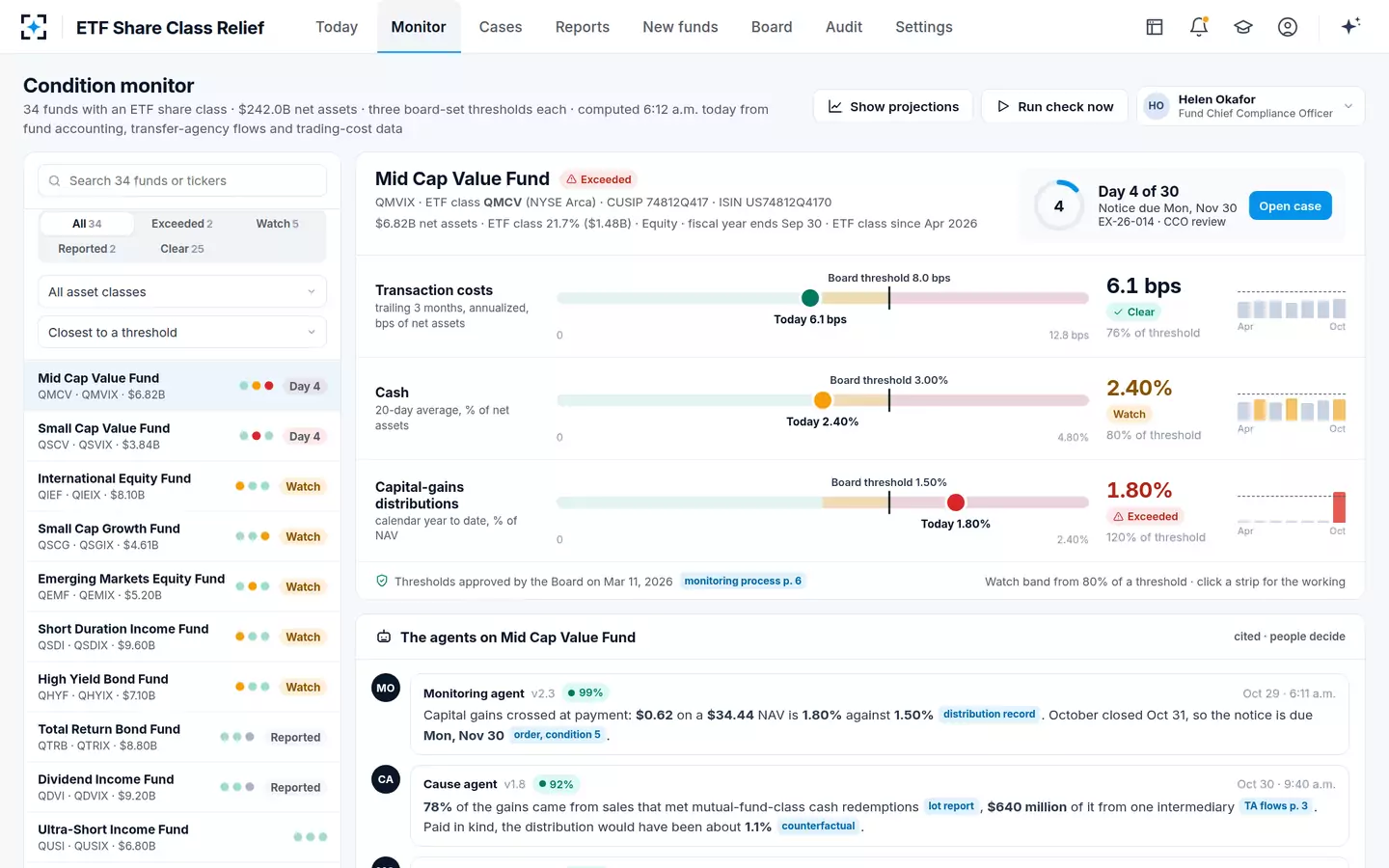
ETF Share Class Relief reads class flows from the transfer agent's records and attributes each threshold crossing to the flows and trades behind it, so an exchange is not mistaken for a cash redemption. On the sample, the solution separated the mutual-fund-class redemptions that forced sales, $95.8 million of a $122.8 million distribution at the Mid Cap Value Fund, from the ETF-class activity that went out in kind. What that attribution means for the board's annual finding is the subject of the benefits of an ETF share class, measured for the board.
The exchange privilege as a remedy for a cash-heavy intermediary
A conversion programme is also a lever on the order's thresholds. Every holder who moves from a mutual fund class to the ETF class is one fewer holder whose cash redemptions can force sales that realize gains for every class. Where one intermediary's reallocation is driving the mutual fund classes' cash redemptions, offering it the exchange privilege for the rest of the reallocation moves the same assets without a sale.
That is what the sample adviser's remediation plan proposed after the Mid Cap Value Fund's distribution crossed its 1.50% threshold: the largest redemption, from one intermediary, had realized $50.7 million of gains, and paid in kind it would have left the distribution at about 1.06% of net assets. The plan offered the intermediary the exchange into the ETF class for its remaining reallocation. In the solution, the adviser's notice to the board carries that recommendation with each figure cited, and the CCO and the treasurer approve it before the board liaison releases it.
Funds joining the relief, step by step, with thresholds tested on 36 months
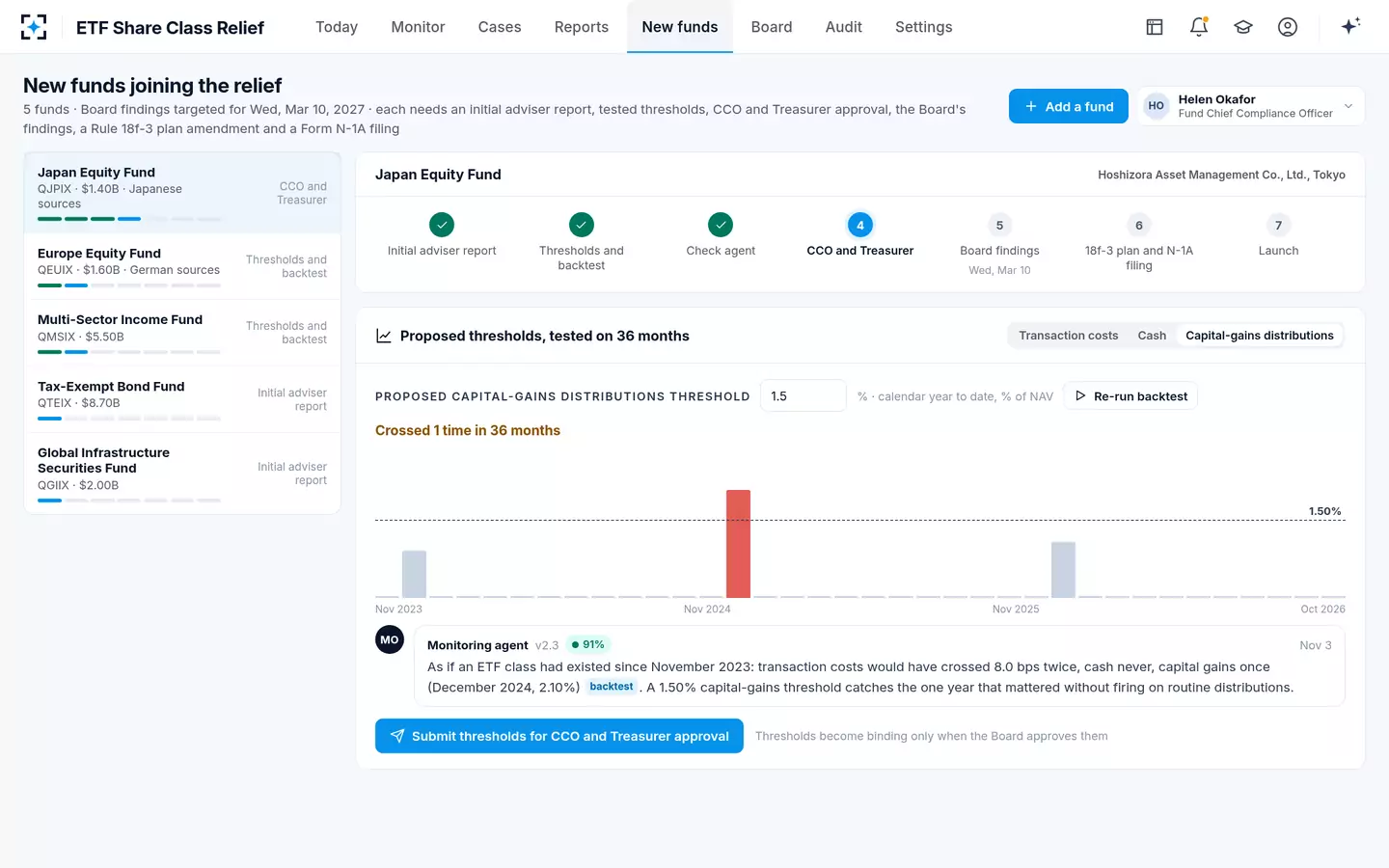
The full launch sequence, from the first filing to the first ETF-class trade, is in ETF share class application: from filing to the first ETF-class trade. The monitor, the attribution and the board notices are on the ETF Share Class Relief page.
Questions people ask
Does a fund have to offer an exchange into its ETF class?
No. The notice says a fund "may offer" an exchange privilege, and condition 1 permits it alongside Rule 6c-11 operations. If it does, the mutual fund prospectus must describe the ETF shares and the privilege, and exchanges must be at relative net asset value under section 11(a).
Is a mutual fund share class conversion a taxable event?
An exchange between classes of the same fund keeps the holder in the same portfolio, and section 1036 provides no gain or loss on exchanges of common stock solely for common stock in the same corporation; the first applicants called class exchanges tax-free. Cash received alongside is taxed up to its amount, and the fund's own disclosure is what holders rely on.
Can ETF-class shares be converted back to the mutual fund class?
Generally not. The exchange privilege runs from the mutual fund class to the ETF class, with exceptions only where the ETF class is terminated or the fund merges into one without an ETF class. An ETF-class holder who wants out sells on the exchange.
Does the exchange force the fund to sell securities?
No. The ETF shares issued are newly issued by the fund, not bought in the market, and net assets simply move between classes. That is why the applicants said the privilege could move holders without adverse consequences to the fund.
How should exchanges appear in the board's monitoring?
Separately from cash redemptions. An exchange moves net assets between classes without a trade, so counting it as a mutual-fund-class outflow overstates the cash redemptions behind realized gains and distorts the class attribution the order's thresholds depend on.
Can a board convert an entire class?
As a last resort. The notice lists conversion of an entire class into another class of the same fund, "as otherwise permitted under the Act", among the remedies an adviser may recommend after a threshold is exceeded. It would need its own board decision, disclosure and tax analysis.