The SEC published notices of 99 distinct applications for ETF dual share class relief in the Federal Register between 1 October 2025 and 21 September 2026: Dimensional's alone, then batches of 30, 17, 23 and 18 under the title "Multi-Class ETF Fund Exemptive Relief", then ten single notices. That is our count of unique 812- file numbers in the 15 notices, and the Federal Register showed no further notice by 28 October 2026. The SEC's own figure, in an order of 17 March 2026, was that "approximately 100 applications have been filed" (Exchange Act Release 34-105028). Each granted order leaves the fund with standing conditions: reports, board findings, thresholds and 30-day notices. Botminds' ETF Share Class Relief is built to run those conditions once the order is in hand.
Every figure here comes from the SEC's notices and orders as published in the Federal Register. The method is set out further down so that anyone can repeat the count; the dates are the dates the SEC issued each notice, which the Federal Register prints a few days later.
The queue, notice by notice: 99 applications in 15 notices
- Dimensional, 29 Sep 20251
- 17 Dec batch30
- 27 Jan batch17
- 25 Mar23
- 29 Apr18
- Singles, Jun–Sep 202610
- Hearing window
- First order, 17 Nov
- Batch orders, 13 Jan
- Exchange Act relief, 17 Mar 2026
How many ETF dual share class applications has the SEC noticed?
Ninety-nine, by our count of the Federal Register through 28 October 2026. The SEC gives notice of every exemptive application before it rules: under Rule 0-5, notice "will be published in the Federal Register" with the earliest date an order may be entered, and an order "will be issued as of course" after that date unless the Commission orders a hearing (17 CFR 270.0-5). The notices are therefore the most complete public list of who has asked for the relief and when.
Two other SEC figures bracket ours. In March 2026 the Commission wrote that "approximately 100 applications have been filed" and that it had "issued Multi-Class ETF Orders to over 48 registered open-end management investment companies". Applications filed are not the same as applications noticed: an application can sit with the staff for months, and the SEC's count included applications its notices had not yet reached. Orders go to registrants, usually trusts or corporations with many series, so 48 order recipients can cover many more funds than that.
The relief in the public record
99
applications noticed in the Federal Register, 1 Oct 2025 to 21 Sep 2026 (our count)
15
notices: Dimensional's, four batches and ten singles
~100
applications filed with the SEC as of 17 Mar 2026, in the SEC's words
48+
registered investment companies with orders by 17 Mar 2026, per the SEC
When were the applications filed?
Most were filed long before the first order. Of the 99 noticed applications, 72 were filed before the SEC noticed Dimensional's on 29 September 2025, and 81 before the order of 17 November 2025. Dimensional's own application had been filed on 13 July 2023 and amended three times before it was noticed. The queue was built while the industry waited for a precedent, then cleared in batches once the precedent existed.
Noticed applications by the quarter they were first filed
Amendments tell the same story. Thirty-two of the 99 applications were amended three times before notice and sixteen four times; 19 were noticed with no amendment at all. In the first batch, 20 of the 30 applications carried an amendment dated October to December 2025, after Dimensional's last amendment of 26 September. The plain reading is that applicants conformed their terms to the precedent once it was settled.
How long did it take from filing to notice?
It fell from years to weeks. Dimensional's application waited 809 days from filing to notice. The median for the first batch was 431 days, then 320, 271 and 176 for the next three, and 34 days for the ten applications noticed singly from June to September 2026. Seven of the 99 were noticed within 45 days of filing.
Median days from first filing to notice, by notice
The speed of the late notices fits the SEC's expedited procedure. Since June 2021, an applicant may ask for expedited review when its application matches, in substance, two others granted within the past three years (the test is set out in the ETF share class application plan), and the rule then requires that, no later than 45 days from filing, notice be issued or the applicant told it is not eligible. The notices do not say which applicants asked for expedited review, so the fit is an inference, not a fact. What is clear is that once there were orders to copy, an application that copied them moved quickly.
Why did the SEC notice applications in batches?
Because they asked for the same thing. Between December 2025 and April 2026 the SEC published four omnibus notices, each titled "Multi-Class ETF Fund Exemptive Relief Under the Investment Company Act of 1940", that describe the requested order once and then list each applicant with its 812- file number, filing and amendment dates and contact addresses. Eighty-eight of the 99 applications came through those four notices. Each still received its own order: the first batch's notice, Investment Company Act Release 35834, was followed on 13 January 2026 by separate orders for different applicants, among them releases 35867 and 35891 as the SEC later cited them.
From June 2026 the SEC switched to single notices, one per application, and the waits shortened sharply. The pattern in the singles also shows who is still arriving: three of the ten came from one series trust, Datum One Series Trust, each paired with a different sub-adviser and filed in June 2026, which is how a multi-adviser trust brings funds under the relief one adviser at a time.
What EDGAR's index shows: exemptive applications nearly doubled in 2025
EDGAR's quarterly form indexes show the surge in exemptive applications of every kind, ETF-class requests among them. Counting unique accession numbers for Form 40-APP, the form for applications under the Investment Company Act, we find 121 filings in 2023, 148 in 2024, 284 in 2025 and 131 in the first nine months of 2026. Amendments, filed as 40-APP/A, rose from 137 in 2023 to 418 in 2025.
Form 40-APP filings, all kinds of exemptive application
The caveat matters. A 40-APP can be an ETF-class request, a co-investment request, a manager-of-managers request or any other exemption, so the EDGAR count shows the load on the SEC's exemptive staff, not the ETF-class queue. For the queue itself, the Federal Register notices are the better source.
How to count the applications yourself
The count can be repeated in an afternoon from public pages. The steps below are the ones we used; they also show where the count can go wrong.
Re-counting ETF-class applications from the public record
- Search the Federal Register for SEC notices since September 2025
Agency: Securities and Exchange Commission; document type: notice; phrase "ETF Class" or "Multi-Class ETF". The batch notices are titled "Multi-Class ETF Fund Exemptive Relief Under the Investment Company Act of 1940"; singles carry the applicants' names.
- Drop the notices that are not applications
Exchange rule filings for listing "Class Exchange-Traded Fund Shares" and the Exchange Act order of March 2026 use the same words but are not applications.
- Count file numbers, not notices
Each application has one 812- file number. A batch notice lists many; count unique numbers across all notices.
- Use the issue date for timing
Each notice is dated by the SEC a few days before the Federal Register prints it; we used the SEC's date.
- Read the filing dates from the notice
Every entry states when the application was filed and amended. That gives the waiting time without opening the application itself.
- Find orders on the SEC's notices and orders page
Orders are issued by the SEC as Investment Company Act releases; the ETF-class orders are not printed in the Federal Register.
What does the count not tell you?
It does not tell you how many funds have an ETF class, how many have launched one, or how much money sits in them. An application covers a registrant and its existing and future series, so one application can bring dozens of funds within the relief or none. An order permits; it does not require. A fund can hold an order and never add the class.
It also does not tell you how the classes behave once they trade. That is the point of the conditions. Each fund that uses an order must have its board find the plan in each class's best interests before launch and at least annually, set thresholds for transaction costs, cash and capital gains distributions, and receive the adviser's notice within 30 days after any period in which a threshold is exceeded. The conditions, one by one sets them out as tests.
Four public sources, and what each one counts
| Source | What it counts | What it misses |
|---|---|---|
| Federal Register notices | Applications the SEC has noticed, with filing dates | Applications filed but not yet noticed; orders |
| SEC orders (Investment Company Act releases) | Registrants granted relief | Which series use it; launches |
| EDGAR Form 40-APP index | All exemptive applications and amendments filed | Which applications are ETF-class requests |
| SEC statements in later releases | The Commission's own running totals, such as "approximately 100 applications" | Dates other than the one stated |
What a granted order commits a fund to
The order is the start of the work, not the end. Dimensional's order took effect the day it was granted, bound by the conditions of the amended application (IC-35786), and the notice of its application sets out nine conditions (IC-35770). For a registrant that brings many funds into the relief, that means a board finding, a set of thresholds and a monitoring history for every fund with an ETF class.
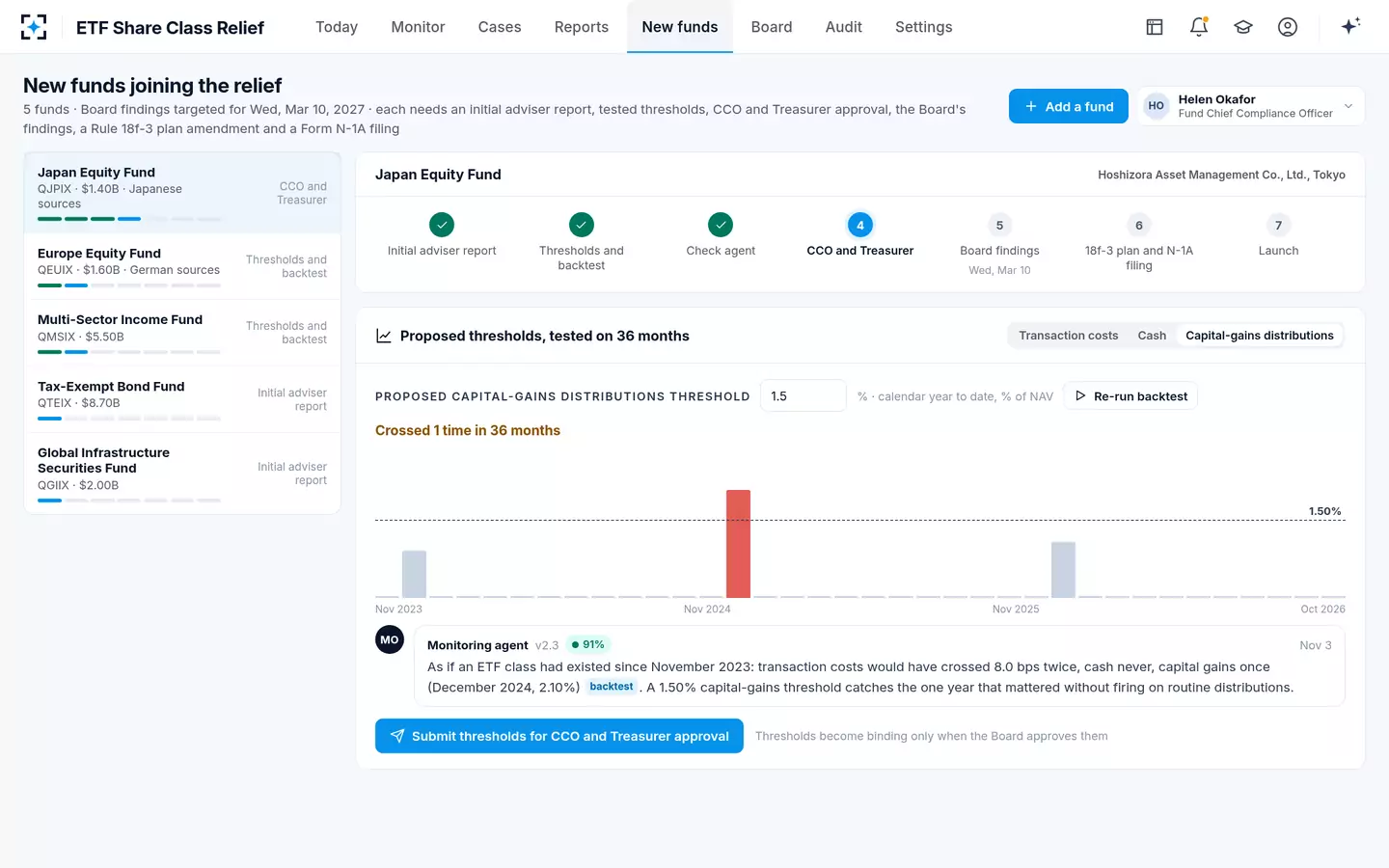
On the fictional Quillfield Funds Trust sample in ETF Share Class Relief, that is 34 funds with an ETF class and three thresholds each: 102 values computed every morning, with five more funds preparing initial adviser reports and backtested thresholds for a March 2027 board meeting.
ETF Share Class Relief: five more funds joining the relief, each step to launch
Is the queue still growing?
Slowly, by the public record. After 99 notices in under twelve months, the Federal Register carried none between 21 September and 28 October 2026. Of the 99, only 15 were first filed in 2026. The SEC's October 2026 proposal on closed-end funds describes the open-end orders as granted "with a significant number being issued so far" (91 FR 63388) and proposes letting closed-end funds issue multiple classes by rule; it is a proposal, with comments due by 4 December 2026, and it does not change the open-end orders.
For a fund family deciding now, the practical point is the precedent. An application that follows the existing orders' terms has a well-worn path, and six of the ten recent single notices came within 40 days of filing. The application plan lays out the steps from filing to the first ETF-class trade.
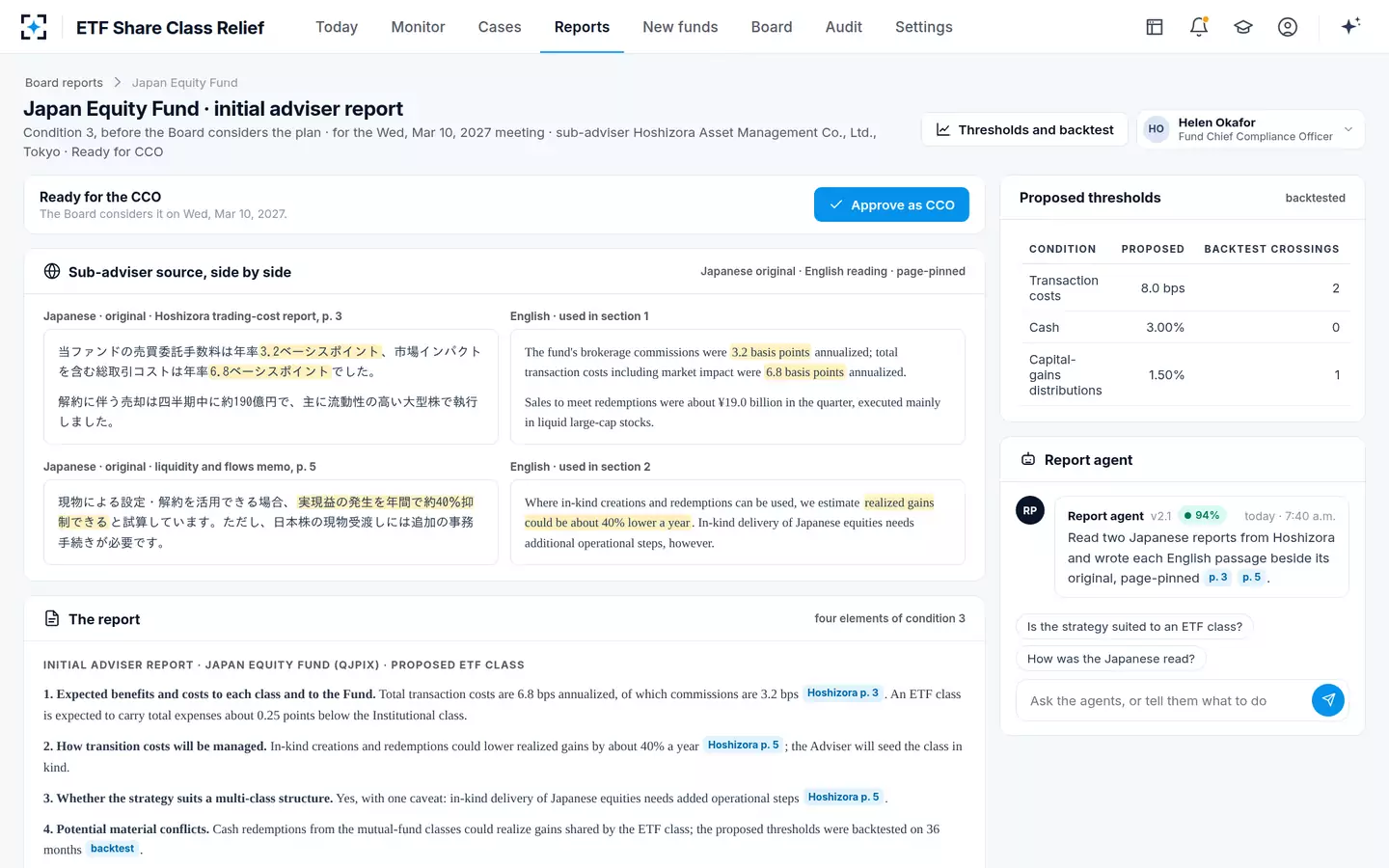
Each new fund's initial adviser report, drafted in ETF Share Class Relief from its own sources
Questions people ask
Which fund was first to get ETF share class relief?
Dimensional. The SEC noticed the application of DFA Investment Dimensions Group, Dimensional Investment Group, Dimensional ETF Trust and Dimensional Fund Advisors on 29 September 2025 and granted the order on 17 November 2025. The application had first been filed on 13 July 2023.
How many ETF share class applications are there?
The SEC said "approximately 100 applications have been filed" as of 17 March 2026. Our count of Federal Register notices gives 99 applications noticed by 21 September 2026, with no further notice by 28 October 2026.
How long does the SEC take to grant ETF share class relief?
After notice, an order follows unless a hearing is ordered; for the first batch, noticed on 17 December 2025 with hearing requests due on 12 January 2026, orders were dated 13 January 2026. From filing to notice, the median fell from 431 days for that batch to 34 days for the singles of mid-2026.
Where can I search SEC exemptive orders?
Orders are issued as Investment Company Act releases and listed on the SEC's notices and orders pages. The Federal Register carries the notices, which name the applicants, give the 812- file number and state the filing dates.
Are ETF share class applications public?
Yes. The applications are filed on EDGAR as Form 40-APP, and every notice tells readers to search EDGAR by the file number for the applicants' representations, legal analysis and conditions.
Does a granted application mean the fund has an ETF class?
No. An order permits a registrant's funds to add the class on its conditions; each fund still needs its board's findings, a registration filing and a listing before an ETF share is issued. Some order holders may never launch one.