An ETF share class application is a request to the SEC for an order under sections 6(c) and 17(b) of the Investment Company Act that lets a fund add one exchange-traded class to its mutual fund classes; it is filed on EDGAR as Form 40-APP, noticed in the Federal Register, and granted unless a hearing is ordered. With close to 100 precedents on file, an application that copies the existing orders' terms can ask for expedited review, under which the SEC must issue the notice or decline expedited treatment within 45 days of filing (17 CFR 270.0-5). The order, though, is the first of several steps: the adviser's initial report, the board's findings, approved thresholds, a plan amendment, a registration filing, a listing and a first trade, and then monitoring for as long as the class exists. Botminds' ETF Share Class Relief drafts the board papers for each fund joining the relief, backtests the proposed thresholds, and runs the monitoring, notices and records from the first day of trading.
Timings below come from the SEC's rules and from the dates in its own notices and orders; the 26-week plan is our suggestion, not an SEC requirement. Examples come from a fictional sample, Quillfield Funds Trust, as it runs through the solution.
A 26-week plan from filing to the first ETF-class trade, by owner
- Draft to precedent
- Expedited review, up to 45 days
- Hearing window
- Order
- Registration amendment
- Choose funds
- Initial adviser report, thresholds, backtest
- Board book and vote
- Monitoring set up
- Not started
- APs, market maker, custodian
- Listing and launch
How do you apply for ETF share class relief?
You file an application that asks for the same exemptions on the same conditions as the orders already granted. Dimensional's, the first, asked for exemptions from sections 2(a)(32), 5(a)(1), 18(f)(1), 18(i), 22(d) and 22(e) and rule 22c-1 under section 6(c), and from sections 17(a)(1) and (2) under sections 6(c) and 17(b), for its existing and future series "advised by the Advisor" (IC-35770). Later applications used the same structure: the batch notices since December 2025 describe every request in the same words and refer readers to each applicant's own representations and conditions on EDGAR.
Copying matters for speed. Rule 0-5 allows an applicant to request expedited review if the application is "substantially identical to two other applications for which an order granting the requested relief has been issued within three years", and defines substantially identical as requesting relief from the same sections, "containing identical terms and conditions, and differing only with respect to factual differences that are not material to the relief requested". The application must carry a notation on its cover, marked copies against the two precedents, and a signed letter explaining the choice of precedents.
How long does exemptive relief take?
For a copied application, weeks rather than months, by the public record. The ten applications noticed singly between June and September 2026 waited a median of 34 days from filing to notice; six were noticed within 40 days. The hearing window then runs about four weeks: the Wasatch notice of 16 September 2026 set 13 October for hearing requests (Federal Register, 21 September 2026). Under Rule 0-5, an order "will be issued as of course" after that window unless a hearing is ordered; for the first batch, with requests due 12 January 2026, orders were dated 13 January.
The SEC clock for a copied application
45days
from filing for the SEC to notice an expedited application or say it is not eligible
34days
median from filing to notice, ten single notices, Jun–Sep 2026 (our count)
~4weeks
hearing window after a notice, in the 2026 notices
120days
to answer staff comments on a non-expedited application before it is deemed withdrawn
Applications that depart from precedent take the standard route. The SEC's 2020 release set the frame: the staff had moved to "a new internal target of providing comments on both initial applications and amendments within 90 days" for filings from June 2019, and an application outside expedited review is deemed withdrawn if the applicant does not respond to comments within 120 days (85 FR 57089). The first ETF-class applications show what novelty costs: Dimensional's was filed on 13 July 2023 and noticed 809 days later. The public count charts how the wait fell as precedent built up.
Before you file: four decisions that shape everything after
Which funds, which thresholds, who carries the notices, and how the transition will be paid for. The order's conditions make each of these a board matter later, so they are better settled before counsel drafts. The initial adviser report must discuss "the appropriateness of the Fund's investment strategy for the Multi-Class ETF Fund structure" and "how the Advisor intends to manage the reasonably expected costs associated with the transition", so a fund whose strategy cannot be delivered in kind, or whose holders will churn through the mutual fund classes, is a harder case to make.
Decide these before the application is drafted
- Which funds join first
An order covers existing and future series; start with the funds whose portfolios move most easily in kind.
- What each fund's thresholds will be
The adviser recommends levels, calculation methods and periods; backtest them on the fund's own history before proposing them.
- Who receives the 30-day notices
The adviser may notify a designated committee or member of the board instead of the full board; if the board wants that route, it designates one.
- How the transition costs are managed
Seeding, any exchange privilege and the first creations all move assets; the initial report must say how costs will be handled.
- Whether to offer the exchange privilege
It is optional, runs one way, and needs intermediary support and dividend-date restrictions.
- Who owns the monitoring
Compliance, fund accounting and the adviser each hold part of it; one owner for each threshold avoids gaps.
The board meeting that makes the order usable
Nothing can be issued until the board acts. Before the first issuance of ETF shares, a majority of the directors and a majority of the independent directors must find, on the strength of the initial adviser report, that the multiple class plan is good for each class on its own and for the fund as a whole. At the same meeting the adviser recommends, and the board approves, the monitoring process: thresholds for transaction costs, cash and capital gains distributions, how each is calculated and the periods over which it is measured. The Rule 18f-3 plan is amended to add the class.
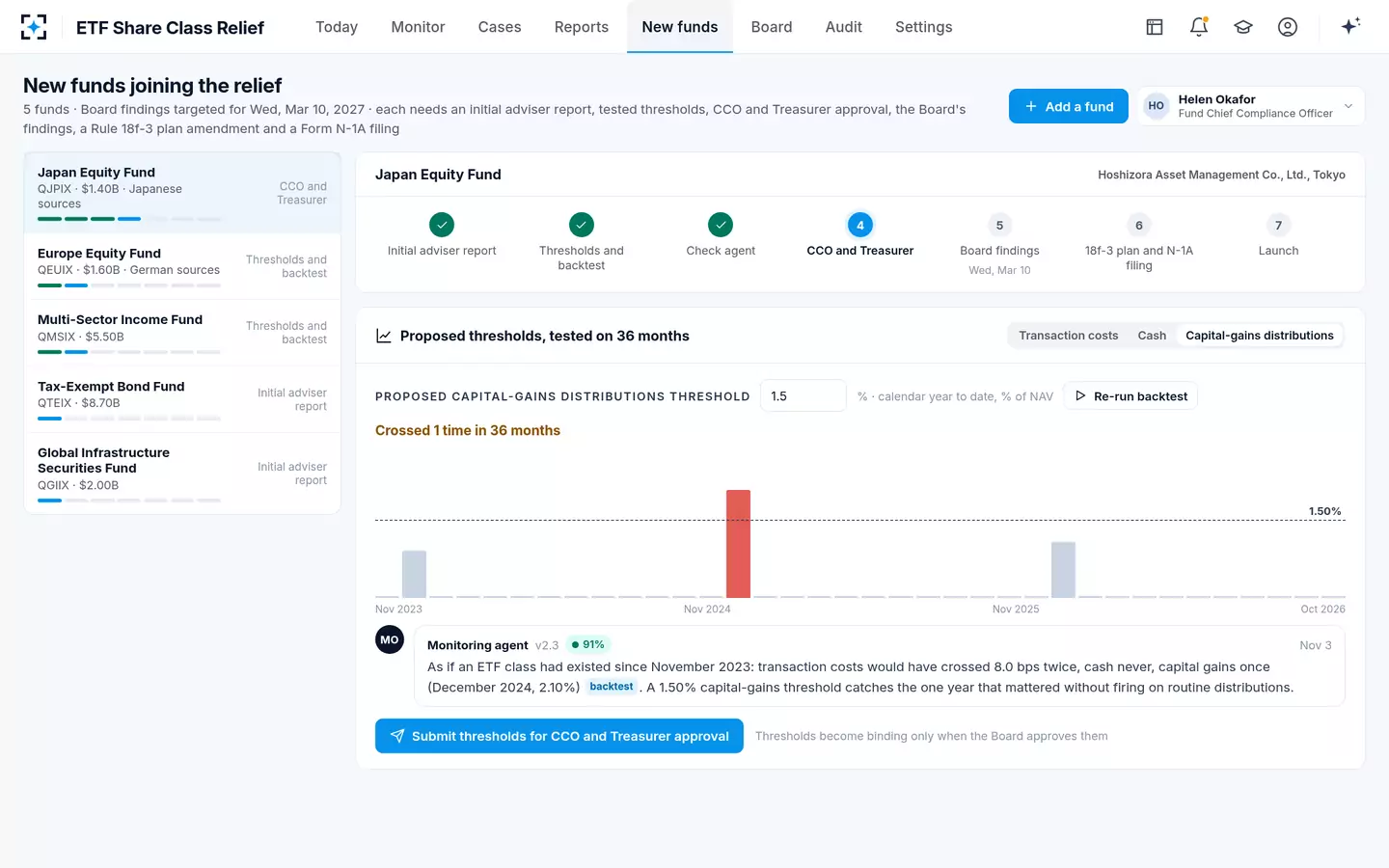
The board book for that meeting is the biggest single drafting job in the plan. On the Quillfield sample, five funds are joining the relief for a meeting on 10 March 2027, and each needs its own initial adviser report with the four required discussions and its own thresholds, backtested on 36 months. For the Japan Equity Fund the Report agent drafted the report from the Tokyo sub-adviser's Japanese reports, with the English beside each passage, and the backtest showed the proposed 1.50% capital gains threshold would have fired once in three years, in December 2024.
ETF Share Class Relief tracks five funds joining the relief, step by step, to the board meeting
Registration, listing and launch
The ETF class needs its own prospectus and a listing. The disclosure steps commit the fund to a prospectus for each kind of share, cross-disclosure on each class's prospectus and website, generic "ETF" naming and a plain-English web page on how the classes differ. Counsel chooses the filing path; if the amendment is filed under Rule 485(a)(1), it becomes effective "on the sixtieth day after the filing thereof" unless a later date is designated (17 CFR 230.485). The choice between the two filing paths is set out in 485APOS vs 485BPOS, from Botminds' Annual Prospectus Update.
Listing is simpler than it was a year ago. In November 2025 the SEC approved generic listing rules for "Class Exchange-Traded Fund Shares" on Cboe BZX, NYSE Arca and Nasdaq, followed by NYSE and NYSE Texas in April 2026; and in approving them the SEC made continuing compliance with Rule 6c-11 the core listing test (SEC order, NYSE Arca Rule 5.2-E(j)(9)). The SEC's March 2026 Exchange Act order gives broker-dealers conditional relief for creations and redemptions in an ETF class that has an order (Release 34-105028). Authorized participant agreements, a market maker, the custodian's basket process and the Rule 6c-11 website are standard ETF launch work, walked through in how to launch an ETF in the US, from Botminds' Fund Launch Management.
Who owns which part of the plan
Today
Drafts the application to precedent, answers staff comments, files the registration amendment.
With agents
Gets the draft findings resolution prepared from the same monitoring history the board saw.
Still theirs: the application, the filing path, the legal judgments
Today
Writes the initial report and recommends thresholds for each fund, from spreadsheets.
With agents
Gets each report drafted with figures cited and thresholds backtested on the fund's history.
Still theirs: the recommendations it signs
Today
Chases each fund through report, approval, findings, plan amendment and filing.
With agents
Sees every joining fund's steps on one screen, with what is waiting on whom.
Still theirs: which funds join, and when
Today
Review and sign the board book, then build the monitoring by hand before launch.
With agents
Approve drafts with reasons; monitoring starts computing on the first trading day.
Still theirs: both approvals
Day one: the first monitoring period starts with the first trade
The conditions begin when the class does. From the first ETF share, the fund is subject to the board-approved monitoring process, every value for every period becomes part of the six-year record, and the first exceedance starts a 30-day clock from the end of its period. A fund that launches in the middle of a month with a monthly period has a short first period, and capital gains distributions can arrive in the first year if the fund realized gains before the class existed.
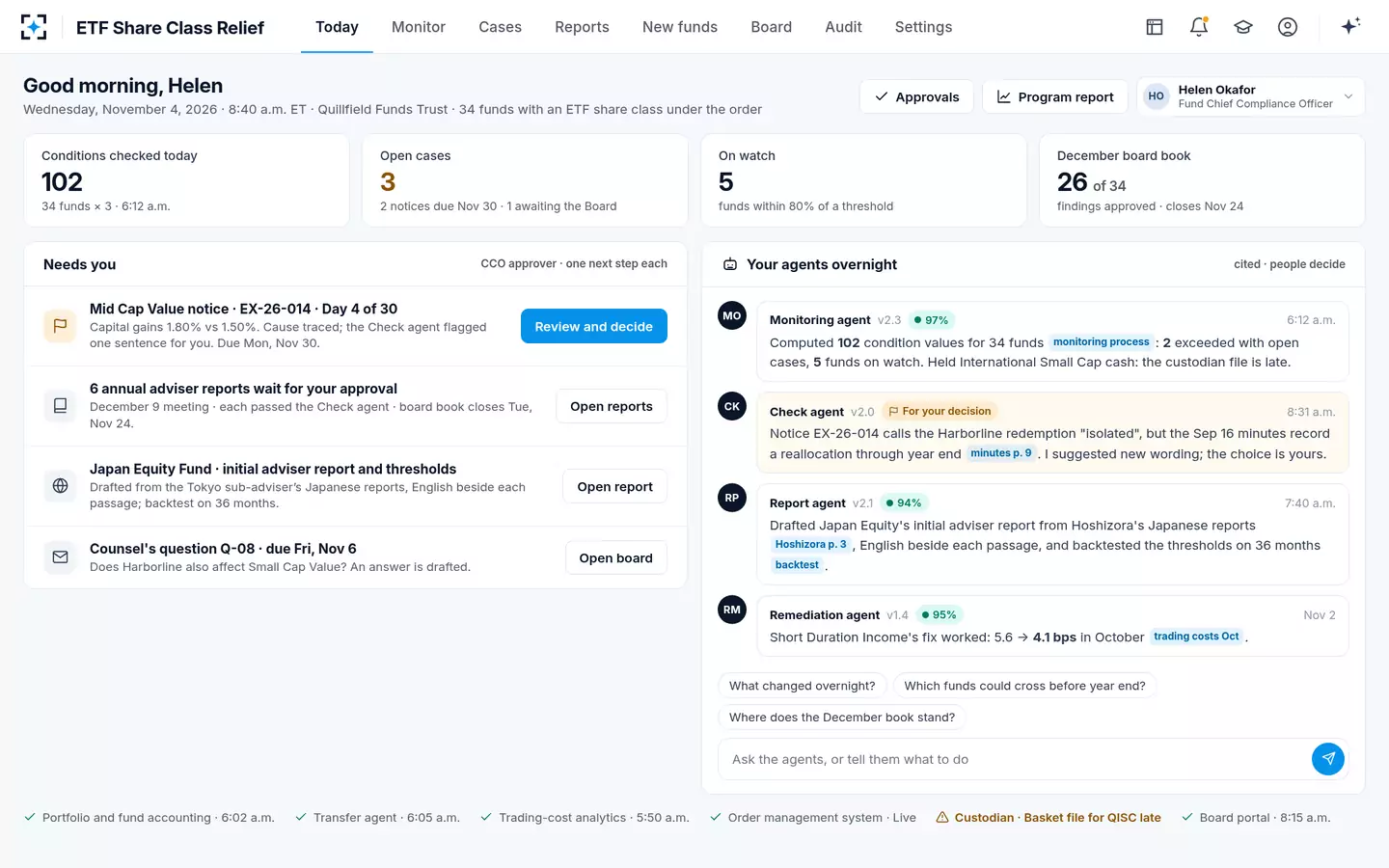
That is the work that never stops, and it is where ETF Share Class Relief earns its place. Each morning its Monitoring agent computes the three thresholds for every fund from fund accounting, transfer-agent flows and trading-cost data; a crossing opens a case, the Cause agent traces it, the Notice agent drafts and the Check agent tests the draft against the order, prior notices and the minutes; the CCO and treasurer approve and the board liaison releases. The seats the order adds describes the standing work by role.
The CCO's morning in ETF Share Class Relief once the class trades
What can go wrong between the order and the first trade?
Most failures at this stage are sequencing errors, and each is visible in the record afterwards. The findings must be dated before the first ETF share is issued; the plan amendment must include the ETF class before it issues; the thresholds must be approved at the initial approval, not after the first month; and if notices are to go to a committee or a single director rather than the full board, that designation is better made before the first crossing than during it. The first three are conditions of the relief the fund operates under from its first trade.
The quieter risk is data. The monitoring process needs fund accounting's realized gains by lot, the transfer agent's flows by class and intermediary, and trading-cost data by order, each available on the schedule the approved method assumes. A fund that launches before those feeds are reliable starts its six-year record with gaps. The Quillfield sample's rule is to hold any value whose source is more than one business day old and flag it, and four cases in the sample year were withdrawn after a source system corrected a value, each with its reason on the record.
The first year after launch, month by month
Once the class trades, the calendar is set by the periods the board approved and by the annual finding. With monthly periods, each month end closes a period for each of the three thresholds; any exceedance starts its 30 days; and the record grows whether or not anything crossed. Before the first anniversary of the initial findings, the adviser delivers the ongoing report and the board re-finds the plan, "no less frequently than annually". In between, the adviser may recommend changes to thresholds or periods, each of which goes back to the board.
The ongoing report is easier to write in month thirteen if month one was recorded properly. It must discuss observed benefits and cost savings, observed conflicts or harm, and anything the board asks; a year of computed values, crossings, causes and remedies is the evidence for all three. In ETF Share Class Relief the Report agent drafts it from that history, and the Check agent tests it against the year's notices before the CCO reads it.
What does an ETF share class application cost?
No regulator publishes a cost for ETF-class applications specifically. The nearest official figure is older and narrower: in 2019 the SEC staff estimated that the direct cost of a typical fund's application for ordinary ETF relief, mostly legal fees, was about $100,000, varying with complexity (84 FR 57162). An ETF-class application that copies precedent is a smaller drafting job than a novel one; what costs more is what follows, because the conditions add reports, findings and monitoring for every fund that uses the order, every year.
The way to price it is by output. Count, for each fund joining, one initial adviser report and one set of backtested thresholds before launch; then, every year, one ongoing report, one annual finding and up to twelve monitoring periods per threshold, three thresholds per fund. On the Quillfield sample, 34 funds produce 102 values a day and, in 2026, ten notices, all inside 30 days and sent on day 16 on average.
What to ask of anyone who will help you go live
Whether you use counsel, an administrator, a consultant or software, the questions are the same, and they are about the years after the order more than the weeks before it. A partner who can draft the application but not run the monitoring leaves the hardest part with you.
Questions for a go-live partner or a tool
- Can you backtest our proposed thresholds on our own funds before the board meeting?
Thresholds are the board's decision; a backtest is the evidence it needs to make it.
- Will the initial adviser report cover all four required discussions, with sources?
A report missing one fails condition 3.
- From the first trading day, who computes each threshold, by what method, from what data?
The method and the period are part of what the board approved.
- How is the 30-day clock started and tracked?
It runs from the end of the period, not from when the crossing is noticed.
- Can each figure in a notice be traced to its source?
The treasurer will not sign figures he cannot check.
- What does the six-year record contain, including quiet months?
Condition 8 covers documents showing a threshold was exceeded or not exceeded.
Questions people ask
What form is used to apply for SEC exemptive relief?
Applications under the Investment Company Act are filed on EDGAR as Form 40-APP, with amendments as 40-APP/A. Each receives an 812- file number, which the SEC's Federal Register notice quotes.
How long does SEC exemptive relief take?
For an application substantially identical to two orders granted within three years, the SEC must notice it or say it is not eligible for expedited review within 45 days, and an order follows the hearing window. ETF-class applications noticed singly in mid-2026 took a median of 34 days from filing to notice.
Can the board make its findings before the SEC grants the order?
The condition is timed to the first issuance of ETF shares, not to the order: the findings must come before the first ETF share is issued and before any material amendment of the plan. Placing the meeting after the order lets the findings rest on the conditions as granted.
Do we need a new application for each new fund?
Not if the order covers it. The first order applies to existing and future series advised by the applicant's adviser; each new fund still needs its own initial adviser report, board findings and thresholds before its ETF class issues shares.
When does monitoring have to start?
With the first ETF share. The fund is then subject to the board-approved monitoring process, and every period's values form part of the record kept for six years.