ETF share class exemptive relief is an SEC order under sections 6(c) and 17(b) of the Investment Company Act that lets a registered open-end fund offer one class of exchange-traded shares alongside one or more mutual fund classes of the same portfolio. The first was granted to Dimensional on 17 November 2025, "effective immediately, subject to the conditions contained in the application, as amended" (IC-35786), and later orders have followed the same conditions. Complying means turning each of the nine conditions into a test with a record: a dated report with the required contents, a vote with the right majorities, a threshold computed by the approved method, a notice inside its window. Botminds' ETF Share Class Relief runs those tests for every fund each day and drafts the documents that prove them, while the adviser, the CCO and the board make every decision.
The conditions quoted here are those in the SEC's notice of Dimensional's application (IC-35770, 29 September 2025). The worked examples come from a fictional sample, Quillfield Funds Trust, as it runs through the solution.
The nine conditions as tests: what to check, and what proves it
- 1. The ETF class runs under Rule 6c-11
Test: each business day's website disclosures and basket records exist. Record: the Rule 6c-11 records, kept five years.
- 2. Findings before the first ETF share
Test: minutes show a majority of directors and of independent directors found the plan in the best interests of each class and the fund, dated before first issuance.
- 3. The initial adviser report
Test: the report covers all four required discussions and reached the board before the vote.
- 4. The monitoring process recommended
Test: thresholds, calculation methods and periods for costs, cash and capital gains distributions were recommended at initial approval.
- 5. Monitoring run, plan re-found each year
Test: every value for every period is computed and kept; any exceedance reached the board within 30 days of the period end; the annual finding is minuted.
- 6. The ongoing adviser report
Test: it covers observed benefits, observed conflicts or harm, and the board's requests, and mentions every exceedance of the year.
- 7. The disclosure steps
Test: separate prospectuses, cross-disclosure on each class's prospectus and website, generic "ETF" naming, plain-English website page.
- 8. Six years of records
Test: findings, reports and monitoring documents, crossings and months without one, are retained and retrievable.
- 9. The sunset
Test: counsel tracks any Commission rule that would permit the structure, because the relief expires on its compliance date.
What does ETF share class exemptive relief permit?
It permits two things the Act otherwise blocks: running a class as an ETF, and running that ETF class next to mutual fund classes of the same fund. The notice calls them "ETF Operational Relief" and "ETF Class Relief". The first gives the ETF class the same relief Rule 6c-11 gives an ordinary ETF; the second exempts the structure from sections 18(f)(1) and 18(i), which govern senior securities and equal voting rights.
The fund needs the order because neither rule reaches it. Rule 6c-11 defines an ETF as a fund whose shares are listed and traded at market prices, which suggests that all of the fund's shares must be listed. Rule 18f-3 lets classes differ only in their distribution and service arrangements and the costs of those, and ETF shares, listed and redeemable only by the creation unit, differ in much more. The SEC said as much in 2019, when it declined to bring share class ETFs under the new ETF rule and told sponsors to use "our exemptive application process" (Exchange-Traded Funds, 84 FR 57162).
The sections an ETF share class order exempts, and why each is needed
| Provision | What it otherwise requires | Why an ETF class needs relief |
|---|---|---|
| Sections 2(a)(32) and 5(a)(1) | Shares of an open-end fund are redeemable by each holder | ETF shares are redeemable only in creation units |
| Section 22(d) and rule 22c-1 | Sales at the prospectus offering price, based on net asset value | ETF shares trade on the exchange at market prices |
| Section 22(e) | Redemptions paid within seven days | Foreign holidays and settlement cycles can delay in-kind delivery |
| Sections 17(a)(1) and 17(a)(2) | No sales or purchases between the fund and its affiliates | Affiliated authorized participants exchange in-kind baskets with the fund |
| Sections 18(f)(1) and 18(i) | No class with priority over another; every share an equal vote | The ETF class and the mutual fund classes carry different rights |
A separate SEC order settles the broker-dealer side. On 17 March 2026 the Commission granted conditional relief from Exchange Act rules 10b-10 and 14e-5 and section 11(d)(1) for creations and redemptions in ETF classes, on condition that the fund has an order requiring its ETF class to run "in compliance with the requirements of rule 6c-11" (Exchange Act Release 34-105028). Condition 1 is therefore load-bearing twice: it holds up the fund's own relief and the relief its authorized participants rely on.
What conditions come with ETF share class relief?
Nine, and they divide into three kinds. Conditions 1 and 7 are about how the ETF class operates and is described; conditions 2 to 6 are the governance loop of reports, thresholds and findings; conditions 8 and 9 are the record and the end date. The governance loop is where compliance work concentrates, because it never finishes: the monitoring runs every period and the plan must be re-found "no less frequently than annually".
The order in four numbers
9
conditions in the order, each one a test a fund must be able to evidence
3
thresholds the board approves: transaction costs, cash, capital gains distributions
30days
after the period ends, for the adviser to notify the board of an exceedance
6years
of findings, reports and monitoring records, the first two easily accessible
Condition 1: the ETF class is tested as an ETF
The first test is the most mechanical. The ETF class must operate "in compliance with the requirements of Rule 6c-11", with two exceptions: the fund lists only one class, and it may offer an exchange privilege. Everything else in the rule applies, including the website disclosures each business day before the open and the written basket policies, which must set out in detail how custom baskets are built and accepted if the fund uses them (17 CFR 270.6c-11). The fund also files Form N-1A and N-CEN as an ETF that relies on the rule would.
The evidence is the Rule 6c-11 record: each basket published, the custom-basket checks and the website history. Those records already run five years under Rule 6c-11(d). What the condition adds is that a failure here is not only an ETF-rule problem; it is a breach of the order on which the whole multi-class structure rests.
Conditions 2 and 3: the findings and the initial adviser report
Before the first ETF share is issued, a majority of the directors and a majority of the independent directors must find "that the plan is in the best interests of each Mutual Fund Class and the ETF Class individually and of the Multi-Class ETF Fund as a whole". The test has three parts a CCO can check from the minutes: who voted, whether both majorities were met, and whether the date precedes the first issuance. The same finding is needed before any material amendment of the plan to include an ETF class.
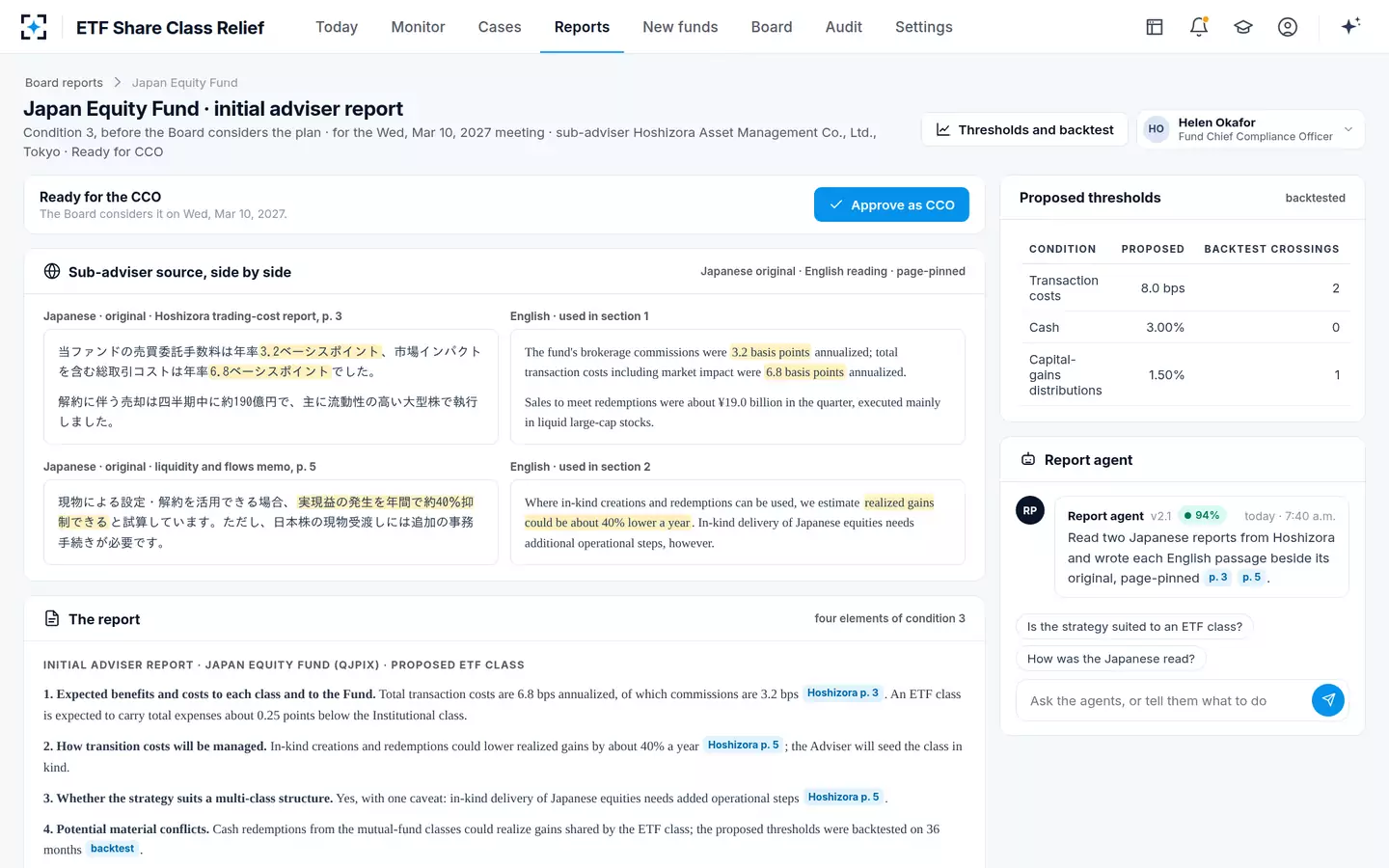
The initial adviser report is what the board finds on. The notice lists four required discussions: the "reasonably expected benefits and costs to each class individually and the Fund as a whole"; how the adviser will manage the costs of the transition; whether the fund's strategy suits the structure; and any other potential material conflicts, "including any other sources of potential cross-subsidization". A report that covers three of the four is not a weaker report; it is a failed condition. Reasonable expectations may rest on "reasonable assumptions and good faith estimates", based on historical data for existing funds.
An initial adviser report drafted in ETF Share Class Relief, the four required discussions in order
Conditions 4 and 5: the monitoring process and the 30-day notice
The adviser recommends, and the board approves, numeric thresholds for "(i) costs associated with portfolio transactions, (ii) cash levels and (iii) capital gains distributions", with the calculation method and the measurement period for each, all designed to bring conflicts between the mutual fund classes and the ETF class to light. How a board chooses those levels and periods is the subject of capital gains distribution threshold monitoring. The adviser may recommend more thresholds; changes to thresholds or periods go back to the board.
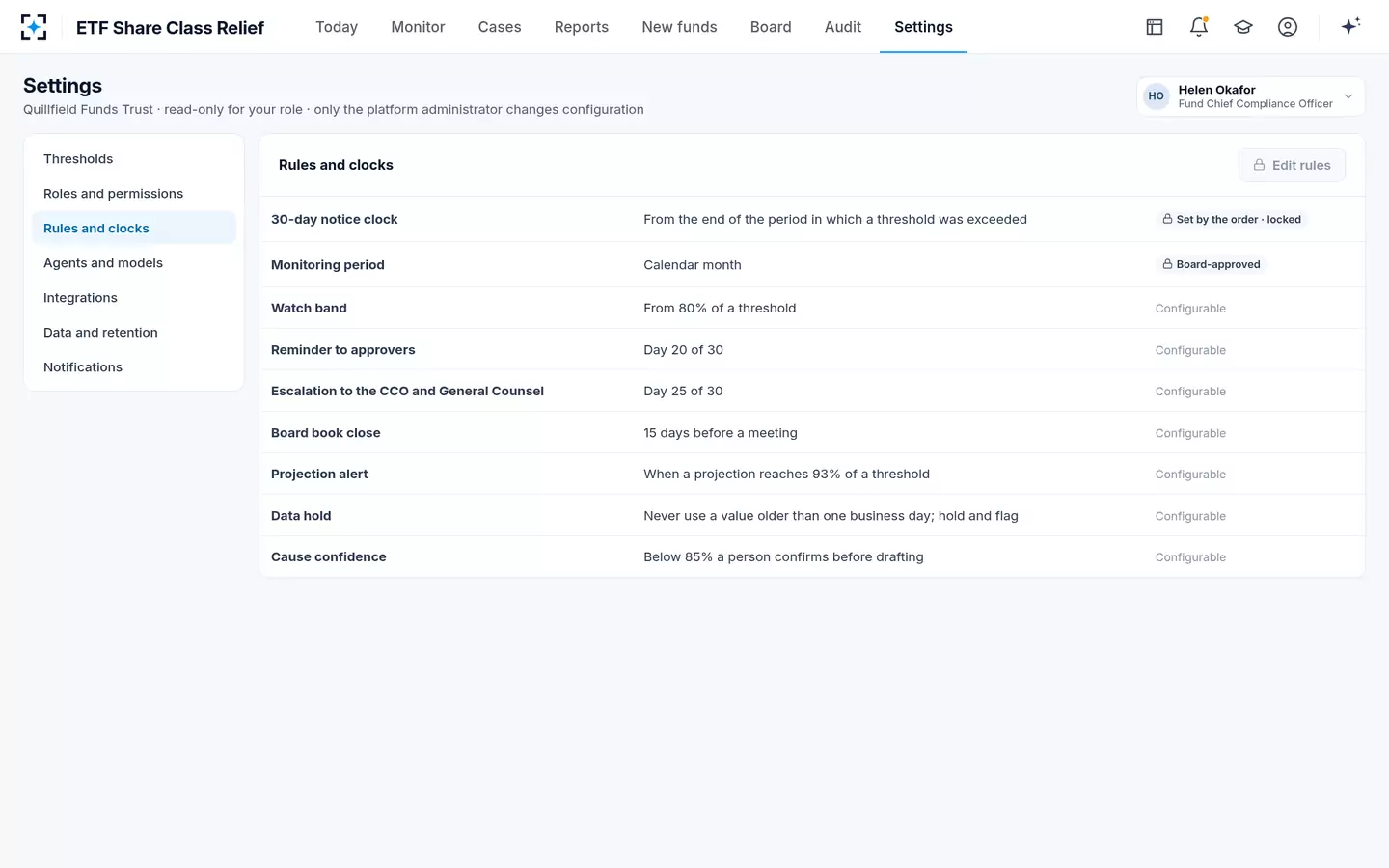
"If a Multi-Class ETF Fund exceeds an established numerical threshold, the Advisor will notify the Board no later than 30 days following the end of the applicable time period in which the threshold was exceeded."
SEC notice of application, IC-35770, representation 11
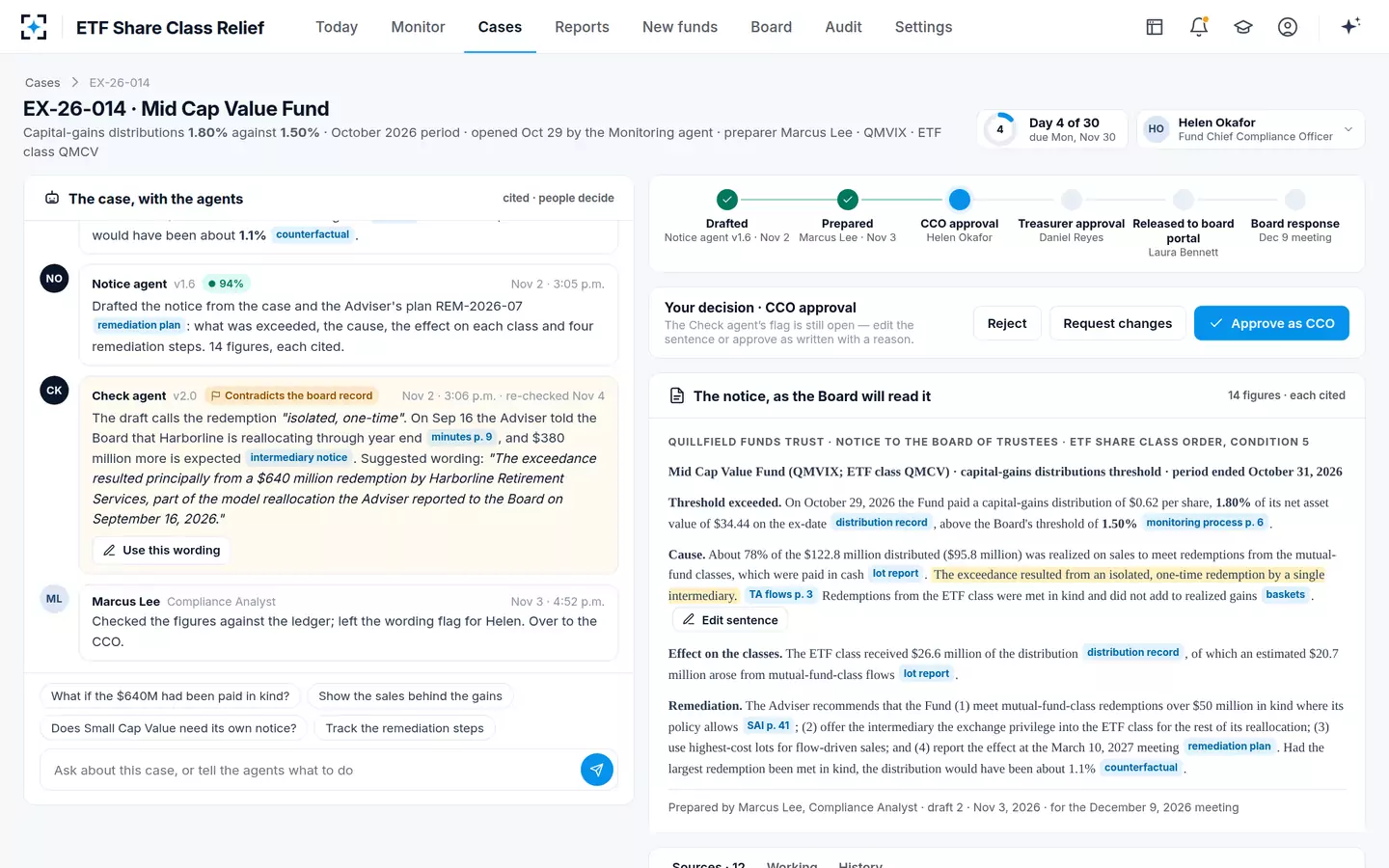
The notice carries the cause and the cure: "a written explanation of the Advisor's assessment of the causes of the Fund exceeding the threshold(s), and any proposed recommendations for what, if any, remedial actions the Fund should take." Footnote 17 lists six examples, from adjusting in-kind transactions and trade execution, through credit lines to reduce uninvested cash and tax-lot management to reduce capital gains distributions, to fee changes, better disclosure and, at the far end, closing a class or converting all of it. The test is therefore four questions per period: was every value computed by the approved method; did any exceed; if so, did the notice reach the board, or its designated committee or member, by day 30; and did it state causes and remedies?
Two choices made here decide how hard the condition is to live with. A monthly period means up to twelve windows a year per threshold per fund; a quarterly one means fewer notices but a later warning. And the clock starts at the end of the period, not when someone notices: a crossing found at a month-end review three weeks into the next month has a week left. The capital gains threshold shows one crossing traced from the declaration to the notice.
In ETF Share Class Relief the order's clock is locked and the board's thresholds are settings
Condition 6: the ongoing adviser report and the annual finding
At least once a year the board must find again that the plan "continues to be in the best interests of each Mutual Fund Class and the ETF Class individually", and the adviser's ongoing report informs that finding. It must discuss "any observed benefits or cost savings" from the structure, "any observed material conflicts of interest" between the classes or "observed material negative consequences" to either, and "any other information that the Board requests". Footnote 18 gives examples of consequences: effects on portfolio size, liquidity, liquidity risk management and operations.
The test that catches most problems is a reconciliation: every exceedance notice sent during the year should appear in the ongoing report, with what the remedy achieved. A report that describes a smooth year while the monitoring record holds three notices invites the question the board should have asked. In the solution the Report agent drafts the ongoing report from the same monitoring history the notices came from, and the Check agent tests it against them before anyone reads it.
Conditions 7, 8 and 9: disclosure, records and the end date
Condition 7 binds the fund to the disclosure steps, nine in all, from "separate prospectuses for a Fund's ETF Shares and Mutual Fund Shares" to "plain English disclosure on its website about ETF Shares and how they differ from Mutual Fund Shares". Each is a yes-or-no test on a document or a web page, best rerun at every prospectus update.
Condition 8 is the record. It covers the documents behind conditions 2, 3, 5 and 6, and "any documents created pursuant to the Ongoing Monitoring Process that evidence a Multi-Class ETF Fund has exceeded or not exceeded an established threshold", kept "for a period not less than six years, the first two in an easily accessible place". The phrase "or not exceeded" is the one to design for: a fund must be able to show its quiet months as readily as its crossings.
Condition 9 is the sunset. The relief "will expire on the compliance date (or such other date established by the Commission) of any Commission rule under the Act that provides relief permitting the operation of a Multi-Class ETF Fund structure". The Federal Register showed no SEC proposal for such a rule for open-end funds as of 28 October 2026; the SEC's 5 October 2026 proposal on multiple classes for closed-end funds is only a proposal, and covers a different kind of fund. The history of share classes suggests why the condition is there: the SEC granted about 200 multiple-class orders before replacing them with Rule 18f-3 in 1995, as the 18f-3 adopting release recounts.
What does the order leave to the board's judgement?
It leaves the numbers. The order sets no threshold level, no period and no definition of a material conflict; it requires that the thresholds be "reasonably designed" to identify material conflicts and that the board approve them. That is deliberate flexibility, and it moves the burden of proof onto the record: if a threshold is set where it never fires, or fires every month, the board will be asked why.
The useful evidence is a backtest. On the Quillfield sample, the adviser's proposed thresholds for the Japan Equity Fund were run against 36 months of the fund's own history: transaction costs above 8.0 basis points would have fired twice, cash above 3.00% never, and capital gains distributions above 1.50% once, in December 2024, at 2.10%. That tells a board what it is approving: an alarm that would have rung three times in three years, each time for a reason it would have wanted to hear.
What evidence will an examiner ask for?
The SEC's examination staff have said they will look. Among the areas of focus in the fiscal 2027 priorities published on 23 October 2026 are "RICs that operate in reliance on exemptive orders, including their implementation and compliance with such orders" (SEC Division of Examinations, FY2027 priorities). For an ETF-class fund that means the order, the plan and a file that answers each condition's test with a document, a date and a name.
An examination file for one fund with an ETF class
| Condition | Evidence that answers it | Where it usually lives |
|---|---|---|
| 1 | Daily website captures, basket files, custom-basket approvals | ETF operations, custodian |
| 2 and 5 | Minutes with both majorities, the plan as approved, each annual finding | Board portal, secretary |
| 3 and 6 | The initial and each ongoing adviser report, with their sources | Adviser, compliance |
| 4 | The recommended thresholds, methods and periods; the board approval; any changes | Compliance, board portal |
| Monitoring | Every computed value by period, crossings and quiet months, each notice with its date of delivery | Compliance, fund accounting |
| 7 | Both prospectuses, website pages, marketing review records | Counsel, marketing compliance |
| 8 | Retention schedule and retrieval test | Records management |
ETF Share Class Relief keeps that file as a by-product of the work. Every computed value, crossing, draft, check, approval and release is a row on a read-only audit trail kept six years, and an evidence set for one fund or one condition exports for an examination. The seats that carry each condition covers who does what inside the fund.
One notice, as the board will read it, every figure cited
Questions people ask
What is SEC exemptive relief for an ETF share class?
An order under section 6(c) of the Investment Company Act, and section 17(b) for affiliated in-kind transactions, exempting a fund from the provisions that would stop it from offering an exchange-traded class next to mutual fund classes. The first was granted to Dimensional on 17 November 2025; the relief applies only on the conditions in the application.
Is ETF share class relief the same as Rule 6c-11?
No. Rule 6c-11 lets ordinary ETFs operate without an order, but it does not cover an ETF that is one class of a multi-class fund. The order gives the ETF class the same operational relief as Rule 6c-11, on condition that it complies with the rule, and adds relief from sections 18(f)(1) and 18(i) for the class structure.
Who decides the thresholds in an ETF share class order?
The adviser recommends them and the board approves them, with the method of calculation and the measurement periods. The order names the three subjects, transaction costs, cash and capital gains distributions, but no levels. Any change goes back to the board.
What happens if a fund misses the 30-day notice?
The order does not set a penalty; a late notice is a failure to meet a condition of the relief the fund operates under. Examination staff have said they will review funds' implementation of and compliance with exemptive orders, so the late notice and its cause would be part of the record they read.
Can an ETF share class order be relied on by future funds?
The Dimensional application asked for relief for existing and future series of its registrants and other registered funds "advised by the Advisor". New funds of the same adviser can therefore join, but each must go through the initial adviser report and board findings before its ETF class issues a share.
Do ETF share class orders expire?
Yes, on condition 9: the relief ends on the compliance date of any Commission rule that permits the structure. Until such a rule is adopted, the orders continue on their conditions.