A standalone US ETF does not have share classes: it issues one class of shares that trade on an exchange, and Rule 6c-11, the ETF rule, does not cover a fund with more than one. Since 17 November 2025, though, the SEC has granted exemptive orders that let a mutual fund offer one ETF share class alongside its mutual fund classes, all owning the same portfolio (IC-35786). So the US answer is now "an ETF can be a share class", not "an ETF can have share classes". In Europe the answer differs again: the Central Bank of Ireland permits a UCITS to have a listed "UCITS ETF" share class and unlisted classes side by side. Funds that use the new US orders take on standing conditions, from board findings to 30-day notices, and Botminds' ETF Share Class Relief is built to run them.
The structures below are drawn from the SEC's rules, releases and orders and from the Central Bank of Ireland's published guidance.
Who can have what: five structures, three of them in force in the US
United States
A standalone ETF
One class of shares, listed and traded at market prices; created and redeemed only by authorized participants. Operates under Rule 6c-11 without an order.
One class
United States, since 17 Nov 2025
A mutual fund with an ETF share class
One listed ETF class beside one or more mutual fund classes, all owning one portfolio. Needs an SEC exemptive order with conditions.
One ETF class, many mutual fund classes
United States, 2000 to 2007 orders
Vanguard's share class ETFs
Earlier orders let certain Vanguard index funds add an exchange-traded class; the SEC left them in place in 2019.
One ETF class, by individual order
Ireland and other UCITS domiciles
A UCITS with a UCITS ETF share class
Listed and unlisted share classes within one UCITS, permitted by the Central Bank of Ireland since 2018, the listed class named "UCITS ETF".
Listed and unlisted classes
United States, proposed Oct 2026
Closed-end funds with multiple classes
An SEC proposal would let closed-end funds issue multiple classes by rule; listed closed-end funds with unlisted classes were discussed only as an alternative.
A proposal, not law
Do ETFs have share classes in the US?
Not a standalone ETF. Rule 6c-11 defines an exchange-traded fund as a registered open-end company whose shares are listed on an exchange and traded at market-determined prices, and the applicants for the first ETF-class order noted that "this definition suggests that all of the investment company's shares must be listed" (IC-35770). A fund with an unlisted class cannot rely on the rule, and a fund relying on the rule has one class. What changed in 2025 is the other direction: a mutual fund can now add an ETF as one of its classes, by order.
The reason is section 18 of the Investment Company Act. Rule 18f-3 lets mutual funds issue multiple classes, but apart from distribution and service arrangements the classes must carry identical rights and obligations (17 CFR 270.18f-3(a)(4)). ETF shares and mutual fund shares do not: ETF shares trade on an exchange and are redeemed only in large blocks, while any mutual fund holder can redeem at net asset value. In 2019 the SEC said in so many words that an ETF could not use Rule 18f-3 to exist as a class inside a fund (84 FR 57162); what Rule 18f-3 still governs sets out what the orders kept and what they changed.
Can an ETF have multiple share classes?
Not in the US structures in force today. The ETF share class orders allow a fund to offer "one ETF Class and one or more Mutual Fund Classes", and condition 1 requires that the fund "will list only one class of its shares on an Exchange". A fund cannot use the order to run two listed ETF classes with different fees, for example. Its mutual fund classes can still differ from one another in the usual ways Rule 18f-3 allows, such as distribution and service arrangements.
Europe is different in kind. The Central Bank of Ireland lets a UCITS have "both listed and unlisted share classes", and lets the "UCITS ETF" identifier be used "at the level of the sub-fund or listed share class" (CBI UCITS Q&A, ID 1088). The Q&A's text sets no limit of one listed class like the US orders' limit; whether a particular structure is permitted is a matter for the Central Bank's review of each fund.
The exception that came first: Vanguard's share class ETFs
The US had ETF share classes long before 2025, through a handful of earlier orders. From 2000 to 2007 the SEC issued orders allowing some Vanguard mutual funds to add an exchange-traded class, and when it adopted Rule 6c-11 in 2019 it wrote: "We are not rescinding exemptive relief previously granted to share class ETFs." By the SEC's figures, at the end of 2018 there were 68 share class ETFs, holding 25.6% of all US ETF net assets, $854.6 billion.
Three decades of share classes and ETFs in the US, in four periods
| Period | What the rules allowed | How |
|---|---|---|
| 1995 to 2000 | Multi-class mutual funds, but no exchange-traded class | Rule 18f-3, adopted 23 February 1995, effective 3 April 1995 |
| 2000 to 2019 | Vanguard share class ETFs, alongside ETFs that were separate funds | Individual exemptive orders, the first in December 2000, the last in 2007 |
| 2019 to 2025 | ETFs without an order, but no new ETF share classes | Rule 6c-11, adopted 25 September 2019; share class ETFs left to the exemptive process |
| Since 17 November 2025 | One ETF class beside mutual fund classes, on conditions | ETF share class orders, starting with Dimensional (IC-35786) |
Why did the US wait until 2025?
Because in 2019 the SEC chose consistency for ordinary ETFs over a quick answer for share class ETFs. It said openly that the choice had a cost: "Leveling the ETF playing field is a goal for rule 6c-11, and we acknowledge that our approach will result in there being a segment of ETF assets that are unable to rely on the rule." Its reason was that share class ETFs raise conflicts the ETF rule was not built to manage, so it told sponsors to "request relief from sections 18(f)(1) and 18(i) of the Act through our exemptive application process" and committed to "assess all relevant policy considerations in the context of the facts and circumstances of each particular applicant" (84 FR 57162).
Applicants then took time to build answers to those conflicts. Dimensional filed in July 2023 and revised the application three times; the SEC noticed it in September 2025, 809 days after the first filing by our count of the dates in the notice. The conditions it ended with, from the initial adviser report to the 30-day notice, are the price of the answer: the SEC did not decide that ETF classes cause no conflicts, it decided that a board with the right reports and thresholds can watch for them.
What changed on 17 November 2025?
The SEC granted Dimensional an order with immediate effect, bound by the conditions of its amended application, and a queue of applicants followed. The SEC had said in 2019 that share class ETFs raise "policy considerations that are different" from ordinary ETFs, chiefly that an ETF class dealing in kind and a mutual fund class dealing in cash "may give rise to differing costs to the portfolio". The new orders answer that with conditions rather than a refusal: an initial adviser report, board findings before launch and at least annually, board-set thresholds for transaction costs, cash and capital gains distributions, a notice to the board within 30 days after any period in which a threshold is exceeded, and six years of records. The conditions, one by one sets them out as tests.
The new structure, in numbers
99
applications for ETF-class relief noticed in the Federal Register by 21 Sep 2026 (our count)
48+
registered investment companies with orders by 17 Mar 2026, per the SEC
1
listed ETF class allowed per fund under the orders
3
thresholds each fund's board must approve and watch
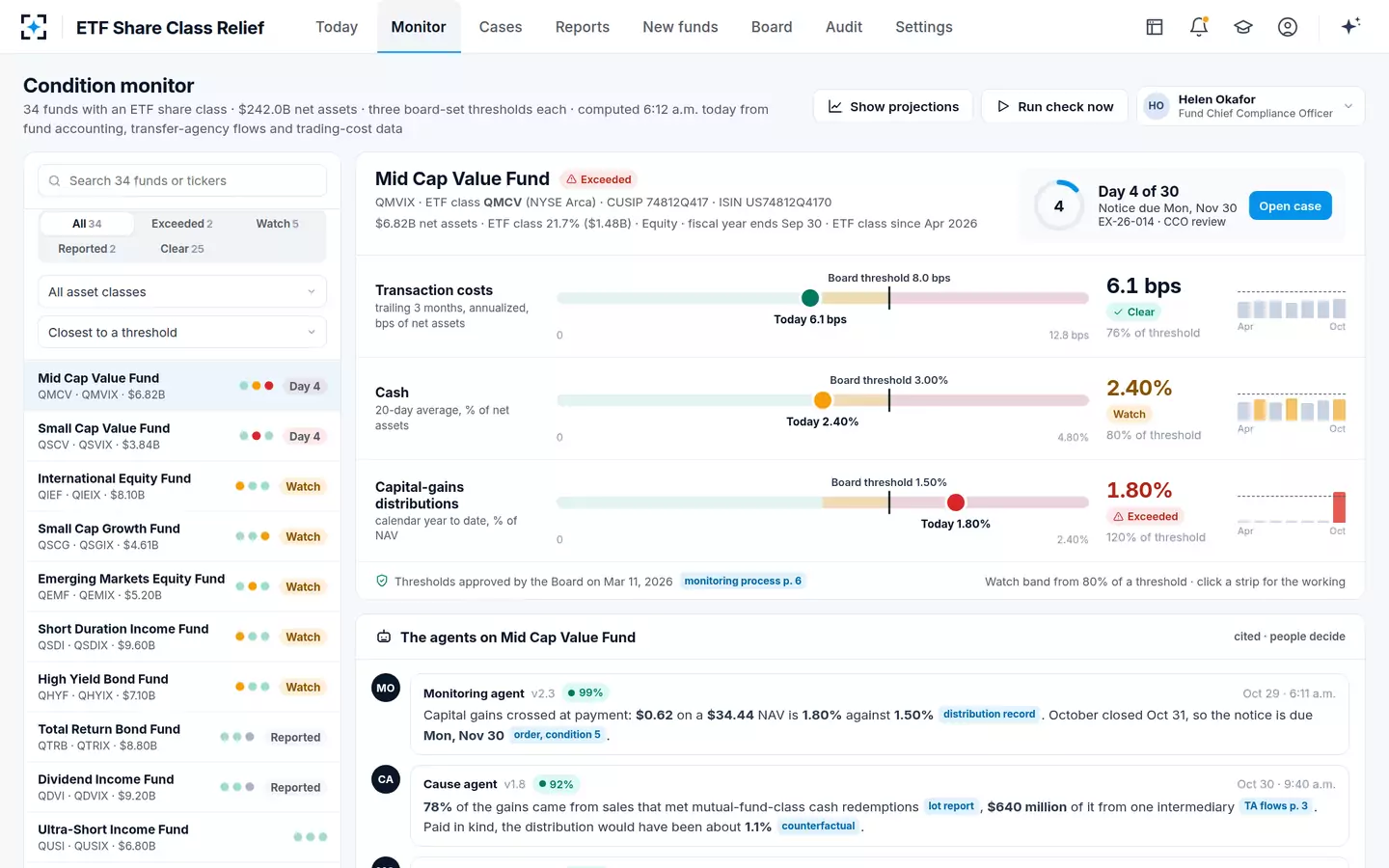
Inside the fund, those conditions are permanent work. On a fictional sample in ETF Share Class Relief, Quillfield Funds Trust, 34 funds with an ETF class mean 102 threshold values computed every morning, and any crossing opens a case with the order's 30-day clock.
ETF Share Class Relief: every fund with an ETF class, against its board's thresholds
ETF share classes in Europe: listed and unlisted classes in one UCITS
Ireland reached its answer earlier and by guidance rather than order. In a feedback statement of 14 September 2018 the Central Bank set out the concern, that holders of listed shares can exit during the day while unlisted holders wait for the next net asset value, and concluded: "the Central Bank finds that there are no grounds to prohibit listed and unlisted share classes" (CBI, Feedback Statement on DP6). It added that "investors choose whether to invest in a listed or unlisted share class" and that "the benefit this optionality provides outweighs any potential detriment in times of market stress".
The Central Bank drew its test from ESMA's opinion on share classes (ESMA34-43-296), whose principles it quotes: that "each share class should share a common investment objective"; that each class should have procedures to "minimise the risk that features that are specific to one share class, could have a potentially adverse impact on other share classes of the same fund"; that class features "should be pre-determined"; and that where investors choose between classes, the features of each "should be clearly disclosed". The second principle is the European version of the conflict the US orders police with thresholds.
The conditions are about disclosure. The prospectus must set out "in tabular format, the differences between investing in a listed share class and in an unlisted share class", covering at least the ability to deal, the dealing mechanism, costs, minimums and shareholder rights; for instance, "investors in an unlisted share class are direct shareholders in the UCITS. Investors in a UCITS ETF share class will not be direct shareholders in the UCITS". The US orders cover similar ground through separate prospectuses and cross-disclosure, and add a monitoring loop the Irish Q&A does not ask for.
An ETF share class in the US and in Ireland
US mutual fund with an ETF class: SEC exemptive order, fund family by fund family
Irish UCITS with a UCITS ETF share class: Central Bank of Ireland guidance (Q&A ID 1088), each fund reviewed
US mutual fund with an ETF class: One listed ETF class; one or more mutual fund classes
Irish UCITS with a UCITS ETF share class: Listed and unlisted classes; the listed class named "UCITS ETF"
US mutual fund with an ETF class: Separate prospectuses, cross-disclosure, generic "ETF" naming, plain-English web page
Irish UCITS with a UCITS ETF share class: A table in the prospectus comparing dealing, costs, minimums and rights; liquidity and price risk factors
US mutual fund with an ETF class: Board thresholds, 30-day notices, annual findings, adviser reports, six-year records
Irish UCITS with a UCITS ETF share class: Not specified in the Q&A beyond the general rules for UCITS
US mutual fund with an ETF class: 17 November 2025
Irish UCITS with a UCITS ETF share class: 2018, after the Central Bank's ETF discussion paper
What about closed-end funds and interval funds?
Not yet, and only by proposal. On 5 October 2026 the SEC proposed letting registered closed-end funds and business development companies issue multiple share classes by rule, codifying "what has become routine exemptive relief" (91 FR 63388). The proposal discusses, as an alternative it did not propose, letting an exchange-listed closed-end fund offer "one or more continuously distributed share classes" beside its listed shares, which it calls "broadly analogous" to the open-end ETF-class orders and says "would present novel investor protection challenges". Comments are due by 4 December 2026; nothing in the proposal changes the open-end orders.
How to tell which kind of share you own
Read the prospectus cover and the name. Under the US orders, the cover of the ETF class's prospectus tells you the shares trade on an exchange and cannot be redeemed one by one; the ETF shares go by a generic label or a trade name, not the fund's own name; and each class's documents point prominently to the other. In Ireland, the listed class carries "UCITS ETF" in its name.
Five checks on any ETF you hold
- Is it a fund, or a class of a fund?
An ETF class's prospectus will disclose that the fund also offers mutual fund classes.
- Who else owns the portfolio?
In a dual-class fund, mutual fund holders' cash redemptions can realize gains that every class shares.
- How have capital gains distributions looked?
Distributions come from the shared portfolio, whichever class caused them.
- What does the website say about the classes?
US funds with an ETF class must publish plain-English disclosure on how the classes differ.
- Can you switch classes?
Some US funds let mutual fund holders exchange into the ETF class; the reverse is generally not offered.
For a holder weighing the two kinds of class in the same fund, the ETF share class of a mutual fund compares them row by row, and switching classes covers the exchange and its tax questions.
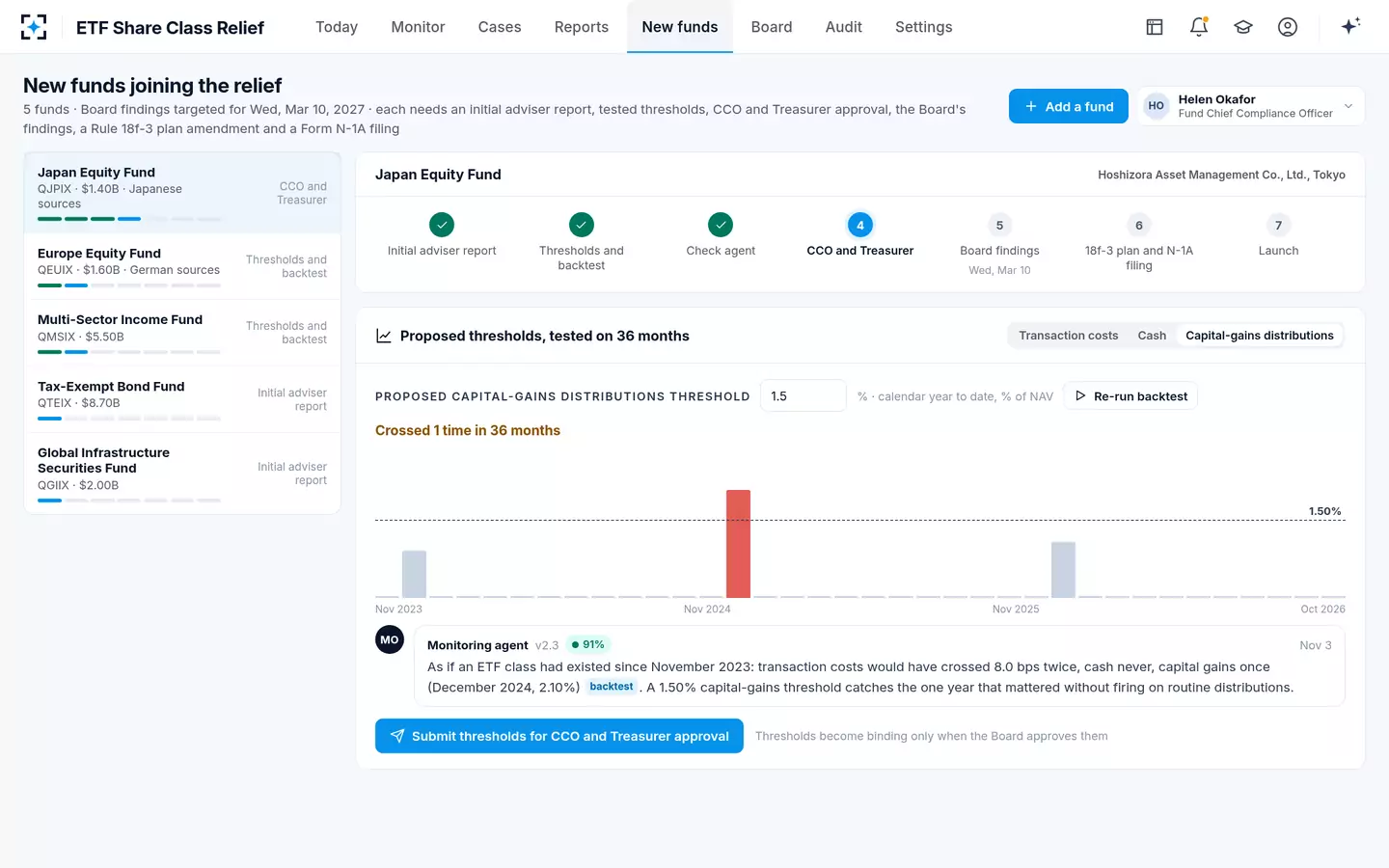
In ETF Share Class Relief, funds joining the relief go through the board one by one
Questions people ask
What is an ETF share class?
A class of exchange-traded shares issued by a fund that also has mutual fund classes, all owning the same portfolio. In the US it requires an SEC exemptive order; the first was granted on 17 November 2025.
Do ETFs have different share classes like mutual funds?
A standalone US ETF does not; it has one class. Under the ETF share class orders, a fund may list only one class, the ETF class, while its mutual fund classes can differ from one another as Rule 18f-3 allows.
Why couldn't US funds add an ETF share class before 2025?
Rule 18f-3 requires all classes to have the same rights apart from distribution and service arrangements, and Rule 6c-11 covers only funds whose shares are listed. The SEC said in 2019 that share class ETFs should seek individual exemptive relief, and it began granting it in November 2025.
Did the SEC approve ETF share classes?
It granted exemptive orders, starting with Dimensional on 17 November 2025, rather than adopting a rule. By March 2026 it had issued orders to over 48 registered investment companies, and each order expires if the SEC later adopts a rule permitting the structure.
Are UCITS ETF share classes the same as US ETF share classes?
They are similar in idea, listed and unlisted classes of one fund, but differ in basis and conditions. Ireland permits them under Central Bank guidance focused on disclosure; the US requires an SEC order with board thresholds, 30-day notices and annual findings.