An ETF share class of a mutual fund is a class of exchange-traded shares issued by an ordinary open-end mutual fund, owning the same portfolio as the fund's other classes. Investors in the ETF class buy and sell on an exchange at market prices, and only authorized participants create and redeem shares with the fund, in large blocks and usually in kind; investors in the mutual fund classes buy and redeem directly with the fund at net asset value, usually in cash. Since 17 November 2025 the SEC has granted orders that allow the structure, on conditions meant to stop one class's cash flows from costing the other (IC-35786). Botminds' ETF Share Class Relief runs those conditions: it measures the costs each class may impose on the other every day and drafts the reports the board relies on.
The SEC's orders call such a fund a "Multi-Class ETF Fund". The rights of each class quoted below come from the notice of the first application (IC-35770); the examples come from a fictional sample, Quillfield Funds Trust, as it runs through the solution.
The ETF class and the mutual fund class of one fund, row by row
ETF class: The fund's whole portfolio, pro rata
Mutual fund class: The same portfolio, pro rata
ETF class: On an exchange, through a broker, at the market price
Mutual fund class: From and to the fund, at the next net asset value
ETF class: Authorized participants only, in creation units, usually in kind
Mutual fund class: Every shareholder, in any amount the fund accepts, usually in cash
ETF class: Holdings, NAV, market price, premium or discount, bid-ask spread (Rule 6c-11)
Mutual fund class: NAV
ETF class: The ex-dividend date
Mutual fund class: One business day before the ex-dividend date
ETF class: Only if the investor's broker offers a program, days after payment
Mutual fund class: Automatic, at NAV, on the ex-dividend date
ETF class: Generally not into the mutual fund class
Mutual fund class: May exchange into the ETF class if the fund offers the privilege
ETF class: Its own prospectus; called "ETF" or a trade name
Mutual fund class: Its own prospectus, disclosing that the ETF class exists
What is an ETF share class of a mutual fund?
It is one class among several in a single registered fund, distinguished by being listed. The order lets a fund pair a single listed ETF class with any number of mutual fund classes, and the ETF class must run as an ETF "in compliance with the requirements of Rule 6c-11", except that only one class is listed and the fund may let mutual fund shareholders exchange into it. Everything else about multi-class funds still applies: the classes are governed by a written plan under Rule 18f-3, and income, gains and expenses are allocated across them by a method applied consistently (17 CFR 270.18f-3).
The word "class" is doing real work. A clone ETF that copies a mutual fund's strategy is a separate fund with its own portfolio, costs and tax history. An ETF class has none of those of its own. Its investors own a slice of the same securities, realized gains and tax lots as the mutual fund's investors, which is both the attraction and the risk.
ETF share class vs ETF: what is different from a standalone ETF?
To its holders, an ETF class trades like any ETF; the difference is who else owns the portfolio. A standalone ETF's portfolio changes only through creations, redemptions and the manager's own trades. An ETF class's portfolio also changes whenever the mutual fund classes take in or pay out cash, so the ETF class's holders feel the trading and the realized gains caused by investors who never touch the exchange.
The SEC saw this in 2019, when it adopted the ETF rule and left share class ETFs out. "An ETF share class that transacts with authorized participants on an in-kind basis and a mutual fund share class that transacts with shareholders on a cash basis may give rise to differing costs to the portfolio," it wrote; "while certain of these costs may result from the features of one share class or another, all shareholders would generally bear these portfolio costs" (84 FR 57162). Its footnote names three: brokerage and other trading costs from mutual fund cash flows, "cash drag associated with holding the cash necessary to satisfy mutual fund share class redemptions", and "distributable capital gains associated with portfolio transactions".
Two ways money leaves the portfolio, and who bears the cost
| Path | What the fund does | Cost to the portfolio | Who bears it |
|---|---|---|---|
| Mutual fund class redemption | Pays cash at NAV; sells securities or holds cash to do so | Commissions and market impact; cash held out of the market; realized gains on securities sold | Every class, through the shared portfolio |
| ETF class redemption by an authorized participant | Delivers a basket of securities in kind | Little trading cost; no gain recognized by the fund on the securities delivered | Mostly the authorized participant, through its transaction fee |
| Mutual fund to ETF class exchange | Issues new ETF shares for the mutual fund shares at relative NAV | None in the portfolio; assets move between classes | Neither class directly |
The seven differences in rights between the classes
The applicants listed them: "Mutual Fund Shares will be individually redeemable while ETF Shares generally will be redeemable only in Creation Units"; ETF shares trade on an exchange and mutual fund shares do not; the exchange privilege is generally limited to the mutual fund class; dividend reinvestment works differently; and declaration dates, record dates and payment dates may differ. Rule 18f-3 cannot cover them, because it allows classes to differ only in distribution and service arrangements, and that is why the structure needs an order rather than a plan amendment alone.
The dividend differences are small but real. Mutual fund holders who reinvest are "continuously invested", the notice says, while ETF holders who reinvest will be "out of the market" for several days on the amount of the dividend, and footnote 29 adds that this "will affect the relative performance of the classes". Voting can shift slightly too: because mutual fund holders can reinvest sooner, each could hold more votes than an ETF holder in the days after an ex-dividend date. The applicants judged the effect on any vote "extremely unlikely" to matter; it is still a difference a board has been told about.
Why can one class's cash flows cost the other?
Because only one of the classes forces the fund to sell. When a large intermediary redeems from a mutual fund class, the fund pays cash; if it has to sell appreciated securities to raise it, it realizes gains that every class must distribute. The ETF class's own redemptions go out in kind, and section 852(b)(6) of the Internal Revenue Code spares the fund the gain on securities it hands out to meet a redemption request (the mechanics are in the benefits of an ETF share class). The asymmetry is the whole reason for the thresholds.
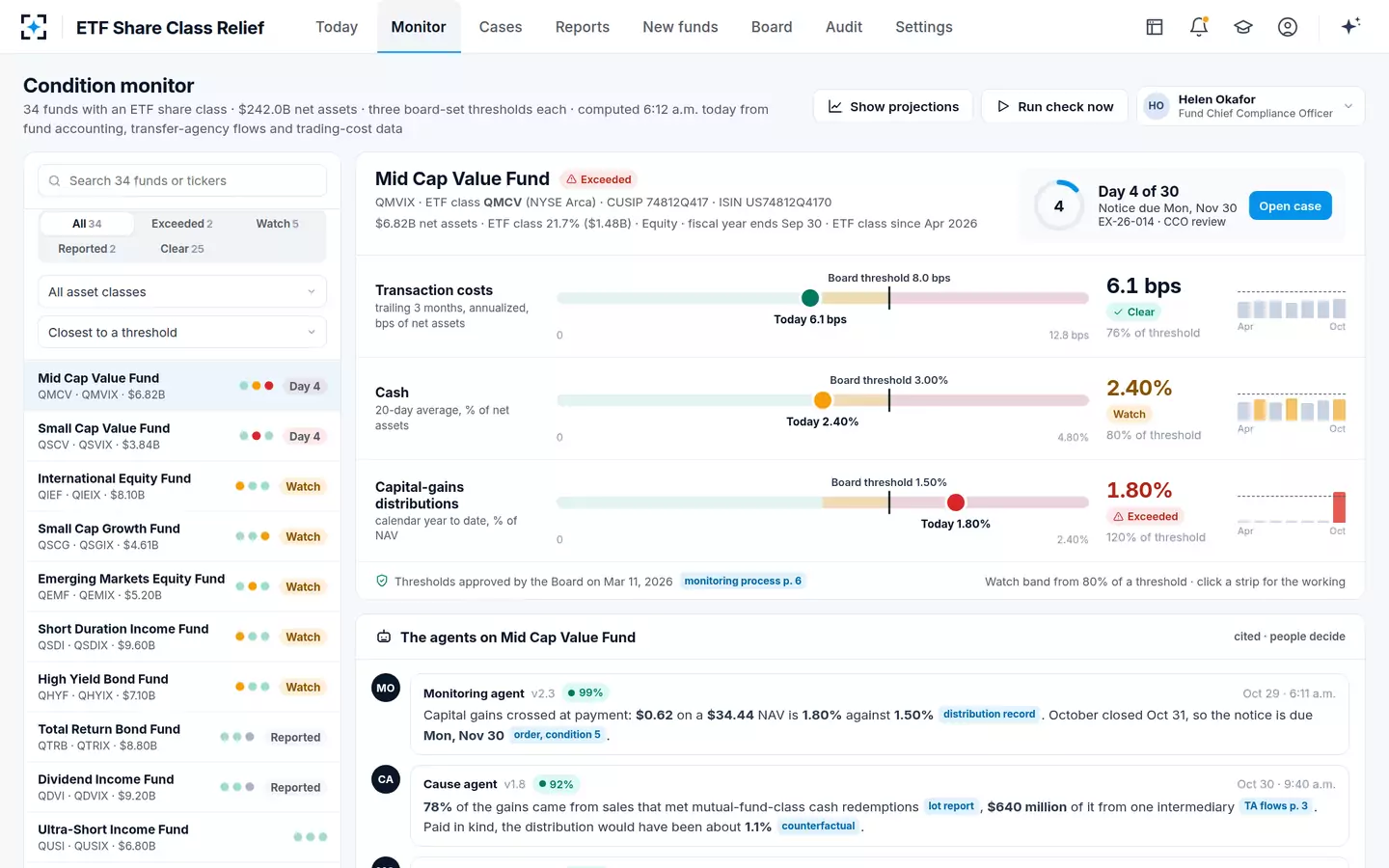
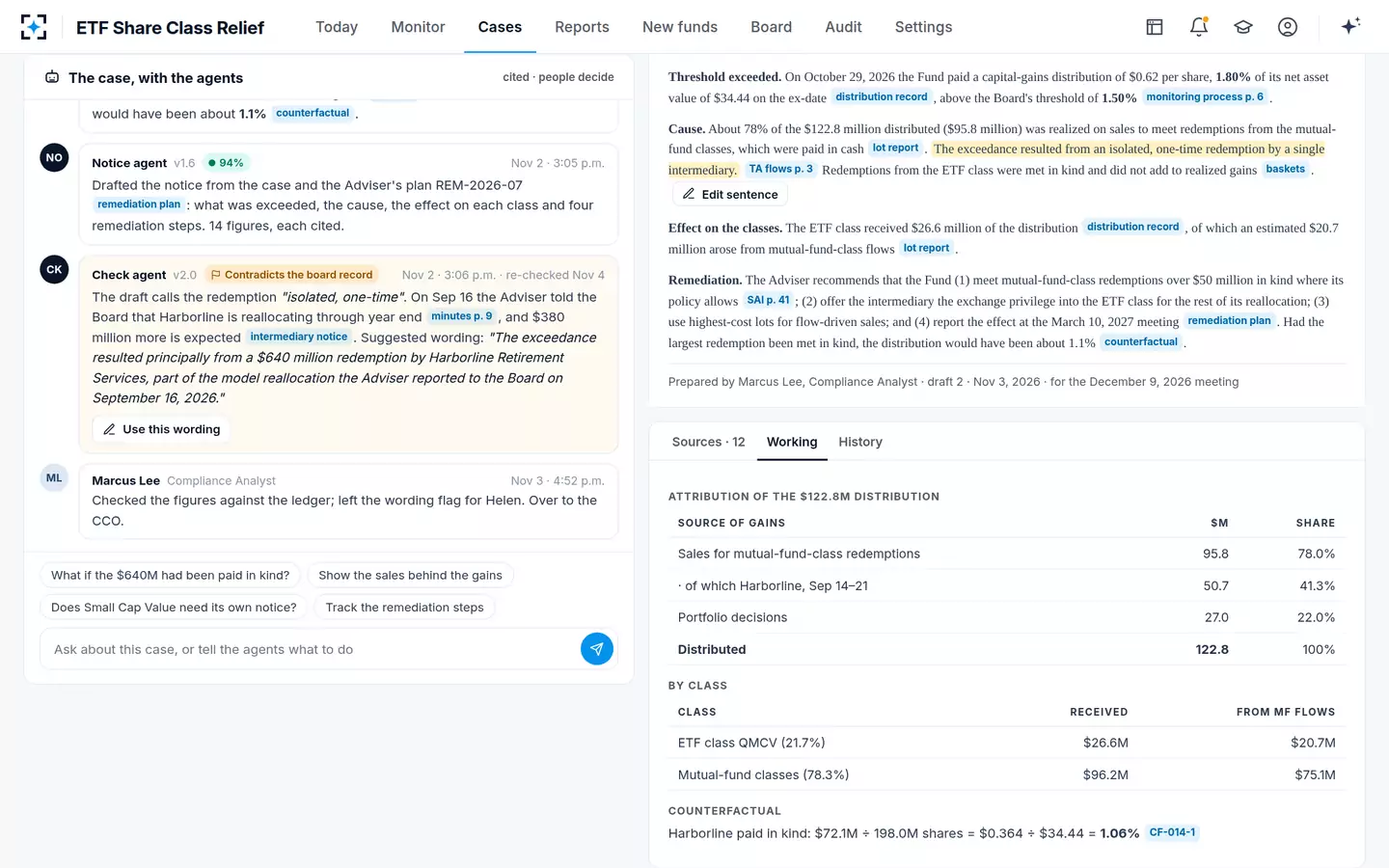
The Quillfield sample shows the size it can reach. Its Mid Cap Value Fund, $6.82 billion with an ETF class of 21.7%, paid a capital gains distribution of $122.8 million on 29 October 2026: 1.80% of net asset value, against the board's threshold of 1.50%. The solution's Cause agent traced 78% of the gains to sales that met mutual-fund-class cash redemptions, most of them from one intermediary in mid-September. The ETF class received $26.6 million of the distribution, an estimated $20.7 million of it caused by flows in the other classes.
Where one sample distribution came from, and where it went
ETF Share Class Relief measures three thresholds per fund against the board's limits every morning
What are the benefits of an ETF share class, and who says so?
The benefits on record are the applicants' own claims, each introduced in the notice with "Applicants believe". For mutual fund holders, the applicants believe in-kind transactions through the ETF class "may contribute to lower portfolio transaction costs and greater tax efficiency", that the ETF class is another distribution channel "that could lead to additional asset growth and economies of scale", and that frequent traders can use ETF shares "without disrupting the Fund portfolio".
For ETF holders, they argue the reverse flow helps: mutual fund cash flows "can be used for efficient portfolio rebalancing" and "may allow for greater Basket flexibility", and an existing fund gives ETF investors "access to established Fund investment strategies". The two lists are honest about the trade: each class is said to help the other, which is exactly why the order asks the adviser to report, every year, whether the benefits were observed.
Has this been done before? Vanguard's orders, 2000 to 2007
Yes. Vanguard held a handful of such orders, issued between 2000 and 2007, and the SEC left them in place when it adopted Rule 6c-11 in 2019. By the SEC's own figures for the end of 2018, 68 share class ETFs held 25.6% of all US ETF net assets, $854.6 billion. The structure was large long before it was open to others.
Share class ETFs before the 2025 orders
68
share class ETFs at the end of 2018
25.6%
of all ETF net assets that year
$854.6bn
held in those share class ETFs
What changed in 2025 is access and oversight. The earlier orders went to one fund family; any fund family may now apply on the same terms, and the new orders carry a governance loop built for the conflicts the SEC described in 2019: an initial adviser report, thresholds, 30-day notices, annual findings and an annual adviser report. Do ETFs have share classes? traces the US and European answers side by side.
Which mutual funds have an ETF share class?
Any fund whose registrant holds an order may add one, and the public record names the applicants. By the SEC's own count in March 2026, more than 48 registered open-end funds already held orders (Exchange Act Release 34-105028); by 21 September 2026 the Federal Register carried notices for 99 applications, by our count. An order covers a registrant's existing and future series, so the number of funds that could add a class is far larger than the number of orders. Which have actually launched one is a question for each fund's prospectus, because an order permits a class but does not create one. The public count shows how to read the notices.
What does each class's investor see?
Two prospectuses and two names. Under the disclosure steps in the order, each class has its own prospectus; each class's prospectus and website must say plainly that the other class exists; the ETF shares carry a generic label or a trade name rather than the fund's name, and are never sold as a mutual fund; and the fund's website explains in plain English how the two kinds of share differ. The full list of nine steps is in the nine conditions of the relief.
Five questions to answer from the prospectus before choosing a class
- What does each class cost?
Expense ratios can differ by class; the ETF class also carries a bid-ask spread and possible premium or discount when you trade.
- Does the fund offer an exchange privilege?
If it does, mutual fund holders may move into the ETF class at relative NAV; the reverse is generally not offered.
- How have capital gains distributions looked?
Distributions are paid by every class from the same realized gains, whatever caused them.
- How are dividends paid and reinvested?
ETF holders reinvest only if their broker offers a program, and later than mutual fund holders.
- What does the fund say about conflicts between classes?
The applicants undertook to inform investors that transactions through one class could generate transaction costs and tax consequences for shareholders in the other.
What keeps one class from paying for the other?
The board, with numbers. The adviser must recommend, and the board approve, thresholds for portfolio transaction costs, cash and capital gains distributions, built to show when one class's activity is costing the other. If a threshold is exceeded, the adviser notifies the board within 30 days after the period ends, with its assessment of the cause and any remedy, and once a year the board must find again that the plan is in the best interests of each class.
The remedies in the notice are practical: more in-kind transactions or a different execution strategy, credit lines to reduce uninvested cash, better tax-lot management and harvesting of losses, transaction or redemption fees, better disclosure, and at the limit the discontinuation or conversion of a class. On the Quillfield sample, the counterfactual the solution ran for the board is a simple one: had the largest redemption been paid in kind, as the fund's policy already allowed for redemptions over $50 million, the distribution would have been 1.06% of net asset value, under the threshold. Putting a number on the ETF class's benefits shows why that matters to the board.
ETF Share Class Relief attributes a distribution by class, with the in-kind counterfactual
Questions people ask
What is the difference between an ETF share class and a mutual fund share class?
The ETF class is listed and trades on an exchange at market prices, with creations and redemptions only through authorized participants in large blocks. The mutual fund class is bought and redeemed directly from the fund at net asset value. Both own the same portfolio.
Can I convert my mutual fund shares to the ETF share class?
If the fund offers an exchange privilege, mutual fund holders may exchange into newly issued ETF shares at relative net asset value. The privilege generally runs one way only. The sponsor's conversion steps cover the mechanics and the tax position.
Does the ETF share class have the same expense ratio?
Not necessarily. Under Rule 18f-3, classes can pay different distribution and shareholder-servicing expenses, but advisory and custody fees and other portfolio-management costs are generally shared on the same basis. Each class's prospectus shows its own fee table.
Is an ETF share class more tax efficient than the mutual fund class?
Both classes share the same realized gains, allocated in proportion to each class's net assets under the fund's allocation method. The ETF class's in-kind redemptions can reduce the gains the fund realizes, which helps every class; mutual fund cash redemptions can increase them, which costs every class.
Why did the SEC require conditions for ETF share classes?
Because the two kinds of class put different costs on one portfolio. The SEC said in 2019 that these structures raise "policy considerations that are different" from ordinary ETFs, and the orders address them with adviser reports, board thresholds, 30-day notices and annual findings.