The Rule 18f-3 adopting release, published on 2 March 1995 (Investment Company Act Release 20915, 60 FR 11876), replaced roughly 200 individual exemptive orders with a rule that lets a mutual fund issue multiple classes of the same portfolio, on one central condition: the board, including a majority of the independent directors, must find the class plan "in the best interests of each class individually and the fund as a whole". The ETF share class orders granted since November 2025 build on that rule rather than replacing it. They require the same finding before launch, then add what the 1995 release chose not to require, a finding at least once a year, together with adviser reports, board-approved thresholds and 30-day notices. Each of those is a decision with an owner. Botminds' ETF Share Class Relief puts agents on the preparation, computing, tracing, drafting and checking, and leaves every finding, threshold and remedy with the board and the adviser.
The 1995 and 1997 releases and the current rule are quoted from the Federal Register and the eCFR; the ETF-class conditions from the SEC's notice of the first application (IC-35770). Examples come from a fictional sample, Quillfield Funds Trust, as it runs through the solution.
Five decisions in an ETF-class fund, and who owns each
Decision 1
Adopt or materially amend the multiple class plan to add an ETF class
Who decides
Board: a majority of directors and a majority of independent directors find it in the best interests of each class and the fund
Who prepares
Adviser: initial adviser report. Agents: draft the report and the findings resolution, every figure cited
Rule 18f-3(d); conditions 2–3
Decision 2
Approve the monitoring process: thresholds, methods, periods
Who decides
Board approves; any change goes back to the board
Who prepares
Adviser recommends. Agents: backtest proposed thresholds on the fund's history
Conditions 4–5
Decision 3
Decide the cause and the remedy after an exceedance
Who decides
Adviser assesses causes and recommends; board decides what, if anything, to do
Who prepares
Agents: compute, trace the cause, run counterfactuals, draft the notice
Monitoring process; footnote 17
Decision 4
Re-find the plan in each class's best interests
Who decides
Board, at least annually, with both majorities
Who prepares
Adviser: ongoing adviser report. Agents: draft it from the year's monitoring record
Conditions 5–6
Decision 5
Choose an allocation method other than those the rule lists
Who decides
Board, with a majority of independent directors, determines it is fair to each class
Who prepares
Treasurer and fund accounting propose; agents can test it against class returns
Rule 18f-3(c)(1)(v)
What did the Rule 18f-3 adopting release decide?
It decided that multi-class funds no longer needed orders, and that the board would carry the protection the orders used to impose. "Since 1985, the Commission has issued approximately 200 exemptive orders allowing funds to issue multiple classes of shares representing interests in the same portfolio," the release begins, and "the orders frequently impose as many as 20 conditions." The rule replaced them, effective 3 April 1995, and "emphasizes the responsibilities of the board of directors to establish and monitor allocation and other procedures in the best interests of each class and of the fund as a whole."
Three choices in the release still shape ETF-class work. The board's single finding replaced several reviews: under the orders, boards had to approve the issuance of classes, approve allocations, "monitor for conflicts of interest among classes and take any action necessary to eliminate conflicts". The release did not adopt the annual approval it had proposed, after commenters argued it ran "counter to the Commission's recent elimination of certain annual review requirements". And it dropped a separate finding that a plan is "fair", because the best-interests finding "provides the same protection".
"Rule 18f-3 gives the board of directors, particularly the independent directors, significant responsibility to approve a fund's plan and oversee its operation."
SEC, Rule 18f-3 adopting release, 60 FR 11876 (2 March 1995)
The release also told boards what to look at. In making its findings, "the board should focus, among other things, on the relationship among the classes and examine potential conflicts of interest among classes regarding the allocation of fees, services, waivers and reimbursements of expenses, and voting rights". Thirty years later the ETF-class orders name a narrower and more measurable set of conflicts, but the instruction is the same: look at what one class can do to another.
What does Rule 18f-3 require of the board today?
Four things, all in paragraphs (c) to (e) of the rule as it stands (17 CFR 270.18f-3). Before the first issuance of a class and before any material amendment, a majority of directors and a majority of independent directors must find the plan, "including the expense allocation", in the best interests of each class and the company. Before any vote, "the directors shall request and evaluate, and any agreement relating to a class arrangement shall require the parties thereto to furnish, such information as may be reasonably necessary to evaluate the plan". If the fund allocates by a method the rule does not list, both majorities must determine it "is fair to the shareholders of each class" and that each class's return will differ only by expense differentials, a power added by the 1997 amendments (62 FR 51762). And the board must meet the fund governance standards of Rule 0-1(a)(7) (17 CFR 270.0-1).
The information duty is the one that matters most for preparation. The rule puts the obligation to furnish information on the parties to the class arrangements, chiefly the adviser and distributor, and the obligation to request and evaluate it on the directors. Whoever drafts the board materials is working inside that duty, which is why every figure in them has to be traceable to its source.
What did the 1997 amendments change?
They gave boards a new decision about money. The 1997 release "expand[s] the specified methods a multiple class fund may use to allocate among its classes income, gains and losses", and permits "any other allocation method that the fund's board of directors determines is fair to the shareholders of each class" (62 FR 51762, effective 10 November 1997). The rule now lists relative net assets, the simultaneous equations method and, for daily dividend funds, the settled shares method and a per-share method, before the board-approved fallback in paragraph (c)(1)(v).
That fallback is where the ETF-class orders reach for it. A fund that declares dividends daily on its mutual fund classes and monthly on its ETF class would allocate on an adjusted ratio, and the notice says the board "would determine that, after applying the Asset Adjustment, the annualized rates of return of the ETF Shares and Mutual Fund Shares generally will differ only by the expense differentials among the classes", the test paragraph (c)(1)(v) sets. A 1997 board power is thus part of how some ETF-class funds keep their classes even.
Why the ETF class could not be added under Rule 18f-3 alone
Because the rule requires classes to be alike in everything except their distribution and service arrangements and the expenses of those. Paragraph (a)(4) requires each class to "have in all other respects the same rights and obligations as each other class", and ETF shares do not: they are redeemable only in creation units, tradable on an exchange, reinvested and paid on a different calendar. The SEC said so in 2019: "An ETF cannot rely on rule 18f-3 to operate as a share class within a fund" because "the rights and obligations of the ETF shareholders would differ from those of investors in the fund's mutual fund share classes" (84 FR 57162).
So the orders keep the rule and exempt the differences. Condition 2 requires the fund to "comply with Rule 18f-3 under the Act, except to the extent that the ETF Class and Mutual Fund Class have different rights and obligations as described in the application", and repeats the rule's finding in the ETF-class wording. The rule's allocation methods, voting provisions and governance standards continue to apply.
What do the ETF-class orders add to Rule 18f-3?
They add a governance loop, and with it the annual review the 1995 release declined to impose. The comparison is the clearest way to see where the new work lies.
The 1995 multi-class rule and the 2025 ETF-class orders, side by side
Rule 18f-3 (1995, as amended): Before the first issuance and before any material amendment
ETF share class orders (from 2025): The same, and again at least annually
Rule 18f-3 (1995, as amended): Directors request and evaluate what is reasonably necessary
ETF share class orders (from 2025): An initial adviser report with four required discussions, and an ongoing adviser report each year
Rule 18f-3 (1995, as amended): Not specified; the board oversees the plan
ETF share class orders (from 2025): Board-approved thresholds for transaction costs, cash and capital gains distributions, with methods and periods
Rule 18f-3 (1995, as amended): None specified
ETF share class orders (from 2025): Adviser notifies the board within 30 days after a period in which a threshold was exceeded, with causes and remedies
Rule 18f-3 (1995, as amended): The plan filed as an exhibit; general recordkeeping rules
ETF share class orders (from 2025): Six years for the findings, the adviser reports and each monitoring result
Rule 18f-3 (1995, as amended): Identical except distribution and service arrangements
ETF share class orders (from 2025): Seven listed differences permitted, with disclosure steps
History is also why the orders end with a sunset. The 1995 release recorded about 200 orders before the rule; by March 2026 the SEC counted approximately 100 ETF-class applications. Condition 9 provides that the relief expires on the compliance date of any Commission rule that permits the structure, and the SEC's October 2026 proposal to extend multiple classes to closed-end funds by rule shows the same path being taken elsewhere (91 FR 63388, a proposal, comments due 4 December 2026).
What may agents prepare, and what stays with the board and the adviser?
Agents may prepare anything that is computation, tracing, drafting or checking; they may not make any finding, approve any threshold, choose any remedy or send anything to the board. The line follows the rule's own split between the parties who furnish information and the directors who evaluate it, and the order's split between the adviser who assesses and recommends and the board that approves.
Preparation by agents, decisions by people, in one exceedance
Agent
Monitoring agent computesEach threshold value by the board-approved method, every morning, each with its working and sources.
Never: change a threshold, or open a case on a projection alone
Agent
Cause agent tracesThe crossing to class flows, intermediaries, trades and lots, with a counterfactual.
Never: recommend a remedy on its own
A person decides
Adviser assesses and recommendsOwns the assessment of causes and the remedial recommendation the order requires.
Agent
Notice and Check agents draft and testDraft the notice from the case and the remediation plan; test it against the order, prior notices and the minutes.
Never: approve, or rewrite silently
A person decides
CCO and treasurer approve; board decidesTwo people approve with a reason; the liaison releases; the board decides what, if anything, to do.
Regulators are watching exactly this line. In its fiscal 2027 examination priorities, the SEC's Division of Examinations observes that firms are building what it calls "super intelligence" into drafting and compliance surveillance work, and says it is examining whether firms still meet obligations that apply whatever the technology (SEC, FY2027 examination priorities). The obligations here are the board's and the adviser's whatever drafts the paper. A system that keeps that boundary visible, by role locks rather than by policy alone, makes it easier to show an examiner who decided what.
In ETF Share Class Relief the CCO approves with a reason and a signature; no agent can
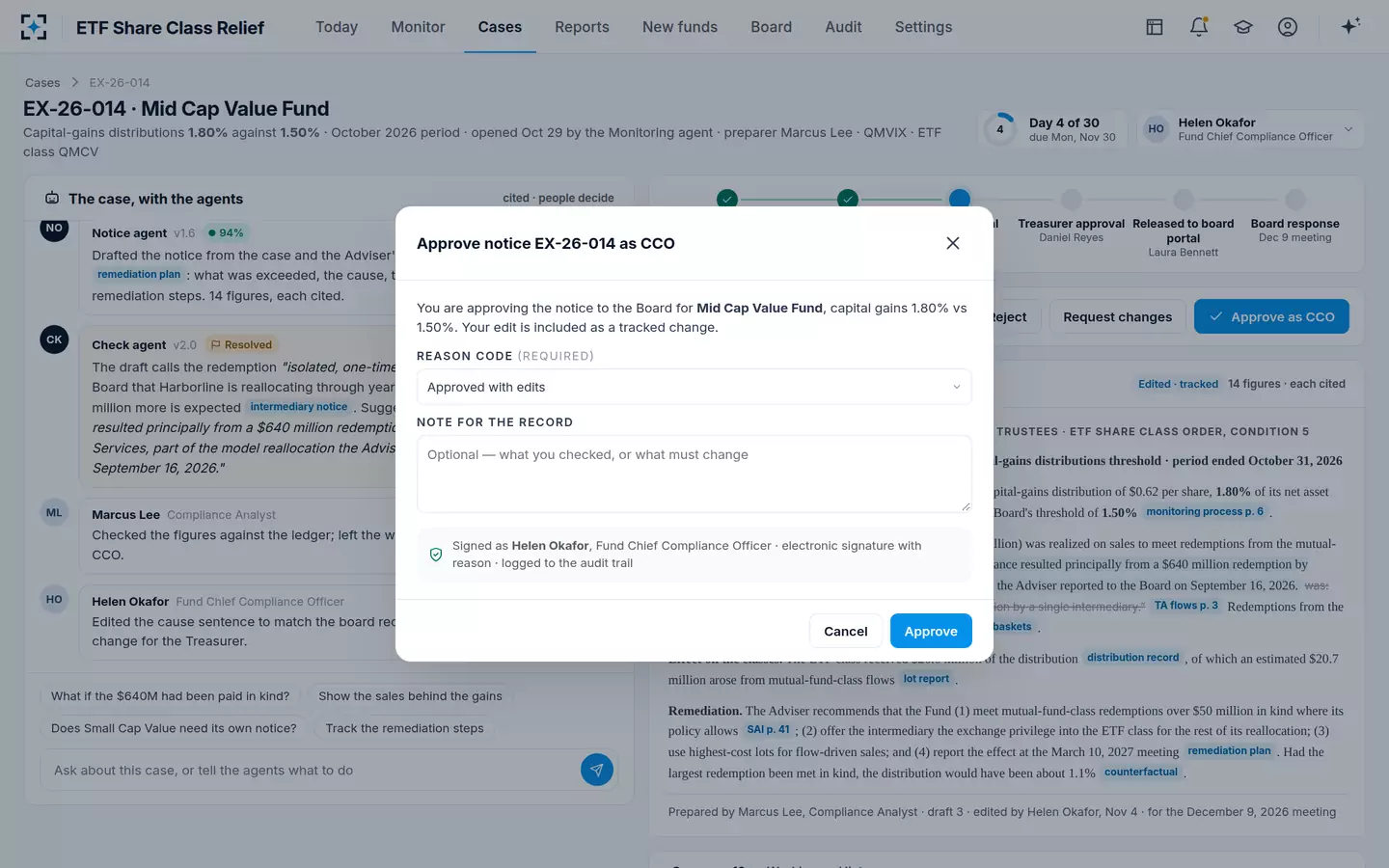
Where the line sits in the sample's own controls
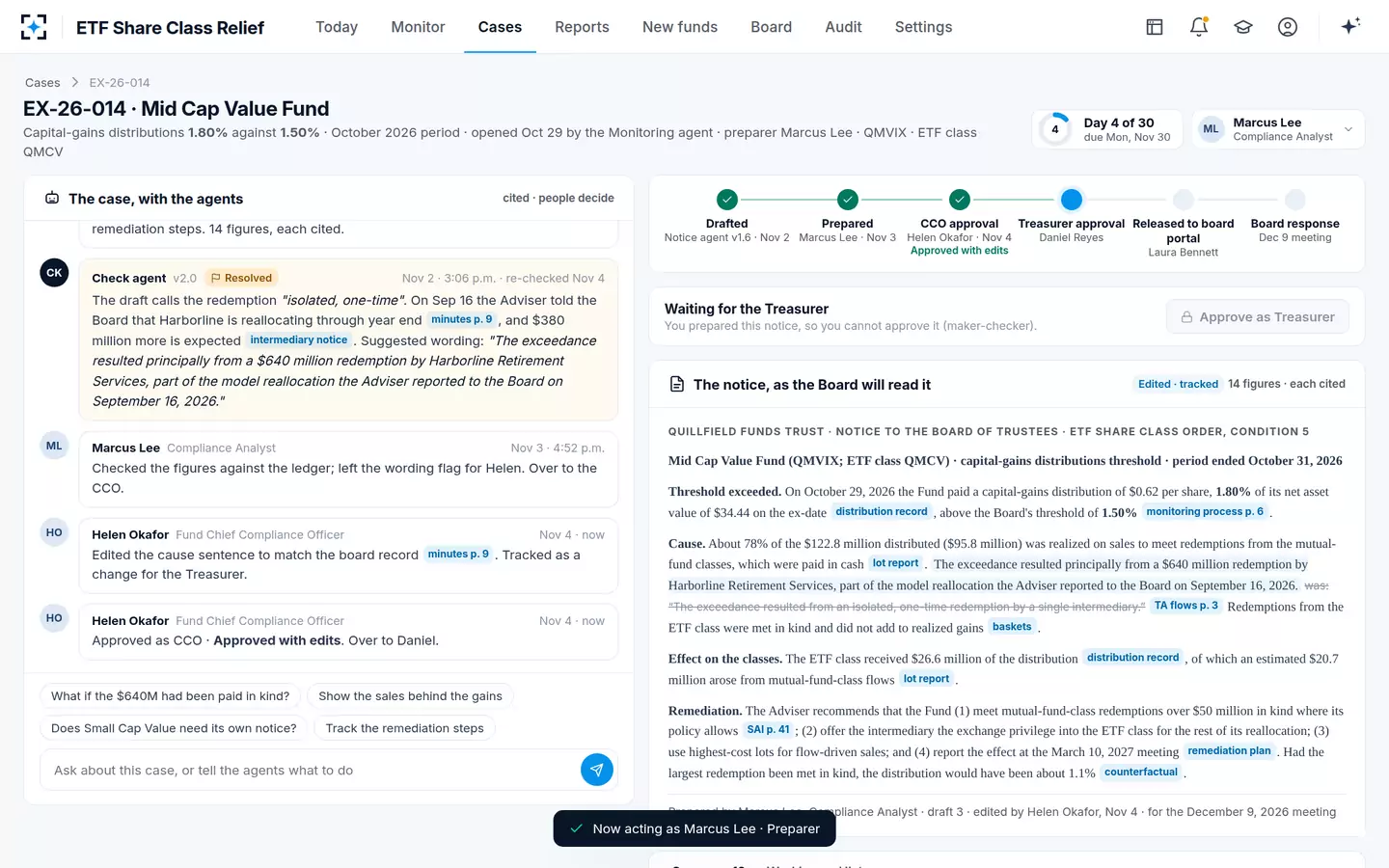
The sample trust's controls make the boundary mechanical. A preparer cannot approve what they prepared or edited; the CCO approves first and the treasurer second; only the board liaison releases to the board portal; and a threshold change goes to the CCO, the treasurer and then the board with its backtest. The agents' own versions change only with the CCO's and treasurer's approval, so the board can be told which version of each agent prepared which paper.
The preparer is locked out of approving his own notice
The record behind each decision
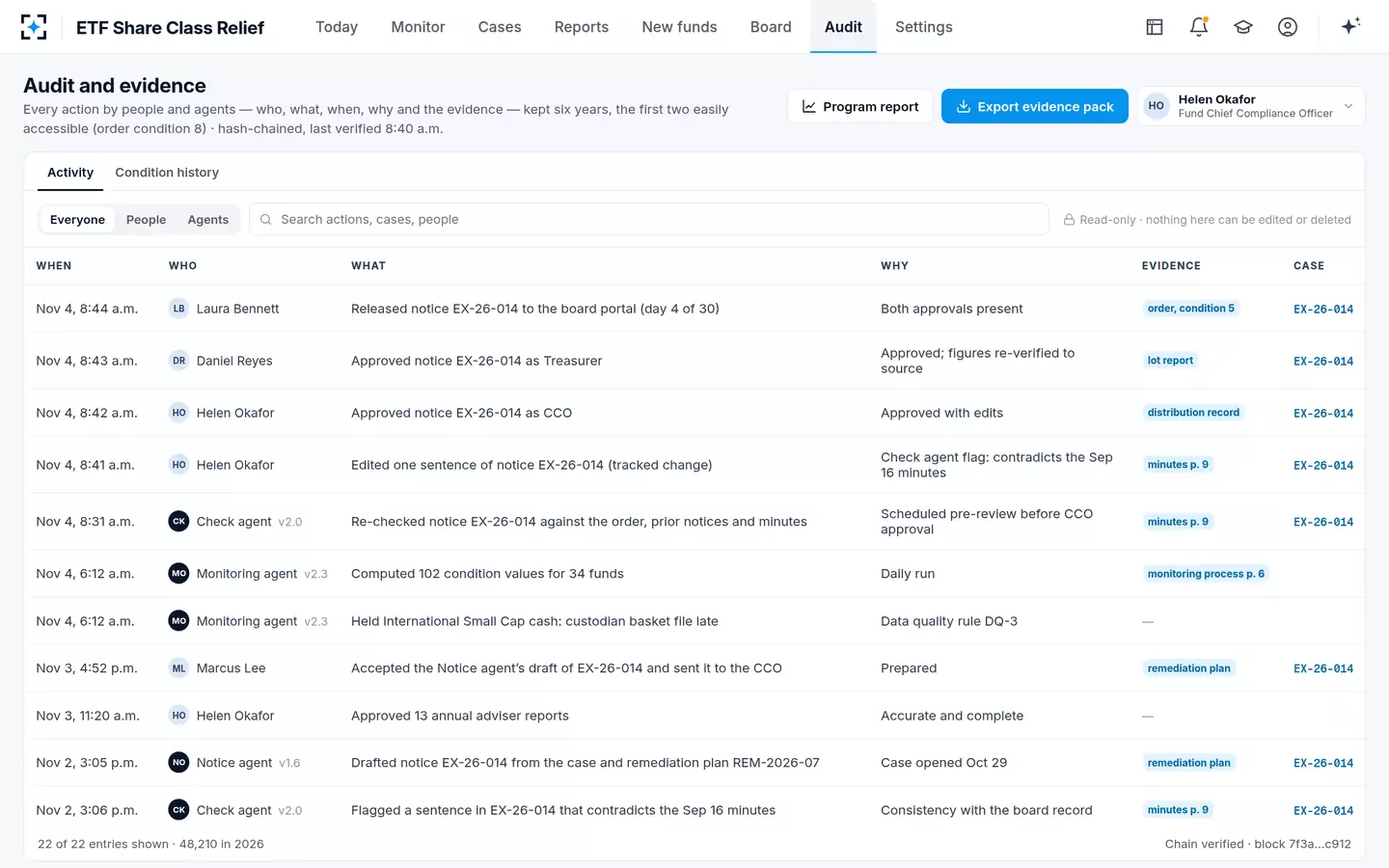
Each decision leaves a record the order requires the fund to keep. Condition 8 covers "any documents created pursuant to the requirements in conditions 2, 3, 5, and 6", that is, the findings and the material behind them and both adviser reports, plus the monitoring documents that show a threshold was "exceeded or not exceeded", for six years, the first two in an easily accessible place. Rule 18f-3 itself requires the plan to be in writing and, in the 1995 release's words, to "provide a detailed statement of the differences among the classes".
What the record rarely shows by itself is who prepared what. A board that relies on a draft findings resolution should be able to see which figures came from which system, who checked them and who changed the wording. ETF Share Class Relief keeps each step by a person or an agent as a read-only row on an audit trail, with who, what, when, why and the evidence, kept six years. The conditions as tests shows the evidence each condition calls for, and the seats the order adds who carries it day to day.
ETF Share Class Relief keeps every step by people and agents on a read-only trail
Questions people ask
What is a Rule 18f-3 plan?
The written plan a multi-class fund must adopt under Rule 18f-3(d), setting out each class's separate arrangement for distribution and shareholder services, the expense allocation, and any conversion features or exchange privileges. The board, including a majority of independent directors, must find it in the best interests of each class and the fund before the first issuance and before any material amendment.
When was Rule 18f-3 adopted?
The SEC adopted it in Investment Company Act Release 20915, dated 23 February 1995 and published at 60 FR 11876 on 2 March 1995, effective 3 April 1995. It was amended in 1997 to widen the permitted allocation methods and clarify voting.
Does Rule 18f-3 require annual board approval?
No. The 1995 release proposed annual approval and did not adopt it. The ETF share class orders do require a finding at least annually, informed by the adviser's ongoing report.
Can an agent or a vendor make the best-interests finding?
No. The finding belongs to the directors, by a majority of the board and a majority of the independent directors. Agents can compute the figures, trace causes and draft the resolution; the vote is the board's.
What is the Rule 18f-3 adopting release number?
Investment Company Act Release No. 20915, with Securities Act Release No. 33-7143, file number S7-32-93. The SEC's 2019 ETF rule release cites it as the "Multiple Class Adopting Release".