The operational considerations of an ETF share class are mostly not about the exchange. The SEC's first order, granted to Dimensional on 17 November 2025, lets a mutual fund add one exchange-traded class to the same portfolio on the conditions set out in its amended application (IC-35786), and those conditions create permanent work: an initial adviser report, board best-interest findings before launch and at least once a year, board-approved thresholds on transaction costs, cash and capital gains distributions, a notice to the board within 30 days after any period in which a threshold is exceeded, an annual adviser report, separate disclosure and six years of records. Each lands on a named seat. Botminds' ETF Share Class Relief is built for that standing work: agents compute every threshold each morning, trace a crossing to its cause and draft the notices and reports, while the adviser, the CCO, the treasurer and the board keep every decision.
The examples come from a fictional sample trust, Quillfield Funds Trust, with 34 funds that have an ETF class, as it runs through the solution. Everything quoted from the order comes from the SEC's notice of Dimensional's application (IC-35770, 29 September 2025), whose conditions the order adopts and later applicants have followed.
Six seats, and how each one's ETF-class work changes
Today
Writes the initial adviser report, recommends the thresholds, explains each crossing within 30 days and writes the annual report, from spreadsheets and memos.
With agents
Gets each report drafted with every figure cited, and each crossing traced to the class flows and lots behind it.
Still theirs: the causes it attests to, the remediation it recommends
Today
Re-ties every figure in a notice or report to fund accounting before signing, and reconciles dividend dates that now differ by class.
With agents
Clicks any figure through to the distribution record or lot report, and sees each edit as a tracked change.
Still theirs: the numbers, and the second approval
Today
Learns of a crossing from a month-end spreadsheet reviewed weeks later, with part of the 30 days gone.
With agents
Sees the crossing the morning it happens, with the cause traced and a draft notice checked against the minutes.
Still theirs: the first approval, and what the compliance program says
Today
Make the findings and approve thresholds from a board book assembled by hand.
With agents
Read findings drafts, notices and reports in which each figure links to its source.
Still theirs: every finding, every threshold, every remedy
Today
Uploads approved memos to the portal and keeps the board's answers in email.
With agents
Releases only what both approvers signed, and files each response against the case that caused it.
Still theirs: the release, and the minutes
Today
Brings new funds into the relief one board cycle at a time, testing thresholds by hand.
With agents
Gets proposed thresholds backtested on 36 months of each fund's history before the board sees them.
Still theirs: which funds join, and when
What are the operational considerations of an ETF share class?
They fall into three groups: running the ETF class as an ETF, keeping two kinds of class fair to each other inside one portfolio, and proving both to the board for as long as the order is used. The first is familiar work for anyone who has launched an ETF. The second and third are new, because they exist only when exchange-traded and mutual fund shares sit on the same book.
Running the class as an ETF is condition 1: the class operates "in compliance with the requirements of Rule 6c-11", except that the fund lists only one class and may offer an exchange privilege. That brings the rule's daily website disclosures (holdings before the open, net asset value, market price, premium or discount, median bid-ask spread) and its basket policies (17 CFR 270.6c-11). The exchanges' listing standards add the same test: when the SEC approved the first generic listing rules for these shares on 24 November 2025, it treated continuing compliance with Rule 6c-11 as the central condition for listing (SEC order on NYSE Arca Rule 5.2-E(j)(9)).
Keeping the classes fair is where the conditions concentrate. The SEC had explained in 2019 why it would not fold ETF classes into the ETF rule: an ETF class that deals in kind and a mutual fund class that deals in cash can cause different costs, and all shareholders bear them. The order answers that concern with reports, thresholds and findings rather than with a ban, which is why the work is continuous rather than a one-time launch project. How one portfolio serves both kinds of investor sets out the mechanics in more detail.
Which seat owns which condition?
The adviser owns most of the writing and the board owns every decision. Footnote 10 of the notice settles a question many fund groups ask first: if a fund uses a sub-adviser, "the Fund's primary Advisor will be responsible for complying with the conditions". The table maps each condition to the seat that carries it and the clock it runs on.
Nine conditions, the seat that carries each, and its clock
| Condition | What it requires | Seat | When |
|---|---|---|---|
| 1. Operate as an ETF | Run the ETF class under Rule 6c-11, one listed class, an optional exchange privilege, Form N-1A and N-CEN as for ETFs | Adviser, ETF operations | Every business day |
| 2. Board findings | A majority of directors and of independent directors find the multiple class plan in the best interests of each class and the fund | Board | Before the first ETF share, and before any material amendment |
| 3. Initial adviser report | Benefits and costs to each class, transition costs, strategy fit, conflicts | Adviser | Before the first findings |
| 4. Monitoring process proposed | Recommend the thresholds, how they are calculated and the periods they cover | Adviser | At initial approval |
| 5. Monitoring and annual findings | Run the board-approved process; the board re-finds the plan in the best interests of each class | Adviser, board | Each period; at least annually |
| 6. Ongoing adviser report | Observed benefits and savings, observed conflicts or harm, anything the board asks | Adviser | Before each annual finding |
| 7. Disclosure steps | Separate prospectuses, cross-disclosure, generic "ETF" naming, plain-English website explanation | Counsel, adviser | At launch, then ongoing |
| 8. Records | Findings, both adviser reports and every monitoring result, kept six years | CCO, records | Six years |
| 9. Sunset | Relief expires when a Commission rule permitting the structure takes effect | Counsel | If and when a rule is adopted |
Two details in that table cause most of the operational surprises. The 30-day notice is the adviser's, not the fund's: within 30 days after the end of the period in which a threshold was crossed, the adviser must tell the board in writing what caused it and what, if anything, it recommends. And the notice may go to "a designated committee, or a designated member, of the Board", which means a board that wants to use that route should decide who it is before the first crossing, not after it.
The adviser: three reports and a 30-day clock
The adviser writes three kinds of document, and each has a fixed list of contents. The initial adviser report must weigh the benefits and costs each class can expect and those of the fund as a whole, explain how transition costs will be managed, say whether the strategy suits the structure, and name any other material conflicts, including any other way one class could end up subsidizing another. The ongoing report covers observed benefits and savings, observed conflicts or "observed material negative consequences", and anything the board asks for.
The third is the exceedance notice, and it is the only one with a clock. Its period is whatever the board approved: the adviser recommends the measurement period along with each threshold, and the board approves both. A monthly period produces up to twelve notice windows a year for each threshold and each fund; at Quillfield, 34 funds and three thresholds mean 102 values to watch each morning. The notice's remedies are listed too, from more in-kind transactions and better tax-lot management to "discontinuation of a class". Watching the capital gains threshold walks through one crossing from projection to notice.
One exceedance, from crossing to board, with the adviser's obligations in the middle
Agent
Compute the three valuesTransaction costs, cash and capital gains distributions for every fund each morning, from fund accounting, transfer-agent flows and trading-cost data.
Never: change a threshold, or open a case on a projection alone
Agent
Trace the causeTies the crossing to the class flows, intermediaries, trades and lots behind it, and runs the counterfactual the board will ask for.
Never: recommend a remedy on its own
A person decides
Adviser confirms the cause and remedyThe adviser owns the explanation and the recommended remediation the order requires.
Agent
Draft and check the noticeDrafts the notice from the case and the remediation plan, then reads it against the order, prior notices and the minutes.
Never: send
A person decides
CCO and treasurer approve; liaison releasesTwo different people approve with a reason; only the board liaison releases to the board or its designated committee.
The treasurer: thresholds, allocations and dividend dates
The treasurer's seat changes in three places: the threshold methods, the class allocations and the dividend calendar. The order requires the thresholds' "method for calculating such thresholds" to be board-approved, so a capital gains distribution threshold is not just a percentage: it is a numerator (what counts as a distribution), a denominator (net asset value on which date) and a period (calendar year to date, or a rolling window). At Quillfield the board approved 8.0 basis points of transaction costs over a trailing three months, 3.00% cash on a 20-day average and 1.50% of net asset value in capital gains distributions, calendar year to date. Each is sample data, but each shows a choice the treasurer has to defend.
Allocations do not change in principle. Rule 18f-3 still requires income, gains and losses and fund-wide expenses to be allocated on a consistent method, and an ETF-class fund stays bound by Rule 18f-3 in everything except the ways its ETF and mutual fund classes are allowed to differ (17 CFR 270.18f-3). What changes is the calendar around them. The notice expects the mutual fund classes' record date to fall "one business day before the ex-dividend date" while the ETF class's is the ex-dividend date itself, and expects mutual fund dividends to be paid first. Cash held to pay the ETF class's later dividend must sit in a custodial account and may not be invested beyond sweep vehicles and interest-bearing accounts, so that one class's dividend money does not earn for the whole fund.
The CCO and the board: findings, governance and the record
The CCO's work is to make the findings possible and the record complete; the board's work is to make the findings. Both start before launch. A majority of directors, and a majority of the independent directors, must find that the plan serves each mutual fund class, the ETF class and the fund as a whole, and must make that finding again at least once a year. Rule 18f-3 also requires the board to meet the governance standards of Rule 0-1(a)(7): independent directors in the majority, choosing their own new colleagues, and advised by independent counsel if they use counsel at all (17 CFR 270.0-1).
The record is wider than many compliance calendars assume. Condition 8 requires a fund to keep, on top of the Rule 6c-11(d) records, the documents behind the findings and both adviser reports, plus every monitoring document showing whether a threshold was crossed or not, for six years, the first two within easy reach. Months without a crossing are part of the record. Rule 6c-11's own records run five years, so a fund with an ETF class keeps two retention clocks for overlapping material.
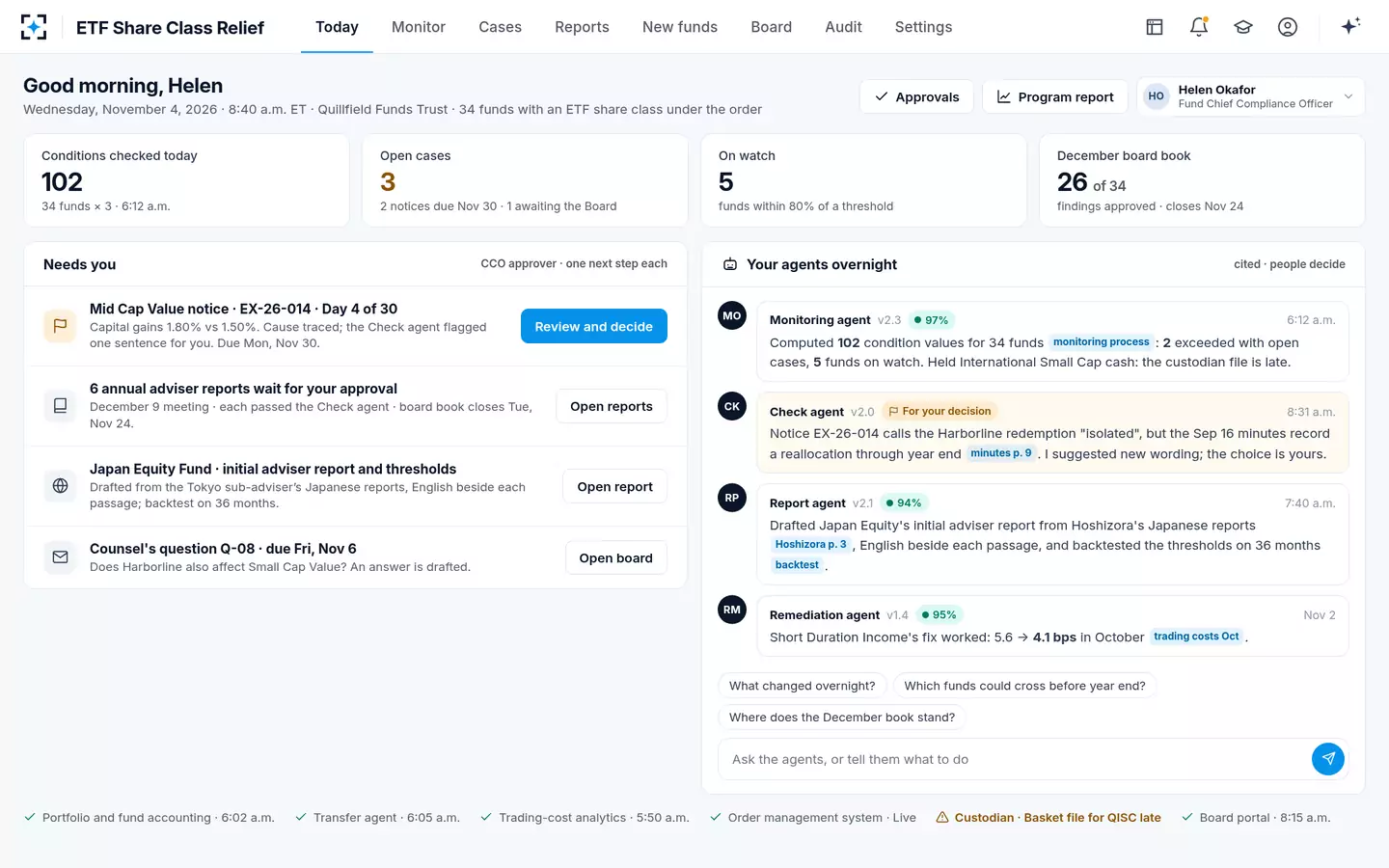
The CCO's morning: three open cases, five funds on watch, 26 of 34 findings approved
Operations and the transfer agent: the exchange privilege and two kinds of holder
The transfer agent and the operations team carry the class differences the notice lists. Applicants identified "seven ways in which Mutual Fund Shares and ETF Shares will have different rights": individual redemption against creation units, exchange trading, a one-way exchange privilege, dividend reinvestment, declaration dates, record dates and payment dates. Each is a process with an owner.
The exchange privilege is the one that touches the most systems. It lets mutual fund shareholders swap into the ETF class, the shares issued are "newly issued ETF Shares, and not ETF Shares purchased in the secondary market", and the swap must conform to section 11(a) of the Investment Company Act. The reverse is not offered except where the ETF class is terminated or the fund merges into one without an ETF class. A fund that offers it needs an intake route for the requests, the restrictions the notice anticipates around dividend dates to stop a holder collecting a dividend twice, and a way to show the board how much of each month's class flow came through it. ETF share class conversion sets out the exchange step by step.
Disclosure: separate prospectuses and a generic name
Condition 7 commits the fund to the disclosure steps, and they shape the prospectus calendar for years. Each kind of share gets its own prospectus; each class tells its readers, in its prospectus and on its website, that the other exists; the ETF shares carry a generic label or a trade name instead of the fund's name and are never marketed as a mutual fund; and the website explains in plain English how the two differ. The steps are listed in full in the nine conditions of the relief.
For the people who run the annual update, that means one portfolio now has two documents to keep in step, each of which must describe the other. Botminds' Annual Prospectus Update covers that side of the work (see how often a mutual fund prospectus must be updated); this solution keeps the monitoring and board record the disclosures describe.
Where does the time go in a 30-day notice window?
Most of it goes to finding the crossing. Botminds' estimate for a fund family running the monitoring on month-end spreadsheets is that twelve of the 30 days pass before anyone sees the crossing, and four more go to tracing its cause through class flows and lots. Drafting, review and release take most of what is left, which is why late notices are a data problem before they are a writing problem.
Where an exceedance notice's 30 days go, by hand and with agents
Month-end spreadsheets
- Finding the crossing · compliance · 40%
- Tracing the cause · fund accounting · 13%
- Drafting · adviser · 10%
- Checking, markup and release · 17%
- Days left · 20%
With ETF Share Class Relief
- Tracing · 3%
- Drafting · 3%
- Markup and release · 4%
- Days left · 90%
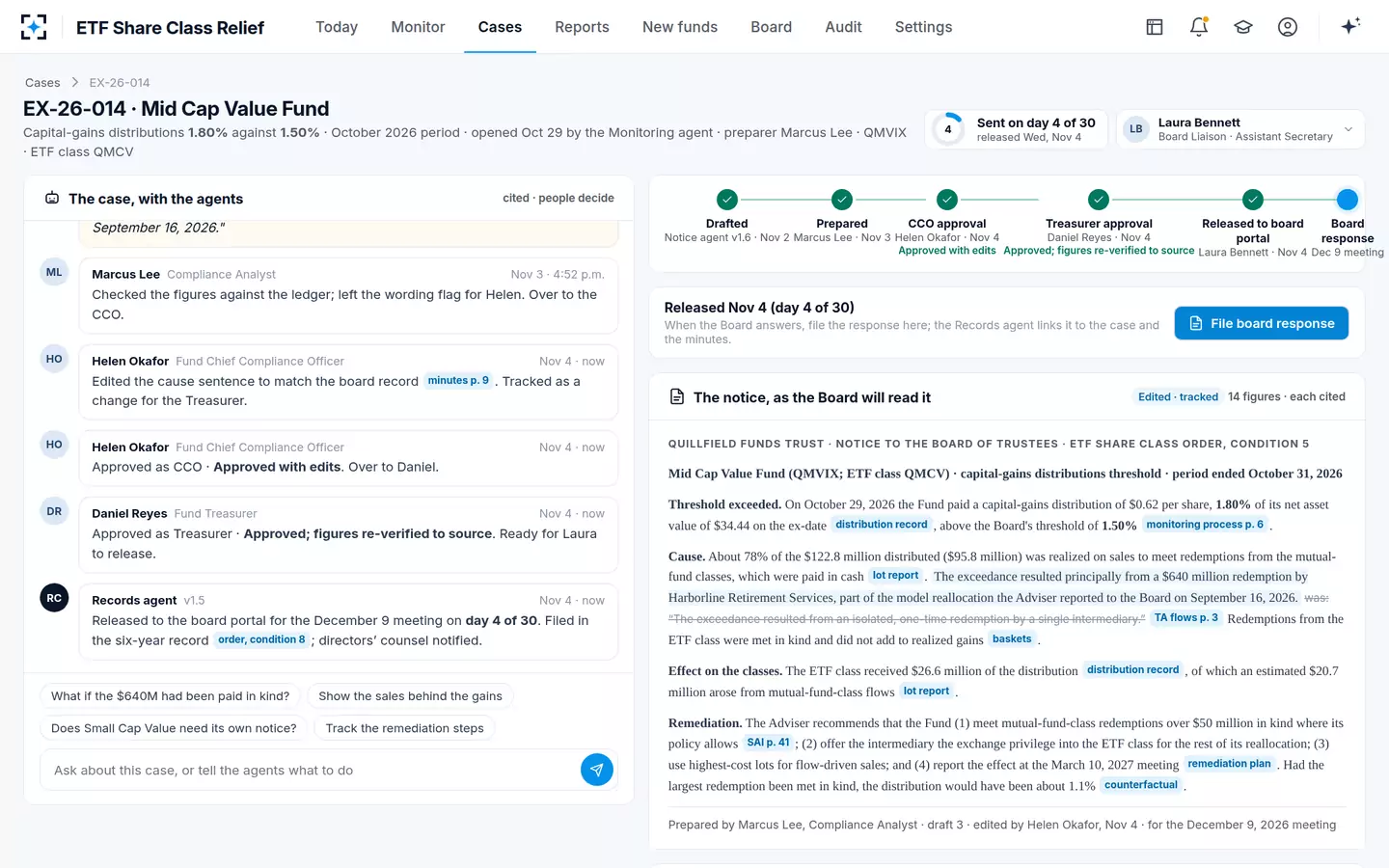
The estimate's shape matters more than its precision. If the crossing is found the morning it happens, the remaining work fits comfortably; if it is found at month-end review, every later step is compressed. On the Quillfield sample, the Mid Cap Value Fund's October notice reached the board portal on day 4 of 30, and the sample program report shows ten notices in the year, all inside 30 days.
What to look for in software for ETF share class monitoring
Look for a system that computes the order's thresholds from your own records every day, explains each value, and keeps the board record, rather than one that only stores documents or only produces a monthly report. The relief is less than a year old, and its conditions are specific; the checks below separate a tool that carries the seats' work from one that adds a seat.
Eight things to ask before you buy software for ETF-class conditions
- Does it compute each threshold the way your board approved it?
The method and the period are part of the board approval; a tool with fixed formulas will be wrong for some fund.
- Can every value be traced to its source row?
The treasurer signs figures, not dashboards. Each value should open on the distribution record, lot report or flow file behind it.
- Does it project, or only report?
A December distribution declared in late October is visible weeks before it is paid. A projection gives the adviser time to act; a report gives it a notice to write.
- Does it trace a crossing to the class that caused it?
The adviser must explain causes. Attribution to class flows, intermediaries and lots is the analysis the board will ask for.
- Is the 30-day clock fixed to the period end?
The order counts from the end of the period in which the threshold was exceeded, not from discovery.
- Can people, not the tool, approve and release?
Maker-checker, reason codes and a single releasing role keep the board record defensible.
- Does it keep the months with no crossing?
Condition 8 covers documents showing a threshold was "exceeded or not exceeded". Silence must be on the record too.
- Will it draft the adviser reports from the same data?
The initial and ongoing reports reuse the monitoring history; two systems mean two versions of the truth.
Where ETF Share Class Relief fits, and where it does not
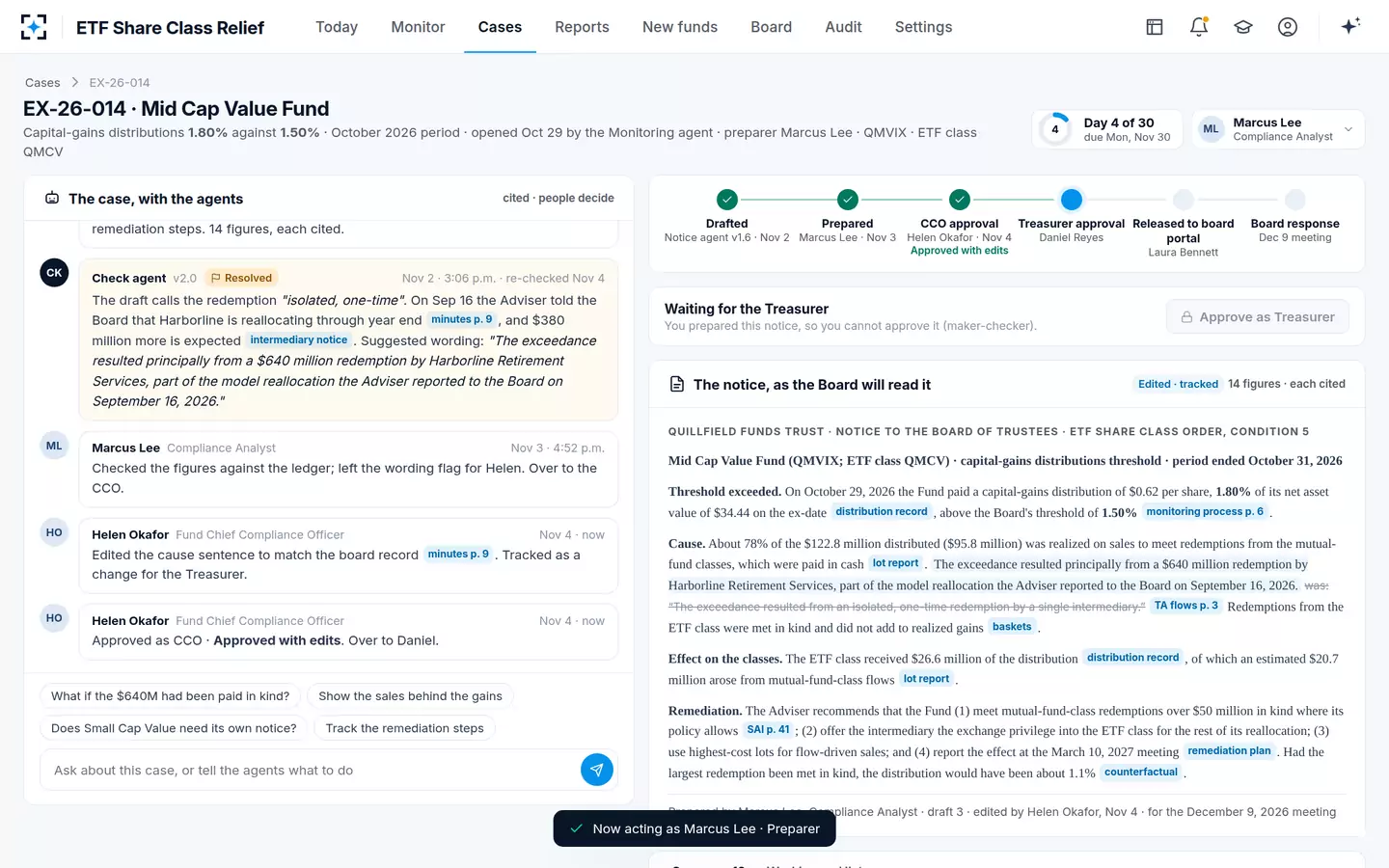
The solution takes the monitoring, the cause analysis, the drafting and the record. Seven agents compute the three values for every fund each morning, trace crossings, draft the notices, the adviser reports and draft findings, check every draft against the order and the minutes, track remediation and keep the six-year record. People approve: the CCO first, the treasurer second, the board liaison releases. A preparer cannot approve their own work, and no agent changes a board-approved threshold.
It does not run the ETF itself. Baskets, creations and redemptions with authorized participants, the Rule 6c-11 website, listing and market-maker arrangements are launch and capital-markets work; Botminds' Fund Launch Management covers that side, starting with the ETF basket creation process. It does not replace fund accounting or the transfer agent either: it reads their records and cites them. And it does not make a finding. The draft findings resolution it prepares is a draft until the board votes.
Maker-checker in ETF Share Class Relief: the person who prepared a notice cannot approve it
Bringing a new fund into the relief: the seats in order
Each new fund repeats the pre-launch sequence: initial adviser report, proposed thresholds, the board's findings, the Rule 18f-3 plan amendment and the registration filing. On the sample, five funds are joining for a board meeting on 10 March 2027, and each proposed threshold is backtested on 36 months of the fund's own history. For the Japan Equity Fund, the backtest showed transaction costs would have crossed 8.0 basis points twice, cash never, and capital gains distributions once, in December 2024. A threshold that would have fired every month is a threshold the board will soon stop reading; one that never fires measures nothing.
The sequence from application to first trade, with owners and weeks, is laid out in the ETF share class application plan.
Released to the board with 26 days to spare
Questions people ask
What is the ETF share class structure?
One registered open-end fund with one class of exchange-traded shares that operates as an ETF and one or more mutual fund classes, all owning the same portfolio. The SEC's orders call it a "Multi-Class ETF Fund". It relies on an exemptive order because Rule 18f-3 requires classes to have the same rights, and ETF shares and mutual fund shares do not.
Who monitors ETF share class conditions?
The adviser recommends the thresholds and must notify the board of any exceedance; the board approves the monitoring process and re-finds the plan at least annually. Compliance usually runs the day-to-day monitoring, and where a sub-adviser manages the fund, the notice says the primary adviser remains responsible for the conditions.
Does an ETF share class need its own prospectus?
Yes, under the disclosure steps the orders adopt: there will be separate prospectuses for the ETF shares and the mutual fund shares. Each class must also disclose prominently that the other exists, and the ETF prospectus cover must say the shares are listed and not individually redeemable.
How long must ETF share class records be kept?
Six years, the first two in an easily accessible place, for the findings, both adviser reports and the monitoring documents showing a threshold was exceeded or not. That is in addition to Rule 6c-11's own records, which run five years.
Can the board delegate the exceedance notices to a committee?
The notice allows the adviser to fulfil the notification requirement "by notifying a designated committee, or a designated member, of the Board". The findings themselves cannot be delegated that way: they need a majority of the directors and of the independent directors.
What does an ETF share class cost to run?
No regulator or independent study publishes the running cost. The useful way to measure it is by seat: count the reports, notices and findings a year your thresholds and periods will produce, and the hours each takes from finding to release.