Mutual funds are required to update their prospectus at least once a year. Two rules set the pace. Section 10(a)(3) of the Securities Act says that a prospectus used more than nine months after its registration statement became effective may not carry information more than sixteen months old, and Rule 8b-16 under the Investment Company Act requires a registered fund to amend its registration statement within 120 days after the close of each fiscal year. For an open-end fund that keeps selling shares, the answer is one post-effective amendment a year, usually filed under Rule 485(b), keyed to its fiscal year-end. Botminds' Annual Prospectus Update is the solution that runs that yearly update for fund legal and filing teams: agents find every reason the documents must change, draft the blackline and check every number, while counsel approves each change and the Chief Legal Officer signs.
The work is hard less because of what changes than because of what does not. A statutory prospectus, a summary prospectus for every fund and a statement of additional information (SAI) carry thousands of numbers and dates, and each one has to be current on the effective date whether or not anyone touched it this year. A complex with several registration statements on different fiscal years runs that season several times over.
Two fiscal year-ends, one rhythm: four months to file, then a year in use
- Audit2 mo
- File by Apr 302 mo
- Updated prospectus in use until the next April 3012 mo
- Audit2 mo
- File by Oct 282 mo
- Updated prospectus in use until next October12 mo
Why the annual prospectus update happens every year: two clocks that stop on one date
The yearly cycle is the product of two separate rules that happen to agree. The first is in the Securities Act and governs the prospectus as a selling document. Section 10(a)(3) reads: "when a prospectus is used more than nine months after the effective date of the registration statement, the information contained therein shall be as of a date not more than sixteen months prior to such use" (15 U.S.C. 77j(a)(3)). Audited financial statements are dated at the fiscal year-end, so their sixteen months start running on the last day of the fiscal year.
The second is in the Investment Company Act and governs the fund as a registered company. Rule 8b-16(a) says that every registered management investment company that files Form N-CEN "shall amend the registration statement required pursuant to Section 8(b) by filing, not more than 120 days after the close of each fiscal year" the form prescribed for the amendment (17 CFR 270.8b-16). Form N-1A serves as the registration statement under both Acts, so one post-effective amendment answers both rules.
Count the days and the two rules meet. For a fund with a December 31 year-end, 120 days lands on April 30. Sixteen months after the previous December 31 is also April 30. The amendment that brings in this year's audited figures is due on the same day the prospectus carrying last year's figures runs out of time. For a June 30 year-end the dates are October 28 and October 30, two days apart. That is why fund lawyers speak of the annual update as a season with a fixed end, not as a filing that can slide.
What does Section 10(a)(3) require, and what does it leave out?
Section 10(a)(3) sets a maximum age, not a schedule. It applies only once a prospectus is "used more than nine months after the effective date", and the information must be current only "so far as such information is known to the user of such prospectus or can be furnished by such user without unreasonable effort or expense". A fund that stops offering shares stops needing a current prospectus; a fund that keeps selling needs one every day it sells.
Rule 485 builds the filing path around it. A post-effective amendment filed under Rule 485(b) becomes effective on filing, or on a date the fund designates up to thirty days later, if it is filed only for listed purposes, the first of which is refreshing the financial statements to meet section 10(a)(3) (17 CFR 230.485(b)(1)(i)). That is why a routine annual update rarely waits on SEC review. A change that does not fit one of the listed purposes moves the amendment to Rule 485(a), which waits sixty days. Our guide to 485APOS vs 485BPOS walks through that test change by change.
Two things the rule does not do are worth stating. It does not stop a fund from updating more often: any change during the year can be made by a supplement or an amendment. And it does not make the update optional for funds that changed nothing. A fund whose strategy, fees and managers were all the same still has a new fee table, new performance, new financial highlights and a new date on the cover, because Rule 423 requires each prospectus used after effectiveness to be "dated approximately as of such effective date" (17 CFR 230.423).
How often must performance statistics in a mutual fund prospectus be updated?
In the prospectus itself, once a year, to the most recent calendar year-end. Form N-1A, Item 4(b)(2), requires a bar chart of "the Fund's annual total returns for each of the last 10 calendar years" and a table of average annual returns for 1, 5 and 10 years against a broad market index (Form N-1A). If the fiscal year is not the calendar year, the fund adds "the year-to-date return information as of the end of the most recent quarter in a footnote to the bar chart". Where applicable the fund also states that "updated performance information is available" and gives the website or toll-free number where it is.
Advertising runs on a faster clock. Under Rule 482(g), total return quotations in a fund advertisement must be current to the most recent calendar quarter, with month-end figures "current to the most recent month ended seven business days prior to the date of use" available by phone or website, or the advertisement itself must carry those month-end figures (17 CFR 230.482(g)). The prospectus is an annual document; the performance page on the website is a monthly one.
The calendar-year rule is also where a stale number most often hides. The 1-year column in the returns table should roll forward every year; a cell that was typed over by hand instead of being linked to the performance system does not. In the sample Annual Prospectus Update cycle on this site (fictional funds and data throughout), a Class I one-year return still read 3.42%, the calendar 2024 figure, while the 5- and 10-year cells beside it had been updated.
When the season peaks: the 485BPOS filing calendar, month by month
The season is visible in public data. Every Rule 485(b) amendment is filed on EDGAR under the form type 485BPOS, and the SEC publishes quarterly index files of every filing (SEC, Accessing EDGAR Data). By our count of those indexes, funds and other registrants filed 4,908 485BPOS amendments in 2025, and 1,773 of them, 36%, came in April. We checked the totals against the SEC's own full-text search, which returned the same numbers.
April carries a third of the year's 485(b) amendments
April 30 is the 120-day date for every fund with a December fiscal year-end, so the April peak is what the two rules predict. The smaller bumps in February and October fall where the 120-day dates of October and June year-ends land. The count has been steady: 4,762 amendments in 2023, 4,664 in 2024, 4,908 in 2025 and 4,178 in the first nine months of 2026. Sibling guide 485BXT filings shows what the same index says about delayed 485(a) amendments, which moved far more.
One registration statement's season, from fiscal year-end to filing
Inside a fund group the season starts before the fiscal year closes and ends after the filing is accepted. The audit and the annual report come first: the financial statements and financial highlights the prospectus and SAI draw on are prepared for the annual report and filed on Form N-CSR, a season of its own that our colleagues cover in the Form N-CSR filing deadline guide. The prospectus work runs alongside it and depends on it.
What changes in an annual update, and where each number comes from
| Part of the update | What must change | Where it comes from |
|---|---|---|
| Fee table and expense example | Annual fund operating expenses by class, any fee waiver and the 1-, 3-, 5- and 10-year example | Fund accounting close; the expense limitation agreement and the board minutes for any waiver |
| Performance | Bar chart, average annual returns, after-tax returns, index returns | Performance system, as of the calendar year-end |
| Financial highlights and SAI tables | Per-share data, ratios, turnover, advisory fees paid, brokerage | Fund accounting and the audited annual report |
| Management | Portfolio managers, other accounts managed, compensation, holdings | Investment team roster and sub-adviser notices |
| Board and governance | Trustees, officers, committees, the number of portfolios overseen | Board minutes and the secretary of the trust |
| Rule-driven text | New disclosure a rule requires on or after its compliance date | Legal: the rule release and its dates |
| Supplements | Every change made by sticker during the year | The 497 filings on EDGAR |
A waiver shows why the inputs matter. Form N-1A lets the fee table net out a waiver only if the arrangement still has a year or more to run from the effective date. An expense limitation that expires eleven months after the new effective date has to come out of the table, so the board's extension, if there is one, must reach the drafter before the fee table is final.
Who carries the update, desk by desk
The annual update belongs to fund legal, but the work runs across five or six desks. The figure below follows the roles in a mid-size complex. The labour market statistics give a sense of the cost: the Bureau of Labor Statistics puts the median pay of lawyers at $76.76 an hour in May 2025 (BLS), paralegals and legal assistants at $30.24 (BLS), compliance officers at $38.81 (BLS) and financial managers, the series that covers fund treasurers, at $80.08 (BLS). No public series covers regulatory reporting managers in fund groups.
The annual update season, seen by the people who carry it
Today
Reviews a Word blackline and typesetter proofs, round after round, and asks where each changed line came from.
With agents
Reviews each change with its trigger and source one click away, and asks the agents in the change itself.
Still theirs: Approves every change
Today
Runs the filing calendar for several registration statements and chases sources by email.
With agents
Approves the plan of what must change, sees late sources escalated, and assembles the filing he cannot sign.
Still theirs: Owns the calendar and the EDGAR submission
Today
Re-keys fee tables and returns into last year’s tables; checks the numbers she changed.
With agents
Confirms the proposed numbers against fund accounting and performance while every number is checked.
Still theirs: Proposes; never approves her own change
Today
Decides 485(a) or 485(b) from what reaches him late in the cycle.
With agents
Receives only the doubtful changes, each with the reasoning, and decides the filing path.
Still theirs: Decides and signs
Today
Checks that disclosures match what compliance tests, often after drafting.
With agents
Confirms rule-driven definitions against the compliance tests on one screen.
Still theirs: Confirms the compliance facts
Where the weeks go: re-checking the numbers that did not change
Most of an annual update is not drafting. It is gathering the reasons for change from board minutes, fund accounting, the performance system, rule memos and notices, and then proving that every number in a several-hundred page set is current. An analyst checks the numbers she changes. The ones that should have changed by themselves, through a link to a system, and did not, are the ones that reach the SEC.
Our estimate for one registration statement's annual update in a mid-size complex is about 22 working days by hand, spread across collecting changes, re-keying tables, drafting, review rounds, the filing-path test and assembling exhibits and Inline XBRL. With agents doing the collecting, re-keying and checking, our estimate is about eight and a half days, most of it people reviewing and deciding.
The annual update season in four numbers
16
months: the most a prospectus’s information may age once it is used nine months after effectiveness
Securities Act §10(a)(3)
120
days after the fiscal year-end to amend the registration statement
Rule 8b-16(a)
4,908
485BPOS amendments filed on EDGAR in 2025
Our count of SEC indexes
36%
of them filed in April, the 120-day month for December year-ends
Our count of SEC indexes
How Annual Prospectus Update runs a fund complex's season
Annual Prospectus Update keeps the season on one screen. The home screen shows every registration statement on the filing calendar with its file date, the changes waiting for counsel, the stale numbers caught overnight and the filing-path questions with the Chief Legal Officer. In the sample complex, 116 funds in seven registration statements file from July to the following April, because their fiscal years end at different times.
Annual Prospectus Update’s home screen: seven filing dates, one season
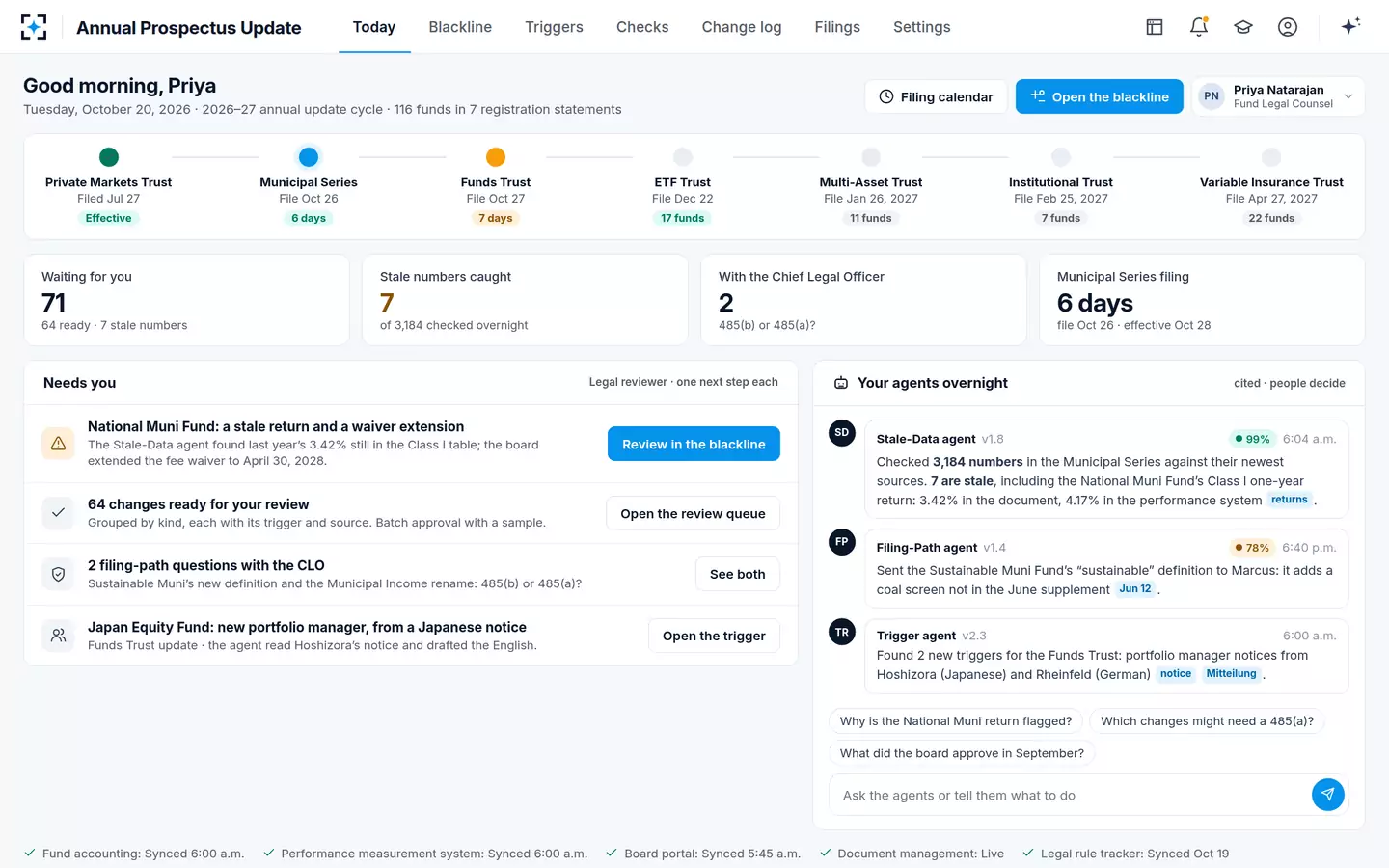
Behind the screen, seven agents divide the mechanical work. The Trigger agent reads the systems of record and lists every reason a document must change since last year's filing, each matched to the passages it affects, and nothing is drafted until the filing manager approves that plan. The Drafting and Rule agents draft each change in house style. The Stale-Data agent checks every number in the prospectus, summary prospectuses and SAI against its newest signed-off source each night, including the ones nobody edited. The Filing-Path agent tests each change under Rule 485(b) as it is drafted and sends doubtful ones to the Chief Legal Officer. People approve every change, and a drafter can never approve her own.
The design target is that no stale number reaches the filed prospectus. In the sample cycle, the overnight check read 3,184 numbers across a 204-page prospectus, fourteen summary prospectuses and a 148-page SAI, and found seven that were out of date, each with the reason it was missed. How that check differs from a blackline is the subject of what a blackline comparison misses.
Preparing for next season: what to set up before the fiscal year closes
The 120 days are short because most of them are spent waiting. Teams that run a calm season do four things before the year-end. They list every registration statement with its fiscal year-end, 120-day date and planned effective date. They link every number in last year's documents to its source system, so a cell typed over by hand is visible before it goes stale. They collect the year's 497 supplements, so each one is folded into the new prospectus. And they ask the board calendar which actions, such as waiver extensions and manager changes, will land before the filing.
The fourth step is the one most often missed. Board meetings that approve the expense limitation agreements or a new sub-adviser often fall in the last weeks before the filing; a waiver extended at that meeting changes the fee table, the expense example and a footnote in every summary prospectus of the series. Our guide to sticker supplements covers the changes that cannot wait for the next season at all.
Questions people ask
How often must a mutual fund prospectus be updated?
At least once a year for a fund that keeps selling shares. Section 10(a)(3) of the Securities Act limits a prospectus used more than nine months after effectiveness to information no more than sixteen months old, and Rule 8b-16 requires the registration statement to be amended within 120 days after each fiscal year-end. Changes during the year are made by supplement.
What is the 16-month rule for a prospectus?
It is the limit in Section 10(a)(3): once a prospectus has been used more than nine months after its effective date, its information must be as of a date not more than sixteen months before it is used. For a fund with a December 31 year-end, sixteen months runs to April 30 of the year after next, the same date as the 120-day deadline for the next update.
Is the annual update always a 485(b) filing?
Usually, but not always. Rule 485(b) covers an amendment filed only to bring the financial statements up to date under Section 10(a)(3), to make non-material changes or for the other listed purposes. If the update also makes a material change, such as a new investment objective, it is filed under Rule 485(a) and becomes effective sixty days after filing.
Does the summary prospectus have to be updated at the same time?
Yes. Rule 498 requires the summary prospectus to give the same Items 2 to 8 information as the statutory prospectus, so a new fee table or return in one means a new summary prospectus. Each definitive summary prospectus must be filed under Rule 497(k) no later than the date it is first used.
When do most funds file their annual update?
In April. By our count of the SEC's EDGAR indexes, 1,773 of the 4,908 485BPOS amendments filed in 2025 came in April, the month in which the 120-day deadline falls for funds with a December fiscal year-end.
What happens if a fund's prospectus goes past sixteen months?
The prospectus no longer meets Section 10(a)(3), the standard a selling prospectus must meet, so the fund needs an amendment that brings the information up to date before it relies on that prospectus again. That is why filing teams treat the 120-day date as fixed and escalate any registration statement with changes still open in the last week.