An AI prospectus generator, in the sense most people search for, is a tool that writes a prospectus from a prompt or a template. For a mutual fund's annual update that is the wrong frame. The fund already has a prospectus, effective and on file; the work is to find every reason it must change since last year, draft each change, check every number against its source, decide whether each change fits Rule 485(b), and assemble a filing that counsel can represent and the Chief Legal Officer can sign. Botminds' Annual Prospectus Update uses agents for the finding, drafting and checking, and keeps every approval and signature with people. The clearest way to judge any AI tool for this work is to follow one change through it, which this guide does.
One fee waiver change: three minutes of agent work, four minutes of counsel’s
- Trigger found1 min
- Drafted, tested, exhibit added2 min
- Asked, answered1 min
- Source read, approved3 min
Can AI write a mutual fund prospectus? A better question to ask
A language model can produce text that reads like a prospectus. That is not the hard part. Form N-1A already fixes the structure, the order of Items 2 to 8 and much of the wording, and a fund's prospectus from last year already exists. What fails in an annual update is the fact behind the text: a waiver date the board extended that never reached the footnote, a return typed over by hand, a manager change announced in a sub-adviser's notice. A tool that writes fluent text from a prompt has no way to know any of those.
The better question is what a tool reads, what it writes, and what it may never do. A tool worth relying on starts from the fund's systems of record, writes nothing without a reason it can cite, checks numbers it did not write, and leaves approval and signature with named people. The rest of this guide shows what that looks like on one change.
Two meanings of “AI prospectus generator”
A prompt-to-prospectus generator: A prompt, a template or last year’s text.
A traced annual update: The systems of record: board minutes, fund accounting, performance, the rule tracker, the roster, the year’s supplements.
A prompt-to-prospectus generator: Text that reads well.
A traced annual update: A change only where a trigger requires one, each with its source.
A prompt-to-prospectus generator: As given in the prompt or the template.
A traced annual update: Every number in the documents checked against its newest signed-off source, including the ones nobody edited.
A prompt-to-prospectus generator: Not addressed.
A traced annual update: Each change tested under Rule 485(b) as it is drafted; doubtful ones go to the Chief Legal Officer.
A prompt-to-prospectus generator: Whoever accepts the output.
A traced annual update: A named reviewer approves each change, never the person who proposed it; the CLO signs.
One change, traced: a fee waiver from board minute to filing
Take a sample fund group as it runs through Annual Prospectus Update: the fictional Quillfield Municipal Funds Trust, fourteen funds with Class A, C and I shares, filing Post-Effective Amendment No. 71 on October 26, to be effective October 28, 2026. Its National Muni Fund has an expense limitation agreement that caps total operating expenses after the waiver at 0.75%, 1.50% and 0.45% for the three classes, and the prospectus fee table shows a 0.07% waiver line. The footnote says the agreement runs through October 31, 2026, three days after the new effective date.
That date is a problem under Form N-1A. The fee table may show a waiver only if it still has twelve months or more to run when the registration statement goes effective (Form N-1A, Item 3, Instruction 3(e)). Without an extension, the waiver line and the net expense figures would have to come out, and the expense example would change with them; what that does to a fund's place among its peers is the subject of fee waivers and the net fee. The fund counsel in this story is Priya Natarajan, a fictional character in the sample.
Step 1: the agent finds the trigger in a system of record
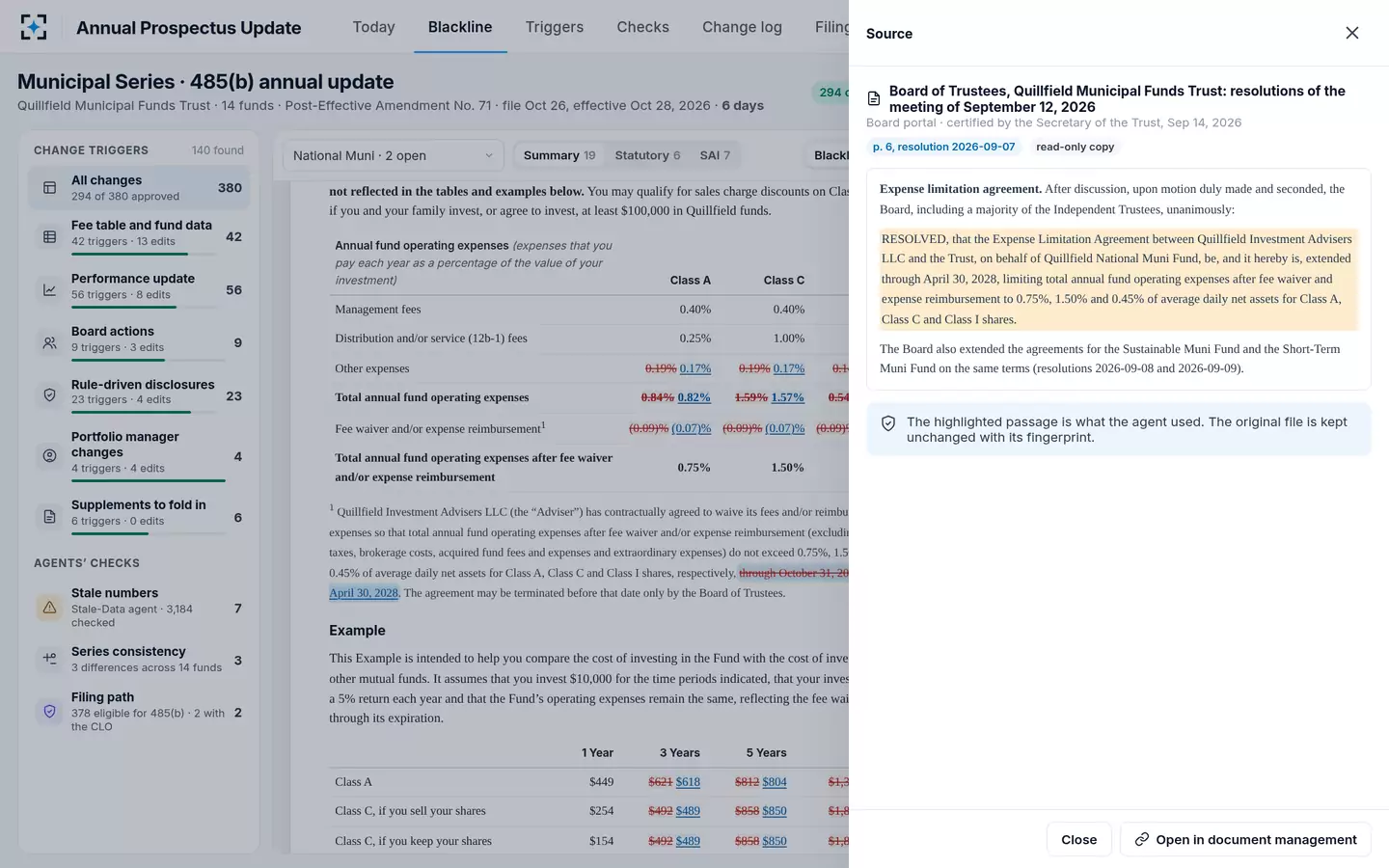
On September 12, the board resolved to extend the expense limitation agreement through April 30, 2028, at the same limits; the Secretary of the Trust certified the resolution on September 14. At 4:30 that afternoon the Trigger agent, which reads the board portal among seven systems of record, found the resolution and the signed Amendment No. 4 to the agreement, and added a trigger: board action, National Muni Fund, fee waiver footnote, matched to the passage it changes in last year's filing.
The agent does not draft. Its plan of triggers for the series had been approved by the regulatory reporting manager on September 2, and nothing is drafted without a trigger on an approved plan. That is the first answer to "where did this change come from?": a page of a certified resolution, with the original file kept unchanged.
The board’s resolution, opened on the passage the agent used
Step 2: the draft, in house style and under the one-year test
A minute later the Drafting agent drafted the change. The footnote's date became "through April 30, 2028", in the fund group's house style, whose rule 14 sets what every waiver footnote says and whose rule 3 prefers "through" to "until". The limits stayed at 0.75%, 1.50% and 0.45%. The agent noted the reason the change matters: the extension carries the waiver well past one year from the October 28 effective date, so the waiver line can stay in the table.
Drafting here is narrow by design. Form N-1A asks that responses be "as simple and direct as reasonably possible", and that the prospectus avoid "excessive detail, technical or legal terminology, and complex language" (Form N-1A, General Instruction C.1). The best draft of a waiver extension is usually the old footnote with one date changed. An agent that rewrote the paragraph would create review work and risk, not value.
Step 3: the filing-path test and the exhibit
At 4:33 two more agents had acted. The Filing-Path agent tested the change under Rule 485(b)(1) and recorded it as eligible under paragraph (v), "Making any non-material changes which the registrant deems appropriate" (17 CFR 230.485(b)(1)(v)). A waiver extended at the same limits keeps the waiver line as it was; the change did not fall below the confidence threshold or on the list of changes that always go to the Chief Legal Officer. The assembling agent added Amendment No. 4 to the expense limitation agreement to Part C of the registration statement as an exhibit.
Three minutes of agent work, then, produced a cited trigger, a drafted change, a recorded filing path and an exhibit. None of it is approved. The change sits in the queue as ready for review, with its thread open for questions.
Who does what on one change in Annual Prospectus Update, and what each may never do
Agent
Trigger agentFinds the certified resolution and the signed amendment, and matches them to the passages they change.
Never: drafts or decides
Agent
Drafting agentDrafts the footnote in house style and answers counsel’s question with citations.
Never: approves its own draft
Agent
Filing-Path and assembling agentsRecord the change as eligible under Rule 485(b)(1)(v); add the amendment to Part C as an exhibit.
Never: decide below the threshold, sign or send
A person decides
Fund administration analystChecks the draft against the resolution and the signed amendment and proposes it for approval.
A person decides
Fund counselReads the source, asks her question, and approves with a reason code.
A person decides
Chief Legal OfficerSigns the amendment once every change in it is decided.
Step 4: one person checks, another approves
On October 19 the fund administration analyst, Hannah Kowalski in the sample, checked the footnote against the certified resolution and the signed amendment and proposed the change for approval. When she opens it, Approve and Reject are locked: a person who drafted or proposed a change can never approve it, even when she also holds the reviewer role, and a reviewer's own edit goes to a second reviewer.
Viewed by the analyst who proposed it: Approve and Reject are locked
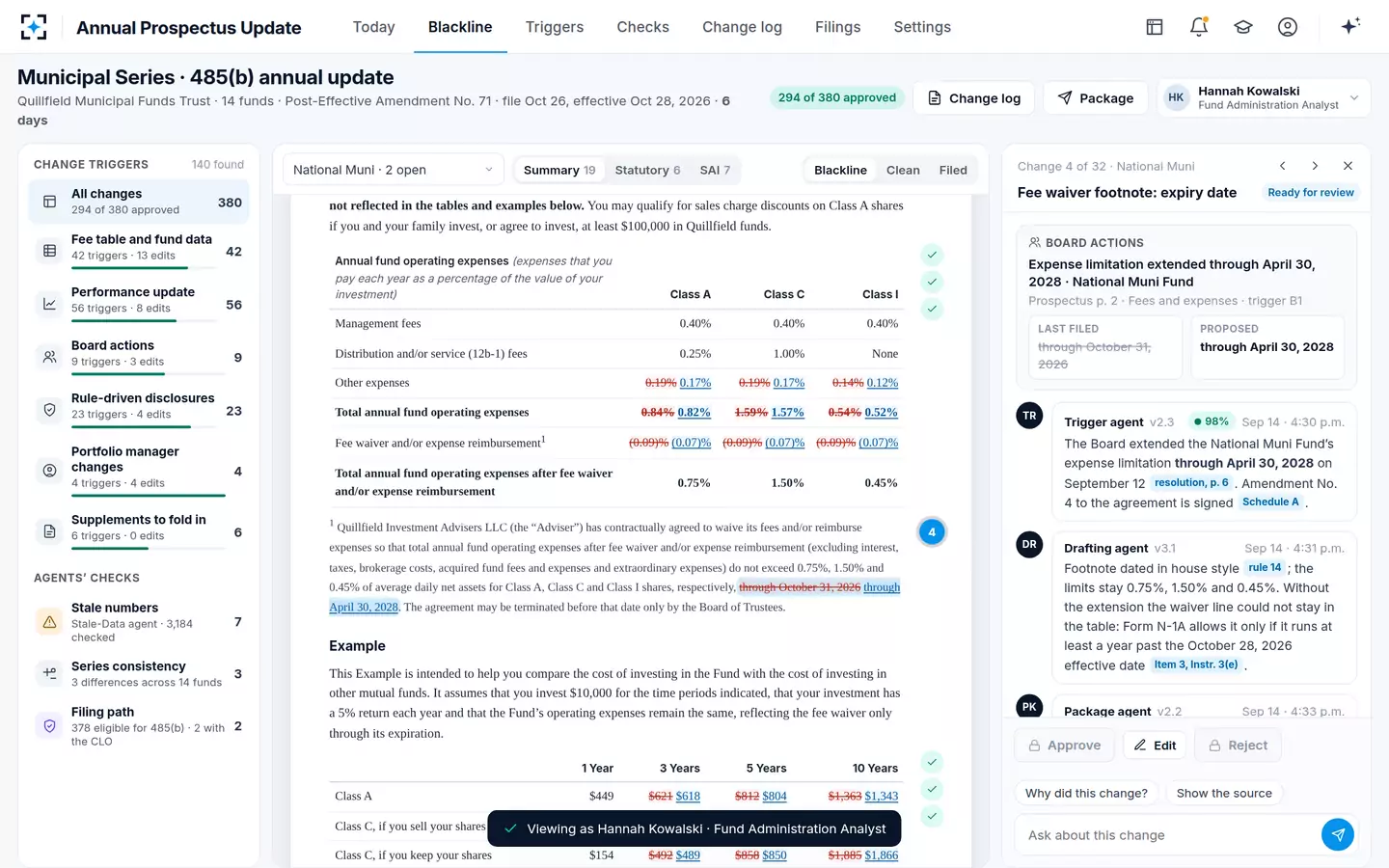
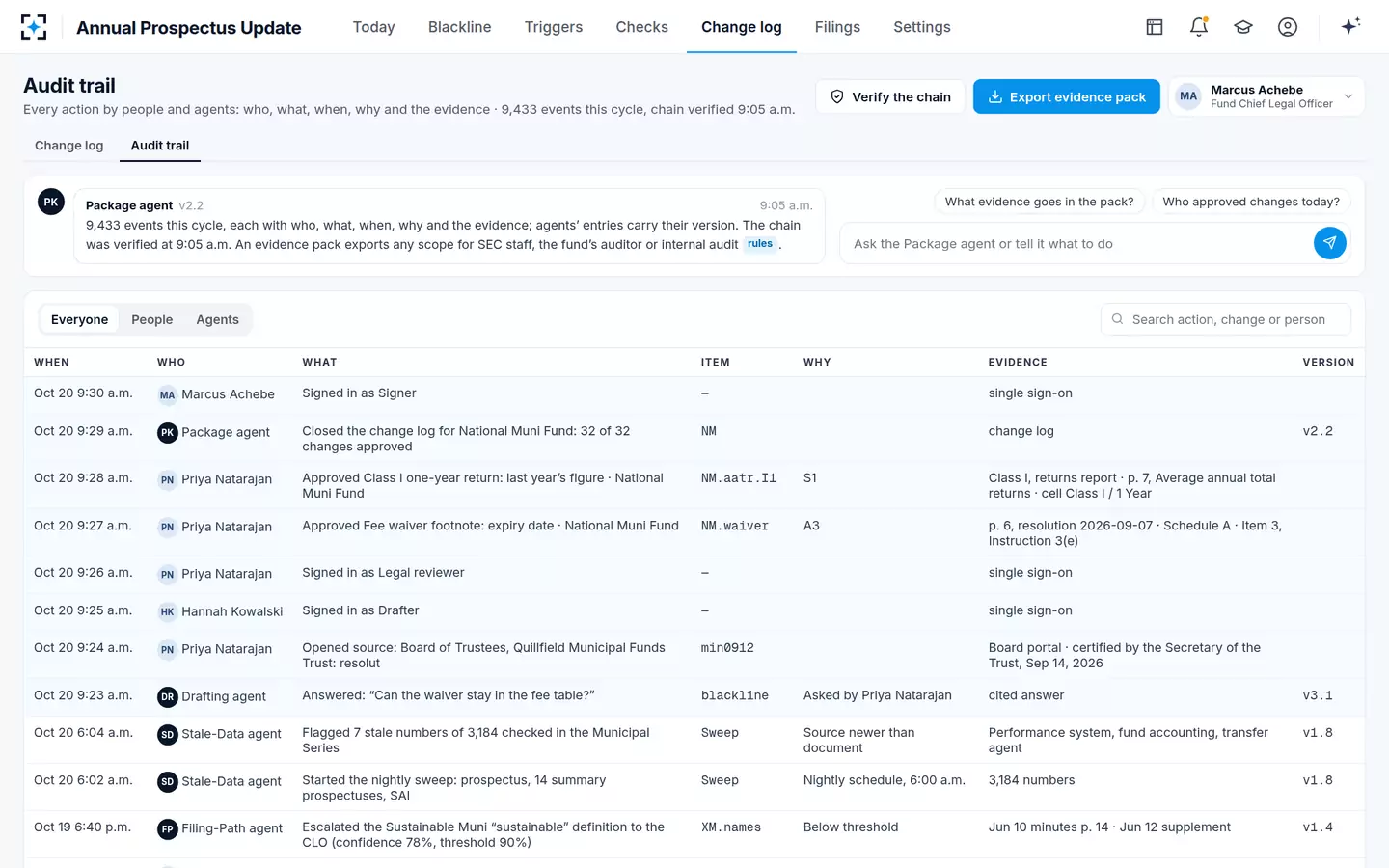
On October 20 at 9:23 counsel opened the change and typed a question into its thread: "Can the waiver stay in the fee table?" The Drafting agent answered with the board resolution, the amendment and the Form N-1A instruction: the table may show a waiver only if it runs at least a year past the October 28, 2026 effective date, so without the extension the 0.07% waiver line would have to come out. At 9:24 she opened the source; at 9:27 she approved with reason code A3, "Matches the board's resolution or source". Two minutes later the National Muni Fund's change log closed at 32 of 32 approved.
The trace, as the audit trail records it
Who signs an AI-drafted prospectus?
The same people who sign any other. A post-effective amendment under Rule 485(b) carries the registrant's certification on the signature page that it meets the rule's requirements, and if counsel prepared or reviewed it, counsel must give the SEC, with the filing, a written statement that nothing in it disqualifies the amendment from that path (17 CFR 230.485(b)(4); the rule's words are in 485APOS vs 485BPOS). No rule moves that responsibility to a tool, and nothing in a well-designed tool should suggest otherwise.
What a tool can change is the evidence the signers have. In Annual Prospectus Update, signing opens only when every change is decided; the assembling agent turns the recorded decisions into a draft of counsel's representation, and the filing manager who puts the filing together is barred from signing it. In the sample cycle the Chief Legal Officer signs, then the filing manager sends it to the filing agent. The agents never approve a change, sign or send.
What SEC examiners say about "super intelligence" drafting tools
The SEC's Division of Examinations addresses these tools directly, in its own vocabulary. Its fiscal 2027 priorities describe registrants using what the Division calls "super intelligence (SI)" tools for work that includes drafting and compliance monitoring, and say the examiners want to see how those tools change results and whether a firm's existing duties are still met, whatever software does the drafting (SEC, Fiscal Year 2027 Examination Priorities). The same document lists summary prospectuses among the fund filings examiners assess, and fees and waivers first among their areas of focus.
For a prospectus tool, those two passages meet on the same page. A waiver footnote drafted by a tool is held to the same standard as one drafted by a person, and the examiner will ask how the fund knew it was right. A trace like the one above, from resolution to approval with reasons, is the kind of answer the question needs.
Prospectus drafting guidelines any AI tool should follow
Form N-1A sets the drafting standard for funds: the prospectus should disclose the fund's fundamental characteristics and risks "using concise, straightforward, and easy to understand language", and it should avoid "simply restating legal or regulatory requirements to which Funds generally are subject" (Form N-1A, General Instruction C.1). For an AI tool, three more guidelines follow from the annual update itself. Change only what a trigger requires. Keep a fund group's approved wording for shared passages, and propose one wording for the series rather than fourteen variations. And never let a draft carry a number that has not been compared with its source.
What to ask before buying an AI prospectus tool
The questions below come straight from the trace. Ask a vendor to show each one on one of your own registration statements, starting from last year's filing and this year's sources, not on a demonstration document.
Eight questions for any AI prospectus generator or drafting tool
- Where does each change come from?
It should name the system of record and open the source on the passage used, not cite “the model”.
- Does it draft anything without a reason?
A tool that rewrites unchanged text creates review work and risk.
- Does it check the numbers it did not write?
Stale numbers are the ones nobody edited; ask for coverage across the prospectus, summaries and SAI.
- Who decides the filing path?
A tool may test each change under Rule 485(b); a named person should decide anything doubtful.
- Can the drafter approve her own change?
Maker-checker should be enforced by the tool, not by convention.
- Can the tool sign, file or send?
It should not. Counsel and the registrant sign; the filing manager sends.
- How is a new version tested?
Ask how a new release is evaluated against last year’s filed changes before it is used.
- What does the audit trail record?
Who, what, when, why, the evidence, and for an agent its version, for every action.
Where Annual Prospectus Update fits, and where it does not
It fits the work between last year's filing and this year's: finding triggers, drafting, checking every number, testing the filing path and assembling the filing for a complex with several registration statements and many funds. Seven agents find every trigger, draft the blackline and check every number; counsel approves, the CLO signs. Before go-live it is run on last year's update: in the sample, a dry run found 371 of 374 changes that had actually been filed, and three stale numbers that had been missed.
It does not replace counsel's judgment on materiality, the typesetter's pages or the filing agent's EDGAR submission, and it adds less where a single fund with few changes is updated by one lawyer in a week. For the systems it works beside, see keeping the document system and SEC filing software vs drafting agents. The accuracy measures it reports are set out in what a blackline misses.
Questions people ask
Is there an AI prospectus generator for mutual funds?
Tools exist that generate prospectus text from prompts or templates. For a mutual fund's annual update the useful tools work differently: they start from the existing filing and the fund's systems of record, draft only what a trigger requires, check every number against its source and leave approvals and signatures with people.
Can AI decide whether a change needs a 485(a) filing?
It can test each change against the purposes listed in Rule 485(b) and say how confident it is. The decision on a doubtful change should stay with the Chief Legal Officer, because counsel's written representation under Rule 485(b)(4) covers the whole amendment.
How long does one prospectus change take with agents?
In the sample cycle traced here, the agents found, drafted, tested and filed the exhibit for one fee waiver change in three minutes, and counsel's review took four. The analyst's check happened the day before. Those are sample timings, not a measured result at a customer.
Does the SEC allow AI to draft fund disclosures?
No rule forbids it, and no rule changes who is responsible. The SEC's fiscal 2027 examination priorities describe registrants using what the Division calls "super intelligence" tools for drafting, and examiners will look at whether firms still meet their existing obligations.
What does the Form N-1A waiver rule require?
Item 3, Instruction 3(e), lets the fee table show a fee waiver or expense reimbursement only if it will reduce expenses for no less than one year from the effective date of the registration statement. A fund that shows one must also disclose how long it is expected to continue, including the expected termination date, and who can end it.