Mutual fund filing requirements around the prospectus come down to one registration statement on Form N-1A, updated at least once a year by post-effective amendment under Rule 485, plus supplements under Rule 497, a summary prospectus for each fund filed under Rule 497(k), Inline XBRL for the risk/return summary and website posting under Rule 498. The SEC prices the core of that work in hours: its estimate for Form N-1A is 297.7 hours per response, and about 1.79 million hours a year across the 6,002 responses it expects. Multiply those hours by the people who do them and the annual prospectus update becomes a costed programme, which is how a fund CFO should judge Botminds' Annual Prospectus Update: by the hours it takes out of the update and the errors it keeps out of the filing.
The SEC’s estimate of hours per filing, by form
Mutual fund filing requirements: what a fund files, and when
An open-end fund files on a fixed rhythm, and the prospectus family is only part of it. The table sets out the filings this guide prices, with their timing rule. The annual shareholder report and its financial statements on Form N-CSR are a separate season; our colleagues cover it in the Form N-CSR filing deadline guide.
The prospectus filings, and the reports around them
| Filing | What it is | When |
|---|---|---|
| Post-effective amendment, Rule 485(b) | The annual update of the prospectus, summary sections, SAI and Part C | Within 120 days after the fiscal year-end (Rule 8b-16); effective on filing |
| Post-effective amendment, Rule 485(a) | Material changes and new series | 60 days before effectiveness, 75 for a new series |
| Rule 497(c) forms or a 497(j) certification | The forms of prospectus and SAI used after effectiveness, or a certification that they did not differ | Within five days after effectiveness |
| Rule 497(k) summary prospectus | One per fund | No later than first use |
| Rule 497(e) supplement | Any varying prospectus or SAI: the sticker | Before it is used |
| Inline XBRL | Tagged risk/return summary, Items 2 to 4 | With or before the amendment’s effectiveness |
| Form N-CEN | Annual report of census-type information about the fund | Within 75 days after the fiscal year-end |
| Form N-PORT | Monthly report of portfolio holdings | Monthly, as of month-end |
What does a Form N-1A filing take? The SEC's 297.7 hours
The front page of Form N-1A carries the figure: "Estimated average burden hours per response .......... 297.7" (SEC, Form N-1A). Behind it sits the approval the Office of Management and Budget gave the SEC in July 2024 for the Form N-1A information collection: 6,002 responses a year, 1,787,043 hours and $143,540,098 in annual cost burden (OMB control number 3235-0307, reginfo.gov). Divide the hours by the responses and you get the form's 297.7. Divide the cost and you get about $23,900 of outside cost per response, our arithmetic on the SEC's totals.
Two smaller collections sit beside it. For Rule 498, the SEC estimates that "approximately 11,241 funds are using a Summary Prospectus", at 1.5 hours per fund per year for the cover and the website posting, and "approximately $21,400 per fund" in annual cost (89 FR 5047, January 2024). For Inline XBRL across fund filings, it estimated about 323,724 hours a year once tagged shareholder reports were added (88 FR 17900, March 2023).
The Form N-1A burden, in the SEC’s own totals
6,002
Form N-1A responses a year in the SEC’s approved estimate
OMB 3235-0307, July 2024
1.79M
hours a year across those responses
1,787,043 hours
$143.5M
annual cost burden, the SEC’s estimate of costs beyond staff hours
About $23,900 per response, our arithmetic
$21,400
per fund a year for the summary prospectus, in the SEC’s estimate
11,241 funds, January 2024
How the SEC counts the burden, and what its estimates leave out
The burden figures are Paperwork Reduction Act estimates, and the SEC is plain about their limits. Its notices say the estimates "are made solely for the purposes of the Paperwork Reduction Act and are not derived from a comprehensive or even representative survey or study of the costs of Commission rules and forms" (88 FR 17900). They are averages across every kind of response, from a small trust's single-fund update to an initial registration statement, and they count the form's requirements, not the fund group's own processes around them.
Three costs are therefore outside the 297.7 hours for most fund groups. The first is review: rounds between counsel, the filing team and the typesetter, which a burden estimate does not model. The second is error: a stale number that has to be fixed by a supplement after filing, or a waiver line that has to come out of the fee table. The third is the complex itself: a fund group with seven registration statements and 116 funds does not run one update but seven, each with dozens of summary prospectuses. Use the SEC's hours as a floor and a common unit, and price your own on top.
Pricing the hours: what an annual update costs in wages
The Bureau of Labor Statistics gives the wage side. In May 2025 the median pay of lawyers was $76.76 an hour (BLS), of paralegals and legal assistants $30.24 (BLS), and of compliance officers $38.81 (BLS). These are national medians across all industries, before benefits and overhead; fund groups and their counsel pay more, and a loaded rate from your own finance team is the right input.
On those medians, the SEC's 297.7 hours cost about $22,850 if a lawyer did all of them and about $9,000 if a paralegal did, our arithmetic. Neither is how the work splits, but the range shows why the mix matters: at these medians an hour of a lawyer's time costs about two and a half times an hour of a paralegal's, and checking work that sits on counsel's desk is the most expensive way to do it.
Where the days go in one registration statement's update
The burden estimate does not say where the hours go. Our estimate for one registration statement's annual update in a mid-size complex puts it at about 22 working days by hand. Review rounds with counsel and the typesetter take the largest share, then drafting, then collecting the changes and re-keying the tables. With agents collecting triggers, re-keying numbers and checking every figure, we estimate about 8.5 days, most of it people reviewing and deciding.
Where a registration statement’s update days go, by hand and with Annual Prospectus Update
By hand · 22 days
- Collecting changes · 18%
- Re-keying tables · 18%
- Drafting · 23%
- Review rounds · 27%
- Filing path, exhibits, XBRL · 14%
With agents · 8.5 days
- Collecting changes · 12%
- Re-keying tables · 12%
- Drafting · 23%
- Review rounds · 35%
- Filing path, exhibits, XBRL · 18%
The shares tell the story more plainly than the totals. By hand, more than a third of the time goes on collecting changes and re-keying tables, work no one would choose to pay counsel's rates for. With agents, the review rounds become the largest share, which is where the people's time should go. The fewer rounds are not a promise: in the sample cycle on fictional data, the team needed two review rounds with counsel against four the year before.
A trigger list where each row is work nobody re-keys
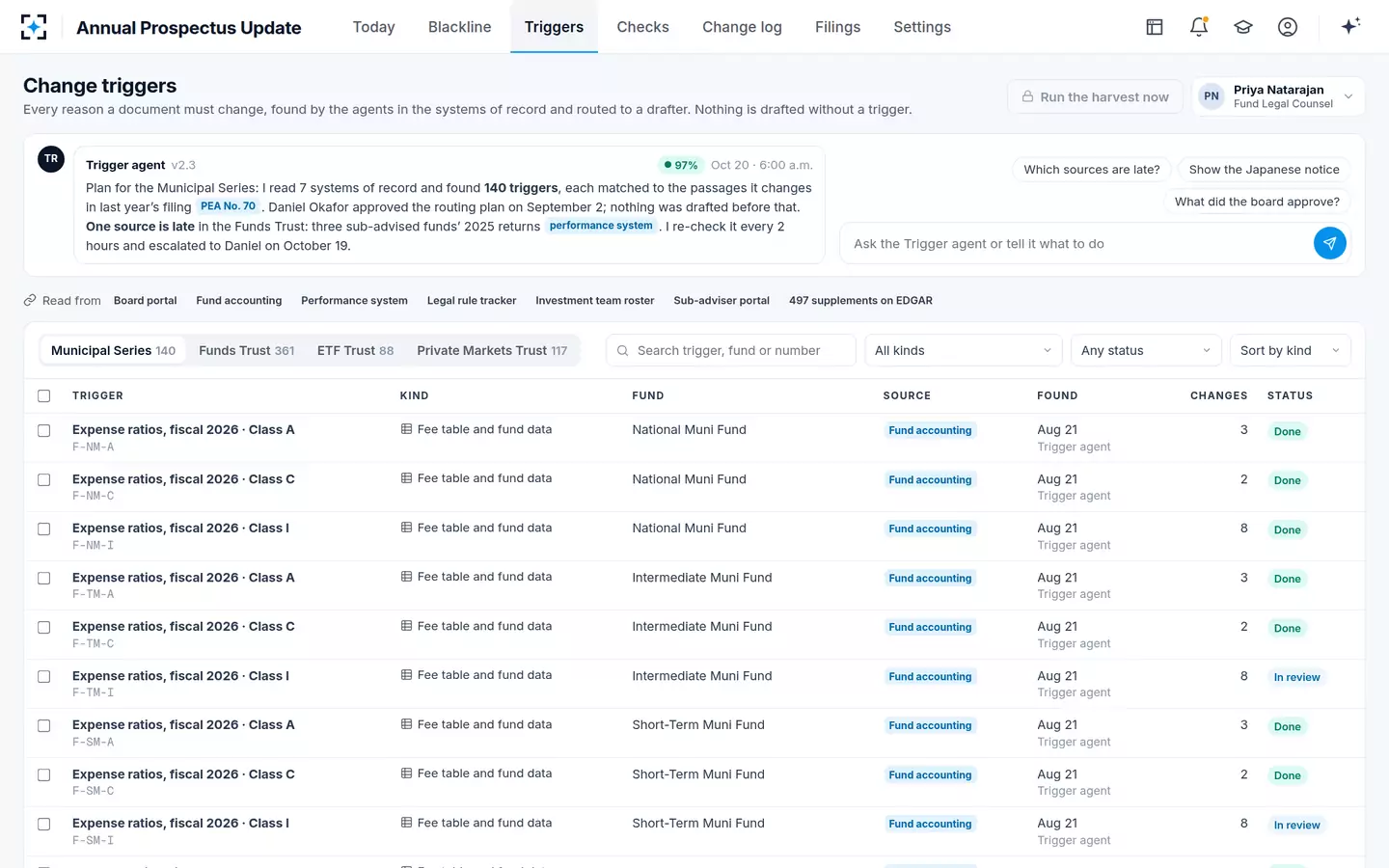
Item 3 of Form N-1A: the fee table that drives the most rework
Item 3 is where hours turn into rework. The fee table and expense example change every year, they appear in the statutory prospectus and in every summary prospectus, and they depend on two sources that move late: the fund accounting close and the board's decisions on waivers. Form N-1A adds two rules that create work at the end of the cycle. A change in annual fund operating expenses that would materially affect the table must be shown by restating the expense information "using the current fees as if they had been in effect during the previous fiscal year", with a footnote. And a waiver may appear only if it will run at least a year past the effective date (Form N-1A, Item 3, Instructions 3(d)(ii) and 3(e)).
Each of those rules can reopen a table that was thought final. A waiver extended at a September board meeting changes the footnote, and a fee cut approved at the same meeting can require restated figures. In the sample cycle, 42 of the 140 triggers were fee table and fund data. The hours a team spends on Item 3 rarely show in a burden estimate, and they are the ones most worth taking out.
A formula for the return on the annual update
The return on any tool for this work has four terms, and only two of them are hours. Price each with your own numbers rather than a vendor's: the hours from your last update, the loaded rates from your finance team, the supplements you filed to correct errors, and the full cost of the tool, including the time to set it up.
What Annual Prospectus Update is worth to a fund group, as four terms
Hours taken out
hours saved per registration statement × number of registration statements × loaded rate
Collecting, re-keying and checking. Our estimate is about 13.5 days per registration statement; replace it with your own after a trial on last year’s update.
Head of regulatory reporting
Review rounds avoided
rounds avoided × hours per round × counsel’s rate
Outside counsel’s time included. The sample cycle needed two rounds against four the year before.
Fund legal
Errors kept out of the filing
corrective supplements avoided × cost of a supplement
Drafting, approval, filing, Inline XBRL if Items 2 to 4 change, and the website update.
Fund CLO
Cost of the solution
subscription + setup + time to run the trial
Setup includes a dry run on last year’s update; count the hours of the people who take part.
Fund CFO
The third term is the one most often left out, because a corrective supplement looks small. It is a full cycle in miniature: drafted, approved by counsel, filed under Rule 497(e), tagged if it changes the risk/return summary, posted, and then folded into the next update. Our guide to sticker supplements sets out that cycle, and what a blackline misses shows the stale numbers that cause most of them.
What changes the cost, and what does not
Four things move the cost of an annual update more than anything else: the number of registration statements, the number of funds and classes in each, the number of changes in the year, and the number of review rounds. A complex with seven registration statements filing between July and April, as in the sample, runs seven seasons a year; consolidating fiscal year-ends is a governance decision that changes the cost more than any tool. Our guide to how often mutual funds update their prospectus explains why each year-end brings its own deadline.
What does not change is the responsibility. Counsel still gives the Rule 485(b)(4) representation, the Chief Legal Officer still signs, and the typesetter and filing agent still do their work. Annual Prospectus Update takes the mechanical hours out of the middle; the decisions at the ends stay where they are. The design target is that no stale number reaches the filed prospectus, a target and not a measured result.
Questions people ask
What are the SEC filing requirements for a mutual fund?
An open-end fund keeps a registration statement on Form N-1A current with at least one post-effective amendment a year under Rule 485, files supplements and summary prospectuses under Rule 497, and submits Inline XBRL for its risk/return summary. It also files Form N-CEN each year, Form N-PORT each month and its shareholder reports on Form N-CSR.
How many hours does a Form N-1A filing take?
The SEC's estimate is 297.7 hours per response, printed on the form, from an approved total of 1,787,043 hours across 6,002 responses a year. The SEC says such estimates are for Paperwork Reduction Act purposes and do not come from a representative survey.
What does Item 3 of Form N-1A require?
Item 3 is the fee table: shareholder fees and annual fund operating expenses as a percentage of the investment, with an expense example. Its instructions require restated figures when a change in expenses would materially affect the table, and allow a fee waiver line only for an arrangement lasting at least one year from the effective date.
How much does a summary prospectus cost a fund?
In its January 2024 notice, the SEC estimated about $21,400 per fund per year in cost burden and 1.5 hours per fund for the cover and website requirements of Rule 498, across about 11,241 funds using a summary prospectus.
What are the 485 filing requirements?
A Rule 485(b) amendment must be filed only for listed purposes, carry the registrant's certification and, where counsel prepared or reviewed it, counsel's written representation of eligibility. A Rule 485(a) amendment can contain any change and becomes effective sixty days after filing, or seventy-five for a new series.
What does an annual prospectus update cost?
No regulator publishes an all-in figure. The SEC's burden estimate averages 297.7 hours and about $23,900 of outside cost per Form N-1A response, our arithmetic on its totals; a fund group's real cost depends on its registration statements, funds, changes and review rounds, which is why the formula above uses your own numbers.