A 485BXT filing is a post-effective amendment filed for one purpose: to designate a new effective date for an amendment filed under Rule 485(a) that has not yet gone effective. Rule 485(b)(1)(iii) allows the new date to be no earlier than the date first designated and "no later than thirty days after that date", so a fund that needs more time files one 485BXT for each extra month. Every 485BXT, like every other fund filing, is public on EDGAR, and by our count of the SEC's own index files there were 4,364 of them in January to September 2026, against 1,530 in the same months of 2025. A fund group's filing calendar is therefore visible to anyone who reads the index. Botminds' Annual Prospectus Update keeps the internal side of that calendar, every registration statement's dates and open changes, on one screen for the filing team.
485BXT filings by quarter: the count stepped up at the start of 2026
What is a 485BXT filing?
It is the EDGAR form type for an amendment filed only under Rule 485(b)(1)(iii), which EDGAR labels "New effective date for post-effective amendment". The purpose it serves is narrow. A 485(a) amendment becomes effective on the sixtieth day after filing, or the seventy-fifth for a new series, unless something changes that date (17 CFR 230.485(a)). If the fund is not ready, because staff comments are still open, a board approval is pending or a service provider is late, it can file a 485BXT to push the date back. The 485BXT itself changes no disclosure; it only moves a date.
Rule 485(d) explains why the fund files a 485BXT rather than simply letting the date pass. An amendment that includes a prospectus "shall not become effective under paragraph (a)" if a later amendment relating to the prospectus is filed before it goes effective, unless the later one is filed under 485(b) and designates either the original date or a new one under (b)(1)(iii). The 485BXT is that later amendment, built to keep the pending 485(a) alive on a new date.
The 485BXT rule: thirty days at a time
The rule caps each step. Paragraph (b)(1)(iii) allows "Designating a new effective date for a previously filed post-effective amendment pursuant to paragraph (a) of this section, which has not yet become effective, Provided, that the new effective date shall be no earlier than the effective date designated in the previously filed amendment under paragraph (a) of this section and no later than thirty days after that date". Each 485BXT moves the date by up to thirty days from the date before it, so a launch held back for three months produces at least three of them.
That arithmetic is why the count measures filings, not funds. One pending amendment can generate a chain of 485BXTs, and one 485BXT can cover every series in a pending amendment. The index does not say why any date moved. What it does show is how many pending 485(a) dates were moved, by whom and when: the public trace of every pending date that moved.
How many 485BXT filings are there? Nearly three times as many in 2026
By our count of the SEC's EDGAR indexes, registrants filed 1,721 485BXTs in 2023, 1,779 in 2024 and 2,309 in 2025, then 4,364 in the first nine months of 2026 alone. 485APOS amendments, the filings a 485BXT extends, rose too, from 969 in January to September 2025 to 1,365 in the same months of 2026, but by far less. In 2025 there were about 1.6 485BXTs for every 485APOS; in the first nine months of 2026, about 3.2.
The annual update's form types on EDGAR, by year
| Form type | What it is | 2023 | 2024 | 2025 | 2026, Jan–Sep |
|---|---|---|---|---|---|
| 485BPOS | Amendment effective on filing under Rule 485(b) | 4,762 | 4,664 | 4,908 | 4,178 |
| 485APOS | Amendment under Rule 485(a): 60 or 75 days | 970 | 1,059 | 1,446 | 1,365 |
| 485BXT | New effective date for a pending 485(a) | 1,721 | 1,779 | 2,309 | 4,364 |
| 497 | Supplements and varying forms of prospectus | 10,506 | 10,813 | 11,598 | 9,134 |
| 497J | Certification that the forms used did not differ | 4,526 | 4,660 | 4,924 | 4,250 |
| 497K | Summary prospectus | 19,108 | 20,589 | 21,562 | 17,102 |
Who files 485BXTs: five registrants, almost half of 2026
The 2026 count is concentrated. In the SEC's full-text search, the five registrants with the most 485BXT filings in January to September 2026 account for 1,953 of the 4,364, or 45%; three of the five carry “ETF” in their names, and the largest alone filed 760, about half as many as the whole market filed in the same months of 2025. A year earlier, the top five filed 500 of 1,530, or 33%.
The 2026 increase is concentrated in a few registrants
4,364
485BXT filings, January to September 2026
1,530 in the same months of 2025
45%
of them filed by just five registrants
33% for the top five in 2025
760
485BXTs filed by the single most active registrant in nine months
Our reading of SEC full-text search
3.2
485BXTs per 485APOS in 2026 so far, against 1.6 in 2025
Our count of SEC indexes
The rise is not only at the top. Outside the five most active registrants, the rest of the market filed 2,411 485BXTs in January to September 2026, against 1,030 outside the top five a year earlier, our arithmetic on the same data. The useful number for a filing team is its own: how many of its 485(a) dates it moved last year, and how many days each move added to a launch or a material change.
What the public calendar shows, and what only the fund group knows
EDGAR shows every filing's form type, registrant and filing date, and the filing itself shows the effective date on its facing sheet. Read together, they give a public calendar of each registration statement: when its annual update went in, which 485(a) amendments are pending, how often they were extended and when stickers followed. What the index cannot show is everything that decides those dates.
The public filing calendar and the internal one
What EDGAR shows anyone: Filing date, form type and the effective date on the facing sheet.
What only the filing team knows: Fiscal year-end, 120-day date, board meeting dates, typesetter slots, the planned effective date.
What EDGAR shows anyone: A 485APOS on file, and each 485BXT that moved its date.
What only the filing team knows: Which staff comments are open, who owes the response, and whether the next date will hold.
What EDGAR shows anyone: The filed documents, once filed.
What only the filing team knows: Every change still being drafted, its trigger, its source and whether it is approved.
What EDGAR shows anyone: Nothing until it happens.
What only the filing team knows: Registration statements with changes still open a week before the 120-day date.
How to pull your own fund group's filings from EDGAR
The SEC publishes the data for free. Its guide to accessing EDGAR data explains that "Indexes to all public filings are available from 1994Q3 through the present", that the full and quarterly index files "are rebuilt weekly, early on Saturday mornings" to pick up corrections and deletions, and that filings submitted late in the day may show up "in the following business day's index" (SEC, Accessing EDGAR Data). The same page asks automated users to declare who they are and to stay under ten requests a second.
Four steps from EDGAR's index to your own filing calendar
- 1
Download the quarterly form index
EDGAR publishes a full index of every public filing for each quarter, sorted by form type, from 1994 onwards. One file per quarter lists form type, company name, CIK, date filed and the path to the filing.
- 2
Keep the 485 and 497 form types
485APOS, 485BPOS, 485BXT, 497, 497J and 497K are the annual update’s family. Count unique accession numbers, not lines, so a filing listed twice is counted once.
- 3
Filter to your registrants’ CIKs
Each registration statement files under its trust’s CIK. A fund group with seven trusts has seven CIKs to follow.
- 4
Line them up against your own calendar
Match each filing to the fiscal year-end, the 120-day date and the designated effective date on its facing sheet, and flag any 485(a) still pending.
Two cautions apply to any count. A filing can carry many series, so a count of filings understates the number of funds whose prospectuses changed. And several form types are shared with insurance products, so a fund group should count its own CIKs rather than compare itself with market totals. The season guide uses the same index to show the April peak in 485BPOS filings.
Are SEC comment letters public? Finding the staff's side of the calendar
Yes, after a delay. The SEC announced in 2011 that "Since May 12, 2005, the staff of the Securities and Exchange Commission has been publicly releasing through the EDGAR system" its comment letters and the responses to them "relating to disclosure filings reviewed by the Divisions of Corporation Finance and Investment Management", and that "beginning January 1, 2012, the staff will release filing review correspondence no earlier than 20 business days" after it completes a review (SEC, 2011). The letters appear on EDGAR as form type UPLOAD, and the registrants' replies as CORRESP.
That makes a 485(a) review readable after the fact: the comments the staff made on a pending amendment, the fund's answers, and, from the 485BXTs in between, how long the exchange took. For a filing team planning a material change, other funds' correspondence on similar changes is a useful public guide to what the staff will ask. For the annual update itself, the useful habit is to check last year's comments on your own filings before drafting, because a change promised in a CORRESP letter is one the new prospectus should reflect.
Keeping the internal calendar in Annual Prospectus Update
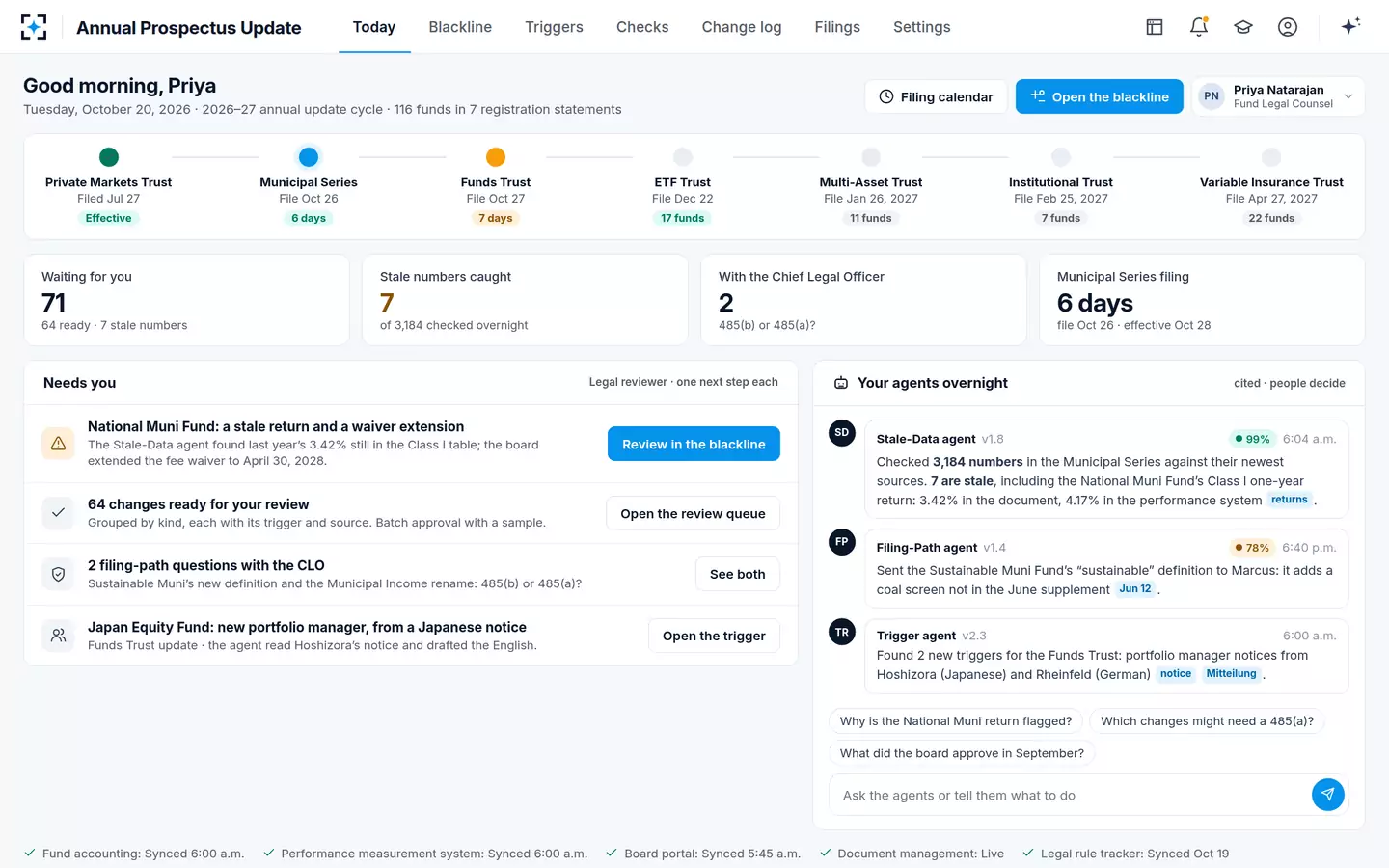
Annual Prospectus Update keeps the internal side on the home screen. Each registration statement sits on a filing timeline with its file date and status, and the tiles below show what is still open: changes waiting for counsel, stale numbers caught overnight, filing-path questions with the Chief Legal Officer and days to the next filing. A registration statement with changes still open five business days before its filing date is escalated; the five days are a setting the fund group chooses.
The internal calendar in Annual Prospectus Update: seven registration statements
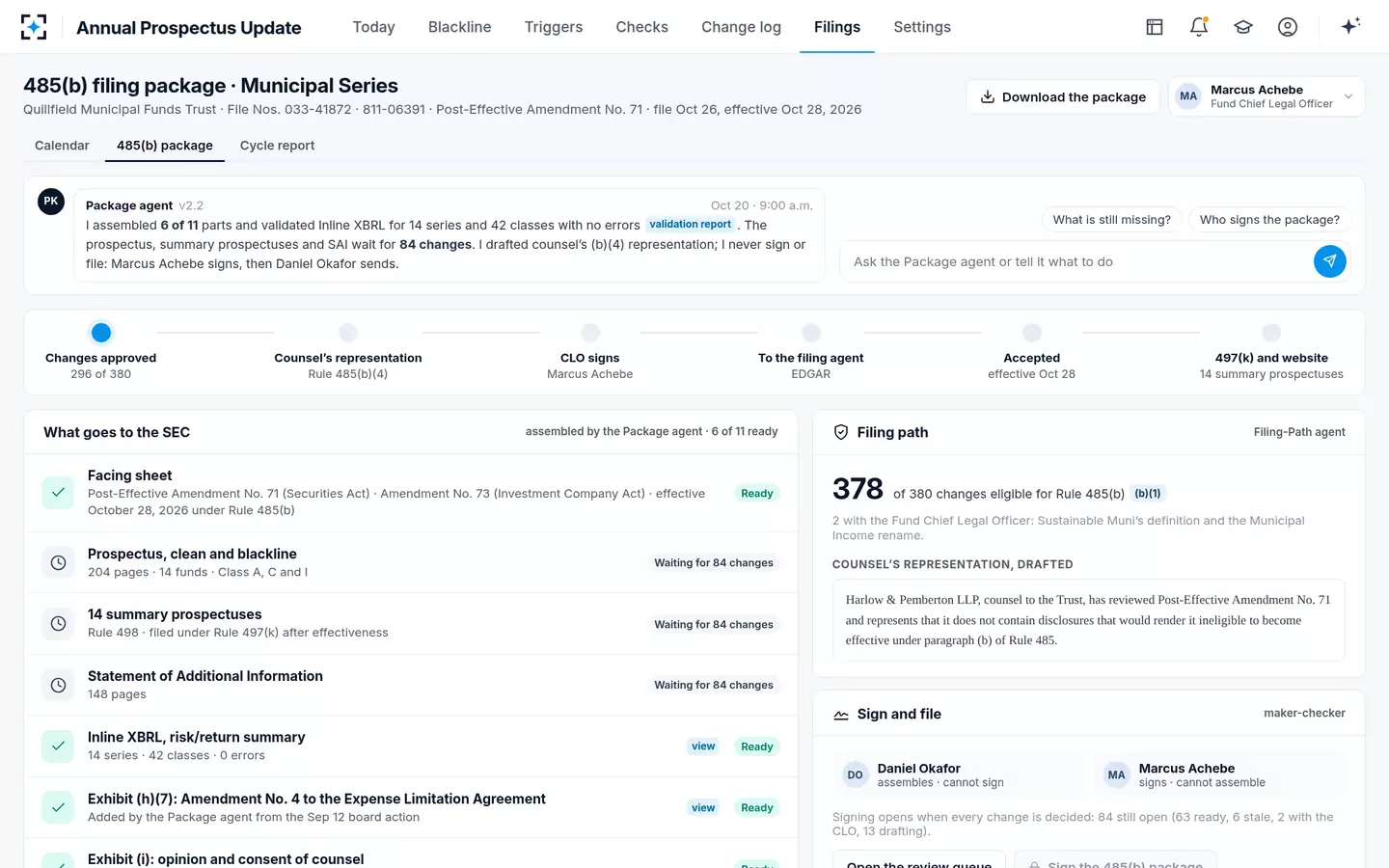
After filing, the trail continues. The agent that assembles the filing puts the amendment together, and once the Chief Legal Officer has signed and the filing manager has sent it, it files each summary prospectus under Rule 497(k) and posts the documents online. Every step lands on the audit trail with who did it and when, so the internal calendar and the public one can be reconciled filing by filing. The filing-path guide covers how the choice between 485(a) and 485(b) is made in the first place.
From approved changes to EDGAR acceptance and the 497(k) filings
Questions people ask
What is form 485BXT?
It is the EDGAR form type for a post-effective amendment filed under Rule 485(b)(1)(iii) to designate a new effective date for a pending 485(a) amendment. It changes no disclosure, and the new date can be no more than thirty days after the date previously designated.
How many times can a 485BXT be filed?
Rule 485(b)(1)(iii) limits each filing to a new date no later than thirty days after the date designated before, and sets no number of filings. A fund that needs more time files another 485BXT before the current date arrives.
How many 485BXT filings were made in 2026?
By our count of the SEC's EDGAR indexes, 4,364 from January to September 2026, against 1,530 in the same months of 2025 and 2,309 in all of 2025. Five registrants filed 45% of the 2026 total.
How do I find a fund's SEC filings on EDGAR?
Search EDGAR by the trust's name or CIK, or download the quarterly form index and filter by form type and CIK. The SEC's index files cover every public filing since the third quarter of 1994 and are rebuilt weekly.
How do I find SEC comment letters on a fund filing?
Look for the form types UPLOAD, the staff's letters, and CORRESP, the registrant's responses, under the trust's CIK. Since 2012 the staff has released review correspondence no earlier than 20 business days after it completes a review.
Does a 485BXT mean something went wrong?
Not necessarily. It means a pending 485(a) amendment was not going effective on its designated date, for reasons the filing does not state. Open staff comments, a late approval or a planned launch date can each be the cause.