A regulatory document management system, for a fund group, is the place the prospectus, summary prospectuses and statement of additional information live: every version, who changed it, who approved it, and the copy that was filed. It is the system of record for the documents, and it should stay that way. What it does not do is the work that makes the annual update hard: finding every reason the documents must change in board minutes, fund accounting, the performance system and the year's supplements, drafting each change, and checking every number against its source. Botminds' Annual Prospectus Update adds agents that do that work around the document system, reading from the sources, writing drafts back as new versions and leaving every approval and signature with people.
The integration map for Annual Prospectus Update: what agents read, what the document system keeps
Read, never written
- Board portal: minutes and certified resolutions
- Fund accounting: expense ratios, fees paid, turnover
- Performance system: calendar-year and quarter-end returns
- Legal rule tracker: rules and their dates
- Roster and sub-adviser notices, in their own language
- EDGAR: the year’s 497 supplements
Agents, between them
- Find each reason to change
- Draft the change in house style
- Check every number against its source
- Test each change under Rule 485(b)
- Assemble the filing set
People approve every change; the CLO signs
Document system: the record
- Last year’s filed prospectus, summaries and SAI
- Every new version, with who changed it
- House style and approved wording
- Originals of each source, unchanged
Out, as today
- Typesetter: pages and proofs
- Filing agent: EDGAR submission and Inline XBRL
- Fund website: Rule 498 posting
What a regulatory document management system does for a fund's prospectus
It holds the documents and their history. A good system for fund documents stores each registration statement's prospectus, summary prospectuses and SAI as controlled documents, keeps every version with its author and time, routes drafts for review, records approvals, produces comparisons between versions and keeps the copy that was filed. Some also hold house style, approved wording for shared passages and the library of past filings that counsel reaches for when a question comes up.
Those functions answer real requirements. Rule 472 asks for every amendment to be marked up to show what it changed (17 CFR 230.472; the blackline comparison guide covers how that mark-up is checked), which needs reliable versions to compare. Rule 498 requires a fund that relies on the summary prospectus to keep its current documents online, in formats people can "permanently retain, free of charge" (17 CFR 230.498(e)). And when examiners look at a fund's filings, as the SEC's fiscal 2027 priorities say they will, "such as summary prospectuses" (SEC, Fiscal Year 2027 Examination Priorities), the document system is where the filed versions and their history are found.
Does a document management system draft the annual update?
No, and it is not built to. A document system manages the documents it is given; it does not know that the board extended a waiver on September 12, that fund accounting closed fiscal 2026 on August 21, or that a sub-adviser sent a notice in Japanese about a new portfolio manager. Those facts live in other systems. Without a link between them, a person carries each one into the document system by hand, from an email, a spreadsheet tracker or a printout of the minutes.
Some systems add templates and data merge, which fill known fields from a feed: a fee table from fund accounting, a returns table from the performance system. That helps where the field is fixed and the feed is clean. It does not help where the change is a judgment, such as a new definition under the Names Rule (whose timing is set out in the Names Rule compliance date guide), or where the link to the feed was broken by a hand edit last year, which is how stale numbers survive. Our guide to what a blackline misses shows six of them from one sample cycle.
Keep the system of record: what agents read, write and never touch
The design rule is simple: the document system stays the record of the documents, and the source systems stay the record of the facts. Agents read from both, and write only to the document system, as drafts that people approve. They never write to fund accounting, the performance system or the board portal, and they never overwrite an approved version.
System by system: what the agents read, what they write, who approves
| System | What the agents read | What they write | Who approves |
|---|---|---|---|
| Document management | Last year’s filed documents, house style, approved wording | New draft versions, the blackline, the change log | Fund counsel, change by change |
| Board portal | Minutes and certified resolutions | Nothing | The board, before the agents see it |
| Fund accounting | Expense ratios, fees paid, turnover, financial highlights | Nothing | Fund accounting signs off its own figures |
| Performance system | Calendar-year and quarter-end returns by class | Nothing | Performance signs off its own figures |
| Legal rule tracker | Rules and their compliance dates | Nothing | Legal maintains it |
| Roster and sub-adviser portal | Manager changes and notices in their own language | Nothing | Investment teams and sub-advisers |
| EDGAR | The year’s 497 supplements | Nothing directly: the filing manager sends | The Chief Legal Officer signs first |
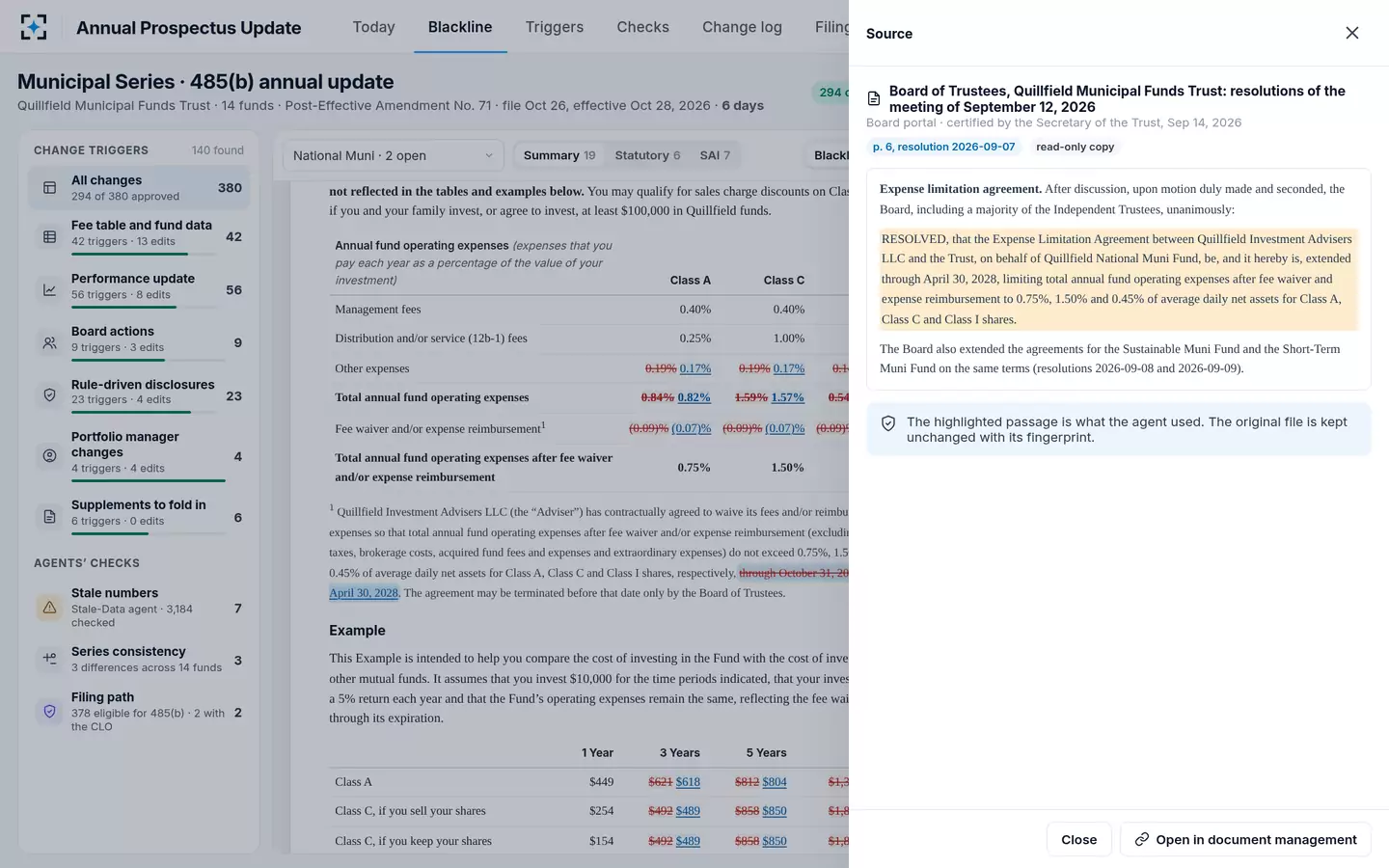
Reading is where most of the value sits. In the sample Municipal Series, the Trigger agent read seven systems of record and found 140 reasons the documents had to change, each matched to the passages it affects in last year's filing (fictional funds and data). Nothing was drafted until the regulatory reporting manager approved that plan. When a source is late, the agent re-checks it on a schedule and escalates it, so the filing team learns about a missing close or a pending board action from the system, not from a typesetter's proof.
A source opened on the passage the agent used, with a link to the document system
Where approvals live: maker-checker on top of the document system
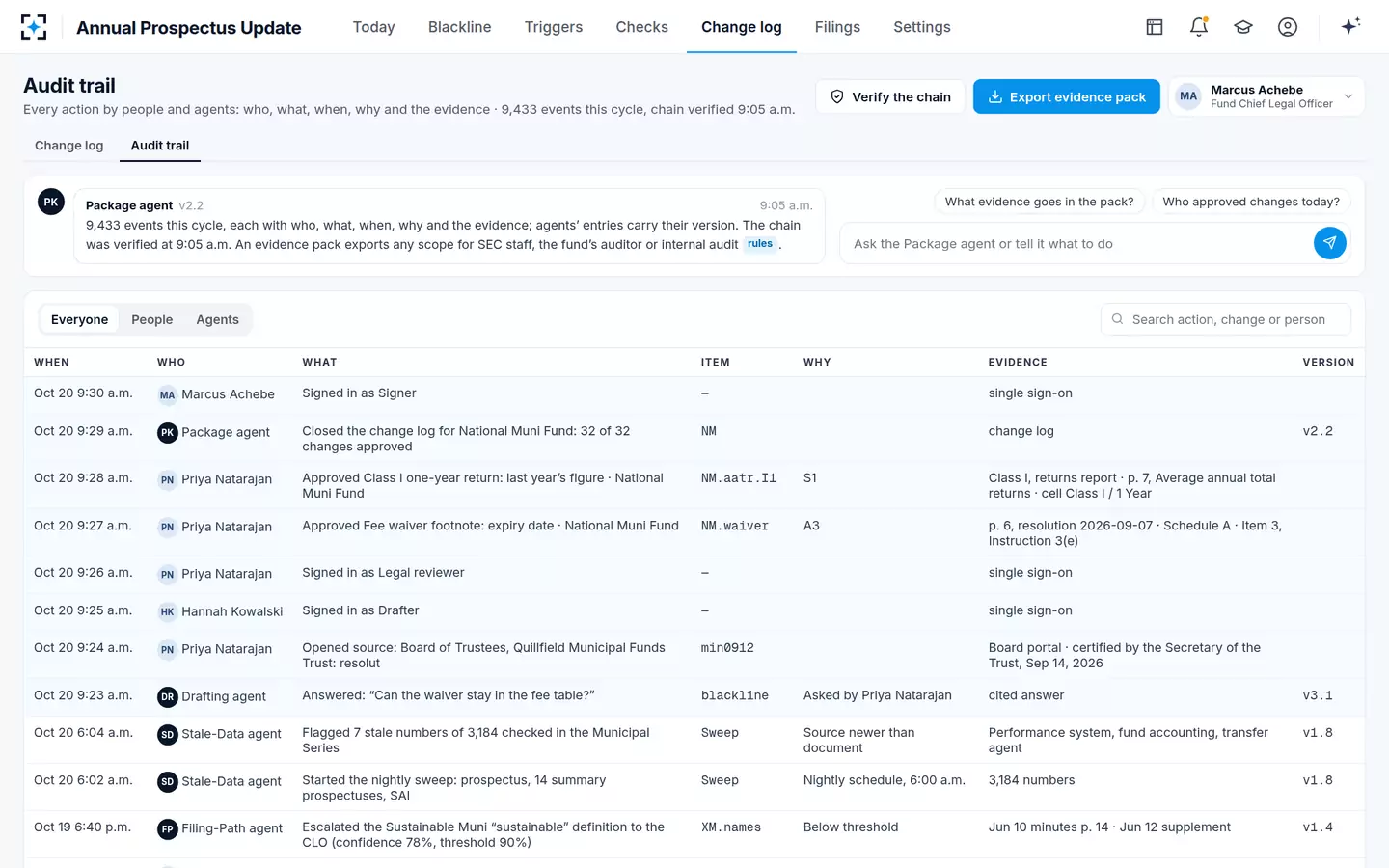
A document system records approvals; whether it enforces who may give them depends on how it is set up. For an annual update the rules that matter are specific. A person who drafted or proposed a change cannot approve it. A reviewer's own edit goes to a second reviewer. Only the Chief Legal Officer decides a filing-path question, and whoever assembles the filing may not also sign it. Annual Prospectus Update enforces those rules on every change and writes each decision, with its reason code, to an audit trail that records who, what, when, why and the evidence.
One change in Annual Prospectus Update, from source to approved version
Agent
Read the sourceThe Trigger agent finds the change in a system of record and cites the passage.
Never: writes to the source
Agent
Draft a new versionThe Drafting agent writes the change into a draft of last year’s document, in house style, with the blackline.
Never: overwrites an approved version
Agent
Check and testEvery number is checked against its source; the change is tested under Rule 485(b).
Never: clears its own flag
A person decides
ProposeAn analyst checks the draft against the source and proposes it.
A person decides
ApproveCounsel approves with a reason code; the approved version becomes the record.
The approval rules sit with the legal function, not with the tool. Rule 485(b)(4) requires counsel who prepared or reviewed a 485(b) amendment to state in writing, when it is filed, that it contains nothing that would make it ineligible for immediate effectiveness (17 CFR 230.485(b)(4)). A trail that shows each change, its source, its filing path and its approver is the evidence behind that representation, wherever the documents are stored.
What should a regulatory document system keep for the annual update?
Keep what someone will ask for later. An examiner, an auditor or the board may ask why a number changed, who approved a definition, or what the fund knew when it filed. The list below is what we would expect to be able to produce for any change in a filed prospectus, from the document system and the trail beside it.
What the record of an annual update should hold
- Every version, with its author and time
Including drafts written by agents, marked as such, with the agent’s version.
- The reason for each change
The trigger: a resolution, a close, a rule, a notice, a supplement.
- The source, unchanged
The original document, kept with a fingerprint, and the passage relied on.
- The decision and its reason code
Who approved, who could not, and why; the filing path and who decided it.
- The filed set
The clean and marked documents, exhibits, Inline XBRL and the EDGAR acceptance.
- What was posted, and when
The documents on the website under Rule 498, and the date each replaced the last.
Document automation for financial services: templates, assembly or agents?
Three kinds of tool are sold under the label, and they solve different parts of the problem. Templates and data merge fill known fields from a known feed, and they are good at fee tables and returns when the feed is clean. Assembly tools put documents together from approved clauses, and they are good at keeping shared passages consistent. Agents read unstructured sources, minutes, notices and rule releases, decide what must change and draft it, and check the result; they are good at the part no template covers.
A fund group usually needs all three, and should buy them as layers rather than replacements. Form N-1A asks that a prospectus use "concise, straightforward, and easy to understand language" (Form N-1A, General Instruction C.1(a)); that is a drafting standard, best kept by approved wording, which the document system already holds. What the agents add is the knowledge of what changed this year.
A go-live plan that leaves the system in place
Because nothing is replaced, go-live is mostly connection and proof. The plan below is the one we would follow for a fund group with a document system already in use: connect read-only, replay last year, run one registration statement live, then the rest. The dates are illustrative.
From read-only connections to a full season, without moving the documents
- Connect read-only3 wk
- Replay last year3 wk
- One statement live4 wk
- The rest join2 wk
The replay is the test that matters. Give the agents last year's sources and last year's starting documents, and compare what they propose with what was actually filed: which changes they found, which they missed, and what they found that the filing missed. The thresholds, reason codes, house style and service levels are settings; a change to one creates a new version that the Chief Legal Officer approves before it applies. How one change looks once live is traced in one update, step by step.
The audit trail beside the document system: every action, with its evidence
Which fund groups should add agents to their document system, and which should not
It fits a fund group whose document system works and whose pain is upstream of it: changes arriving by email, tables re-keyed from reports, numbers nobody re-checks, and filing-path decisions made late. It fits best where there are several registration statements, many funds per series and sources in different systems. It also suits a group that wants to keep its typesetter and filing agent, since the filing leaves through them as before.
It is the wrong first step for a group without a controlled document store, where versions live in shared drives and email; that group should fix the record before adding agents to it. And it adds less for a single-fund registrant whose update is a few dozen changes made by one person. For the filing end of the chain, see SEC filing software vs drafting agents.
Questions people ask
What is regulatory document management software?
It is software that stores regulated documents as controlled records, with versions, review routing, approvals and the filed copy. For a fund, it holds the prospectus, summary prospectuses and SAI for each registration statement and their history from year to year.
Do we need to replace our document management system to use agents?
No. In Annual Prospectus Update the document system remains the record: agents read last year's documents and house style from it and write drafts back as new versions for people to approve. Source systems such as fund accounting are read and never written to.
What is financial document automation?
It covers tools that produce or update financial documents with less manual work: templates and data merge for known fields, assembly from approved clauses, and agents that read unstructured sources and draft changes. In a fund's annual update, the hard part is the last of the three.
Can document automation check numbers in a prospectus?
Templates fill numbers from a feed but do not check numbers that were typed over or carried from a supplement. A check that compares every number in the documents with its newest signed-off source is a separate step; in the sample cycle it found seven stale numbers among 3,184.
How long does it take to connect agents to existing systems?
It depends on the systems and on access, so no single figure applies. A plan that connects sources read-only, replays last year's update and then runs one registration statement live is the safe order; the illustrative plan above takes about twelve weeks.