The difference between a statutory prospectus and a summary prospectus is scope, not substance. The statutory prospectus is the full document that satisfies Section 10(a) of the Securities Act: Part A of Form N-1A, Items 1 to 13, often covering many funds in one book. The summary prospectus is a separate document for one fund that carries only Items 2 to 8, the risk/return summary, under Rule 498, and Rule 498 requires those items to be the same as the statutory prospectus says them. A fund that delivers the summary must post the statutory prospectus, the statement of additional information (SAI) and its shareholder reports online. Botminds' Annual Prospectus Update drafts all three documents in one annual update, so a corrected number in one is corrected in the others.
Statutory prospectus vs summary prospectus: one set of items, three documents
Summary prospectus
Rule 498 · one fund, its classes
- Item 2 · Objectives
- Item 3 · Fee table and expense example
- Item 4 · Strategies, risks, performance
- Item 5 · Adviser and portfolio managers
- Item 6 · Buying and selling shares
- Item 7 · Tax information
- Item 8 · Intermediary compensation
Items 2–8 and only those, in order, plus the cover legend
Statutory prospectus
Form N-1A, Part A · Section 10(a)
- Item 1 · Cover pages
- Items 2–8 · The same summary, word for word
- Item 9 · Objectives, strategies, risks in full
- Item 10 · Management and capital structure
- Item 11 · Shareholder information
- Item 12 · Distribution arrangements
- Item 13 · Financial highlights
The full document; may cover many funds in one book
Statement of additional information
Form N-1A, Part B
- Fund history, investments and risks
- Trustees, officers and their pay
- Control persons and principal holders
- Advisory fees paid and other services
- Portfolio managers: other accounts, pay, holdings
- Brokerage, capital stock, pricing, taxes
- Calculation of performance data
Free on request and on the website; not delivered with every sale
Statutory prospectus vs summary prospectus: the short answer
Rule 498 defines both. A "Statutory Prospectus means a prospectus that satisfies the requirements of section 10(a) of the Act", and a summary prospectus must "provide the information required or permitted by Items 2 through 8 of Form N-1A, and only that information, in the order required by the form" (17 CFR 230.498(a)(6), (b)(2)). Form N-1A requires the same Items 2 to 8 to sit at the front of the statutory prospectus, "in numerical order", for each fund in turn, so every statutory prospectus already contains a summary section for each fund it covers (Form N-1A, General Instruction C.3).
The summary prospectus is optional; the statutory prospectus is not. A fund may choose to deliver the short form in place of the long one, and most do: in its most recent estimate for the rule, the SEC put the number of funds using a summary prospectus at about 11,241 (SEC notice, Federal Register, January 2024). By our count of the SEC's EDGAR indexes, funds filed 21,562 summary prospectuses under Rule 497(k) in 2025 (SEC, Accessing EDGAR Data).
The summary prospectus is the document most fund investors receive
11,241
funds using a summary prospectus, in the SEC’s estimate
SEC notice, Jan 2024
21,562
summary prospectuses filed under Rule 497(k) in 2025
Our count of SEC indexes
3–4
pages: the length the SEC intended for each fund’s summary
SEC release 33-8998, 2009
64%
of investors surveyed for the SEC rarely or never read the statutory prospectus
Survey cited in the 2009 release
What is a summary prospectus under Rule 498?
A summary prospectus is a short prospectus for one fund that Rule 498 deems "a prospectus that is authorized under section 10(b) of the Act". It may describe only one fund, though it may cover several share classes of that fund. The cover must give the fund's name and classes, each class's ticker, the words "Summary Prospectus", the approximate date of first use and a fixed legend telling the investor where to find the statutory prospectus, the shareholder reports and other information, online, by a toll-free number and by email (Rule 498(b)(1)).
The SEC adopted it in 2009, with a stated aim: the amendments "are intended to improve mutual fund disclosure by providing investors with key information in plain English in a clear and concise format, while enhancing the means of delivering more detailed information to investors" (SEC Release 33-8998). The Commission set no page limit, but said it meant the summary to run to about three or four pages. The evidence it cited was a survey: nearly two-thirds of investors said they rarely or never read the statutory prospectuses they received, and over half of those said the documents were too complicated or too long.
Incorporation by reference is allowed, within limits. A summary prospectus may incorporate information from the fund's statutory prospectus, SAI and certain shareholder report content, but not the Items 2 to 8 information it is required to include, and only by reference to the specific document that contains it. The legend then names the document and its date. A summary prospectus that incorporates the statutory prospectus of last year's date is a stale document even if every number on its own pages is right.
What the statutory prospectus must contain that the summary leaves out
The statutory prospectus adds Items 1 and 9 to 13 of Form N-1A to the summary sections. Item 9 sets out the objectives, principal strategies and risks in full, and says where the fund's portfolio holdings disclosure policies are described. Item 10 covers the adviser, sub-advisers, portfolio managers and capital structure. Item 11 is the shareholder information: pricing, purchases, redemptions, dividends, frequent trading policies and tax consequences. Item 12 sets out sales loads, breakpoints and distribution arrangements, and must appear "in one place in the prospectus". Item 13 is the financial highlights table.
Because Items 2 to 8 "need not be repeated elsewhere in the prospectus", the same fact often appears in two forms: a one-line principal risk in Item 4 and a full paragraph on it in Item 9, a portfolio manager's name and start year in Item 5 and the manager's five-year business history in Item 10. That pairing is where inconsistency creeps in. A manager change made in Item 5 and missed in Item 10, or a risk added to Item 9 but not summarised in Item 4, passes every review that reads one section at a time.
Long form and short form, rule by rule
Statutory prospectus: The prospectus that satisfies Section 10(a): Form N-1A Part A, Items 1 to 13.
Summary prospectus: A Section 10(b) prospectus under Rule 498: Items 2 to 8 for one fund, and nothing else.
Statutory prospectus: Any number; each fund’s Items 2 to 8 presented separately at the front.
Summary prospectus: One fund, which may have several classes.
Statutory prospectus: In the registration statement under Rule 485, then the form used under Rule 497(c) or a 497(j) certification.
Summary prospectus: Under Rule 497(k), no later than the date it is first used.
Statutory prospectus: Delivered with or before the security, unless the fund relies on Rule 498.
Summary prospectus: Delivered in its place, if the statutory prospectus, SAI and shareholder reports are online.
Statutory prospectus: Sent free within three business days of a request, on paper or by email, with the SAI and shareholder reports.
Summary prospectus: Given greater prominence than any materials that accompany it, other than other prospectuses.
Statement of additional information: what it holds, and must it be delivered?
The SAI is Part B of Form N-1A, and it is not delivered with every sale. The form describes its purpose as providing "additional information about the Fund that the Commission has concluded is not necessary or appropriate in the public interest or for the protection of investors to be in the prospectus, but that some investors may find useful" (Form N-1A, General Instruction C.2(b)). The back cover of the prospectus must say that the SAI and the shareholder reports "are available, without charge, upon request", with a toll-free number and a website address.
It is still part of the registration statement and still updated every year. The SAI carries the tables that go stale fastest: advisory fees paid in each of the last three fiscal years, brokerage commissions, portfolio turnover, principal holders as of a recent date, trustees' compensation, and each portfolio manager's other accounts and fund holdings. Form N-1A also says the SAI "should be made available at the same time that the prospectus becomes available". In the sample Annual Prospectus Update cycle (fictional funds and data), several of the seven stale numbers the overnight check found were in the SAI, among them a principal-holder table still dated a year earlier and a turnover rate that repeated the prior year's figure.
The website legend: a summary prospectus is only as good as its link
A fund that relies on Rule 498 to deliver the summary instead of the statutory prospectus takes on a website obligation. The legend's address "must be specific enough to lead investors directly to the Statutory Prospectus and other materials", not to a home page (Rule 498(b)(1)(v)(A)). The current summary prospectus, statutory prospectus, SAI and the latest annual and semi-annual reports must be online, free, on or before the time the summary is sent, and stay there for at least 90 days after the delivery.
The online versions must let a reader move "directly back and forth" between each section of the summary and the corresponding detail in the statutory prospectus and SAI, or between links and the tables of contents of both. A paper copy must go out within three business days of a request. So the annual update does not end at EDGAR acceptance: the new documents must replace the old ones online, with working links, before the first new summary is sent. Our guide to SEC filing software looks at who owns that last step.
It is our intent that funds prepare a concise summary (on the order of three or four pages) that will provide key information.
SEC, Release 33-8998 (2009)
Does the summary prospectus change what investors choose?
Not in a controlled test of it. In an experiment published in 2009, as the rule took effect, economists gave subjects either statutory prospectuses or summary prospectuses and asked them to choose an equity and a bond portfolio. "We find no evidence that the Summary Prospectus affects portfolio choices," the authors report, and subjects in both groups failed to avoid sales loads even with a one-month investment horizon (Beshears, Choi, Laibson and Madrian, NBER Working Paper 14859).
The finding cuts against two easy conclusions. It does not show that the short form is useless: it shows that the short form did not make worse decisions than the long one, at a fraction of the length. And it suggests that the value of the summary lies in being accurate and findable rather than in its layout. A summary that differs from its statutory prospectus breaks Rule 498(f)(4); a summary that is merely plain does not move choices by itself.
What examiners read: summary prospectuses in the SEC's 2027 priorities
The SEC's Division of Examinations names the summary prospectus directly. Its fiscal 2027 priorities state: "RIC examinations typically assess compliance programs, disclosures, governance practices, and filings, such as summary prospectuses" (SEC, Fiscal Year 2027 Examination Priorities). The same passage puts fund fees and expenses, including waivers and reimbursements, first among the areas of particular focus, followed by whether disclosures align with stated strategies, filings and marketing.
Both sit on the first pages of every summary prospectus: the fee table with its waiver line, and the principal strategies. Rule 498(f)(4) adds the consistency test: the Items 2 to 8 information in the summary "must be the same as the information provided in response to Items 2 through 8 of Form N-1A in the Fund's Statutory Prospectus". The fee and expense data also flow into the tailored shareholder report; our colleagues on Tailored Shareholder Reports cover that document.
Six consistency checks between the long and short form before they are filed
- Items 2 to 8 match, byte for byte
Every number, date and sentence in the summary is the one in the statutory prospectus’s summary section for that fund.
- Item 4 risks match Item 9
Each principal risk in the summary has its full description in Item 9, and nothing in Item 9 is a principal risk the summary omits.
- Item 5 managers match Item 10 and the SAI
Names, titles and start years agree in all three places, and the SAI’s other-accounts table covers each manager.
- The fee waiver runs a year past the effective date
Form N-1A allows the waiver line only for an arrangement lasting no less than one year from the effective date.
- The legend points at the new documents
The address leads directly to this year’s statutory prospectus, SAI and reports, and any incorporated document is named with its date.
- Shared passages read the same across the series
Purchase and sale, tax and intermediary compensation text are usually identical for every fund; a difference should be deliberate.
Keeping the long and short form identical in Annual Prospectus Update
Annual Prospectus Update drafts the statutory prospectus, the summary prospectuses and the SAI as one set. A change is made once, at its source, and carried to every place the fact appears: a corrected return in the statutory prospectus's summary section changes the fund's summary prospectus, and a new portfolio manager in Item 5 opens the Item 10 and SAI passages for the same change. The Series Consistency agent compares every shared passage across the funds of a series and proposes one wording for one approval.
Series consistency in Annual Prospectus Update: eight passages, fourteen funds
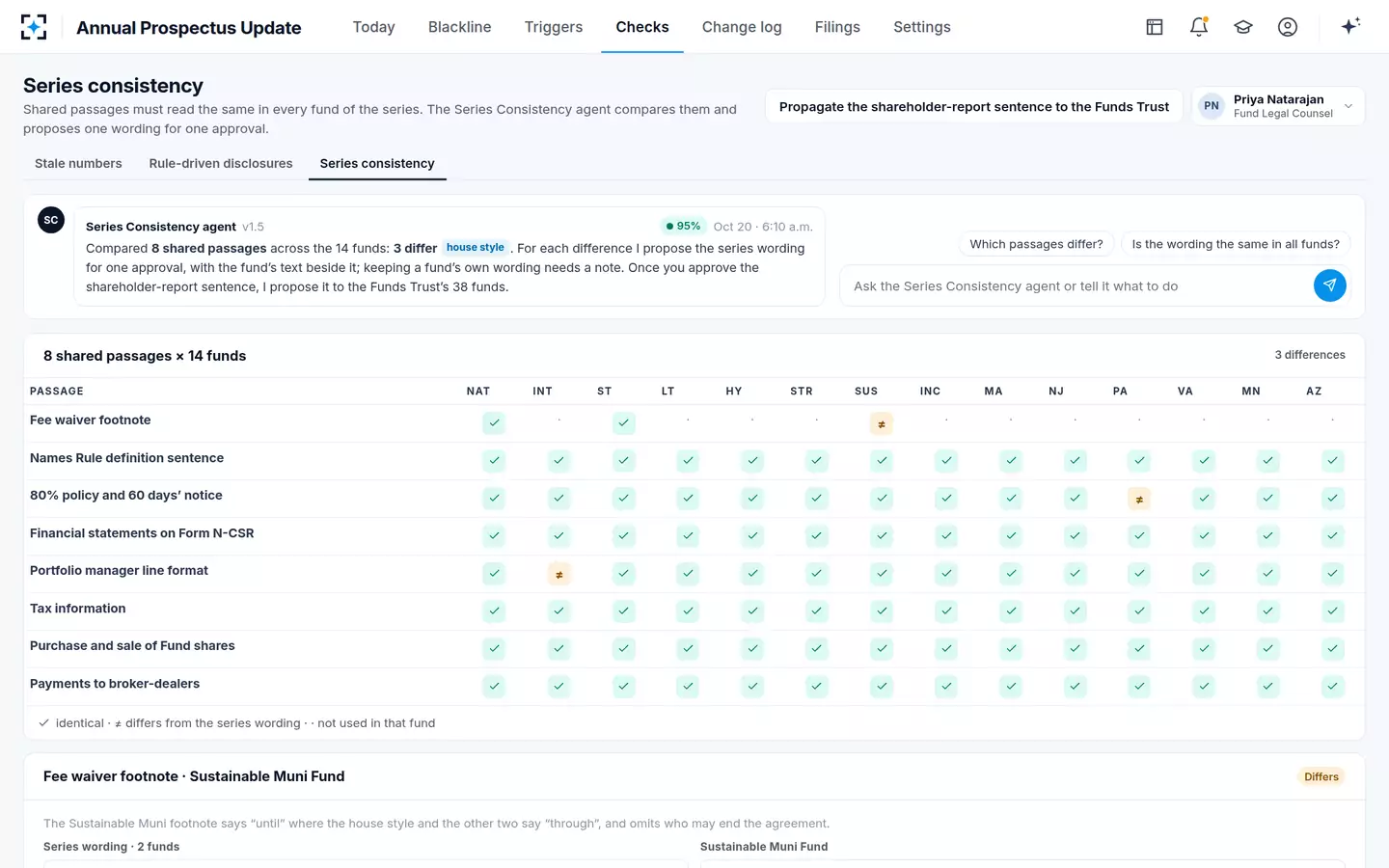
The overnight check then reads every number in all three documents against its newest signed-off source, so a fee table that was right in the statutory prospectus but stale in one summary prospectus is caught before the 497(k) filing. In the sample cycle that check read 3,184 numbers across a 204-page prospectus, fourteen summary prospectuses and a 148-page SAI. After effectiveness, the assembling agent files the summary prospectuses under Rule 497(k) and posts the documents online; people approve every change and only the Chief Legal Officer signs. The same overnight check explains why a blackline comparison on its own is not enough.
Questions people ask
Is a summary prospectus a legal prospectus?
Yes. A summary prospectus that complies with Rule 498(b) is deemed a prospectus authorized under Section 10(b) of the Securities Act. Sending it satisfies the obligation to deliver the statutory prospectus only if the conditions of Rule 498, including the website posting, are met.
What are the summary prospectus requirements under Rule 498?
It must give the Items 2 to 8 information of Form N-1A for one fund, and only that, in the form's order, with a cover carrying the fund's name, classes, tickers, date and a fixed legend. The statutory prospectus, SAI and shareholder reports must be online, free, for at least 90 days after delivery, and paper copies must go out within three business days of a request.
Must the statement of additional information be delivered to investors?
No. The SAI is part of the registration statement but is sent only on request, free of charge; the prospectus back cover must say how to get it, and a fund relying on Rule 498 must post it online. Form N-1A asks that it be available at the same time as the prospectus.
Can one summary prospectus cover several funds?
No. Rule 498(b)(4) says a summary prospectus "may describe only one Fund, but may describe more than one Class of a Fund". A statutory prospectus may cover many funds, but it must present each fund's Items 2 to 8 together before moving to the next.
How is a summary prospectus filed with the SEC?
Each definitive summary prospectus is filed under Rule 497(k) no later than the date it is first used, which shows on EDGAR as form type 497K. By our count of the SEC's indexes, there were 21,562 such filings in 2025.
Why do funds use a summary prospectus at all?
Because it lets them meet the delivery obligation with a few pages for one fund instead of a long multi-fund book. The SEC estimated in 2024 that about 11,241 funds use one, and that complying with the cover and website conditions takes about 1.5 hours per fund a year.