A blackline comparison is a document that shows every difference between two versions of the same text, with deleted words struck through and inserted words underlined or coloured, so a reviewer can read only what changed. Fund lawyers use it to review the annual prospectus update: last year's filed prospectus on one side, this year's draft on the other. The limit is built into the method. A blackline compares two versions with each other, not with the facts, so a number that should have changed and did not leaves no mark at all. Botminds' Annual Prospectus Update keeps the blackline, with every edit numbered to the reason it was made, and adds an overnight check of every number in the prospectus, summary prospectuses and SAI against its newest signed-off source.
A blackline answers one question: what is different from last year
What a blackline shows: Every number someone edited, old value struck, new value underlined.
What it cannot show: Whether the new value is the right one, or came from a preliminary close.
What a blackline shows: Nothing: no mark means no difference from last year.
What it cannot show: A return, turnover rate or holder table that should have rolled forward and did not.
What a blackline shows: Nothing beyond the text itself.
What it cannot show: The board resolution, rule or notice behind the edit, and whether it was approved.
What a blackline shows: Only the two versions being compared.
What it cannot show: Whether the summary prospectus and SAI say the same thing as the statutory prospectus.
What a blackline shows: The size of the change, by how much is marked.
What it cannot show: Whether the change fits a purpose in Rule 485(b), which turns on what changed, not on how many words.
What is a blackline comparison?
A blackline is the output of a document comparison: one document that shows the earlier version and the later version at once, with each deletion and insertion marked. Word processors and dedicated comparison programs produce them from two files, Word to Word or PDF to PDF. Lawyers ask for "a blackline against the last filing" because it lets a reviewer skip the hundreds of pages that did not change and spend their time on those that did.
In a fund's annual update the blackline does a lot of work. The fee table shows last year's other expenses struck and this year's underlined; the expense example rolls forward; a waiver footnote shows the old expiry date struck through and the new one inserted. Each marked change becomes a question for counsel: where did this come from, and is it right? A good blackline answers that question for the marks it makes. It cannot answer it for the marks it does not make.
Blackline and redline: is there a difference?
Often the two words mean the same thing: a marked comparison of two versions. Some teams keep "redline" for changes tracked as they are typed in a word processor, and "blackline" for a comparison generated afterwards from two clean files. The distinction matters in one way. Tracked changes show only what the editors chose to record; a generated comparison shows every difference between the files, including edits made with tracking off. For a filing, the generated comparison is the one to trust.
What the securities rules ask a marked copy to show
The rules ask for a marked copy, and they ask it to show changes. Securities Act Rule 472(a) requires copies of every amendment to a registration statement "marked to indicate clearly and precisely, by underlining or in some other appropriate manner, the changes effected in the registration statement by the amendment" (17 CFR 230.472(a)). On EDGAR, Regulation S-T says the requirement is met by tags around each changed paragraph, and adds: "Financial statements and notes thereto need not be marked for changed material" (17 CFR 232.310).
Both rules assume that the question is what the amendment changed. Neither asks the filer to show what it left alone, because a registration statement is supposed to be current in every part. That second obligation is carried by the people who sign, not by the marked copy, and it is the one the blackline cannot help with.
A blackline compares this year's draft with last year's filing. An investor reads the result as a statement of the facts today.
What a blackline misses: the numbers nobody edited
The errors that survive an annual update are rarely bad edits. They are numbers that were supposed to change through a link, a feed or a routine, and did not. A cell typed over by hand last year no longer updates from the performance system; a sentence copied from a mid-year supplement brings that supplement's figures with it; a table in the SAI is rolled forward with the new date and the old numbers. In the blackline, each of these looks exactly like a passage that was correct and did not need to change.
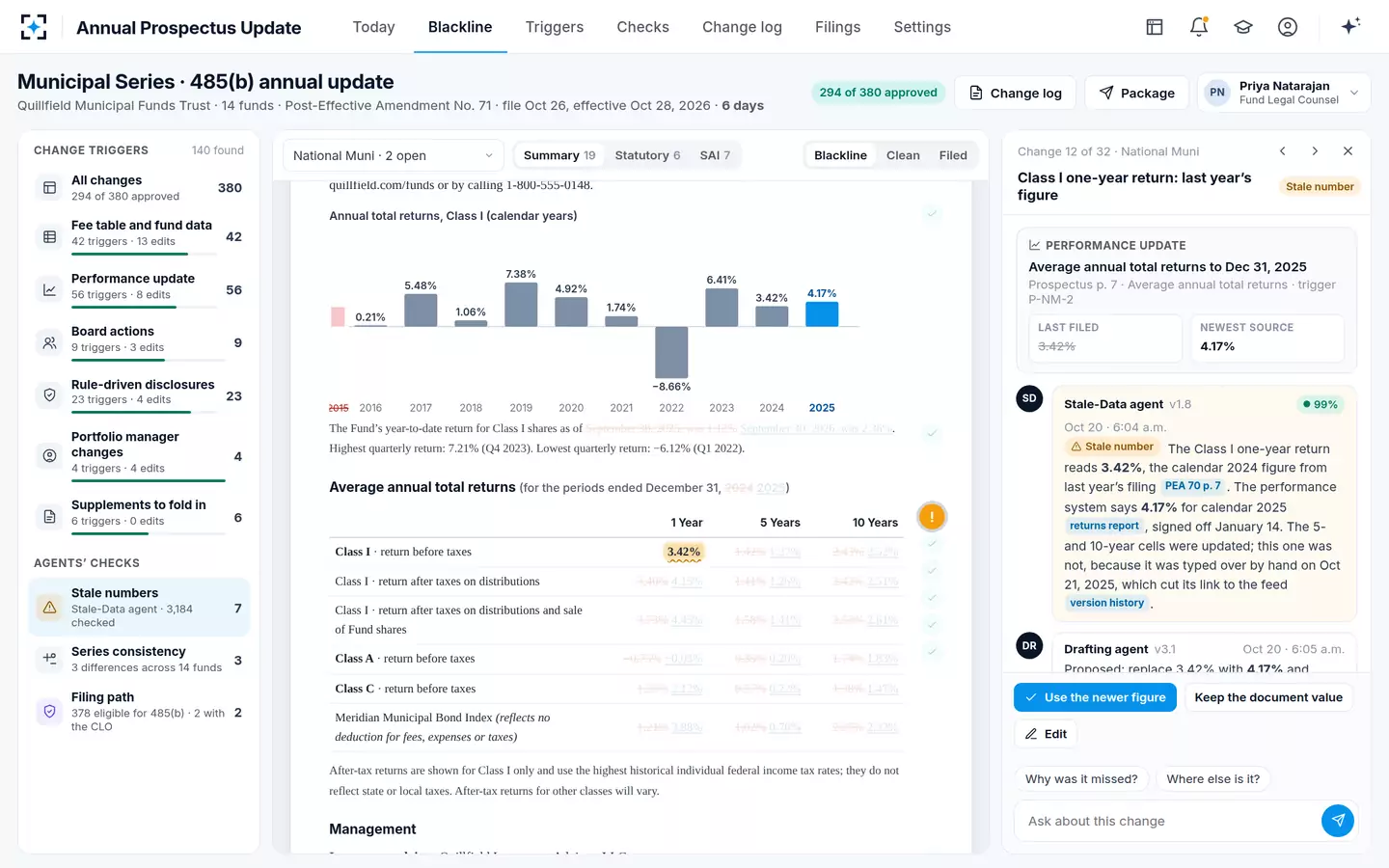
The sample cycle in Annual Prospectus Update shows the pattern (fictional funds and data throughout). The overnight check read 3,184 numbers, dates and counts across a 204-page prospectus, fourteen summary prospectuses and a 148-page SAI. It found 3,174 current, 3 rounding differences for a person to confirm and 7 stale numbers. None of the seven was marked in the blackline, because none had been edited.
One overnight check in Annual Prospectus Update: prospectus, summaries and SAI
3,184
numbers, dates and counts compared with their newest signed-off source
3,174
current: they match their source
7
stale: none of them marked in the blackline
3
rounding differences inside tolerance, each confirmed by a person
Seven stale numbers, and why each one was missed
The reasons matter more than the count, because each one points at a step in the process that can be fixed. The table sets out six of the seven from the sample cycle, with what the document said, what the source said and why the number had not been caught.
Why stale numbers survive a blackline: six cases from one sample cycle
| Where | The document said | The source said | Why it was missed |
|---|---|---|---|
| Class I one-year return, prospectus p. 7 | 3.42%, the calendar 2024 figure | 4.17% for calendar 2025, signed off January 14 | Typed over by hand the year before, which cut its link to the performance feed; the 5- and 10-year cells beside it updated |
| Portfolio turnover, prospectus p. 57 | 31% | 27% for fiscal 2026 | The sentence was carried from a June 12 supplement that still quoted fiscal 2025 |
| Portfolio turnover, SAI p. 41 | 18% | 23% for fiscal 2026 | The fiscal 2026 column repeated the fiscal 2025 rate |
| Principal holders, SAI p. 112 | As of September 30, 2025 | As of September 30, 2026 | Last year’s holder table and date; two holders had crossed 5% since |
| Advisory fees paid | $6,874,118 | $6,912,404 at the final close | Taken from the preliminary July close |
| Portfolios overseen by each trustee | 112 | 116 | A count that grows with the complex and lives in no feed |
A stale return the blackline did not mark: 3.42% where the source says 4.17%
How do you measure prospectus accuracy? Four measures beyond the blackline
Accuracy in a prospectus update can be measured, and the measures are simple once every number has a source. The four below are the ones we would ask any team, or any tool, to report for each registration statement before signing. Each is a ratio with a definition a reviewer can recompute, and each catches something the others do not.
Four measures of an accurate annual update
Coverage
What share of the numbers was compared with a source?
Numbers checked ÷ numbers in the documents
3,184 of 3,184 in the sample
Stale rate
How many were out of date when checked?
Stale numbers ÷ numbers checked
7 of 3,184, about 0.2%; the target at filing is 0
Consistency
Does each fact read the same everywhere it appears?
Passages that differ ÷ shared passages, across documents and funds
3 differences in 8 passages across 14 funds
Traceability
Can each change be traced to a reason and a source?
Changes with a cited trigger and source ÷ all changes
380 of 380 changes cited
Coverage is the measure most teams cannot report today, because a person checks the numbers she changed and samples the rest. Stale rate is only meaningful with full coverage: 7 stale numbers in a sample of 300 tells you about a rate; 7 in all 3,184 tells you which seven to fix. Consistency has a rule behind it: Rule 498(f)(4) requires the Items 2 to 8 information in each summary prospectus to "be the same as" the statutory prospectus's (17 CFR 230.498), and shared passages across the funds of a series should read alike unless a difference is deliberate. Traceability is what turns a correct change into a defensible one.
How do you check a prospectus for stale numbers?
Start from the sources, not from the document. A check that reads the prospectus and asks "does this look right?" will pass a plausible stale number; a check that takes each number, finds the system it should come from and compares the two will not. The list below is the method, whether people or agents run it.
Checking a prospectus, summaries and SAI for stale numbers
- List every number, date and count
Not just the tables: ages, start years, the number of portfolios a trustee oversees, dates in footnotes.
- Name each one’s source
Fund accounting, the performance system, the transfer agent, the board minutes, the roster. A number with no source is a risk on its own.
- Compare with the newest signed-off value
Signed off, not preliminary: advisory fees from the final close, returns after sign-off.
- Check the ones nobody edited
An unchanged number in a section that should roll forward each year is a candidate, not a pass.
- Set a rounding tolerance and confirm each case
Small differences from rounding are real but need a person to say so.
- Record why each stale one was missed
A typed-over cell, a supplement’s text, a repeated column: each reason fixes next year’s process.
Fees and waivers first: what an accurate update protects
Not all stale numbers are equal, and the SEC has said where it will look first. Its fiscal 2027 examination priorities name fund fees and expenses, with any related waivers or reimbursements, as the first of two areas of particular focus in fund examinations, and list summary prospectuses among the filings examiners assess (SEC, Fiscal Year 2027 Examination Priorities). The same fee data flows into the shareholder report's cost table, which our colleagues work through in the $10,000 expense example guide.
The fee table has its own date test. Form N-1A lets the table show a fee waiver only while at least a year of it remains from the effective date (Form N-1A, Item 3, Instruction 3(e)). A waiver whose expiry date was right last year and was not extended this year passes the blackline unmarked and fails the form. That is a stale date, not a stale number, and it belongs in the same check.
The blackline and the overnight check together in Annual Prospectus Update
Annual Prospectus Update keeps the blackline as the reviewer's main view and adds what it lacks. Each marked edit carries a numbered marker tied to the trigger behind it, such as a board resolution or a fund accounting close, and the source opens on the passage the agent used. A rail counts the triggers by kind, so counsel can see that 42 fee table and fund data triggers produced the edits in the fee tables. Counsel can ask about any change in its own thread and the agents answer with citations.
Every edit numbered to its trigger, with the agents’ checks beside it
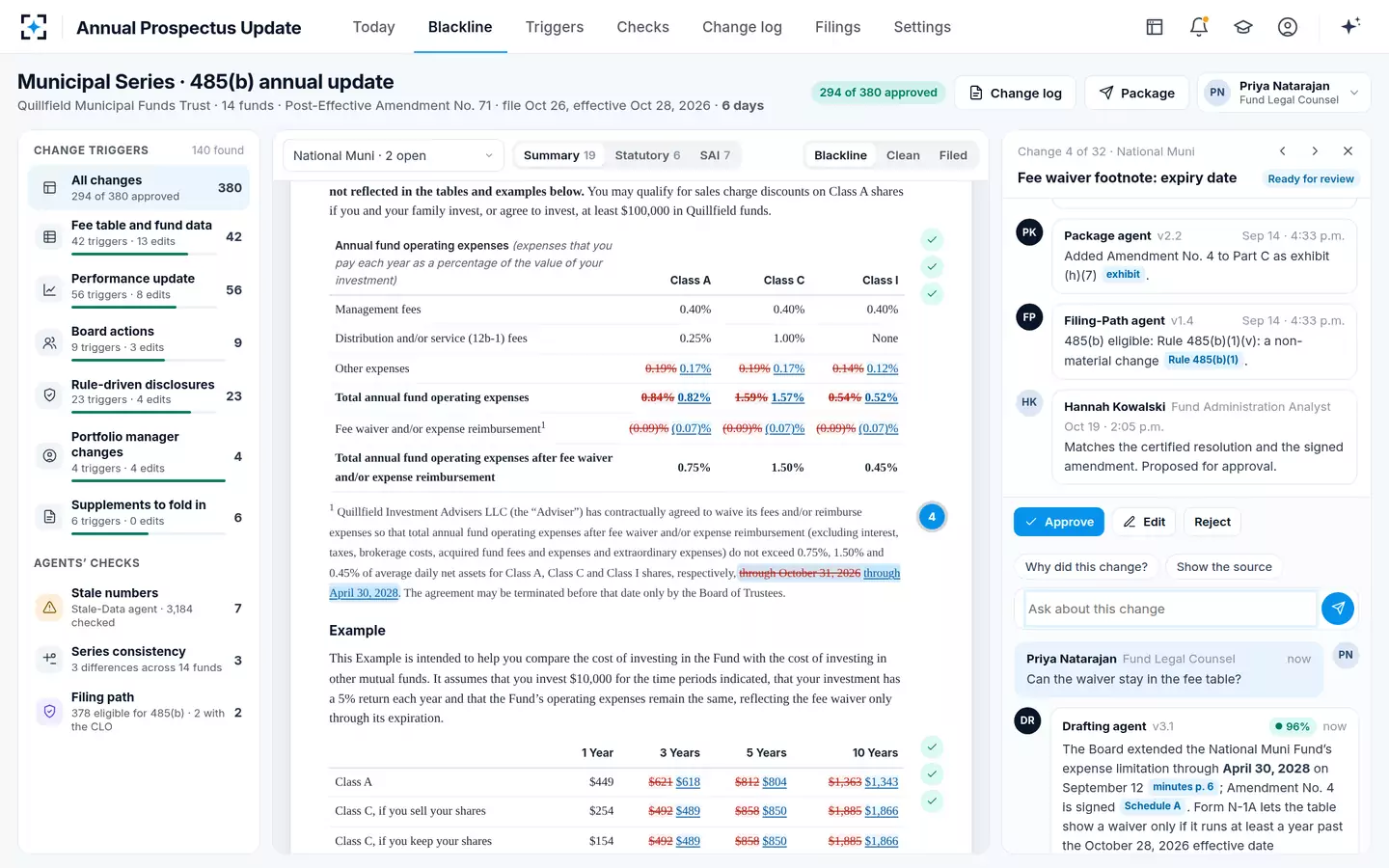
The Stale-Data agent runs the check every night and never edits the document or clears its own flag. Each stale number comes with the newest figure, the source and the reason it was missed; the Drafting agent proposes the fix, and a person decides each one with a reason code. The Series Consistency agent compares shared passages across the fourteen funds. The design target is zero stale numbers in the filed prospectus, a target and not a measured result. How a single change moves through those agents is traced in one update, step by step, and how the long and short forms are kept alike is in statutory vs summary prospectus.
Questions people ask
What is the difference between a blackline and a redline?
Usually none: both are marked comparisons showing deletions and insertions. Where teams distinguish them, a redline is changes tracked while editing and a blackline is a comparison generated afterwards from two clean files, which also catches edits made with tracking turned off.
Can you run a blackline comparison on PDF files?
Yes. Comparison programs work on PDFs as well as word-processing files, though tables and multi-column layouts can compare less cleanly in PDF. For a prospectus, comparing the source files usually gives a cleaner result than comparing typeset proofs.
Does the SEC require a blackline with an amendment?
Securities Act Rule 472(a) requires marked copies of an amendment showing "the changes effected in the registration statement by the amendment". On EDGAR, Regulation S-T Rule 310 is satisfied by tagging each changed paragraph, and financial statements need not be marked.
What is a stale number in a prospectus?
A number, date or count that was current at the last filing and is no longer current on the new effective date: last year's return, last year's turnover rate, a holder table with last year's date. It is usually a number nobody edited, so it leaves no mark in a blackline.
How many numbers are in a fund prospectus and SAI?
It depends on the series, but thousands. In the sample cycle in Annual Prospectus Update, one series of fourteen funds had 3,184 numbers, dates and counts across a 204-page prospectus, fourteen summary prospectuses and a 148-page SAI (fictional data).
What should an accurate annual update report before it is signed?
Four measures: coverage, the share of numbers compared with a source; the stale rate among them; consistency across documents and funds; and traceability, the share of changes with a cited reason and source. A blackline reports none of the four.