485APOS and 485BPOS are the EDGAR form types for the two kinds of post-effective amendment a mutual fund files under Rule 485. A 485APOS is filed under Rule 485(a): it becomes effective sixty days after filing, or seventy-five days if it adds a new series, which gives the SEC staff time to review it. A 485BPOS is filed under Rule 485(b): it becomes effective on filing, or on a date the fund picks up to thirty days later, but only if it is filed for no purpose other than those the rule lists, such as bringing the financial statements up to date or making non-material changes. The choice is made change by change, because one ineligible change makes the whole amendment ineligible, and counsel who prepared or reviewed it must represent in writing that it qualifies. Botminds' Annual Prospectus Update runs that test on every change as it is drafted, so the question is answered weeks before the representation is signed.
The 485(b) test, one change at a time
1Is the change only bringing the financial statements up to date under Section 10(a)(3)?
Yes 485(b)(1)(i)
No Next question
2Is it only disclosing or updating portfolio manager information under Item 5(b) or 10(a)(2)?
Yes 485(b)(1)(iv)
No Next question
3Is it only moving the effective date of a pending 485(a) amendment, by no more than 30 days?
Yes 485(b)(1)(iii), the 485BXT
No Next question
4Is it a change the registrant deems non-material?
Yes 485(b)(1)(v)
No Rule 485(a): 60 days, or 75 for a new series
485APOS vs 485BPOS: what each path allows
Rule 485(a) is the default. A post-effective amendment by an open-end fund "shall become effective on the sixtieth day after the filing thereof", or on a later date designated on the facing sheet up to eighty days after filing. An amendment "for the purpose of adding a series shall become effective on the seventy-fifth day", or up to ninety-five days later (17 CFR 230.485(a)). The Commission may declare it effective earlier, and it may suspend the effective date if the amendment "may be incomplete or inaccurate in any material respect". The rule's own note shows how the days are counted: an amendment filed on November 1 becomes effective on December 31.
Rule 485(b) is the exception, with conditions. The amendment becomes effective on filing, or on a later date up to thirty days after filing, if it is filed only for one or more of the listed purposes, the registrant represents that no other material event requiring disclosure has occurred, the facing sheet says the fund proposes to go effective under paragraph (b), and the signature page certifies that it meets the requirements. The annual update fits because the first listed purpose is "Bringing the financial statements up to date under section 10(a)(3)".
Two paths for a post-effective amendment
485APOS · Rule 485(a): 60 days after filing, or a designated date up to 80 days; 75 days for a new series, up to 95.
485BPOS · Rule 485(b): On filing, or a designated date up to 30 days after filing.
485APOS · Rule 485(a): Any change, including material ones: a new objective, a new strategy, a new series.
485BPOS · Rule 485(b): Only the purposes listed in 485(b)(1), such as updated financial statements, portfolio manager updates and non-material changes.
485APOS · Rule 485(a): Before effectiveness; the staff comments and the fund responds.
485BPOS · Rule 485(b): No review before effectiveness; the fund and counsel answer for eligibility.
485APOS · Rule 485(a): The usual signatures for a registration statement amendment.
485BPOS · Rule 485(b): That it meets 485(b), and that no other material event requiring disclosure has occurred since the latest of three dates.
485APOS · Rule 485(a): No paragraph (b) representation.
485BPOS · Rule 485(b): If counsel prepared or reviewed it, a written representation that it contains nothing that would make it ineligible.
What is a 485(b) filing? The listed purposes, read closely
A 485(b) filing is a post-effective amendment filed "for no purpose other than one or more of" seven listed purposes. Four of them do most of the work in a fund's year. The table below sets them beside the changes a filing team typically puts under each. The list is closed: a change that fits none of them, however small it looks, needs Rule 485(a), Commission approval under (vii), or a separate amendment.
The 485(b)(1) purposes, and what usually goes under each
| Paragraph | The rule’s words | Typical changes in an annual update |
|---|---|---|
| (i) | Bringing the financial statements up to date under section 10(a)(3) | The new fee table, expense example, performance, financial highlights and SAI figures |
| (ii) | Complying with an undertaking to file an amendment containing financial statements … within four to six months after the effective date | A new fund’s first financial statements |
| (iii) | A new effective date for a pending 485(a) amendment, set at most thirty days out each time | Moving a pending 485(a) date while staff comments are resolved: the 485BXT |
| (iv) | Disclosing or updating the information required by Item 5(b) or 10(a)(2) of Form N-1A | A new portfolio manager’s name, title, start year and business experience |
| (v) | Making any non-material changes which the registrant deems appropriate | Waiver extensions, wording updates, rule-driven text that does not change what the fund does |
| (vi) | In the case of a separate account registered as a unit investment trust, to make changes in the disclosure … to reflect changes to disclosure in the registration statement of the investment company in which the unit investment trust invests all of its assets | Variable insurance products only |
| (vii) | Any other purpose which the Commission shall approve | Template filing relief: replicating changes the staff has already reviewed |
An amendment filed only for purpose (iii) goes on EDGAR as form type 485BXT, which EDGAR labels "New effective date for post-effective amendment". Purpose (v) carries most of the judgment. The rule leaves materiality to the registrant: "non-material changes which the registrant deems appropriate". A waiver extension that keeps the fee table's net figures where they were, an updated tax paragraph or a renamed share class can sit comfortably there. A new or changed investment objective, a new principal strategy, or a change in the policy behind a fund's name usually cannot, and filing teams keep a list of such changes that always go to the Chief Legal Officer.
What is a 485(a) filing, and when does it become effective?
A 485(a) filing is the amendment that waits for review: it becomes effective on the sixtieth day after filing, or the seventy-fifth for a new series, unless the fund designates a later date, the Commission accelerates it, or the fund files something that interrupts it. Funds use it for material changes and for launches. Our colleagues on Fund Launch Management cover the 75-day path for a new series in their 485(a) guide.
Sequencing a pending 485(a) and the annual update under Rule 485(d)
The interruption rule matters in a busy year. Under Rule 485(d)(1), an amendment that includes a prospectus "shall not become effective under paragraph (a)" if a later post-effective amendment relating to the prospectus is filed before it goes effective, unless the later one is a 485(b) amendment that keeps the original date or designates a new one under (b)(1)(iii). A third amendment filed under 485(a) before the others are effective stops all of them. A fund with a pending 485(a) and an annual update due has to sequence the two.
How many 485(a) amendments funds file, year by year
The count of 485(a) amendments has risen. By our count of the SEC's EDGAR indexes, funds and other registrants filed 970 485APOS amendments in 2023, 1,059 in 2024 and 1,446 in 2025, and 1,365 in the first nine months of 2026 against 969 in the same months of 2025. Every one of them is sixty or seventy-five days in which the staff can comment.
485(a) amendments on EDGAR have risen by half in two years
The representation counsel gives under Rule 485(b)(4)
Rule 485(b)(4) turns the filing-path test into a signed statement. The registrant's representations "shall be made by certification on the signature page", and "If counsel prepared or reviewed the post-effective amendment filed under paragraph (b) of this section, counsel shall furnish to the Commission at the time the amendment is filed a written representation that the amendment does not contain disclosures that would render it ineligible to become effective under paragraph (b) of this section" (17 CFR 230.485(b)(4)).
That representation covers the whole amendment, but it is built from hundreds of small judgments. In the sample Municipal Series update in Annual Prospectus Update (fictional funds and data), the amendment carried 380 changes. Counsel signing at the end of the cycle is signing for each of them, including those drafted by an analyst in August and never discussed. The safe way to give the representation is to have tested every change as it was drafted and to have the result, and the reason, written down beside it.
The cost of a mistake is the path itself. Rule 485(c)(2) lets the Commission suspend a registrant's ability to file under paragraph (b) "if it appears to the Commission that a registrant which files a post-effective amendment under paragraph (b) of this section has not complied with the conditions of that paragraph". A suspension applies to every later 485(b) amendment until it is lifted, so the registrant would file its routine updates under 485(a), each one waiting sixty days. Rule 485(c)(3) suspends the same ability automatically if a required Interactive Data File is not submitted.
Before counsel gives the 485(b)(4) representation
- Every change has a recorded path
Each change carries the 485(b)(1) paragraph it relies on, and who decided it.
- Purpose (v) decisions have reasons
A change treated as non-material says why, in words a reviewer can test later.
- The always-material list was applied
Objectives, principal strategies, name policies and new principal risks went to the Chief Legal Officer, whatever the drafter thought.
- Events since the last effective date are covered
Every sticker, board action and rule change since the latest of the three dates in 485(b)(2) is either in the amendment or decided not to need disclosure.
- Pending 485(a) amendments are sequenced
Under 485(d), a later amendment can stop a pending 485(a) from going effective.
- The Interactive Data File is ready
Missing Inline XBRL for Items 2 to 4 suspends the 485(b) path automatically under 485(c)(3).
Template filing relief: one 485(a) review for many funds
Purpose (vii), "Any other purpose which the Commission shall approve", is how fund groups avoid filing the same material change under 485(a) for every trust. The SEC staff describes the practice in its accounting and disclosure guidance: "In circumstances in which a fund complex makes substantially identical changes to multiple funds", the registrant can make "a single rule 485(a) filing (a 'Template filing') for staff review", together with a request for relief for the other funds (SEC Division of Investment Management, ADI 2018-02).
The request comes with representations: that the changes in the other filings, the "Replicate filings", are substantially identical to the template, that they incorporate the changes made to resolve staff comments, and that they "will not include any other changes that would otherwise render them ineligible" for 485(b). The staff asks for the request "at least ten calendar days before the date the fund would otherwise be required to file", and a 485(b) amendment relying on it should say so in a cover letter or explanatory note. The guidance is the staff's view, not a rule.
What examiners compare: the disclosure against what the fund does
The filing path is a question about disclosure, and examiners look at the same disclosure from the other side. The SEC's fiscal 2027 examination priorities rank, second among their areas of focus for funds, how portfolios are actually managed and whether that matches what the strategy, the filings and the marketing say (SEC, Fiscal Year 2027 Examination Priorities). A change to what a fund buys that reached the prospectus as a "non-material" wording update is exactly the mismatch that review looks for.
The practical lesson is to decide the path from the change, not from the text. A definition that adds a revenue screen to a sustainability term can be a clarification of what the fund already does, or a narrowing of what it may buy. The words alone do not tell you which; compliance testing does. In the sample cycle, the Chief Compliance Officer's note that compliance testing had applied the screen since July 1 is what the Chief Legal Officer weighed.
How Annual Prospectus Update tests every change under Rule 485(b)
In Annual Prospectus Update the Filing-Path agent tests each change under Rule 485(b)(1) as it is drafted and records the paragraph it relies on. Two settings decide what reaches a person: a confidence threshold, 90% in the sample, below which the Chief Legal Officer decides, and a list of changes that always go to the Chief Legal Officer whatever the confidence, such as a new or changed 80% policy, a change of objective, a new principal risk or a new fund. Both are the fund group's settings, changed only by a new version the Chief Legal Officer approves.
In Annual Prospectus Update, a doubtful definition goes to the Chief Legal Officer
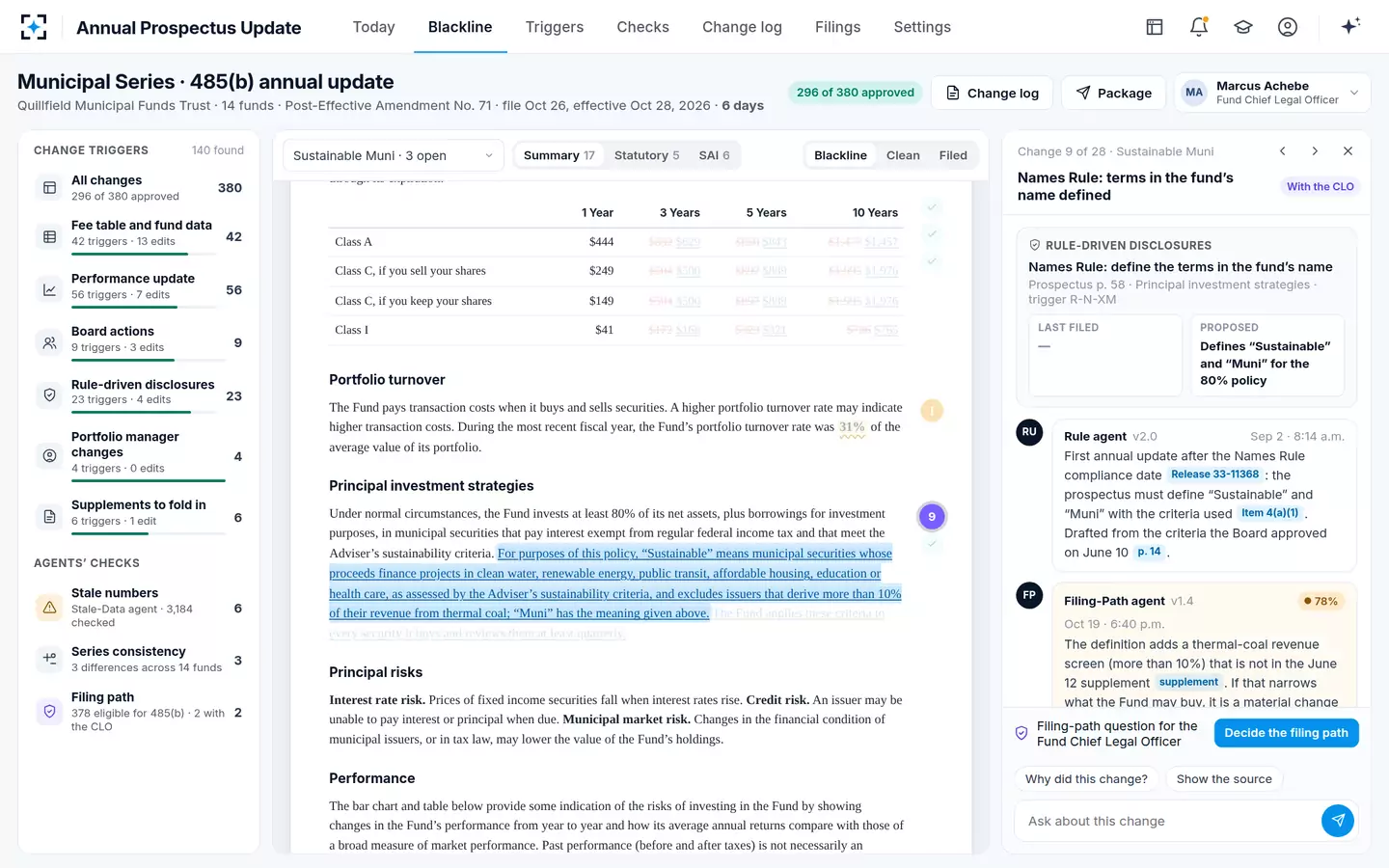
In the sample Municipal Series update, 378 of the 380 changes were tested as eligible under 485(b)(1), and two went to the Chief Legal Officer: the Sustainable Muni Fund's new definition, at 78% confidence, and a fund rename, at 84%. When every change has been decided, the assembling agent drafts counsel's representation from the recorded decisions, and signing opens only then. The agent drafts the words; counsel gives them.
Counsel’s 485(b)(4) representation, drafted from the recorded decisions

A pending 485(a) amendment adds its own calendar, and the 485BXT guide shows how funds move its date while staff comments are answered. How the decisions above are reached, change by change, is traced in one update, step by step.
Questions people ask
What is the difference between 485(a) and 485(b)?
A Rule 485(a) amendment becomes effective sixty days after filing, seventy-five for a new series, and can contain any change. A Rule 485(b) amendment becomes effective on filing or up to thirty days later, but only if it is filed solely for purposes the rule lists and the registrant represents that no other material event requiring disclosure has occurred.
What is Rule 485(b)(1)(iii)?
It is the purpose that lets a fund designate a new effective date for a pending 485(a) amendment that has not yet gone effective. The new date can be no earlier than the one originally designated and no later than thirty days after it. On EDGAR it is filed as form type 485BXT.
Can an annual update be filed under 485(a)?
Yes. If the update also makes a change that does not fit Rule 485(b), such as a new investment objective, the whole amendment is filed under 485(a) and waits sixty days. A fund group can instead make the material change in a separate 485(a) amendment and keep the annual update under 485(b), sequencing the two under Rule 485(d).
Who signs the 485(b) representation?
The registrant certifies on the signature page that the amendment meets the requirements of Rule 485(b). If counsel prepared or reviewed it, counsel also furnishes a written representation that it contains no disclosure that would make it ineligible, filed at the same time as the amendment.
What happens if a 485(b) filing was not eligible?
Rule 485(c)(2) lets the Commission suspend, by written notice, the registrant's ability to file under paragraph (b) if it has not complied with the paragraph's conditions. While the suspension lasts, later amendments must go under 485(a). The registrant may petition for review and ask for a hearing.
Are the SEC staff's comments on a 485(a) amendment public?
Yes, after a delay. Since 2005 the staff has released its review letters and the registrants' responses on EDGAR, and since 2012 it has done so no earlier than 20 business days after completing a review (SEC, 2011). The letters appear as form type UPLOAD and the responses as CORRESP.