A 485a filing is a post-effective amendment to a fund's registration statement filed with the SEC under Rule 485(a), the path for changes that need staff review; filed to add a new series to an existing trust, as a new ETF usually is, it becomes effective on the 75th day after filing, or on a later date the trust designates up to the 95th day, unless the SEC declares it effective sooner. Around that filing sit the steps that make it defensible: the board's approval of the new series and its advisory contract before filing, the answers to staff comments, the final prospectus under Rule 497 and the Form 8-A that registers the shares for listing. Each is a decision someone made and should be able to prove. Botminds' Fund Launch Management drafts the filing sections, tracks the clock and keeps each step's evidence with the launch, while only fund counsel signs a filing.
The dates and screens come from a fictional sample launch in the solution, Quillfield Short Duration Muni ETF in Quillfield ETF Trust; the rules come from the eCFR and SEC forms.
Every registration step as a card: what was decided, by whom, and what proves it
Nov 9
Board approves the series, the advisory contract and fees
- Decides or signs
- Independent trustees, in person
- Evidence
- Minutes; the section 15(c) materials the board considered
- Kept
- 6 years, Rule 31a-2(a)(6)
Dec 3
485(a) amendment adding the series is filed
- Decides or signs
- Fund counsel signs; the filing agent submits
- Evidence
- The filing as submitted; the computed effective date (Feb 16)
- Kept
- With the registration statement
Feb 12
Staff comments answered; 485(b) amendment filed
- Decides or signs
- Fund counsel
- Evidence
- Each comment mapped to the changed sentence and page
- Kept
- With the filing
Feb 16
Amendment effective, 75 days after filing
- Decides or signs
- By operation of Rule 485(a)(2)
- Evidence
- Effective date confirmed against the filing date
- Kept
- With the filing
Mar 12
Final prospectus filed under Rule 497
- Decides or signs
- Fund counsel signs
- Evidence
- The prospectus in the exact form used
- Kept
- With the filing
Mar 15
Form 8-A filed; effective on exchange certification
- Decides or signs
- Fund counsel; the listing agent prepares
- Evidence
- Listing approval and certification
- Kept
- With the filing
What is a 485a filing?
It is a post-effective amendment to an open-end fund's registration statement that does not go effective on filing. Rule 485 gives a registered fund two routes for amending a registration statement that is already effective: paragraph (a), which takes effect automatically after a fixed period so the SEC staff can review it, and paragraph (b), effective on filing, which is available only for a list of limited purposes such as updating financial statements and making non-material changes (17 CFR 230.485). On EDGAR the first shows as form type 485APOS and the second as 485BPOS.
Adding a series is a paragraph (a) event with its own clock. A material change to an existing fund under Rule 485(a)(1) goes effective on the 60th day, or a designated later date no more than 80 days out; an amendment adding a series under Rule 485(a)(2) goes effective on the 75th day, or a designated later date no more than 95 days out. The choice between the (a) and (b) paths for an existing fund's annual update is a separate question, which 485APOS vs 485BPOS covers.
The clocks Rule 485 runs on, and the sample's 75 days
- Automatic period60 d
- Latest date the fund may designate+20 d
- Automatic period75 d
- Latest date the fund may designate+20 d
- Filing to comment responses71 d
- Responses to effective date4 d
How long does the SEC take to review a new fund?
For a new series of an existing trust, the review fits inside 75 days, because the amendment goes effective on the 75th day after filing whether or not anyone has acted. Staff comments, if any, arrive and are answered within that window, and the changes go into a further amendment before the effective date. In the sample, counsel filed the responses with a 485(b) amendment on February 12, four days before the amendment went effective.
Two things can change the date. The fund can designate a later date on the facing sheet, up to the 95th day, or later push a pending date by filing a 485(b) amendment that does nothing but designate a new one, no more than 30 days after the date it replaces; on EDGAR those show as form type 485BXT. And the SEC can move it earlier: under Rule 485(a)(3) the Commission, "having due regard to the public interest and the protection of investors, may declare an amendment filed under this paragraph (a) effective on an earlier date" (Rule 485(a)(3)).
A sponsor with no existing trust has a different, open-ended clock. Its first registration statement on Form N-1A goes effective under section 8 of the Securities Act, after the staff's review, rather than automatically under Rule 485. The SEC estimates the form at 297.7 burden hours per response (SEC Form N-1A), which is why most new ETFs are born as series of trusts that already have one.
Can the SEC accelerate a 485a filing?
Yes, under Rule 485(a)(3), when the Commission considers it consistent with the public interest and investor protection. Acceleration is the Commission's decision, not the registrant's, so a launch plan that depends on it has a dependency nobody inside the firm controls. The safer plan takes the 75th day as the date and treats anything earlier as float.
Delay is the registrant's decision. A 485(b) amendment designating a new effective date is cheap to file and common, and it is the tool to use when an outside step, a custodian, a lead market maker or a listing, cannot be ready. What it must not become is a substitute for knowing why the date moved, which is what the evidence file is for.
What the board approves before the 485a is filed
The prospectus describes contracts, so the contracts come first. The board approves the new series and, under section 15(c), the advisory contract, which needs the votes of a majority of the independent directors, cast in person at a meeting held for that vote (15 U.S.C. 80a-15(c)), along with fees, any expense limitation and the service agreements. In the sample the board met on November 9 and the filing went in on December 3.
The evidence for that meeting has a retention rule of its own. Rule 31a-2(a)(6) requires the fund to keep the documents and other written information the directors considered under section 15(c) in approving a contract for at least six years, the first two in an easily accessible place (17 CFR 270.31a-2). For a launch, that is the request letter, the adviser's responses and the fee and expense materials, kept as the board saw them, not as they were later revised.
Staff comments, responses and the 485(b) that closes them
Staff comments can reach any part of a new series' prospectus, and each response is a change to a sentence the fund will live with. The defensible version maps every comment to the sentence it changed and the page it is on, so a reviewer a year later can see why the prospectus says what it says.
Fund Launch Management: a drafted section beside the SEC comment it answers
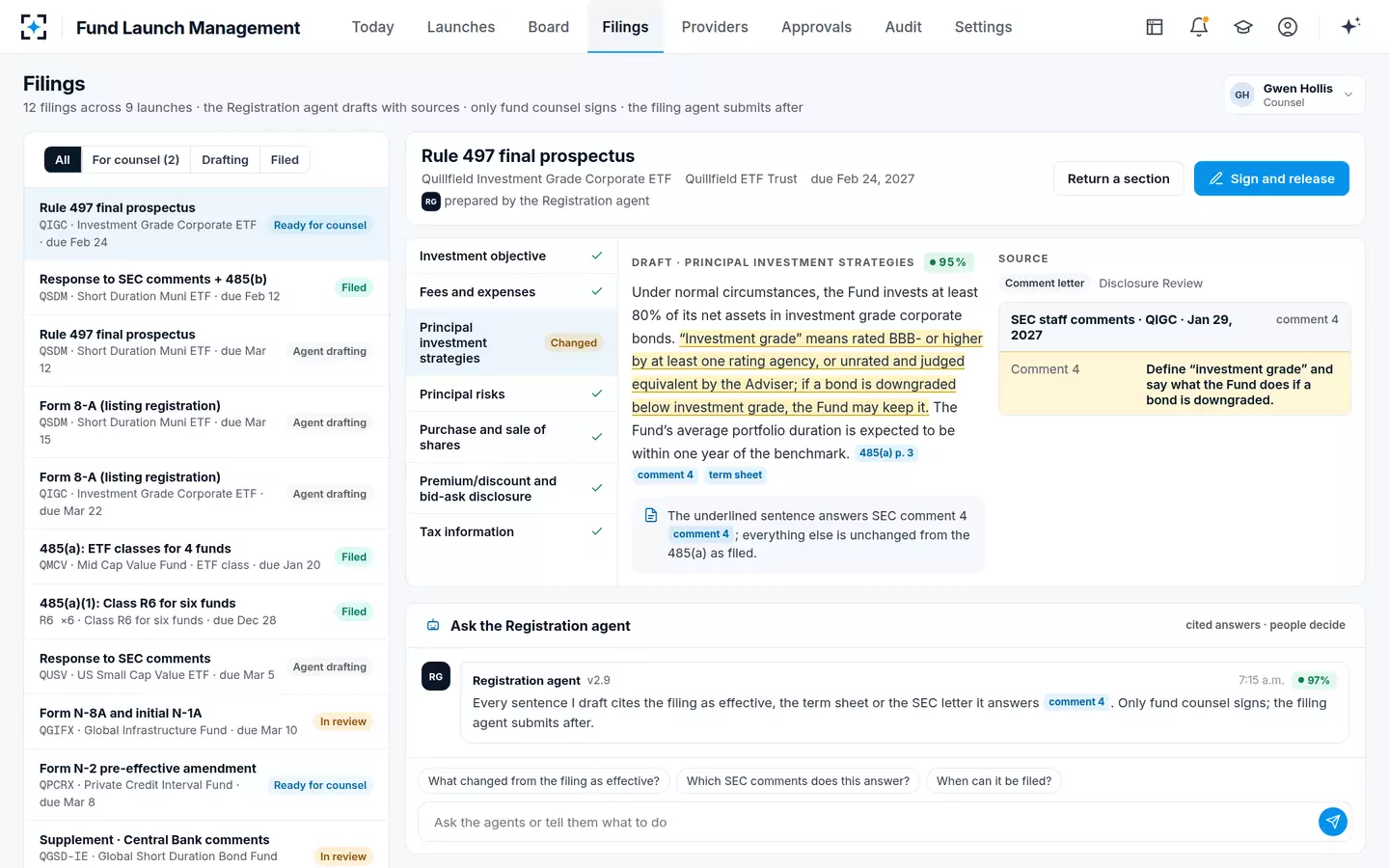
In the sample, the Registration agent drafts each section from the filing as effective and the term sheet, cites every changed sentence to its source, and maps each SEC comment to its response and page. It never files; only fund counsel signs a filing, and the filing agent submits after. That split is the evidence: who drafted, what changed, which comment it answers, who signed.
After effectiveness: the 497 prospectus, Form 8-A and the website
Effectiveness is not the end of the filings. Within five days after the effective date or the start of the public offering, whichever is later, the fund files its prospectus and statement of additional information under Rule 497(c) "in the exact form in which it was used" (17 CFR 230.497). The sample filed its final prospectus on March 12 for a first NAV on March 16.
The shares are registered for exchange trading on Form 8-A, which for a class concurrently registered under the Securities Act becomes effective on the latest of its filing, the SEC's receipt of the exchange's certification, and the effectiveness of the Securities Act registration (SEC Form 8-A). And from the first open the fund must meet the Rule 6c-11 website conditions; nothing is filed for those, but they are conditions of the exemption the fund relies on (Rule 6c-11(c)(1)), covered in the Rule 6c-11 website requirements.
The evidence file: every step, who decided, what proves it
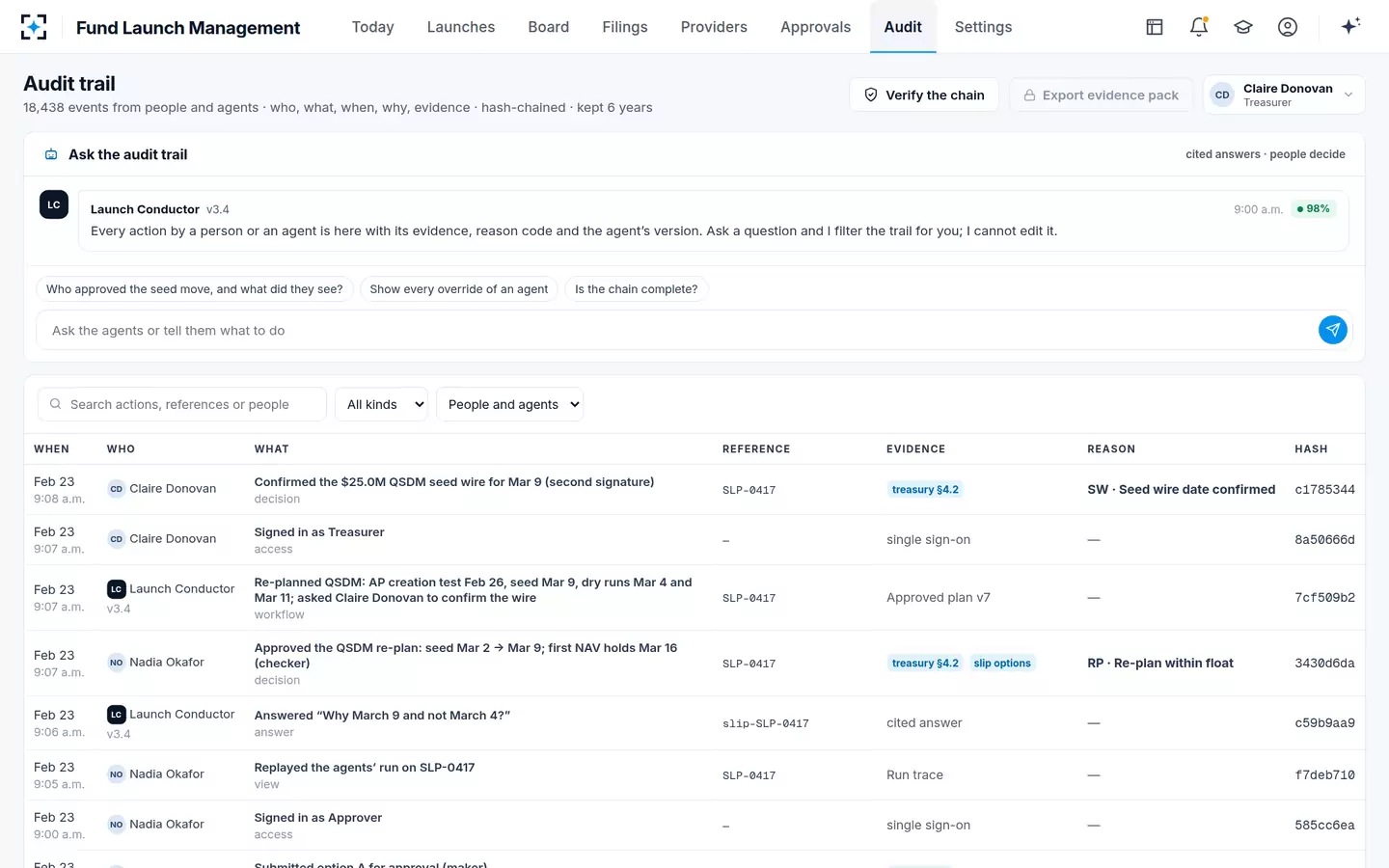
A defensible launch file answers four questions for each step: what was decided, by whom, on what evidence, and when. The SEC staff, the fund's auditors, its board and its own compliance officer may each ask them, at different times and for different reasons, and the answer should not depend on who still has the email.
What a new series' registration file should hold
- Board minutes and the section 15(c) materials
As the board saw them; six years under Rule 31a-2(a)(6).
- The 485(a) as filed, with its accession number and computed effective date
75 days for a new series, or the designated date.
- Every staff comment, its response, and the sentence and page it changed
With who drafted and who approved each response.
- Every date change: 485(b) designations and why
The outside step that forced the delay, with its evidence.
- The final prospectus under Rule 497, in the exact form used
Filed within five days of effectiveness or the offering, whichever is later.
- Form 8-A, the listing approval and the exchange's certification
The Form 8-A is effective only on the latest of the three events.
- Basket policies, authorized participant agreements and the first basket
Rule 6c-11(c)(3) and (d): agreements and basket records for five years.
Fund Launch Management: the audit trail behind the launch file
Form N-2 requirements: when the new fund is closed-end
Form N-2 is the registration form for closed-end funds, including interval funds and business development companies, and it is longer: the SEC estimates 344 burden hours per response, against 297.7 for Form N-1A (SEC Form N-2). Closed-end funds do not use Rule 485(a)(2)'s new-series clock, so a launch plan for an interval fund needs its own registration timeline.
The rules for these funds are also moving. On October 5, 2026 the SEC proposed amendments to the interval fund rule and to "permit regulated closed-end funds to issue multiple share classes, consistent with routine exemptive relief provided to these funds"; comments are due by December 4, 2026, and it is a proposal, not a rule (91 FR 63388). In our count of EDGAR, 187 Form N-2 filings were made in 2025 and 149 in the first nine months of 2026.
How many 485a filings? What EDGAR shows
Filings under Rule 485(a) have risen sharply. In our count of the SEC's EDGAR form indexes, form type 485APOS went from 970 filings in 2023 to 1,446 in 2025, and the first nine months of 2026 already reached 1,365, against 969 in the same months of 2025.
Filings under Rule 485(a), by year
More filings means more comment letters in the staff's queue and more launches competing for the same custodians, exchanges and authorized participants. It does not change the 75-day clock, which runs regardless; it changes how much of the work around the clock is at risk of waiting on someone else. The full ETF launch sequence shows where the 75 days sit among the other steps.
Where Fund Launch Management fits in the registration work
The Registration agent drafts Form N-1A and N-2 sections and comment-response letters from the filing as effective, cites every changed sentence and maps each SEC comment to its response and page. It never files: only fund counsel signs a 485(a), a comment response, a 497 or a Form 8-A, and the filing agent submits after. The Board agent drafts resolutions and the board book with every term cited, and never records a vote; the assistant secretary alone does that.
The Launch Conductor computes the effective date from the filing date and the rule, and treats it as a fixed point the other steps plan around. The design targets are that every plan, filing and seed move is signed by a second person with its evidence, and that no launch misses first NAV because of a dependency nobody saw. A 485(b) date change, if one is ever needed, arrives with the outside step that caused it. For the money side of the same launch, the basket creation process shows how a slip is evidenced and re-planned; the solution is at Fund Launch Management.
Questions people ask
What is the difference between 485APOS and 485BPOS?
485APOS is a post-effective amendment filed under Rule 485(a), which goes effective automatically after 60 days, or 75 for a new series, so the staff can review it. 485BPOS is filed under Rule 485(b) and is effective on filing, but only for limited purposes such as updating financial statements or non-material changes.
Does every new ETF need a 485a filing?
A new series of an existing open-end trust is added by a 485(a) amendment under Rule 485(a)(2). A sponsor launching its first fund in a new trust files an initial registration statement on Form N-1A instead, which follows a different effectiveness process.
What is a 485BXT filing?
It is a Rule 485(b) amendment filed only to designate a new effective date for a pending 485(a) amendment, no more than 30 days after the date it replaces. Funds use it when they need more time before the amendment goes effective.
When must the final prospectus be filed after a 485a goes effective?
Under Rule 497(c), within five days after the effective date or the commencement of the public offering, whichever is later, in the exact form in which it was used.
What is Form N-2?
The SEC's registration form for closed-end funds, including interval funds and business development companies. The SEC estimates 344 burden hours per response, and a proposal of October 5, 2026 would let these funds issue multiple share classes without individual exemptive relief.