Fund launch services are outside teams that run some or all of a fund launch for a sponsor: a white-label trust that supplies the board, compliance program and providers, an administrator's or custodian's launch team, counsel that runs the registration, or a project manager who keeps the tracker. Agents are a different purchase: they add capacity inside the sponsor's own process, planning the critical path, drafting, chasing and checking, while the sponsor's people decide. Either way, what a launch runs on comes from the sponsor: its term sheet, its playbooks, its board precedents, its prior filings, its security master, its provider contacts and its treasury's seed policy. Botminds' Fund Launch Management is the agent route, and it starts from exactly that inventory, so the first question for any buyer is what you already have and who holds it.
The examples come from a fictional sample sponsor in the solution, with 24 launches in flight. The rules cited are the SEC's, linked where they appear.
Half of what a launch runs on is documents your team already keeps
The eight inputs, by who holds them
- Product development · 25%
- Counsel and the secretary · 25%
- Fund operations · 25%
- Launch project managers · 13%
- Treasury · 12%
The same inputs, by where they live today
- Documents and libraries · 50%
- Systems of record · 25%
- The launch mailbox · 13%
- Policies and calendars · 12%
Fund launch services or agents: what is the difference?
A fund launch service takes work off the sponsor's desk by doing it with its own people and, often, its own structure; agents take work off the desk by doing the coordination and drafting inside the sponsor's structure. The first changes who does the work; the second changes how much of it people have to do.
What each buys, and what stays with you
Outside launch services: People and, on a white-label trust, a ready board, compliance program and providers
Agents in your own process: Capacity: plans, drafts, chasers, reconciliations and checks, each cited to its source
Outside launch services: Shared: the provider's process sets much of the order and pace
Agents in your own process: Your people: launch PMs propose, the Head of Product approves, counsel signs, the treasurer co-signs
Outside launch services: Term sheet, investment team, seed, and answers to the provider's questionnaires
Agents in your own process: The same, plus your playbooks, precedents, filings, masters and mailbox, connected
Outside launch services: Partly in the provider's systems
Agents in your own process: In your own audit trail, kept six years
Outside launch services: Your investment team and your accountability as adviser
Agents in your own process: Counsel, the board, the compliance officer, the administrator, the custodian
The two often combine. A sponsor whose first fund sits on a platform still owns its term sheet, its seed, its portfolio manager's basket and its market makers, and still has to know which of the platform's dates its own steps feed. The cost side of that choice is worked through in white label ETF cost; this page is about the inputs, which do not change with the route.
What do you need to launch a fund? The legal minimum, then the inputs
Legally, a US registered fund needs an investment adviser under a written contract its board approves, a board with the independence the statute requires, a registration statement, and service providers to hold, value and record its assets and shares. A new ETF series in an existing trust adds a Rule 485(a) amendment, effective 75 days after filing (Rule 485(a)(2)), basket policies under Rule 6c-11 and the website disclosures the rule requires.
Operationally, it needs eight kinds of input, and the inventory below lists them with who holds each, what the agents do with it, and what stays a person's decision. Every one of them exists at a sponsor that has launched before; the question is whether it is findable, current and in one place.
The input inventory: what you bring, who holds it, what agents do with it
Product committee decision and term sheet
Held byHead of Product
Agents use it toBuilds the critical path and drafts board terms from it
You decideThe fund: strategy, fee, cap, seed, target first NAV
Launch playbooks per fund type
Held byProduct development
Agents use it toTurns each into steps with owners, durations and what each blocks
You decideWhich steps, in what order, with what float
Board portal, minutes and precedent library
Held byAssistant secretary, counsel
Agents use it toDrafts resolutions and the board book, every term cited
You decideEvery vote; the assistant secretary records it
Prior filings and SEC comment letters
Held byFund counsel
Agents use it toDrafts sections and responses from the filing as effective
You decideEvery filing; only counsel signs
Security master, product master, order system
Held byFund operations
Agents use it toBuilds basket files; reconciles reject files line by line
You decideBasket composition; cash in lieu
Custodian, administrator and pricing files
Held byFund operations
Agents use it toRuns test files; checks pricing coverage and NAV dry runs
You decideGo-live, on the Readiness agent's evidence
Provider contacts, emails and service levels
Held byLaunch project managers
Agents use it toChases from the launch mailbox; reads replies in any language
You decideTerms and fees; escalations
Treasury seed policy and exchange calendars
Held byFund treasurer
Agents use it toComputes seed dates and what a slip does to them
You decideEvery seed movement, with a second signature
Fund launch checklist: the playbook is the input that matters most
A fund launch checklist becomes a plan only when each item knows what it blocks. The playbook is where a sponsor writes that down once per fund type: the steps, their owners, their usual durations and their dependencies. In the solution, the playbook types are a series-trust ETF, an ETF share class, a new share class, a standalone mutual fund, a UCITS sub-fund and an interval or tender-offer fund, and the Launch Conductor builds each launch's critical path from the fund type and the target first NAV.
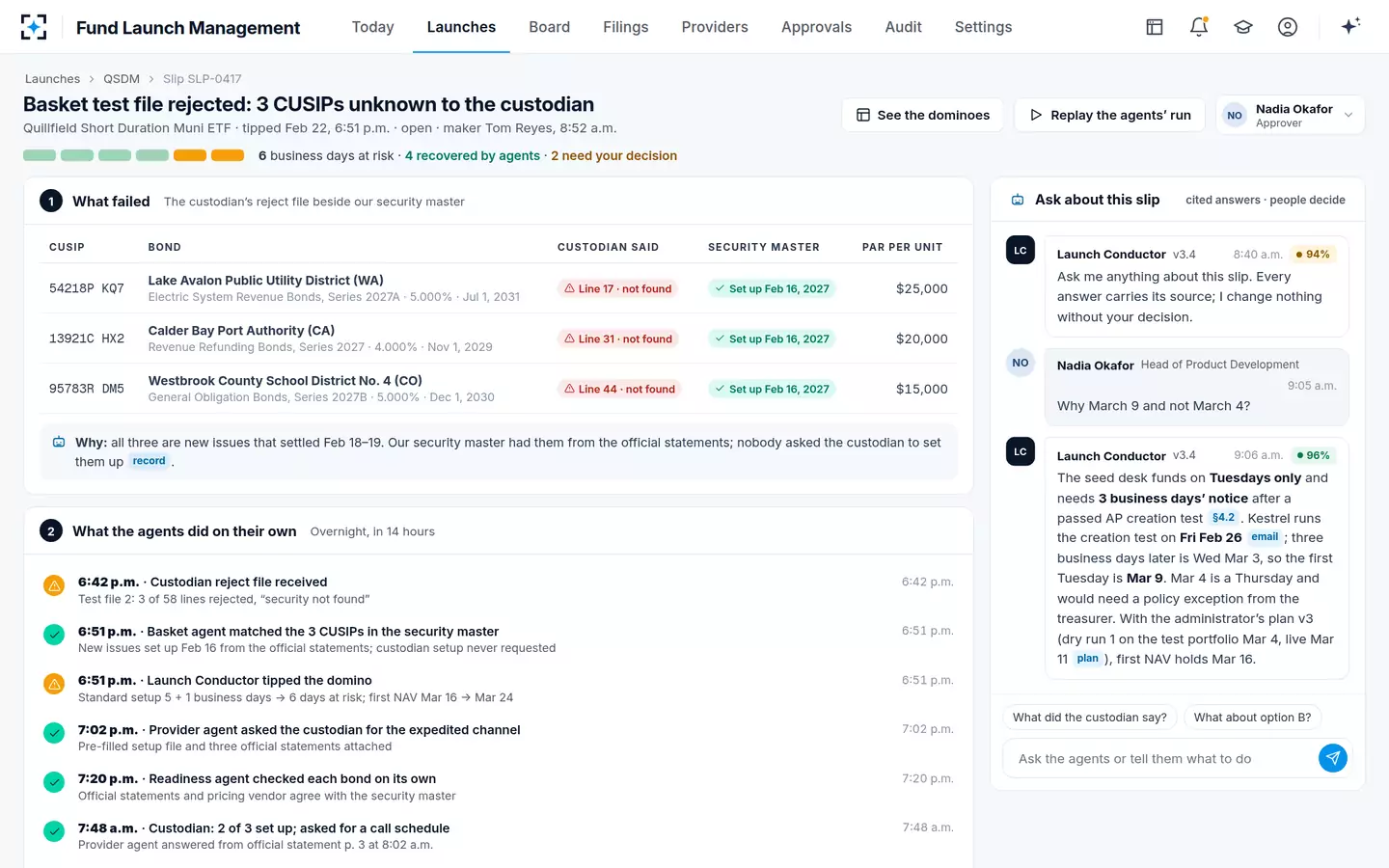
Most sponsors already have the content in old trackers, even if not as a playbook. Bringing three or four past launch trackers lets the first playbook start from what actually happened, including the durations that ran long. The sample sponsor's playbook carried a three-business-day custodian setup for new-issue municipal bonds until a launch proved it too short; the Launch Conductor proposed six, and the change went to the Head of Product for approval like any other setting.
What should a product launch tracker template show?
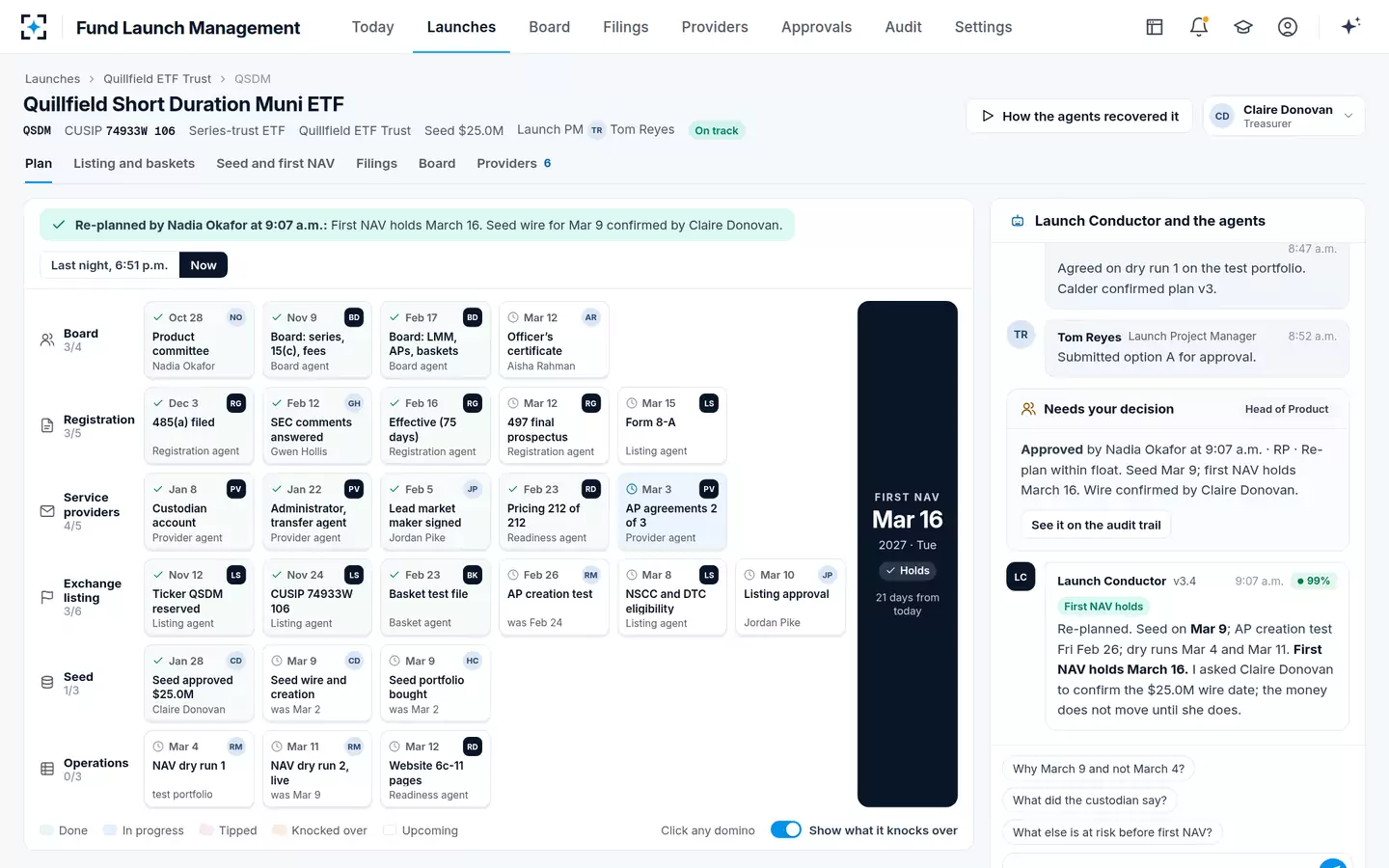
A launch tracker should show, for every step, its owner, its date, its evidence and every later step it would move if it slipped. Most trackers show the first two. The sample sponsor's problem in one line: the tracker knew a basket test was amber, and it did not know that amber blocks the authorized participant's creation test, the seed wire and first NAV.
What a launch tracker needs, beyond status
- Dependencies, not just dates
Each step names the steps that cannot start until it finishes.
- Days at risk, computed
In business days, against the target first NAV, whenever a step slips by more than a set threshold (one business day in the sample).
- An owner who is a person or a named agent
With the outside party behind it and its service level.
- Evidence on the step
The reply, the file, the minute or the filing that proves it is done.
- A decision record for every re-plan
Who proposed, who approved, the reason code, and the evidence they saw.
- A freeze before first NAV
Inside five business days of first NAV in the sample, only the Head of Product moves a date.
Fund Launch Management: asking the agents why, and getting a cited answer
The settings you decide in the first month
Beyond the inputs, a sponsor decides how the controls work. In the solution these are settings, each changed by a change request the Head of Product approves and each versioned. They are the questions an outside service would otherwise answer for you, and they are worth answering deliberately.
The sample's choices give a starting point: tip a step when its forecast slips by one business day; agents ask a person when their confidence is below 90% (95% for the Basket and Readiness agents); escalate a provider task two business days past its service level, with the custodian on three business days per request and sub-custodians on ten; escalate an open decision to the chief operating officer after one business day; freeze dates inside five business days of first NAV; send the board book at least seven days before the meeting; and require two signatures, the Head of Product's then the treasurer's, on every seed movement.
Records are a setting with rules behind it. The sample keeps launch records in the United States and provider email for five years, the period Rule 204-2 sets for an adviser's books (17 CFR 275.204-2); Rule 6c-11 requires authorized participant agreements and basket records for five years (Rule 6c-11(d)), and Rule 31a-2 requires the board's section 15(c) materials for six (17 CFR 270.31a-2). The solution's audit trail is kept six years, so the longest of those is covered.
The first month: on a launch you already have in flight
The fastest honest test of either route is a launch already under way, because its dates, providers and problems are real. For the agent route, that means connecting the inputs read-only, loading the playbook for that fund type, and letting the agents plan and watch beside the existing tracker before anyone relies on them.
A first month on one launch in flight
- Connect inputs, load the playbookwk 1
- Agents plan beside your trackerwk 2
- Compare slips caught and drafts madewk 3
- Decide on settings and scopewk 4
What to measure in that month is simple and checkable: which slips the agents flagged before the weekly call would have, which drafts counsel accepted with how many changes, and how many provider chasers were sent and answered without a person writing them. The product's design targets are that no launch misses first NAV because of a dependency nobody saw, and that every plan, filing and seed move is signed by a second person with its evidence; a first month should show whether the first is plausible on your launches.
Where outside services still fit with agents
Agents do not replace the outside parties a launch depends on, and the solution is built to work with them. It reads the custodian's files through file transfer, the administrator's and pricing vendor's files, the board portal and document management, and sends filings through the filing agent after counsel signs. A sponsor that outsources administration keeps doing so; the questions to ask that administrator are in a fund administration RFP.
What changes is who carries the coordination. In the sample, the Provider agent handled 1,912 tasks across 24 launches and read replies from a Brazilian sub-custodian in Portuguese with the original beside the English; it never agrees to terms or fees. The outside services stay; the weekly status call and the spreadsheet tracker are what the agents replace.
Fund Launch Management: the plan standing again, every step with an owner
Who Fund Launch Management is for, and who it is not for
The solution is for sponsors that launch often enough to want their own process to carry the load: product development teams with several launches in flight, across fund types, with outside parties they do not control. Seven agents do the planning, drafting, testing and chasing; launch project managers propose, the Head of Product approves, counsel signs and the treasurer co-signs. A sponsor launching one fund a year on a platform may find the platform's process enough, and should say so to itself before buying anything.
For the steps the inventory feeds, see how to launch an ETF in the US, and for one agent's work in depth, the ETF basket creation process. The solution is at Fund Launch Management.
Questions people ask
What do fund launch services include?
It depends on the provider: a white-label trust supplies the registrant, board, compliance program and service providers; an administrator's launch team sets up accounting and transfer agency; counsel runs the registration; a project manager runs the tracker. None of them supplies the sponsor's term sheet, investment team or seed.
What should a fund launch checklist include?
Every step from the product committee to first NAV with its owner, date and evidence, and for each step the later steps it blocks. For a new ETF series that includes the board's approvals, the 485(a) and its 75-day clock, the providers, the market maker and authorized participants, basket tests, listing, seed, NAV dry runs and the Rule 6c-11 website.
Can agents run a fund launch without outside providers?
No. A fund still needs its board, counsel, compliance officer, custodian, administrator, transfer agent, exchange and authorized participants. Agents take the coordination, drafting and checking work; the regulated roles stay with people and firms.
How long does it take to start with launch agents?
A first month on one launch in flight is enough to connect the inputs read-only, load the playbook, run the agents beside the existing tracker and compare what each caught. Nothing moves a date, filing or seed without a person's decision during that month or after.
How long must launch records be kept?
It depends on the record: five years for an adviser's books under Rule 204-2 and for authorized participant agreements and basket records under Rule 6c-11, and six years for the board's section 15(c) materials under Rule 31a-2. Keeping the whole launch trail six years covers all three.