The difference between a lead market maker and an authorized participant is the market each one works in. An authorized participant is a clearing firm with a written agreement that lets it create and redeem an ETF's shares directly with the fund, in large blocks, in exchange for a basket of securities. A lead market maker is the exchange member assigned to quote the ETF's shares to everyone else, all day, on the listing market. One firm can be both, and for a new fund it often has to be, because the first creation and the first day's quotes both depend on the same basket file. Launching an ETF is mostly waiting on parties like these, outside the sponsor's walls. Botminds' Fund Launch Management turns each of them into a dependency with an owner and a date, so a launch team sees which outside step will move first NAV before it does.
The dated examples below come from a fictional sample launch as it runs through the solution: Quillfield Short Duration Muni ETF, a new actively managed series in Quillfield ETF Trust with first NAV set for Tuesday, March 16, 2027. The rules and data come from the SEC and the statute, linked where they appear.
Two roles, two markets: what each party does for a new ETF
Authorized participant: The primary market: orders placed directly with the fund, in creation units
Lead market maker: The secondary market: quotes on the exchange where investors buy and sell single shares
Authorized participant: Membership of a registered clearing agency and a written agreement with the ETF or its service provider (Rule 6c-11)
Lead market maker: An exchange assignment as the lead quoting dealer for that ETF; the SEC-approved programs set its quoting standards
Authorized participant: A basket of securities, plus or minus a cash balancing amount, for a block of new shares
Lead market maker: Shares for cash, on both sides of the market, at its own risk
Authorized participant: An accepted basket file, a settled custody account and the fund accepting creation orders
Lead market maker: Holdings it can value and hedge: the daily portfolio disclosure on the fund's website
Authorized participant: Not by Rule 6c-11: the rule defines the agreement, not a duty to create
Lead market maker: Only to the quoting standards of the exchange program it joins
Lead market maker vs authorized participant: what is the difference?
The authorized participant deals with the fund; the lead market maker deals with the market. That one sentence explains most of what each firm asks of a launch team, and why their requests arrive at different times.
The SEC's ETF rule defines the first role precisely. An authorized participant is "a member or participant of a clearing agency registered with the Commission, which has a written agreement with the exchange-traded fund or one of its service providers that allows the authorized participant to place orders for the purchase and redemption of creation units" (Rule 6c-11(a)). Creation units are the only shares the fund itself sells: the rule defines an exchange-traded fund by exactly that exchange with authorized participants, plus shares listed on an exchange and traded at market prices.
The second role has no definition in the ETF rule at all. A market maker, in the Exchange Act's words, is any dealer who "holds himself out (by entering quotations in an inter-dealer communications system or otherwise) as being willing to buy and sell such security for his own account on a regular or continuous basis" (15 U.S.C. 78c(a)(38)). The lead market maker is the one the listing exchange assigns to carry that obligation for a particular ETF, under quoting standards the exchange's rules set and the SEC approves.
So the two firms have different counterparties. The authorized participant's counterparty is the fund, through its distributor, custodian and transfer agent. The lead market maker's counterparties are every buyer and seller on the screen. A launch team that treats them as one checklist line finds out the difference in February, when one is ready and the other is not.
What does an authorized participant do in an ETF launch?
An authorized participant turns the basket into shares. It delivers the securities in the fund's basket, plus or minus a cash balancing amount, and receives a creation unit; on a redemption it does the reverse. Before the first NAV it does that once for real, with seed money, and at least once as a test.
The SEC described the role in its 2019 release adopting Rule 6c-11. An authorized participant "may act as a principal for its own account when purchasing or redeeming creation units from the ETF," and "also may act as agent for others, such as market makers, proprietary trading firms, hedge funds or other institutional investors, and receive fees for processing creation units on their behalf" (SEC, Exchange-Traded Funds, 84 FR 57162). That agency role matters for a launch: a market maker that is not itself an authorized participant still reaches the primary market through one.
For a launch, the authorized participant's work is a short chain with a hard order. Its agreement is signed and the board has approved the arrangements. The custodian sets up every security in the basket. A test file passes. The authorized participant runs a creation test. Only then can seed capital buy the first creation units. In the sample launch, a custodian that had never been asked to set up three new-issue municipal bonds rejected test file 2, and the authorized participant's creation test, the seed wire and both NAV dry runs all leaned after it.
What is a lead market maker for an ETF?
A lead market maker is the dealer that commits to quote an ETF's shares continuously on its listing exchange, so a new fund with no trading history still shows a bid and an offer from the first morning. For a small new ETF, it is often the main source of on-screen liquidity until volume arrives.
The SEC's 2013 order on one exchange's incentive program shows how the role is framed. The program was "designed to encourage market makers to take LMM assignments in certain lower volume ETPs," and among its standards it required lead market makers to "maintain continuous, two-sided trading interest" within a set distance of the national best bid and offer (SEC Release 34-70303). Low volume is the description of every ETF on its first day, which is why the lead market maker agreement is a launch dependency and not a formality.
The lead market maker also depends on the fund's own disclosures. In adopting Rule 6c-11 the SEC noted that market makers and authorized participants "typically calculate their own intraday value of an ETF's portfolio with proprietary algorithms that use an ETF's daily portfolio disclosure and available pricing information" (84 FR 57162). A website that does not show the right holdings before the open on day one leaves the quoting dealer pricing blind, and the Rule 6c-11 website requirements set out exactly what must be there.
Authorized participant vs market maker: can one firm be both?
Yes. "Some authorized participants also act as registered market makers in ETF shares," the SEC wrote in 2019 (84 FR 57162), and its 2013 order addressed the case of "an LMM that is also a Broker-Dealer AP for an ETF" directly (34-70303). The overlap is efficient, because a dealer that can create shares can also cover a short position by creating, rather than buying in the market.
It is also a concentration a launch team should see on paper. If the same firm is the lead market maker, the only authorized participant to have run a creation test and the counterparty for the seed creation, then one firm's credit committee, one operations desk and one loading calendar sit under three dependencies. The sample launch's re-plan turned on exactly this: the authorized participant needed two business days to load a custom basket, so swapping the three rejected bonds for cash in the first creation could not hold the original seed date.
Based on data from Form N-CEN as of July 26, 2019, the median ETF has 23 authorized participant agreements and 4 active authorized participants.
SEC, Exchange-Traded Funds, adopting release (2019)
How many authorized participants does a new ETF need?
Rule 6c-11 sets no minimum, and the SEC chose not to impose one. What the data show is that agreements and activity are different numbers, and that small funds depend on very few active firms.
Small ETFs sign fewer authorized participants and use fewer still
The gap between 23 agreements and 4 active firms is the point. A sponsor can sign agreements in bulk, often through its distributor's standing arrangements, but only the firms that actually want the business will run a creation test in the first week. For the smallest quarter of funds the median is two active authorized participants, so a launch plan that names only one firm for its creation test has no fallback if that firm's desk is busy or its committee says no.
The SEC checked the thin end itself. Of 1,672 funds that could rely on the rule, "only 30 (approximately 1.8% of the funds reviewed) reported having fewer than 2 authorized participants," and on that basis it declined "to prescribe a minimum number of authorized participants that an ETF may use" (84 FR 57162). The practical reading for a launch is simple: plan for at least two firms able to run the first creation, know which one will, and know which one is also the lead market maker.
Who waits on whom: the chain from board vote to first trade
Most of an ETF launch calendar is waiting, and most of the waiting is on someone outside the sponsor. The chain below is the sample launch's own sequence. Every link is a party that cannot start until the one before it has finished.
One sample launch: the outside parties first NAV waited on, in order
Nov 9
Board
Approves the new series, its advisory contract and fees
Jan 8
Custodian
Opens the custody account the baskets will settle into
60 days later
Feb 5
Lead market maker
Signs: it will quote the shares from the first day
28 days later
Feb 17
Board
Approves the lead market maker, the authorized participants and the basket policies
12 days later
Feb 23
Custodian
Accepts basket test file 3, 58 of 58 lines, after rejecting file 2
planned Feb 19
Feb 26
Authorized participant
Runs the creation test against the accepted basket
planned Feb 24
Mar 9
Seed desk and authorized participant
Seed wire funds 20 creation units; the first creation settles
planned Mar 2
Mar 16
Exchange, market maker, administrator
First NAV; the shares trade on quotes the market maker posts
held
Three things stand out. First, the lead market maker signed three weeks before the authorized participant could run anything, because the creation test needs a basket the custodian has accepted, and that was the step that failed. Second, the board appears twice: once to approve the series and once, in the sample trust's practice, to approve the lead market maker, the authorized participants and the written basket policies that Rule 6c-11(c)(3) requires (Rule 6c-11). Third, the seed date is not set by anyone in the chain. It is set by the treasury's own policy, which in the sample funds on Tuesdays only and needs three business days' notice after a passed creation test.
The custodian, the administrator and the transfer agent sit underneath all of it; who holds what among the fund administrator, custodian and transfer agent is set out in the Fund Administration Oversight series. For the launch, what matters is that each of them answers to a request with its own service level, and that none of them sees the others' dates.
What does the authorized participant agreement fix?
The authorized participant agreement is the contract Rule 6c-11 makes part of the definition: without a written agreement allowing orders for creation units, a firm is not an authorized participant of that fund. It fixes how and when orders are placed, what the creation unit is, how the basket and cash balancing amount are communicated, settlement, and the transaction fees the fund may charge to cover its processing costs.
The rule also makes the agreements part of the fund's books. An ETF must keep "all written agreements (or copies thereof) between an authorized participant and the exchange-traded fund or one of its service providers" for at least five years, the first two in an easily accessible place, and for every basket exchanged it must keep the holdings, any custom-basket designation, the cash balancing amount and which authorized participant was on the other side (Rule 6c-11(d); the portfolio composition file guide lists each record). A launch file that cannot show which agreement was in force on the day of the seed creation is missing a record the rule requires.
Each outside party, what it signs, and what the launch waits for from it
| Party | What it signs or provides | What first NAV waits on |
|---|---|---|
| Authorized participants | Participant agreement with the ETF or its distributor | A creation test on an accepted basket; the seed creation itself |
| Lead market maker | Exchange assignment and its quoting commitment | Signature before the exchange approves the listing; quotes from the first trading day |
| Custodian | Custody agreement; custody and cash accounts | Every basket security set up; test files accepted line by line |
| Administrator and transfer agent | Service agreements; fund and share class set up | NAV dry runs on the test and live portfolios; creation orders processed |
| Exchange | Listing application and approval | Listing approval and certification for the Form 8-A to go effective |
| Clearing and depository | Eligibility of the new shares | Shares eligible to clear and settle before the first creation |
| Seed provider | A seed agreement or the sponsor's treasury policy | Cash on the agreed day, after the creation test |
Who seeds a new ETF, and through whom?
Seed money can come from the sponsor's own balance sheet, as in the sample, or from an outside investor, but it enters the fund the same way every other new share does: as a creation unit issued to an authorized participant. Rule 6c-11 defines an ETF as a fund that issues creation units to authorized participants, so the seed creation is an authorized participant's order like any other.
The sample's seed is $25.0 million: 20 creation units of 50,000 shares at $25.00. It moves only after the Head of Product approves the plan and the fund treasurer confirms the wire. When the basket failed, the seed date moved with it, which is why the authorized participant's creation test, not the seed desk, sat on the critical path.
Seeding with securities instead of cash raises tax and affiliation questions of its own. In 2019 the SEC declined to extend the rule's affiliated-person relief so that an ETF's adviser or its affiliates could provide in-kind seed, saying such exemptions "may be considered within our regular exemptive applications process" (84 FR 57162). Seeding a new ETF with appreciated securities under section 351 works through what that means for a conversion.
Fund Launch Management: the outside parties as dominoes, each with an owner and a date
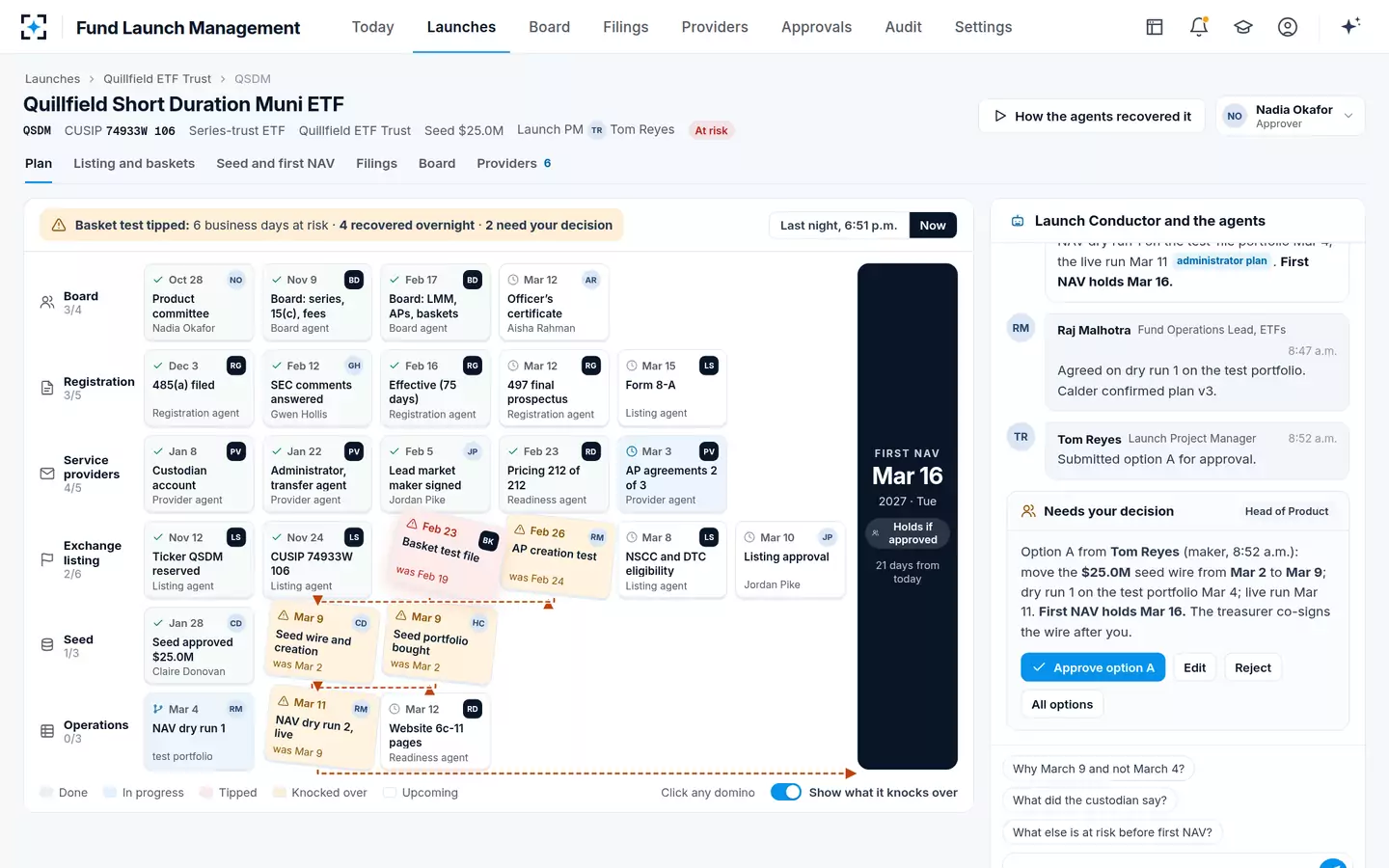
Where Fund Launch Management fits with the market makers and authorized participants
The solution does not replace any of these firms, and it does not negotiate with them. Its agents chase the outside parties and show what a late step knocks over. The Provider agent sends chasers from the launch mailbox, reads every reply, attaches it to the step it moves, and escalates a task two business days past its service level; it never agrees to terms or fees. The Listing agent prepares the ticker reservation, CUSIP request, listing application and Form 8-A and tracks clearing eligibility; it never submits a listing without counsel and never chooses a ticker.
When an outside step slips, the Launch Conductor computes the business days at risk and proposes options with their first NAV dates. A launch project manager submits the re-plan, the Head of Product approves it with a reason code, and a seed move needs the treasurer's second signature. In the sample, the agents recovered four of six days at risk overnight; how the Basket agent read the custodian's reject file follows that night step by step. The full sequence of a launch, from the product committee to first NAV, is set out in how to launch an ETF in the US, and the solution itself is at Fund Launch Management.
Questions people ask
What is an authorized participant of an ETF?
An authorized participant is a member or participant of an SEC-registered clearing agency that has a written agreement with the ETF, or one of its service providers, allowing it to place orders to create and redeem creation units. That is the definition in Rule 6c-11(a). It may trade for its own account or as agent for market makers and institutional investors.
Is an authorized participant the same as a market maker?
No, though one firm is often both. The authorized participant deals with the fund in creation units; a market maker quotes the shares on the exchange for its own account on a regular or continuous basis, as the Exchange Act defines it. A market maker that is not an authorized participant reaches the fund through one.
Is an authorized participant obliged to create or redeem shares?
Rule 6c-11 defines the agreement that makes a firm an authorized participant; it does not impose a duty to create or redeem. That is why a new ETF needs firms that intend to use their agreements, not just a long list of signatures: the SEC's 2019 data showed a median of 23 agreements but only 4 active authorized participants per ETF.
Does an ETF have to have a lead market maker?
Rule 6c-11 does not require one; the role comes from the listing exchange's rules and programs. For a new fund with no trading history, a dealer committed to continuous two-sided quotes is how the shares show a market on day one, which is why the agreement sits on the launch's critical path.
How long must an ETF keep its authorized participant agreements?
At least five years, the first two in an easily accessible place, under Rule 6c-11(d). The same paragraph requires a record of every basket exchanged, including whether it was a custom basket, the cash balancing amount and which authorized participant transacted.