A 351 ETF conversion is a launch in which investors transfer securities they already own, often appreciated ones, to a newly formed ETF in exchange for its shares, relying on section 351 of the Internal Revenue Code to defer the gain they would recognise if they sold. The deferral depends on a test in the Treasury regulations: section 351 does not apply to a transfer to an investment company, and a regulated investment company always is one, if the transfer diversifies the transferors' interests; a transfer is not treated as diversifying where each transferor contributes a portfolio already diversified under the 25% and 50% tests of section 368(a)(2)(F)(ii). Whether the seed portfolio passes is therefore a design decision the sponsor, its tax counsel and the contributors make before the registration is filed. Botminds' Fund Launch Management treats the seed, in cash or in kind, as a launch step with an owner, a date and two signatures, and puts the tax review on the critical path rather than beside it.
This page explains the statute and regulations as written; it is not tax advice, and every conversion needs its own tax opinion. The launch examples come from a fictional sample in the solution.
Does a 351 seeding defer the contributors' gain? Four questions, in order
1
Is the transfer solely for stock, and do the transferors control the fund immediately after?
Yes Go on: section 351(a) can apply
No Section 351 does not apply: the exchange is taxable
§351(a); control is 80% under §368(c)
2
Is the new fund an investment company? A RIC always is.
Yes Go on: the investment-company exception may apply
No The exception does not apply
§351(e)(1); Reg. 1.351-1(c)(1)(ii)
3
Does each transferor contribute a portfolio already diversified under the 25% and 50% tests?
Yes Not treated as diversification: deferral available
No Go on to the general test
Reg. 1.351-1(c)(6); §368(a)(2)(F)(ii)
4
Do two or more transferors contribute nonidentical assets, beyond an insignificant portion?
Yes Ordinarily diversification: the exception applies and gain is recognised
No One transferor, or identical assets: generally no diversification, gain deferred
Reg. 1.351-1(c)(5), including its plan rule
What is a 351 ETF conversion?
It is a tax-deferred contribution of property to a new corporation for its stock, applied to an ETF. Section 351(a) says: "No gain or loss shall be recognized if property is transferred to a corporation by one or more persons solely in exchange for stock in such corporation and immediately after the exchange such person or persons are in control (as defined in section 368(c)) of the corporation" (26 U.S.C. 351(a)). Control means at least 80% of the voting power and 80% of each other class of stock (26 U.S.C. 368(c)).
An ETF series fits the corporate frame because the Code treats each fund of a regulated investment company with more than one fund "as a separate corporation for purposes of this title" (26 U.S.C. 851(g)). A new series seeded only by the contributors is owned entirely by them immediately after the exchange, so control is usually the easy part; the harder part is the exception that follows.
The word "conversion" in the search phrase is loose. Investors are not converting a fund; they are converting their own holdings, often from separately managed accounts, into shares of a new ETF. Converting an existing mutual fund into an ETF is a different transaction, discussed below.
351 exchange rules: the investment-company exception
Section 351 "shall not apply to— (1) Transfer of property to an investment company" (26 U.S.C. 351(e)(1)). The regulations give the test. A transfer is to an investment company if "the transfer results, directly or indirectly, in diversification of the transferors' interests," and the transferee is a regulated investment company, a real estate investment trust or a corporation more than 80% of whose assets are held for investment and are readily marketable securities (26 CFR 1.351-1(c)(1)).
A new ETF is a regulated investment company by design, so the second limb is met and everything turns on the first: does the transfer diversify the people making it? If it does, the exception applies and the contributors recognise gain as if they had sold. If it does not, section 351 applies and the gain is deferred into their new ETF shares.
A transfer ordinarily results in the diversification of the transferors' interests if two or more persons transfer nonidentical assets to a corporation in the exchange.
26 CFR 1.351-1(c)(5)
The diversification test, and the 25% and 50% safe portfolio
Read on its own, paragraph (c)(5) would sink most ETF seedings, which pool different portfolios from many contributors. Paragraph (c)(6) is what makes them possible: "a transfer of stocks and securities will not be treated as resulting in a diversification of the transferors' interests if each transferor transfers a diversified portfolio of stocks and securities" (26 CFR 1.351-1(c)(6)(i)).
"Diversified" borrows the test in section 368(a)(2)(F)(ii): "not more than 25 percent of the value of its total assets is invested in the stock and securities of any one issuer, and not more than 50 percent of the value of its total assets is invested in the stock and securities of 5 or fewer issuers" (26 U.S.C. 368(a)(2)(F)(ii)). The regulation adds a twist for government securities: they count in the denominator of both tests but not as securities of an issuer in the numerator, unless they were acquired to meet the tests.
Applying the 25% and 50% tests to one contributor's portfolio
Largest issuer share
Value of the largest single issuer ÷ value of total assets transferred
Must be 25% or less. Members of a controlled group count as one issuer.
Top-five share
Value of the five largest issuers ÷ value of total assets transferred
Must be 50% or less.
Government securities
In the denominator; not in the numerator
Unless acquired to meet the tests. Reg. 1.351-1(c)(6)(i).
Worked example
$10.0m portfolio: largest issuer $2.2m (22%), top five $4.8m (48%)
Passes both tests. If the largest were $2.6m (26%), it would fail, and that contributor's transfer would count toward diversification.
The practical consequence is that the test is applied contributor by contributor, before the exchange. A seeding where 40 contributors each hand over a broadly diversified account can pass; one where a single founder contributes a concentrated block of one company's stock alongside other people's portfolios is the regulation's own example of diversification. The regulation also disregards a transferor whose nonidentical assets are "an insignificant portion of the total value of assets transferred," and looks through plans: a transfer that is "part of a plan to achieve diversification without recognition of gain" is treated as diversifying.
Seed an ETF with appreciated assets: basis and holding period
If section 351 applies, the gain is deferred, not erased. Each contributor's basis in the new ETF shares is the basis of the securities they gave up, adjusted for any cash or other property received (26 U.S.C. 358), and their holding period in the shares includes the period they held the securities, if those were capital assets (26 U.S.C. 1223(1)).
On the fund's side, the ETF takes the securities with the contributors' basis: for property acquired in a section 351 transaction, "the basis shall be the same as it would be in the hands of the transferor, increased in the amount of gain recognized to the transferor on such transfer" (26 U.S.C. 362(a)). So a seeded ETF starts life with unrealised gains embedded in its portfolio. What it does with them afterwards is where the ETF structure matters: the Code does not apply section 311(b) gain recognition to a regulated investment company's distribution in redemption of its stock on a shareholder's demand (26 U.S.C. 852(b)(6)), which is the provision behind in-kind redemptions. The benefits of an ETF share class covers that mechanism and its limits in depth.
Seeding an ETF with capital gains: in kind or in cash?
The choice is between deferring the contributors' gains and starting the fund with a clean portfolio. Each has costs, and the sponsor should see both before choosing.
Two ways to seed a new ETF
Seeded in kind (section 351): Gain deferred if the exchange qualifies; basis and holding period carry into the ETF shares
Seeded in cash: Any sale to raise the cash is taxable to the investor; the fund is not involved
Seeded in kind (section 351): The contributed securities, at the contributors' basis: embedded gains from day one
Seeded in cash: Bought at market: basis equals cost
Seeded in kind (section 351): Constrained by what contributors hold and by the 25% and 50% tests for each of them
Seeded in cash: Whatever the strategy calls for
Seeded in kind (section 351): Must still meet the RIC asset tests at the close of each quarter
Seeded in cash: Same test; easier to meet when buying fresh
Seeded in kind (section 351): Contributor eligibility, portfolio testing, a tax opinion, custody transfers from many accounts
Seeded in cash: A seed wire under treasury policy
Whichever route is chosen, the fund must qualify as a regulated investment company. At the close of each quarter at least 50% of its assets must be cash, government securities, other RICs and other securities limited to 5% of the fund's assets and 10% of the issuer's voting securities per issuer, and no more than 25% may be invested in any one issuer (26 U.S.C. 851(b)(3)). A seed portfolio built from contributors' holdings has to meet that test too, by the end of the first quarter.
ETF seeding process: where the tax design sits in the launch
The tax design has to be finished before the registration statement describes the fund. The prospectus states the strategy and the principal holdings; if the seed portfolio has to be reshaped to pass the 25% and 50% tests, or to meet the RIC tests, the strategy may have to say so. That puts contributor eligibility and portfolio testing upstream of the 485(a) filing, whose 75-day clock is described in the 485a filing and its evidence file.
The provisions a 351 seeding touches, and when in the launch each one bites
| Provision | What it requires | When it bites |
|---|---|---|
| §351(a) and §368(c) | Transfer solely for stock; transferors control at least 80% immediately after | On the exchange date |
| §351(e)(1); Reg. 1.351-1(c)(1)–(5) | No deferral if the transfer diversifies the transferors' interests | Portfolio testing, before filing |
| Reg. 1.351-1(c)(6); §368(a)(2)(F)(ii) | Each transferor's portfolio: 25% one issuer, 50% five issuers | Contributor eligibility, before filing |
| §358, §362(a), §1223(1) | Carryover basis to contributors and fund; tacked holding period | Records from the exchange date |
| §851(b)(3) | The RIC asset tests at each quarter's close | First quarter-end after launch |
| Rule 6c-11(a)(2) | ETF may sell individual shares, not only to authorized participants, on the day of a reorganization, merger, conversion or liquidation | On the exchange date: whether it fits is for counsel |
| Investment Company Act section 17(a) | Limits on transactions between a fund and its affiliates | If contributors include the adviser or its affiliates |
Two securities-law points sit beside the tax ones. Rule 6c-11 normally has an ETF issue creation units only to authorized participants, but paragraph (a)(2) says an ETF "is not prohibited from selling (or redeeming) individual shares on the day of consummation of a reorganization, merger, conversion or liquidation, and is not limited to transactions with authorized participants under these circumstances" (Rule 6c-11(a)(2)); whether a particular seeding is such a day is a question for counsel. And when the SEC adopted the rule it declined to extend its affiliate relief so that an adviser or its affiliates could provide in-kind seed capital, saying that "expanding the scope of affiliated persons covered by the exemption would constitute novel section 17(a) relief" (84 FR 57162). A seeding that includes the sponsor's own accounts needs that question answered first.
Mutual fund to ETF conversion: tax implications are a different question
Converting an existing mutual fund into an ETF is not a 351 contribution; the fund already holds the portfolio. It is usually structured as a reorganization of one regulated investment company into another, and the Code's rule for transactions between investment companies applies: where two or more parties are investment companies, the transaction is not a reorganization for an investment company "unless it was a regulated investment company, a real estate investment trust, or a corporation which meets the requirements of clause (ii)" (26 U.S.C. 368(a)(2)(F)(i)).
The fund-level questions in a reorganization, the board findings, any shareholder vote and the carryover of losses, are covered in keeping a mutual fund reorganization tax-free, and adding an ETF class to an existing mutual fund under an exemptive order is covered in ETF share class conversion. What the three routes share is the launch work: a board approval, a registration, a listing, a basket and a first creation that must all land on one date.
Before filing: what a 351 seeding needs settled
- Contributor list and eligibility
Who contributes, what each holds, and whether any is the adviser or an affiliate.
- Each contributor's 25% and 50% test
On values at the exchange date, with government securities handled as the regulation says.
- The combined portfolio against the strategy and the RIC tests
Including what must be sold or bought to meet them by the first quarter-end.
- Tax opinion scope and timing
Signed before the exchange; its assumptions written into the plan.
- Custody transfers from every contributing account
Each security set up at the fund's custodian, with its cost basis and acquisition dates.
- Basis and holding-period records
Carried from each contributor to their ETF shares and to the fund's tax lots.
- Counsel on Rule 6c-11(a)(2) and section 17(a)
How the shares are issued on the exchange date, and to whom.
Fund Launch Management: the seed as a two-signature step
Where Fund Launch Management fits in a seeded launch
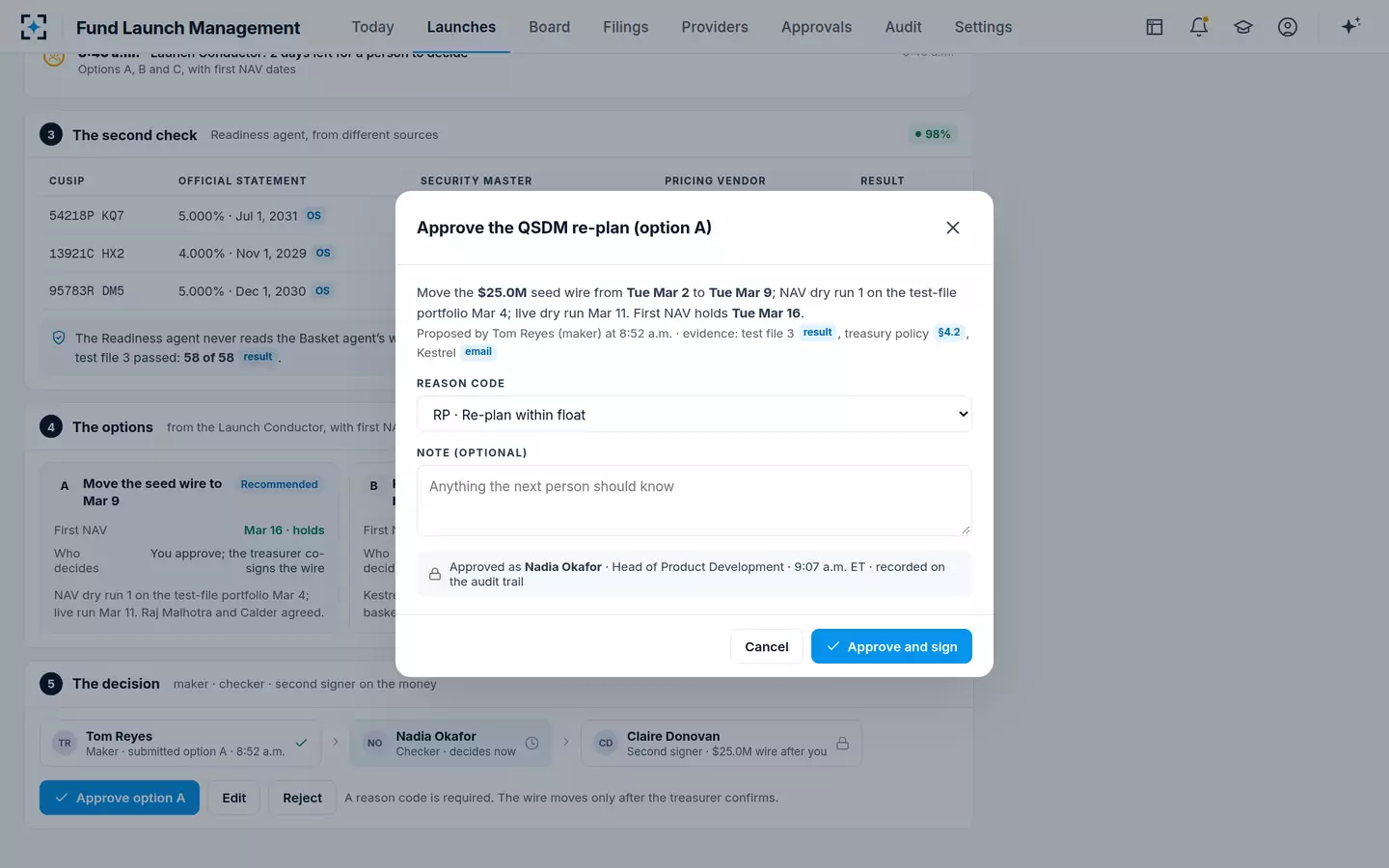
The solution does not decide tax questions and does not give tax advice. What it does is make the tax design a dated part of the launch instead of a parallel workstream that surfaces late. Contributor eligibility, portfolio testing, the tax opinion and the custody transfers become steps with owners and dates, and the Launch Conductor shows what a late one knocks over, as it would for a custodian or a market maker.
The seed itself follows the sponsor's seed capital policy. In the sample, every seed movement needs the Head of Product's approval and the fund treasurer's second signature, and the Readiness agent checks first-NAV readiness, including pricing coverage for every holding, before go-live is decided by a person. The full sequence such a launch fits into is in how to launch an ETF in the US, and the basket the contributed securities become is explained in the portfolio composition file. The solution is at Fund Launch Management.
Questions people ask
Is a 351 ETF exchange tax-free?
It is tax-deferred, if it qualifies. The contributors' gain is carried into their ETF shares through a carryover basis under section 358, and the fund takes the securities at the contributors' basis under section 362(a); the gain is recognised when the shares are sold.
What is the 25/50 test for a 351 ETF?
It is the diversification test of section 368(a)(2)(F)(ii), borrowed by Treasury Regulation 1.351-1(c)(6): no more than 25% of a portfolio's value in one issuer and no more than 50% in five or fewer. A contributor whose portfolio passes is not treated as diversifying by transferring it.
Can one investor seed an ETF with a single stock under section 351?
A single transferor, or several transferring identical assets, is generally treated as not diversifying under Regulation 1.351-1(c)(5). But a concentrated position contributed alongside other people's different holdings is the regulation's own example of diversification, and the fund must still meet the RIC diversification tests each quarter.
Does a 351 conversion need a tax opinion?
Nothing in the statute requires one, but the tests turn on facts at the exchange date and on plans around it, so sponsors and contributors normally want a written opinion before the exchange. This page describes the rules; it is not tax advice.
Can a mutual fund convert to an ETF under section 351?
Not usually: a fund that already holds the portfolio converts through a reorganization of one regulated investment company into another, governed by section 368 and its rules for investment companies, rather than a contribution under section 351.