A mutual fund reorganization, the usual legal form of a fund merger, is tax-free for the shareholders of both funds when it qualifies under section 368 of the Internal Revenue Code: holders of the merging fund exchange their shares solely for shares of the surviving fund, recognize no gain or loss and keep their cost basis, and each fund must be a regulated investment company or meet a diversification test. The tax that does move is the fund's own. The merging fund's capital loss carryforward passes to the survivor but, when a small fund merges into a larger one, is limited each year to the merging fund's value times an IRS rate, 3.95% for ownership changes in October 2026. A liquidation, by contrast, is a taxable sale for every holder and loses the carryforward entirely. Botminds' Fund Rationalization prices those effects per share for every candidate partner on the night of the review, so the product committee chooses merge, close or keep with the tax already on the page.
This guide is for the sponsor's product and tax teams, the fund treasurer and the board. The worked figures come from a fictional sample fund in the solution: an ETF with $18.4 million of net assets and a $4.2 million capital loss carryforward, proposed for merger into a $1.86 billion fund of the same trust. Nothing here is tax advice; the opinion on any merger is counsel's.
The numbers that decide what a fund reorganization costs in tax
0
gain or loss recognized by holders who swap shares solely for shares in a qualifying reorganization
25%
the most of its assets a non-RIC fund may hold in one issuer and still qualify under the investment-company rule
3.95%
the IRS long-term tax-exempt rate for ownership changes in October 2026, which sets the yearly loss limit
$726,800
yearly limit on using the sample fund's $4.2M carryforward after a merger: $18.4M × 3.95%
What makes a mutual fund reorganization tax-free?
A fund reorganization is tax-free when it takes one of the forms in section 368(a)(1), the holders receive "solely" shares, and each fund that is an investment company passes the fund-specific test in section 368(a)(2)(F). Fund mergers mostly use two forms: "a statutory merger or consolidation" (type A), or an acquisition of "substantially all of the properties of another corporation" "in exchange solely for all or a part of its voting stock" (type C), the common form when one series of a trust takes over another's assets (26 U.S.C. 368(a)(1)). Counsel chooses the form and gives the opinion; the sponsor's job is to keep the facts inside it.
Four tax questions for every fund reorganization, and the Code section that answers each
| Question | Section | What it says | What to check |
|---|---|---|---|
| Is it a reorganization at all? | 368(a)(1), (a)(2)(F) | A statutory merger or a stock-for-assets acquisition; funds must be RICs or diversified | Both funds' RIC status for the current year; the form of the transaction |
| Do holders recognize gain? | 354, 358 | No gain or loss on a shares-for-shares exchange; basis carries over | Any cash paid to holders, for fractional shares or otherwise |
| What happens to the fund's tax history? | 381 | The acquirer "shall succeed to and take into account" the transferor's tax items | Capital loss carryforwards, undistributed income, the fund's tax year-end |
| Are the carried-over losses limited? | 382, 383 | After an ownership change, use of pre-change losses is capped each year | Value of the merging fund, the IRS rate for the month, built-in gains and losses |
The investment-company test: the rule written for funds
Section 368(a)(2)(F), headed "Certain transactions involving 2 or more investment companies", is the condition most specific to fund mergers. If two or more parties were investment companies just before the transaction, it is not a reorganization for any such party "(and its shareholders and security holders) unless it was a regulated investment company, a real estate investment trust, or a corporation" that is diversified: "not more than 25 percent of the value of its total assets is invested in the stock and securities of any one issuer, and not more than 50 percent" in five or fewer (26 U.S.C. 368(a)(2)(F)(i)–(ii)).
A registered fund that qualifies as a regulated investment company for the year passes through the first door, so the practical check is the merging fund's RIC status in its final, short tax year. A fund that has been shrinking for years is the one most likely to drift towards a concentration or income test it has not failed before, which is why the tax team should confirm RIC status for the current year before the committee decides, not after the N-14 is drafted.
What holders get: no gain, the same basis, the same holding period
In a qualifying reorganization holders recognize nothing on the day. Section 354 provides that "No gain or loss shall be recognized if stock or securities in a corporation a party to a reorganization are, in pursuance of the plan of reorganization, exchanged solely for stock or securities in such corporation or in another corporation a party to the reorganization" (26 U.S.C. 354(a)(1)). Section 358 carries the basis across: it "shall be the same as that of the property exchanged", adjusted for any cash or other property received (26 U.S.C. 358(a)(1)). The holding period follows, so long-term holdings stay long-term.
That deferral is why the SEC preferred mergers to closures when it rewrote its merger rule in 2002, and why the board must weigh tax in its findings.
mergers give shareholders of small or poorly performing funds an opportunity to shift their assets to a better performing fund without negative tax consequences.
SEC, Investment Company Mergers, Release IC-25666 (2002)
The registration statement has to say so in terms. Form N-14 requires a discussion of "the federal income tax consequences, if any, to the security holders of both parties, including appropriate references to Internal Revenue Code sections" (Form N-14, Item 4(a)(4)). Any cash paid to holders, for fractional shares or otherwise, is the part that can be taxed and needs its own sentence.
Reorganize, liquidate or keep: the tax comparison for the committee
For most holders, closing a fund rather than merging it is the difference between a tax bill this year and none, and for the fund it is the difference between a limited carryforward and a lost one. Section 331 treats a liquidating distribution "as in full payment in exchange for the stock" (26 U.S.C. 331), so every holder in a taxable account realizes a gain or loss.
Liquidating a fund against reorganizing it: what each does to the tax
Liquidation: a taxable sale: Cash taxed as the sale price of the shares (section 331): a capital gain or loss against basis.
Reorganization: tax-free if it qualifies: Shares for shares "solely" in a reorganization: no gain or loss recognized (section 354).
Liquidation: a taxable sale: Ended; any reinvestment starts a new basis.
Reorganization: tax-free if it qualifies: Carried over to the survivor's shares (section 358).
Liquidation: a taxable sale: In the year of the liquidating distribution, chosen by the fund.
Reorganization: tax-free if it qualifies: When the holder later sells, chosen by the holder.
Liquidation: a taxable sale: Lost: the fund ceases to exist and its losses go with it.
Reorganization: tax-free if it qualifies: Carried over to the survivor (section 381), usually subject to a yearly limit (sections 382 and 383).
Liquidation: a taxable sale: The whole portfolio is sold; gains and losses are realized.
Reorganization: tax-free if it qualifies: Only the repositioning trades: holdings the survivor does not want are sold before or after.
Liquidation: a taxable sale: Holders sitting on a loss, who may want to realize it.
Reorganization: tax-free if it qualifies: Holders sitting on a gain, who keep deferring it.
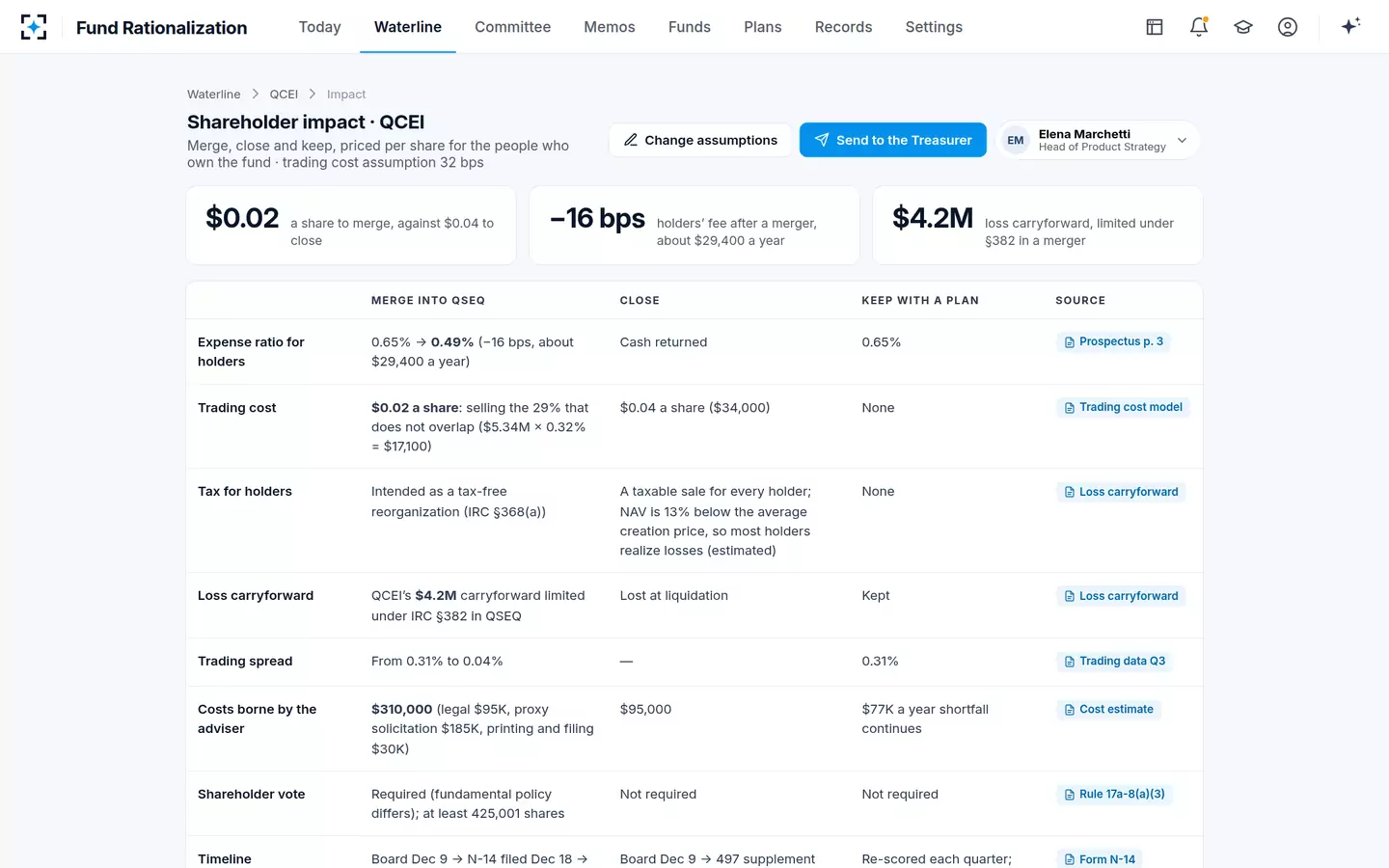
The last row is the one boards most often miss. A liquidation is not worse for every holder. In the sample fund, net asset value is about 13% below the average price at which shares were created, so the solution estimates that most holders would realize losses if the fund closed. For them the merger's deferral is worth little and the survivor's lower fee, 0.49% against 0.65%, is worth more. What closing costs holders beyond tax is set out in ETF closure risk.
What happens to a capital loss carryforward in a fund reorganization?
It survives the reorganization, then shrinks to a yearly allowance. Section 381 makes the survivor "succeed to and take into account" the merging fund's tax items, including its capital loss carryforward, when assets pass in a reorganization of type A, C, D, F or G (26 U.S.C. 381(a)). For a regulated investment company those capital losses carry forward without a time limit: a net capital loss becomes a short-term or long-term capital loss "arising on the first day of the next taxable year" (26 U.S.C. 1212(a)(3)), and keeps doing so until used.
The cap comes from the change of owners. Section 382 limits the taxable income a "new loss corporation" may offset with pre-change losses each year to "the value of the old loss corporation, multiplied by... the long-term tax-exempt rate" (26 U.S.C. 382(a)–(b)), and section 383 applies the same principles to net capital losses (26 U.S.C. 383(b)). A reorganization is an "equity structure shift" under section 382(g)(3); when a small fund merges into a much larger one, its former holders end up owning a small slice of the survivor, which is the ownership change that triggers the limit.
The sample fund's $4.2 million carryforward under the section 382 limit, worked
| Step | Calculation | Result |
|---|---|---|
| 1. Value of the old loss corporation | Value of the merging fund's shares immediately before the change: 850,000 shares × $21.65 | $18.4 million |
| 2. Long-term tax-exempt rate | Highest adjusted federal long-term rate for the month of the change and the two before it (October 2026) | 3.95% |
| 3. Yearly limit | $18.4 million × 3.95% | about $726,800 |
| 4. Years to use the whole carryforward | $4.2 million ÷ $726,800, if the survivor realizes at least that much in net gains each year | about 5.8 years |
| 5. Without the merger | The fund keeps the full $4.2 million, usable against its own future gains with no yearly cap | no limit |
| 6. If the fund liquidates | The fund ceases to exist; the carryforward cannot be used by anyone | lost |
How should tax change the choice of surviving fund?
Tax should rank the candidate partners, not just footnote the chosen one. For a survivor that realizes large gains each year, a $726,800 allowance on a $4.2 million carryforward is used within six years and is worth most of its face value; for a survivor that rarely realizes gains, the losses may sit unused for a long time and are worth far less. The direction can also reverse: if the intended survivor carries the losses and the merging fund is the larger, the survivor's own losses can be the ones limited, and the better structure may be to merge the other way.
In a review run by hand, tax is usually priced after the committee has a shortlist, which means the partner was chosen on holdings overlap and fees alone. By our estimate for the sample firm, pricing the shareholder impact and tax takes five of about 38 business days by hand and comes after scoring and partner-finding. The solution prices it on the night of the run for every candidate partner, beside the overlap ranking and the Rule 17a-8 test of whether holders must vote.
Repositioning: the trades that can make a tax-free reorganization leave a bill
A reorganization is tax-free for holders, but the trades around it are ordinary trades. Holdings the survivor does not want are sold, before the merger by the merging fund or after it by the survivor, and any net gains realized are distributed to whichever holders are in the fund at the time. In the sample case the partner already holds 41 of the merging fund's 58 holdings, 71% of its portfolio by weight, so only the other 29%, about $5.34 million, would be sold.
The solution prices the trading cost of that sale at $17,100, $0.02 a share, against $0.04 a share to close the fund, using a 0.32% trading-cost assumption the treasurer can change only with a reason. Whether the sale realizes gains depends on the lots sold; with net asset value below the average creation price, the sample fund's repositioning is more likely to realize losses, which would add to the carryforward and to the amount the limit applies to. Overlap is a tax variable as well as a portfolio one.
Fund Rationalization prices the merger's tax and cost per share, beside closing and keeping
The final tax year: distributions and the closing date
In a type A or C reorganization the merging fund's tax year ends on the closing date: "The taxable year of the distributor or transferor corporation shall end on the date of distribution or transfer" (26 U.S.C. 381(b)(1)). Like any regulated investment company at a year-end, it usually distributes that short year's income and net gains, which means a distribution in the weeks before the merger. That distribution is taxable to holders in the ordinary way, so the closing date is a tax decision as well as an operational one: a date after a large repositioning sale lands the gains on the merging fund's holders; a date before it lands them on the combined fund's.
The N-14 and the board memo should state the expected pre-closing distribution, if any, and how it was estimated. In the EU the same question is asked of the unit-holder notice rather than the Code: the UCITS Directive requires the information to merging fund holders to include "where relevant, a prominent warning to investors that their tax treatment may be changed following the merger" (Directive 2009/65/EC, Article 43(3)(b)). The clocks for a cross-border merger are in cross-border UCITS merger.
What the board needs to see on tax before it approves
The board needs the tax effect of each option, per share, with its source, before it votes. Among the factors the SEC's 2002 release lists for a board's merger determinations is "Any direct or indirect federal income tax consequences of the merger to fund shareholders" (IC-25666). A memo that says only "intended to be a tax-free reorganization" answers the holders' question and leaves out the fund's.
The tax view Fund Rationalization gives the committee before it chooses merge, close or keep
- Intended structure, and who opines
Type A or C reorganization, both funds' RIC status, and the counsel who will give the opinion; status stays "intended" until then.
- Holders' position against the fund's price history
Whether most holders sit on gains or losses decides how much the deferral is worth to them.
- The carryforward, and its limit with each partner
The section 382 allowance at this month's IRS rate, and how fast each candidate survivor would use it.
- Repositioning trades and their likely gains
The share of the portfolio the survivor would sell, its trading cost and whether the lots sold are at a gain or a loss.
- Distributions around the closing date
Any income or gains the merging fund must pay out before its final tax year ends.
- What closing would cost instead
A taxable sale for every holder, and the carryforward lost.
After the committee decides, the Memo Drafter writes the board memo section, the Rule 17a-8 findings and the Form N-14 outline with each figure cited, and the treasurer and counsel sign before it is released to the board portal. Mergers into an ETF follow different routes, covered in ETF conversion and section 351 and ETF share class conversion. The review itself is on the Fund Rationalization page.
Questions people ask
What are the requirements for a tax-free fund reorganization?
A form listed in section 368(a)(1), usually a statutory merger (type A) or a stock-for-assets acquisition (type C); holders receiving solely shares; and, under section 368(a)(2)(F), each investment company party must be a regulated investment company, a REIT or diversified. Counsel's opinion confirms the facts fit.
What are the tax implications of a mutual fund merger for shareholders?
Usually none on the day: holders swap shares for shares with no gain or loss under section 354 and keep their basis and holding period under section 358. Tax arises when they later sell, or earlier through any distribution of gains realized in repositioning trades or the merging fund's final tax year.
Is a mutual fund liquidation taxable?
Yes, for holders in taxable accounts: section 331 treats the liquidating payment as full payment for the shares, so each holder realizes a gain or loss. The fund's own loss carryforward is lost when it ceases to exist.
How is the section 382 limit on a fund's carryforward calculated?
The yearly limit is the value of the merging fund's shares immediately before the ownership change multiplied by the IRS long-term tax-exempt rate for that month; for October 2026 the rate is 3.95%. Unused limit carries forward, and section 383 applies the same principles to capital loss carryforwards.
Do a fund's capital loss carryforwards expire?
Not for a regulated investment company's net capital losses for taxable years beginning after 22 December 2010: under section 1212(a)(3) each year's excess is treated as a capital loss arising on the first day of the next taxable year, without a time limit. After a merger, sections 382 and 383 govern how fast they can be used.
Must a fund reorganization be approved by shareholders?
Not always. Under Rule 17a-8 a merger of affiliated funds needs no vote of the merging fund's holders when four conditions are met, among them that no fundamental policy and no advisory contract of the survivor is materially different; otherwise holders vote. The tax analysis is the same either way.