Survivorship bias in mutual fund performance is the upward distortion that appears when returns are measured only on funds that still exist: funds that are merged away or liquidated tend to be the weaker performers, so leaving them out makes the average fund, and the persistence of good managers, look better than investors actually experienced. Academic estimates put the bias from a fraction of a basis point to about one percentage point a year, rising with the length of the sample. The same mechanism distorts the tools a product team uses to decide which funds to close: a peer group built from survivors, or a scoring model checked only against today's line-up, flatters itself. Botminds' Fund Rationalization scores every fund each quarter for merge, close or keep; the honest way to test it, or any such model, is to replay it on funds whose fate you already know and read where it disagrees with what happened.
Research findings below are linked to the studies; examples from the solution use fictional sample data.
How large survivorship bias is, and how many funds leave the data each year
0.07%
annual bias in average performance for one-year samples of US mutual funds
1%
annual bias for samples longer than 15 years, on the same data
102
applications to deregister a fund filed with the SEC in 2023, each after a merger or a liquidation
163
merger registration statements on Form N-14 filed in 2025
What is survivorship bias in mutual fund performance?
It is the gap between the performance of funds that survive a period and the performance of all funds that existed at its start. The cause is that closures are not random. Elton, Gruber and Blake put it plainly: "Mutual fund attrition can create problems for a researcher because funds that disappear tend to do so due to poor performance" (Review of Financial Studies, 1996). Their fix was to track every fund that existed at the end of 1976 and, "When a fund merges", to calculate the return "taking into account the merger terms", so that a holder's experience is followed into the surviving fund rather than dropped.
The size of the bias depends on how long the sample is. Carhart, Carpenter, Lynch and Musto showed that "when survival depends on multiperiod performance, the survivorship bias in average performance typically increases with the sample length", and on US data found "the annual bias increases from 0.07% for 1-year samples to 1% for samples longer than 15 years" (Review of Financial Studies, 2002). They also found that "survivor conditioning weakens evidence of performance persistence": some of the apparent ability of past winners to keep winning comes from the losers having been removed.
The longer the sample, the larger the bias: survivors overstate returns by up to 1% a year
Why survivorship bias flatters a fund rationalization model
A rationalization model is a claim about which funds will not recover. Testing it on the line-up you have today checks it only against funds that, so far, have not closed. Every fund the firm already merged or liquidated is missing from that test, and those are precisely the cases where the model's judgement was supposed to matter. A model that proposes closing the funds that later closed, and keeping the ones that survived, has learned nothing if the test set excludes the funds that closed.
Peer groups built from survivors: the same bias inside the model's inputs
Peer groups carry the same flaw into the model's inputs. If the performance factor compares a fund's three-year return with a category built from funds alive today, every peer that closed after a bad three years has been removed, the category average is too high, and a mediocre fund looks worse than it was against the funds investors could actually have held. Incubation adds a second bias at the other end of a fund's life: Evans found that incubated funds' early outperformance disappears once they open to the public, an upward bias that filtering on fund size leaves in place but filtering on fund age or ticker creation date removes (Journal of Finance, 2010). Young and dead funds are both where the numbers lie; mutual fund incubation takes the young end.
How do you test a fund scoring model? Replay it on the funds you closed
Run the model as of each past review date, on the data that was available that day, and compare its proposals with two things: what the committee decided, and what happened to the fund afterwards. The firm's own merged and closed funds are a labelled set it already owns, with the decision, the reasons and the outcome on file. A five-year history of quarterly reviews gives twenty decision dates and every fund that passed through them.
Replaying Fund Rationalization, or any rationalization model, on decided cases
A person decides
Product analystBuilds the set: every fund reviewed at each past date, with the committee's decision and what happened after.
Agent
Fund Scorer, as of the dateScores each fund using only the data available on that date: no later flows, no later performance.
Never: Reads anything dated after the review it is replaying
Agent
Devil's Advocate, as of the dateBuilds the case to keep each proposed fund from the sources that existed then, or concedes.
A person decides
Head of product strategyReads every disagreement between the replay and the decision, and every case where the outcome later proved either wrong.
A person decides
Committee chairApproves any change to weights or thresholds the replay suggests, through the normal proposal and two approvals.
Why a replay must stop at the review date
The hard rule is the date. A replay that lets the model see later data is not a test; it is hindsight. Flows and performance are easy to cut off at the review date. Documents are harder: a distributor's letter dated after the review, or a model-portfolio committee's minutes, must be excluded even if they sit in the same folder. The SEC's recordkeeping rules help here, because the evidence the board saw is meant to be kept: written materials considered under section 15(c) for six years (Rule 31a-2(a)(6)), and the merger's records, including "the bases" of the board's determinations, for six years after a merger under Rule 17a-8 (Rule 17a-8(a)(2)(iv) and (a)(5)).
Reading the disagreements, one by one
An agreement rate is the least useful output of a replay. Two models can agree with the committee 85% of the time and be wrong about entirely different funds. Read each disagreement and sort it by what it says about the model, the committee or the evidence.
Four kinds of disagreement in a replay, and what each one tells you
| The replay proposed | The committee decided | What happened next | What to check |
|---|---|---|---|
| Merge or close | Keep with a plan | The fund recovered and reached its line | Which factor overweighted the past: usually flows or one-year performance. The devil's advocate's case should have held here. |
| Merge or close | Keep with a plan | The fund missed its milestone and closed later | The cost of waiting: subsidy paid, holders' expense ratio, a later and larger taxable exit. |
| Keep with a plan | Merge or close | The fund was merged or closed | Evidence the committee had that the model did not: a distributor leaving, a manager change, a letter in another language. |
| Merge into partner A | Merge into partner B | Holders' fees and returns after the merger | The partner ranking: overlap by weight against fee, vehicle and the holders of the acquiring fund. |
The last row is easy to skip and should not be. Jayaraman, Khorana and Nelling found that after fund mergers targets' shareholders saw better performance and lower expense ratios while acquirers' shareholders saw a "significant deterioration in postmerger performance" (Journal of Finance, 2002). A replay that judges the model only by what happened to the closed fund's holders ignores half the people the board had to protect. Zhao's finding that defunct funds have "smaller size and lower inflows" (Journal of Business, 2005) also predicts what most agreements will look like: the smallest, shrinking funds are easy, and the model earns its place on the middle cases.
How to build the gold set from your own files
Building a replay set from funds you have already decided
- Every review date, not only the funds that left
Include funds kept, so the replay can be wrong in both directions.
- The data as it stood that day
Net assets, flows and performance as of the review date; ranks from that date's category file, including funds since closed.
- The committee's decision and its reason
From the committee minutes and the board memo; a merger's board determinations and their bases are in the minute books.
- What happened after
For kept funds, whether they reached their line; for merged funds, the survivor's fees and returns for both sets of holders; for closed funds, the payout and costs.
- Merger terms for chaining returns
The exchange ratio, so a holder's return can be followed into the surviving fund rather than ending at the merger.
- Documents dated, and cut off
Distributor letters, platform notices and minutes, each with its date, so nothing later leaks into the replay.
- The model's settings at the time, if it existed
Weights, thresholds and lines as they were, so the replay tests the model you ran, not today's.
How Fund Rationalization keeps what a replay needs
A replay is only as good as the record of what the model did at the time. In Fund Rationalization each decision's evidence file holds the agents' case, the devil's advocate's counter-case, the per-share impact with its assumptions, the vote test, the memo and signatures, and the agents' versions, models, instructions and thresholds at run time, with every source hashed. That is the material a later replay, an internal audit or an examination asks for.
One decision's evidence file: case, counter-case and the agents as they ran
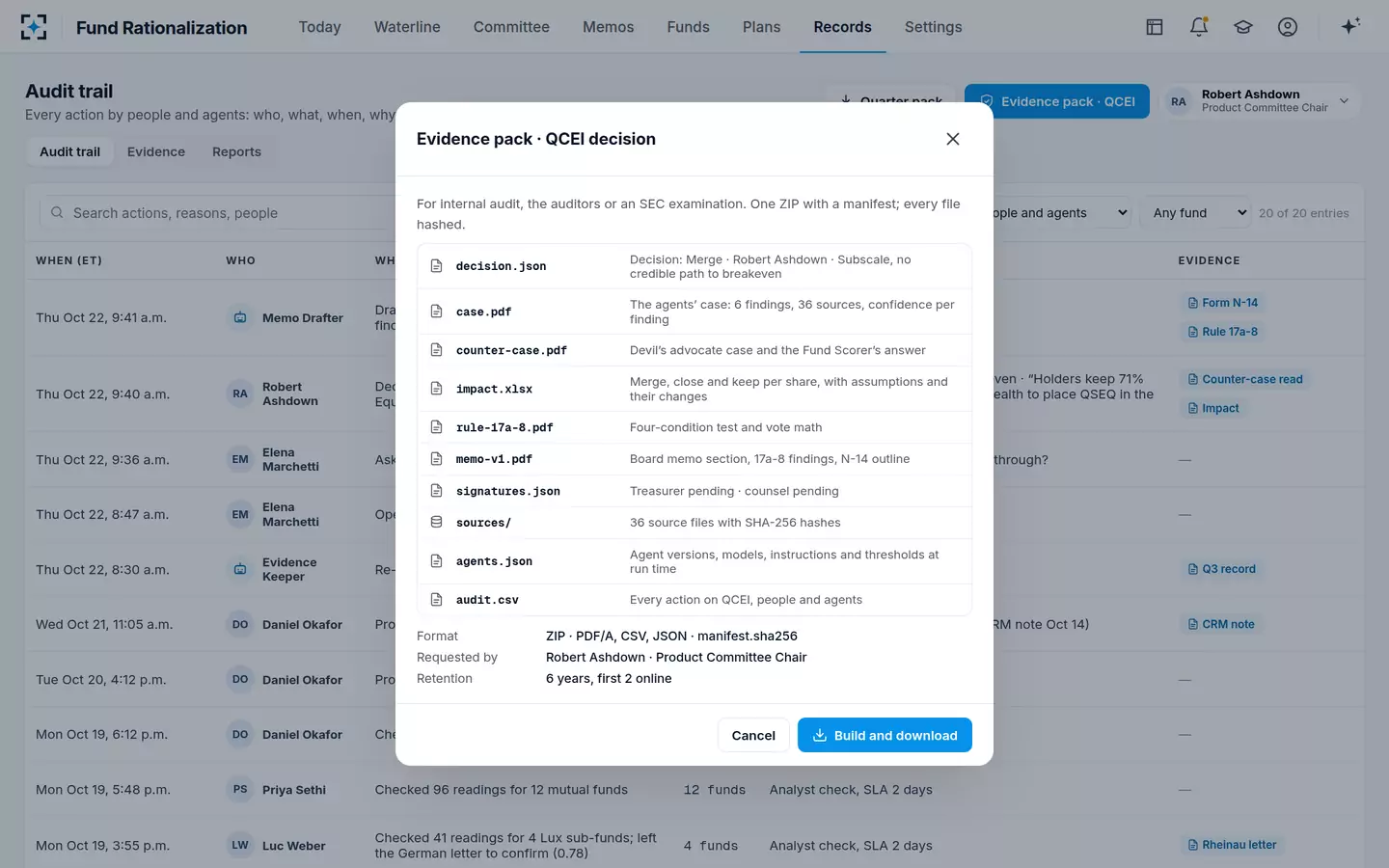
The same discipline applies inside a live quarter. An analyst checks the agents' readings within two business days of the run; a reading below its confidence threshold waits for a person; and a weight change applies only from the next run, after the head of product strategy and the chair approve it. When a replay suggests a change, it goes through that path like any other, so next year's replay can tell which model made which call. How the counter-case is built is in the portfolio rationalization model.
The live case shows its score, its sources and a way to replay the run
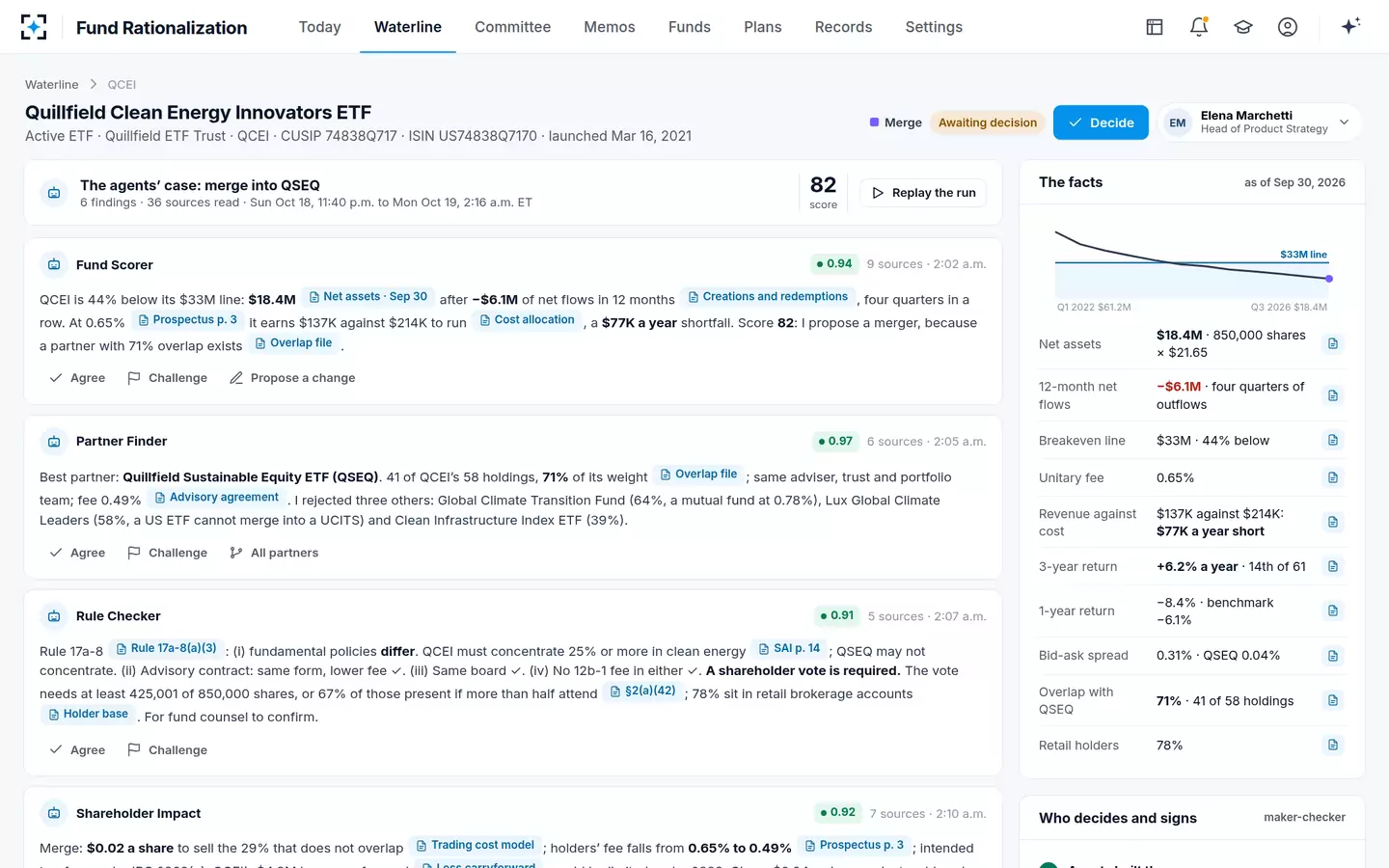
To replay the agents on your own past reviews, start from Fund Rationalization with a sample of decided funds and the files behind them.
Questions people ask
How big is survivorship bias in mutual fund returns?
It depends on the sample's length. Carhart, Carpenter, Lynch and Musto (2002) found annual bias of 0.07% in one-year samples of US funds rising to 1% in samples longer than 15 years, because funds are typically closed after several years of weak results.
What is a survivorship-bias-free mutual fund database?
A database that keeps the full history of funds that merged or liquidated, so a study can include every fund that existed at the start of its period. Academic work on fund performance, including the 2002 study above, relies on such data; the key detail is following a merged fund's holders into the survivor using the merger terms.
How do you prevent survivorship bias in a fund analysis?
Start from every fund that existed at the start of the period, keep the ones that later closed, and follow merged funds' returns into the surviving fund. For a fund rationalization model, replay it on past review dates using only the data available then, including funds that have since closed.
Does survivorship bias affect performance persistence?
Yes. Carhart and co-authors found that "survivor conditioning weakens evidence of performance persistence": removing funds that died after bad runs makes past winners look more consistent than they were.
What is the average survival rate of an ETF?
No regulator publishes a current survival rate for ETFs. A sponsor can measure its own: launches from its new-series filings against deregistrations on Form N-8F, of which our count of the SEC's EDGAR indexes shows 102 in 2023, 99 in 2024 and 78 in 2025 across all registered funds.
How many past decisions do you need to test a rationalization model?
Enough to include disagreements of each kind; five years of quarterly reviews gives twenty decision dates. Every merged, closed and kept fund at each date counts, because a test on survivors alone repeats the bias it is meant to catch.