Mutual fund incubation is the practice of starting a fund privately, usually with the sponsor's own seed money, running it for an evaluation period, and opening it to the public only if its early record is good; funds that do poorly are closed before anyone outside the firm invests. The research finds that incubated funds' early outperformance is real on paper but does not last: in Richard Evans's study, funds outperformed by 3.5% a year risk-adjusted while incubated, drew higher flows when opened, and lost the edge afterwards. That makes a sponsor's launch pipeline and its closure list one process seen from two ends: many of the small funds a product committee reviews for merger or closure were launched on records that flattered them. Botminds' Fund Rationalization, which scores every fund in a line-up each quarter against its breakeven line, scores young funds like any other but, under the sample firm's rule, never proposes closing a fund under three years old.
Figures from the solution are fictional sample data on Quillfield Capital; research is linked where it appears.
What the research and the SEC's filing data say about young funds
3.5%
risk-adjusted outperformance of funds while in incubation, which disappears after they open
1,446
post-effective amendments filed under Rule 485(a) in 2025, the route a new series of an existing trust takes
78
applications to deregister a fund on Form N-8F in 2025, after a merger or a liquidation
75days
after filing before a 485(a) amendment adding a new series becomes effective
What is mutual fund incubation?
It is a way of choosing which funds to launch by letting the market grade them in private first. Evans describes it precisely: "Incubation is a strategy for initiating new funds, where multiple funds are started privately, and, at the end of an evaluation period, some are opened to the public" (Journal of Finance, 2010). The fund family supplies the capital, often a single seed account; the fund files its registration and builds a track record; at the end of the period the family decides which funds to market and which to wind up.
The practice is legitimate and can be sensible: a manager's strategy is tested with real trading before public money is at risk, and a fund that fails costs only the sponsor. The trouble is what the surviving funds' records then mean. If a family starts ten funds and opens the three with the best first two years, those three records are partly skill and partly the luck of being chosen. Evans's study is the clearest measurement of how much.
Why incubated performance fades once a fund is public
Because selection, not skill, explains much of the early record. In Evans's data, funds outperformed non-incubated funds by 3.5% a year, risk-adjusted, while they were in incubation; once opened they drew higher flows on that record, and after incubation the outperformance was gone (Evans, 2010). Investors pay for a record the fund does not repeat, and the fund's later flows reflect the disappointment.
"This performance reversal imparts an upward bias to returns that is not removed by a fund size filter. Fund age and ticker creation date filters, however, eliminate the bias."
Richard B. Evans, 'Mutual Fund Incubation', Journal of Finance (2010)
The second half of that finding is a practical instruction for anyone who scores funds. A fund's age, or the date its ticker was created, separates its private record from its public one; a filter on fund size does not, because incubated funds can be large enough to pass it. A rationalization model reading a young fund's three-year return without knowing when the fund went public is reading the incubation record as if it were the fund's. The same distortion at the other end of a fund's life, when closed funds drop out of the data, is the subject of survivorship bias and mutual fund performance.
One process, two ends: from incubation to the closure list
The funds a product committee reviews for closure are, disproportionately, the funds the launch process produced most recently. The research links the steps: families launch where money and recent success are, incubated records fade, small funds with weak flows are the ones that exit, and how they exit depends on the family. The figure follows a fund through that loop.
The launch-to-closure loop: where each stage's evidence comes from
1 · Incubate
Several funds run privately on the sponsor's seed money for an evaluation period.
In incubation, funds outperform non-incubated funds by 3.5% a year, risk-adjusted (Evans, 2010).
2 · Open
The best performers are opened to the public with their record; the rest never are.
Opened funds attract higher flows on the strength of that record (Evans, 2010).
3 · Fade
Out of incubation, the edge goes: the record was partly selection, not skill.
Post-incubation, the outperformance disappears (Evans, 2010).
4 · Review
Small funds with weak flows reach the rationalization review.
Defunct funds have smaller size and lower inflows (Zhao, 2005).
5 · Merge or close
The committee decides; a family with more share classes is more likely to merge than liquidate.
Merging targets' holders gain, acquirers' lose (Jayaraman, Khorana and Nelling, 2002).
Where new funds come from: money and recent success
Launches follow money. Khorana and Servaes, studying 1,163 US funds started between 1979 and 1992, found that "fund initiations are positively related to the level of assets invested in and the capital gains embedded in other funds with the same objective", to "the fund family's prior performance", to the share of the family's funds with low fees, and to "the decision by large families to open similar funds in the prior year" (Review of Financial Studies, 1999). Families open funds where a category is already crowded and hot, which is also where a new fund is least likely to stand out.
Which young funds exit, and whether they merge or close
Exits follow size and flows. Zhao found that "All defunct mutual fund portfolios are shown to have smaller size and lower inflows", that large families are more likely to merge portfolios within the family, and that a family offering more share classes is "less willing to liquidate a portfolio but more likely to merge a portfolio within the family" (Journal of Business, 2005). For ETFs the launch cycle is sharper still: Ben-David and co-authors found that specialized ETFs lose about 30%, risk-adjusted, over their first five years, because they are launched when the stocks they track are overvalued (Review of Financial Studies, 2023).
Do young funds fill the closure list? What the filing data shows
The SEC's filing indexes show the two ends of the pipeline moving together. Post-effective amendments under Rule 485(a), the route by which an existing trust adds a new series, rose from 970 in 2023 to 1,059 in 2024 and 1,446 in 2025. Deregistrations on Form N-8F, which follow a merger or a liquidation of a whole registrant, ran at 102, 99 and 78. The counts are filings, not funds, and a 485(a) amendment can serve other purposes, but the direction is plain: launches have grown much faster than whole-fund exits.
New-series filings rose half again since 2023; whole-fund deregistrations fell
The undercount in the caption matters. Most funds today are series of a trust, and a series can be liquidated without the trust deregistering; its closing shows up in a prospectus supplement, not an N-8F. A sponsor's own files are a better measure of its pipeline than any public total: how many funds it opened in each year, how many reached their breakeven line within three years, and how many were merged or closed before five.
How should a review treat young funds?
Score them, watch them, and give them a fixed time before they can be proposed for closure. A young fund's record is short and may include its incubation period, its flows are lumpy, and its distribution may not have started; scoring it on the same factors as a ten-year-old fund will put it below the line almost by definition. The sample firm's rule in Fund Rationalization is that funds under three years old are scored but never proposed for closure; they show up on the committee's view, with their trajectory, and become eligible for a merge or close proposal on their third anniversary.
Scoring a young fund in Fund Rationalization: what each factor means before year three
| Factor | What it shows in a young fund | How the sample firm reads it |
|---|---|---|
| Scale against the line | Almost always below the line in the first years | Shown as a trajectory toward the line, not a verdict |
| Flows | Lumpy: seed money in, seed money out, a single allocation | Seed movements identified separately from client flows |
| Performance | A short record, possibly including incubation | Read from the public launch date; incubated history flagged |
| Distribution support | Platform approvals still pending | Pending approvals listed as evidence for the case to keep |
| Partner | A partner may already exist in the family | Recorded; a merger proposal waits until year three |
In Fund Rationalization, a young fund's exemption waits for the head of product

Why young funds still need a case to keep
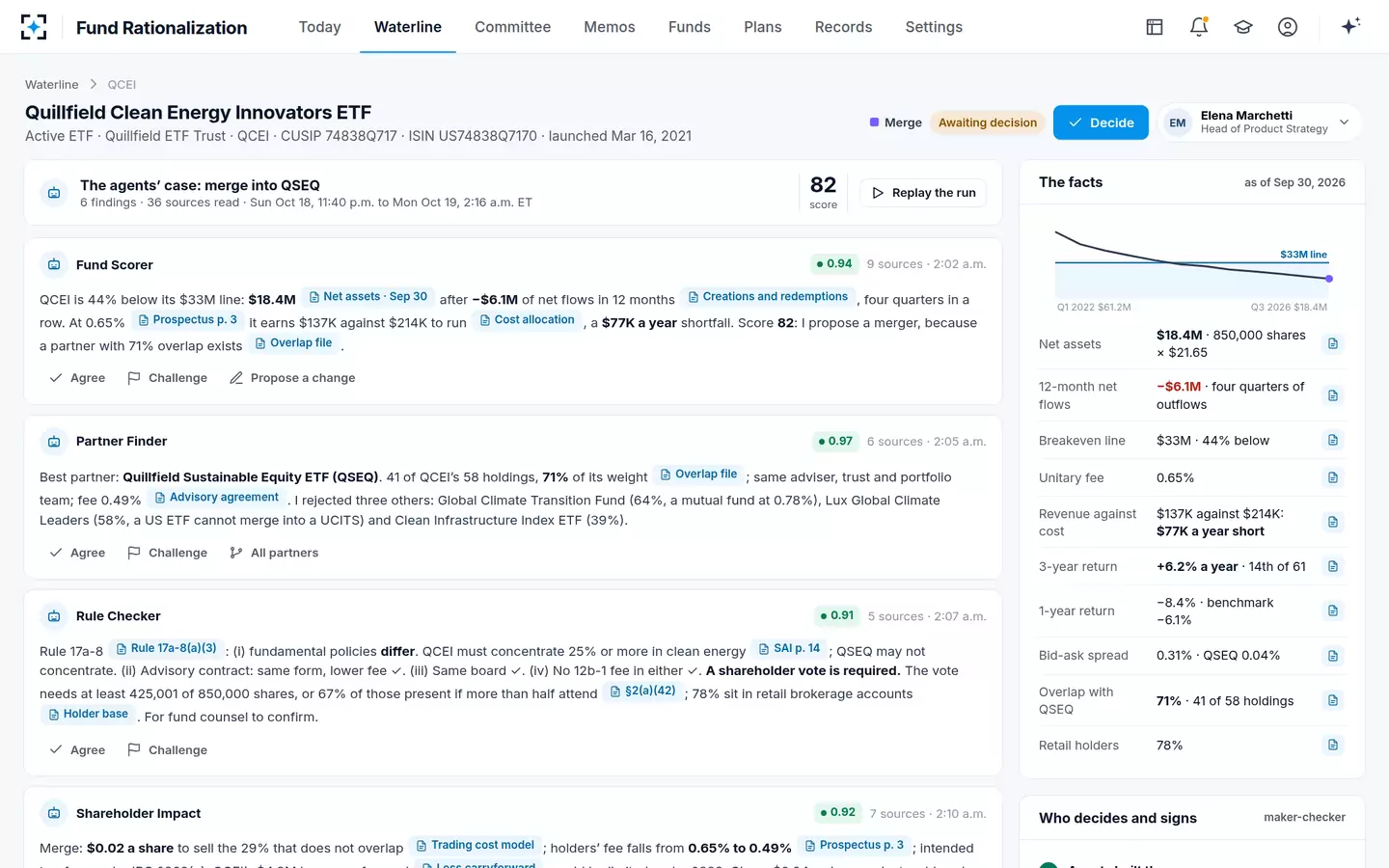
Three years is a rule, not a reason. At the anniversary a fund that has not reached its line becomes eligible for a proposal, and the devil's advocate then has to make the case to keep it from evidence: platform approvals obtained, a model allocation in the minutes, a record in its public years. In the sample review, the contested fund at the top of the committee's agenda had launched on 16 March 2021: five and a half years in, still at 56% of its line after four quarters of outflows, with a top-quartile three-year record and a $9.0 million allocation shortlisted. The agents proposed a merger; the counter-case argued for two more quarters; the chair chose the merger, with a reason.
A fund five years past launch, still below its line, argued both ways
The loop closes in the other direction too. A firm that tracks how its funds fare after launch can feed that back into its launch decisions: which categories its funds reach scale in, how long it takes, and how often the early record held. That analysis starts in the launch process, set out in how to launch an ETF in the US; the review that closes the loop is Fund Rationalization, and how a closing then reaches holders is in ETF closure risk.
Questions people ask
What does incubation fund mean?
An incubation fund, or incubated fund, is a fund run privately for a trial period, usually on the sponsor's seed money, before the sponsor decides whether to open it to the public. Evans (2010) found these funds outperformed by 3.5% a year risk-adjusted while incubated, and that the advantage disappeared once they opened.
What is a fund incubator program?
A sponsor's programme for seeding and testing several strategies at once, opening the ones that perform and closing the rest privately. The research suggests treating the opened funds' early records with care, because selection rather than skill explains part of them; filtering by fund age removes the bias.
What is the success rate of new ETFs?
No regulator publishes a launch success rate for ETFs. A 2023 study found specialized ETFs lost about 30%, risk-adjusted, over their first five years; a sponsor can measure its own rate from its launches and closures.
Why do mutual funds close to new investors?
A fund closes to new investors when its manager judges that more money would hurt the strategy, for example one investing in small or illiquid securities. That is a capacity decision for a fund that is often too popular, the opposite of a rationalization closing, which liquidates a fund that is too small.
What is a soft close on a mutual fund?
A soft close stops new investors from buying the fund while letting existing shareholders keep adding money; a hard close stops all new purchases. Both leave the fund open and its existing holders invested.
Why do new funds close so often?
Because most never reach the size at which their fees cover their costs, and the research finds that exits are concentrated in small funds with weak inflows. Funds launched into crowded, popular categories, and thematic ETFs launched when their stocks were expensive, face the steepest odds.