A portfolio rationalization model for a fund line-up is a scoring rule that ranks every fund by how strongly the evidence points to merging, closing or keeping it: scale against the fund's breakeven line, the trend of flows, what the adviser pays to keep it open, performance, distribution support, and whether a suitable merger partner exists. A model like that is useful and dangerous for the same reason: it turns a judgement into a number, and a number arrives at the committee looking settled. The fix is a maker-checker design in which a second, independent process argues the case to keep each fund the model proposes to merge or close, and the decision-maker sees both. Botminds' Fund Rationalization does this with two agents: the Fund Scorer proposes, a Devil's Advocate on a different model argues to keep from its own sources, the scorer answers it with cited figures, and the product committee chair decides.
Figures from the solution are fictional sample data: Quillfield Capital, 240 funds reviewed for the third quarter of 2026. Research is linked where it appears.
One quarter's review, argued both ways
31funds
below their breakeven line in the sample quarter: 11 proposed to merge, 9 to close, 11 to keep with a plan
8of 20
merge-or-close proposals where the devil's advocate holds its case to keep
12of 20
proposals where it concedes it cannot build a case, which take less of the committee's time
100%
of decisions to carry the counter-case, a reason code and two signatures before the board, the design target
What is a portfolio rationalization model, applied to funds?
It is a scoring rule with weights, thresholds and exceptions, run over every fund on the same evidence. Generic portfolio rationalization, as practised in software estates or product ranges, asks whether each item earns its keep; a fund model asks that and two more questions, because a fund has shareholders whose money is in it and a board that must find a merger in their interests. The model's output is therefore not "kill" or "keep" but one of three proposals, each priced for the people who own the fund.
The sample firm's model weighs six factors and turns them into a score from 0 to 100. A score of 70 or more proposes a merger or closure; 50 to 69 proposes keeping the fund with a plan. Funds under three years old are scored but never proposed for closure, a rule the firm wrote for reasons the research supports.
The sample firm's rationalization model, weight by weight, and what each factor can miss
| Factor | Weight | What it measures | What it can miss |
|---|---|---|---|
| Scale against the line | 30% | Net assets as a share of the vehicle's breakeven line | A fund that is small but growing, or about to win an allocation |
| Flows, 12 months and trend | 20% | Net creations and redemptions, and their direction | A single large redemption that is not a trend |
| Adviser subsidy | 15% | Running cost less fee revenue | Costs allocated in a way that flatters or punishes one fund |
| Performance, 3 and 5 years | 15% | Return and category rank | A young fund whose record is too short, or a style out of favour |
| Distribution support | 10% | Sales by channel, platform and model-portfolio letters | Letters in other languages, read late or not at all |
| A partner exists | 10% | A fund in the complex with at least 50% holdings overlap by weight | Whether holders would actually be better off in it |
Score, then argue: one fund's case, both ways
The clearest way to see why the model needs an opponent is to read one case from both sides. The sample fund, Quillfield Clean Energy Innovators ETF, scores 82: $18.4 million against a $33 million line, four quarters of outflows totalling $6.1 million, a $77,000 yearly subsidy and a partner holding 71% of its portfolio by weight. On the model's evidence it should merge. The devil's advocate, working from different sources, makes the best case it can to keep it.
The scorer's case and the devil's advocate's, point by point, on one sample fund
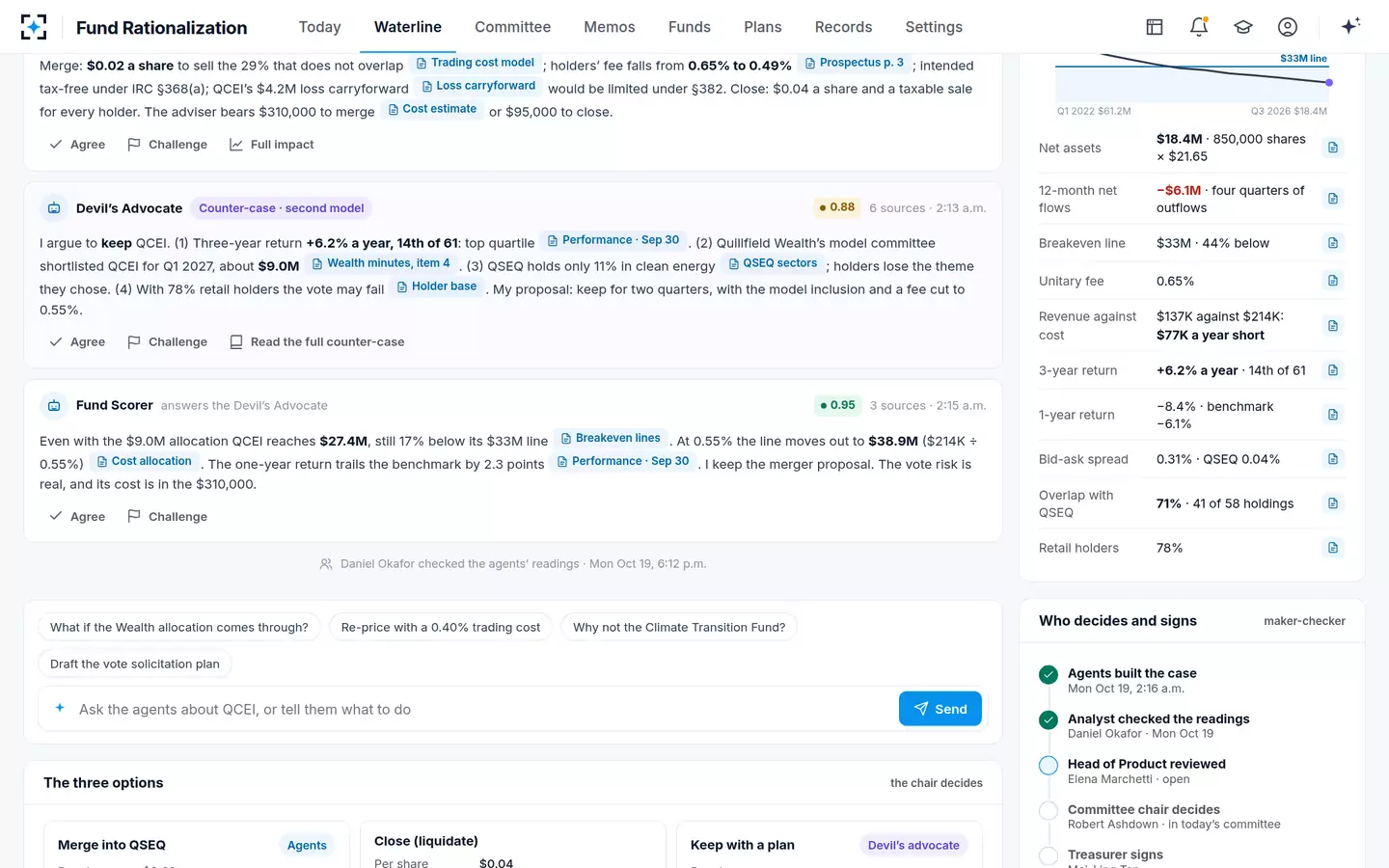
Fund Scorer: merge: $18.4M, 56% of its $33M line, after −$6.1M of flows in 12 months.
Devil's Advocate: keep: Quillfield Wealth's model committee shortlisted the fund for Q1 2027, about $9.0M.
Fund Scorer: merge: One-year return −8.4% against a benchmark at −6.1%, trailing by 2.3 points.
Devil's Advocate: keep: Three-year return +6.2% a year, 14th of 61: top quartile.
Fund Scorer: merge: Sustainable Equity ETF holds 41 of 58 holdings, 71% by weight, at a 0.49% fee against 0.65%.
Devil's Advocate: keep: The partner holds only 11% in clean energy: holders lose the theme they chose.
Fund Scorer: merge: A merger costs $0.02 a share; the adviser bears the $310,000 cost.
Devil's Advocate: keep: With 78% of shares held by retail investors, the shareholder vote may fail.
Fund Scorer: merge: Merge into Sustainable Equity ETF.
Devil's Advocate: keep: Keep for two quarters, with the model inclusion and a fee cut to 0.55%.
Fund Scorer: merge: Even with $9.0M the fund reaches $27.4M, 17% below its line; at 0.55% the line moves out to $38.9M.
Devil's Advocate: keep: Its case stays on the fund's page; the chair must open it before deciding.
Neither column is wrong. The scorer is right that the fund cannot reach its line; the devil's advocate is right that the theme holders chose largely disappears in the merger and that the vote is a real risk. What the comparison does is move the committee's discussion from "should we merge this fund?" to "is the theme worth $77,000 a year and a failed-vote risk?", which is a question a chair can answer and a board can follow.
The counter-case on a second model in Fund Rationalization, and the scorer's cited answer
Why does a scoring model need a devil's advocate?
Because the evidence that a merger or closure is right is never the whole evidence, and the research shows where the missing half tends to be. Studying US fund mergers, Jayaraman, Khorana and Nelling found that target funds' shareholders gained, with better performance and lower expense ratios after the merger, while the acquiring funds' shareholders saw performance worsen markedly afterwards, and that smaller funds were more likely to be merged (Journal of Finance, 2002). A scorer looking at the small fund sees a strong case; the shareholders of the fund it merges into carry a cost the scorer is not built to see. Rule 17a-8 asks the board of each fund to find no dilution for its own holders (Rule 17a-8(a)(2)), so the other side has a legal seat too.
Other findings explain particular blind spots. Zhao found that defunct funds have "smaller size and lower inflows", which is exactly what the model's two heaviest weights measure, so the model will be right about most small funds and wrong in a predictable minority (Journal of Business, 2005). Evans found a "performance reversal" in incubated funds once opened to the public, an upward bias that "is not removed by a fund size filter" but that "Fund age and ticker creation date filters, however, eliminate" (Journal of Finance, 2010): a model reading young funds' performance needs an age rule, which is why the sample firm never proposes closing a fund under three years old. And Ben-David and co-authors found that specialized ETFs lose about 30%, risk-adjusted, over their first five years, an underperformance "driven by the overvaluation of the underlying stocks at the time of the launch" (Review of Financial Studies, 2023), a reason a thematic fund's poor record is not always a reason to doubt its manager.
How the devil's advocate is built, and why on a second model
An agent asked to argue against its own conclusion tends to agree with itself. The devil's advocate is therefore separate in three ways: it runs on a different model, it reads its own sources rather than the scorer's, and it has a narrow job, to build the strongest case to keep each fund proposed for merger or closure and to concede when it cannot make one. Its limits are fixed: it must cite at least two sources, it cannot change a score, and its case is always shown to the chair.
Maker, checker, answer, then a person: how Fund Rationalization argues each fund
Agent
Fund ScorerScores the fund against its line and proposes merge, close or keep, citing every figure.
Never: Decides, or changes a weight without approval
Agent
Devil's Advocate, second modelReads distribution notes, model-portfolio minutes, performance and the holder base, and builds the case to keep, or concedes.
Never: Changes a score, or argues with fewer than two sources
Agent
Fund Scorer answersReplies to each point with cited figures; the exchange stays on the case for everyone to read.
A person decides
Product analystChecks the readings behind both sides; anything read below its threshold, 0.85 for the scorer, waits for the analyst.
A person decides
Head of product strategyReviews the case, asks follow-up questions, and can instruct a re-pricing with a reason.
A person decides
Committee chairDecides with a reason code; on a contested case the decision is blocked until the counter-case has been opened.
The rule that matters most is the last one. A counter-case that can be skipped will be skipped when the agenda is long. In the solution, the chair cannot record a decision on a contested case until the counter-case has been opened, and the opening itself is on the audit trail with who, when and what was read.
What the counter-case changed in the sample review
It sorted the committee's agenda. Of the 20 merge-or-close proposals, the devil's advocate conceded 12: it could not find a source-backed case to keep them. It held its case on 8, and those 8 went first. The 11 funds the model itself proposed to keep with a plan were not argued, because a keep proposal has no counter-case to make; each carries a milestone, and a fund that misses one is re-flagged for the committee.
Where the devil's advocate held its case, and where it conceded
Concessions are as useful as challenges. The funds proposed for closure with the lowest scale, a genomics ETF at 21% of its line and a food ETF at 29%, drew concessions: no distribution note, no allocation, no performance record strong enough to argue from. A committee that knows the opposition looked and found nothing can move through those cases quickly, and spend its time on the fund where a $9.0 million allocation and a top-quartile record are on the table.
Can AI decide which funds to close?
It should not, and in this design it cannot. The agents propose, explain, cite and draft; the committee chair decides, the treasurer and fund counsel sign, and no agent signs, files or releases anything. That division follows the regulators' own concerns. ESMA's 2024 statement on AI in investment services lists over-reliance first among the risks: firms and clients leaning on AI for decisions at the expense of human judgment. It also expects a firm's management body to understand how the firm applies and uses AI (ESMA, 30 May 2024).
In the US, the SEC's examination priorities for fiscal 2027 use the term "super intelligence" for the tools registrants are adopting, including in advisory and portfolio management work, and say the Division of Examinations is working harder to understand how those tools shape outcomes and whether firms still meet their existing obligations (SEC, 23 October 2026). A rationalization model whose every figure links to its source, whose weights are versioned and whose counter-case is on the trail is one an examiner can follow. A model that emits a ranked list is not.
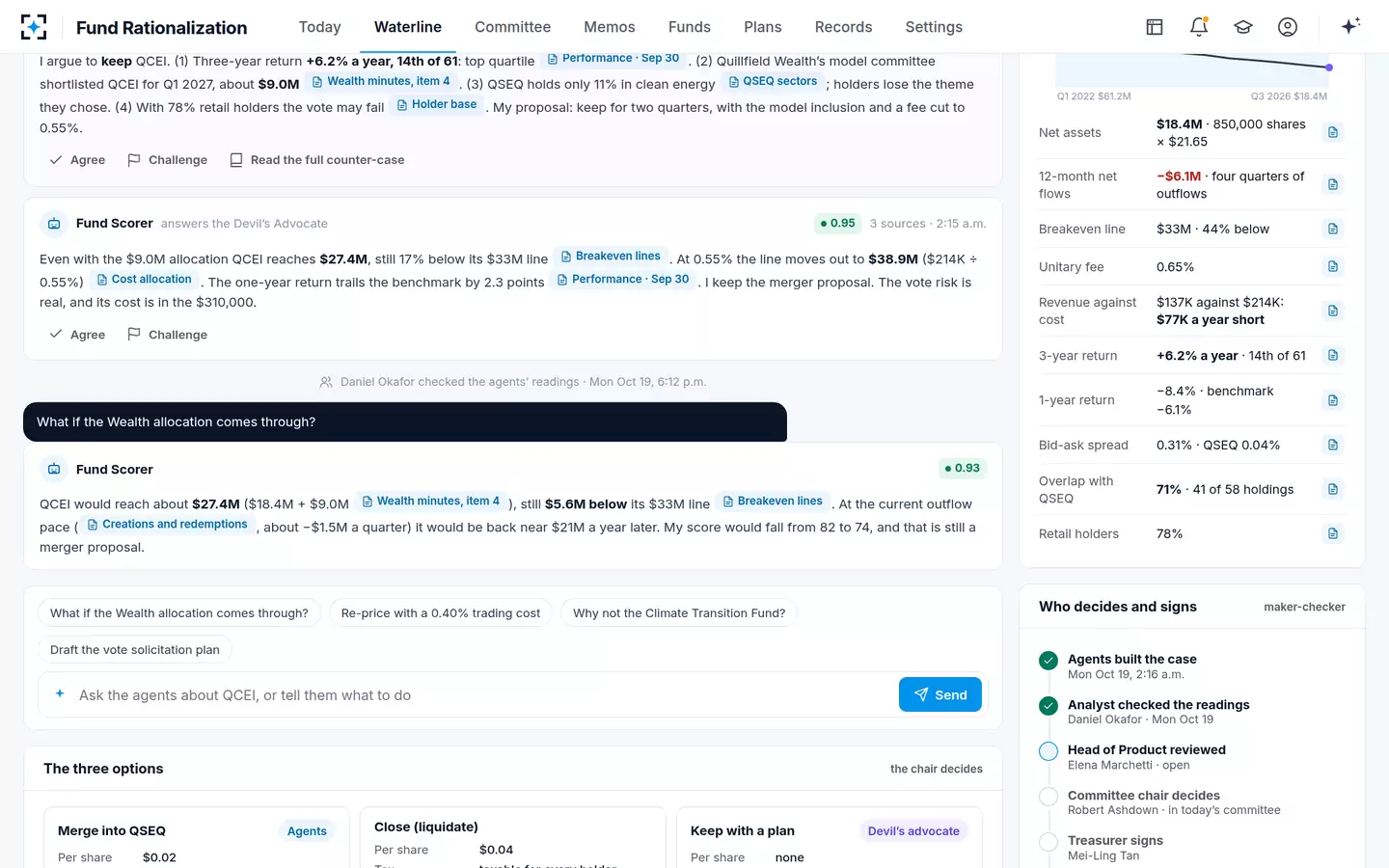
Asking the agents inside the case: the question a chair would ask
How to test a portfolio rationalization model before you trust it
Replay it on decisions you have already made. A model that scores today's funds has no outcome to be judged against for years; the funds you merged or closed in the past five years, and the ones you kept, are a labelled set you already own. Run the model as of each review date, compare its proposals with what the committee decided and with what happened afterwards, and read the disagreements one by one. The method, and the bias it guards against, is set out in survivorship bias and mutual fund performance.
Two tests are specific to the devil's advocate. First, its concessions should be right: a fund it conceded should not turn out, on a closer read, to have had an allocation or a distribution letter it missed. Second, its held cases should be worth the committee's time: if the chair overrides the agents' proposal on almost none of them, the advocate may be arguing weak cases, and its threshold for holding a case needs tuning, through the same proposal-and-two-approvals process as any weight.
What to look for when you buy a rationalization model
Questions to ask of any portfolio rationalization model or tool
- Can you open the source of every figure?
Net assets, flows, overlap, subsidy and performance should each link to the report or file they came from.
- Is the other side argued by something independent?
A different model, different sources, and a rule that the decision-maker sees the counter-case.
- Are the weights yours, versioned and approved?
A weight change should be a settings change with a proposer, two approvers and an effective run.
- Does it know the rules a fund merger must pass?
The Rule 17a-8 vote conditions, the vehicle limits (a US ETF cannot merge into a UCITS) and the tax status of each option.
- Does it price options per share?
Merge, close and keep should each show trading cost, fee change and tax for the people who own the fund.
- Does low confidence go to a person?
A reading below its threshold, such as a scanned letter in another language, should wait for a named person.
- Who decides, and is an override visible?
Only a named person decides, with a reason code; choosing against the proposal should be marked as an override.
- Can you replay it on past decisions?
Running the model as of a past date, on the data available then, is the only accuracy test you can do before going live.
Where it fits, and where it does not: a model with a counter-case earns its keep on a line-up large enough that the committee cannot read every fund's evidence itself, across several vehicles and languages. A firm with a dozen funds and one board may be better served by a good template and a colleague assigned to argue the other side. Either way, the weights and the lines are the firm's, not the vendor's. To see the scorer and the devil's advocate on your own funds, start from Fund Rationalization; the template the model fills is in the product rationalization template.
Questions people ask
What does portfolio rationalization mean for an asset manager?
It means reviewing the fund line-up to decide which funds to merge, close or keep, usually because some never reached a size at which they pay for themselves. For a US fund it ends in board findings under Rule 17a-8 for a merger, or a plan of liquidation; the SEC staff expected about 400 affiliated fund mergers a year when it rewrote that rule in 2002.
Is there a portfolio rationalization template I can start from?
Yes: a template is the per-fund form the model fills, with fields for scale against the line, flows, subsidy, performance, distribution, partner, vote, shareholder cost and the case to keep. The field list Fund Rationalization uses is laid out in the product rationalization template guide, with the source and owner of each field.
What is product rationalization analysis?
It is the evidence behind each proposal: the breakeven calculation, the flow trend, the subsidy, the partner overlap and the per-share cost of each option. In the sample case, the analysis showed a $214,000 running cost against $137,000 of fee revenue, which is the $77,000 subsidy the adviser pays each year.
What is a devil's advocate review?
A review in which someone is assigned to argue against the proposal, so the decision-maker hears the strongest opposing case before deciding. In Fund Rationalization it is a separate agent on a different model, required to cite at least two sources and barred from changing scores; on the sample review it held its case on 8 of 20 merge-or-close proposals.
Can a model decide which funds to close?
It can propose; a person must decide. The fund's board makes the findings a merger requires, and in this design only the product committee chair records a decision, with a reason code, after opening any counter-case.
How are the weights in a fund scoring model set?
By the firm, from its own experience and policy, and changed by proposal and approval rather than by whoever runs the model. The sample firm weights scale at 30%, flows at 20%, subsidy and performance at 15% each, and distribution support and partner availability at 10% each.