A product rationalization template for a fund line-up is the one-page case, per fund, that a product committee uses to decide whether to merge, close or keep it: the fund's size against its breakeven line, twelve months of flows, what the adviser pays to keep it open, performance against peers, distribution support, the best merger partner, the shareholder cost of each option, whether a merger needs a shareholder vote, the tax result, and the case to keep it. The fields are the easy part. The hard part is that the evidence sits in five systems and the decision belongs to different people: the committee proposes, the fund's board makes findings the SEC's merger rule requires, and the treasurer and fund counsel sign what reaches the board. Botminds' Fund Rationalization fills that template for every fund each quarter, with a separate agent arguing to keep each fund proposed for merger or closure, so the people who decide start from a cited case instead of a spreadsheet tab.
The worked examples come from the solution running on fictional sample data: Quillfield Capital, 240 funds across an ETF trust, a mutual fund trust and a Luxembourg SICAV. Rules and research are linked where they appear.
Mergers and closings are routine work at the SEC, not rare events
163
Form N-14 registration statements for fund mergers filed in 2025, up from 110 in 2023
78
Form N-8F applications to deregister a fund filed in 2025, after a merger or a liquidation
3%
fall in ongoing costs of existing EU equity funds in 2024, against 8% for the market as a whole
400
affiliated fund mergers a year the SEC staff expected when it rewrote its merger rule in 2002
What is a product rationalization template for a fund line-up?
It is a standing form, one per fund, that turns a review of the whole line-up into a series of decisions anyone can check. A good template answers four questions in a fixed order: is this fund below the size at which it pays for itself, is that likely to change, what are the realistic options, and what does each option cost the people who own the fund. The order matters because the fourth question is where reviews tend to slip: a shortlist gets agreed on scale and flows, and the tax hit, the trading cost and the vote question arrive weeks later.
Generic product rationalization frameworks, written for consumer goods or software, stop at the first two questions: revenue, margin, a keep-or-kill score. A fund is different in two ways that the template has to carry. A fund has shareholders whose money is in it today, so every option has a per-share cost and, for a liquidation, a taxable sale. And a fund has a board with legal duties, so a merger of affiliated funds is exempt from the Investment Company Act's ban on affiliated transactions only if the board makes specific determinations and the fund keeps the papers to prove it (Rule 17a-8).
Who decides merge, close or keep? The committee proposes, the board finds
The product committee, chaired by a senior executive, decides what management proposes; the fund's board, with its independent directors, decides whether the fund takes part. For a merger between funds of the same complex, Rule 17a-8 requires the board, with a majority of its independent directors, to find that taking part serves the merging fund and that the merger will not dilute its existing shareholders (17 CFR 270.17a-8(a)(2); the Rule 17a-8 guide sets out each finding). A template built only for the committee gives the board a recommendation; one built for both gives the board the evidence its findings rest on.
Six seats, one subscale fund: what each person owns once Fund Rationalization fills the template
Today
Rebuilds each subscale fund's case by hand, one spreadsheet tab per fund, twice a year.
With agents
Opens a cited case per fund, already argued both ways, and spends the week on the contested ones.
Still theirs: What goes to the committee, and in what order
Today
Hears a one-sided deck and answers to the board for every merge or close.
With agents
Reads the case and the counter-case side by side and chooses with a reason code; an override of the agents is marked as one.
Still theirs: The decision
Today
Receive a recommendation and a slide of figures that cannot be traced.
With agents
Receive a memo in which every figure opens its source, with the case to keep summarised.
Still theirs: The Rule 17a-8 determinations
Today
Prices expense ratios, trading cost and loss carryforwards after the shortlist.
With agents
Sees merge, close and keep priced per share before the committee and changes an assumption only with a reason.
Still theirs: A signature on the memo
Today
Finds the fundamental-policy difference that forces a vote after the merger is planned.
With agents
Gets the four vote conditions tested on day one, flagged for confirmation, and an N-14 outline to start from.
Still theirs: The legal opinion and a signature
Today
Copies net assets, flows, holdings and ranks into the template for weeks.
With agents
Checks the agents' readings within two business days; low-confidence readings wait for the analyst.
Still theirs: The check on every reading
Writing the decision rights into the template has a practical effect. The same fund can be "decided" three times: by the committee in October, by the board in December and, if the merger needs a vote, by shareholders in February. A template that names who decides each step, and what each needs to see, stops the second and third decisions from being surprised by facts the first one already had.
What goes in each field, and where its evidence lives
Each field in the template answers one question and has one home system; the template is complete when every figure can be traced back to that home. The table below is the field list Fund Rationalization fills, with the source each field is read from and the person who answers for it.
A fund rationalization template, field by field, with the source behind each answer
| Field | The question it answers | Read from | Who answers for it |
|---|---|---|---|
| Scale against the line | Is the fund big enough to pay for itself? | Fund accounting: net assets, expenses, reimbursements | Treasurer |
| Flows and trend | Is it growing toward the line or away from it? | Transfer agent and ETF creation and redemption orders | Product analyst |
| Adviser subsidy | What does keeping it open cost the adviser each year? | Expense-cap reimbursements, unitary-fee shortfall | Treasurer |
| Performance | Does it deliver what holders bought it for? | Three- and five-year returns, category rank | Product analyst |
| Distribution support | Is anyone still selling it? | Sales by channel, platform and model-portfolio letters | Head of distribution |
| Merger partner | Is there a fund in the complex that holders could move into? | Holdings overlap by weight, objective, vehicle | Head of product |
| Vote and filings | Would a merger need a shareholder vote, and what must be filed? | Prospectus, SAI, advisory contracts, 12b-1 plans, board roster | Fund counsel |
| Shareholder cost | What does each option cost per share, and what is the tax result? | Trading-cost model, fee tables, loss carryforwards | Treasurer |
| The case to keep | What is the best argument against merging or closing? | Model-portfolio minutes, holder base, peer ranks | Whoever is assigned to argue it |
The last row is the one most templates omit. A committee that sees only the case for closing has been handed a conclusion, not a choice, and the board that relies on its paper inherits the gap. The research gives that row more weight than intuition does: why a scoring model needs an agent that argues to keep each fund is set out separately.
How do you set the breakeven line? The one number most templates borrow
The breakeven line is the net asset size at which a fund's fee revenue covers what it costs the adviser to run: divide the annual cost of running the fund by the fee rate. No regulator or independent study publishes a breakeven size for a fund; the figures that circulate are industry rules of thumb, and they assume a cost base that is not yours. Compute your own, by vehicle, from your own cost allocation.
A breakeven line is the fund's own running cost divided by its fee
Running cost
Annual cost to run the fund: administration, custody, audit, index licence, listing, legal, portfolio team allocation
The allocation method should be the one the board already sees in the advisory-contract review.
Treasurer
Fee rate
Net fee the adviser keeps, after waivers and reimbursements, as a share of net assets
For a unitary-fee ETF the fee pays the fund's expenses too, so the shortfall falls on the adviser.
Treasurer
Breakeven line
Running cost ÷ fee rate
Sample fund: $214,000 ÷ 0.65% ≈ $33 million. At a 0.55% fee the same cost needs $38.9 million.
Head of product
Subsidy
Running cost − fee revenue at today's size
Sample fund: $214,000 − $137,000 = $77,000 a year paid by the adviser.
Treasurer
Two consequences follow from the arithmetic. First, a fee cut moves the line away from the fund: the sample fund's own counter-case proposed cutting its fee to 0.55%, which raises its breakeven from about $33 million to $38.9 million. Second, the subsidy is a disclosure question as well as a cost. The SEC's examination priorities for fiscal 2027 put fund fees and expenses, with any waivers or reimbursements, first among the areas registered fund examinations will focus on (SEC Division of Examinations, 23 October 2026). A template that carries the subsidy line puts the reimbursement in front of the committee in the same quarter the examiners might ask about it.
What triggers a rationalization review: renewals, value tests and cost pressure
Most firms run the review when something forces it, and three recurring events do. In the US, the board's annual approval of each advisory contract asks about the adviser's profitability and economies of scale fund by fund, which is where a subscale fund's subsidy first becomes visible; the economies of scale test in a 15(c) review and the rationalization review read the same cost allocation. In the UK, an authorised fund manager must assess at least annually whether each fund's charges are justified by the value delivered, unit class by unit class (FCA COLL 6.6.20R), and the FCA's 2023 review found that most remedies firms took for poor value did not involve cutting fees, and that none of the firms it assessed cut fees for poor performance (FCA, August 2023). A merger is one of the remedies left.
In the EU the pressure comes from the market. ESMA's March 2026 report found that ongoing costs of retail equity UCITS fell 8% in 2024 and those of bond UCITS almost 15%, mainly because new, cheaper funds entered the market; for funds that already existed the falls were 3% and 9% (ESMA, 3 March 2026). An old, small, expensive fund is the part of a line-up that cost competition passes by, and the comparison work behind that is fund peer group analysis. A rationalization template should record which trigger opened each case, because the trigger decides what the board will ask first.
Why the case to keep belongs in the template
The case to keep is evidence, not sentiment, because the research on fund mergers finds winners and losers on both sides. Studying US mutual fund mergers, Jayaraman, Khorana and Nelling found "significant improvements in postmerger performance and a reduction in expense ratios for target fund shareholders", while "acquiring fund shareholders experience a significant deterioration in postmerger performance" (Journal of Finance, 2002). The template therefore has two sets of shareholders to protect, which is exactly how Rule 17a-8 frames the board's no-dilution finding for each fund.
The research also says which funds end up on the list. Zhao's study of fund exits found that funds which disappear are smaller and draw less money than those that survive, and that a family with more share classes tends to merge a fund rather than close it (Journal of Business, 2005). Scale and flows earn their places as the first two fields. The share-class finding is a reminder that the choice between merging and closing is partly about the holders a fund has, and the template should show who they are: in the sample case, 78% of the fund's shares sit in retail brokerage accounts, which makes a shareholder vote harder to win.
From the committee's choice to the board's minutes and six years of files
A template ends in a decision that someone else will later check, so it should produce the papers the rules ask for. Rule 17a-8 requires that the board's determinations "and the bases thereof" be "recorded fully in the minute books" of the merging fund, and that the surviving fund keep written materials describing the merger and its terms for six years, the first two in an easily accessible place (Rule 17a-8(a)(2)(iv) and (a)(5)). The merging fund's board must also meet the fund governance standards: independent directors in the majority, choosing their own successors, with independent counsel if they retain any (Rule 0-1(a)(7)).
How one fund moves through Fund Rationalization, from the overnight score to the board
Agent
Fund ScorerScores every fund 0–100 against its vehicle's line and proposes merge, close or keep, citing each figure.
Never: Decides, or proposes closing a fund under three years old
Agent
Partner Finder and Rule CheckerRanks merger partners by holdings overlap and tests the four Rule 17a-8 vote conditions for each.
Never: Gives a legal opinion
Agent
Shareholder Impact and Devil's AdvocatePrices each option per share; a second agent on a different model argues to keep the fund from its own sources.
Never: Changes a score
A person decides
Product analystChecks the agents' readings; anything read below its confidence threshold waits here.
A person decides
Committee chairChooses merge, close or keep with a reason code, after opening the counter-case on a contested fund.
Agent
Memo DrafterDrafts the board memo section, the 17a-8 findings and the N-14 outline after the decision.
Never: Signs or releases
A person decides
Treasurer and fund counselBoth sign before the memo can reach the board portal; any edit after a signature voids it.
What to look for in a product rationalization template or tool
Whether the template is a workbook, a board-portal form or software, test it against the decisions it has to support rather than the fields it lists. A tool that scores funds well but cannot show where a figure came from will not survive the board's question about it.
Eight tests for a fund rationalization template before you adopt it
- Every figure opens its source
Net assets, flows, overlap and the subsidy each link to the report or file they came from, so a director can check one without asking.
- The line is yours, by vehicle
Breakeven comes from your cost allocation and your fees, with the method written down, not an industry rule of thumb.
- The case to keep is a field, with an owner
Someone, or something, is assigned to argue against each merge or close, and the chair sees it before deciding.
- The vote question is asked on day one
The four Rule 17a-8 conditions are tested when the partner is chosen, not after the committee meets.
- Each option is priced per share
Merge, close and keep each show trading cost, fee change and tax status for the people who own the fund.
- Decision rights are explicit
The template names who proposes, who decides and who signs, and marks a decision that overrides the recommendation.
- It runs every quarter, not twice a year
A fund that misses a keep-with-a-plan milestone comes back on its own instead of waiting for the next review.
- It leaves the files the rules ask for
Board determinations with their bases, and merger papers kept six years, without a separate clean-up exercise.
Where Fund Rationalization fits, and where it does not
Fund Rationalization fits where the review is recurring and the line-up is large enough that rebuilding cases by hand is the bottleneck. On the sample firm, the overnight run scored 240 funds against their lines and placed 31 below them, proposed as 11 merges, 9 closures and 11 funds to keep with a plan. The devil's advocate conceded 12 of the 20 merge-or-close proposals and held its case on 8, and those 8 went first on the committee's agenda.
The breakeven waterline: every active ETF against its line, with the subscale funds marked
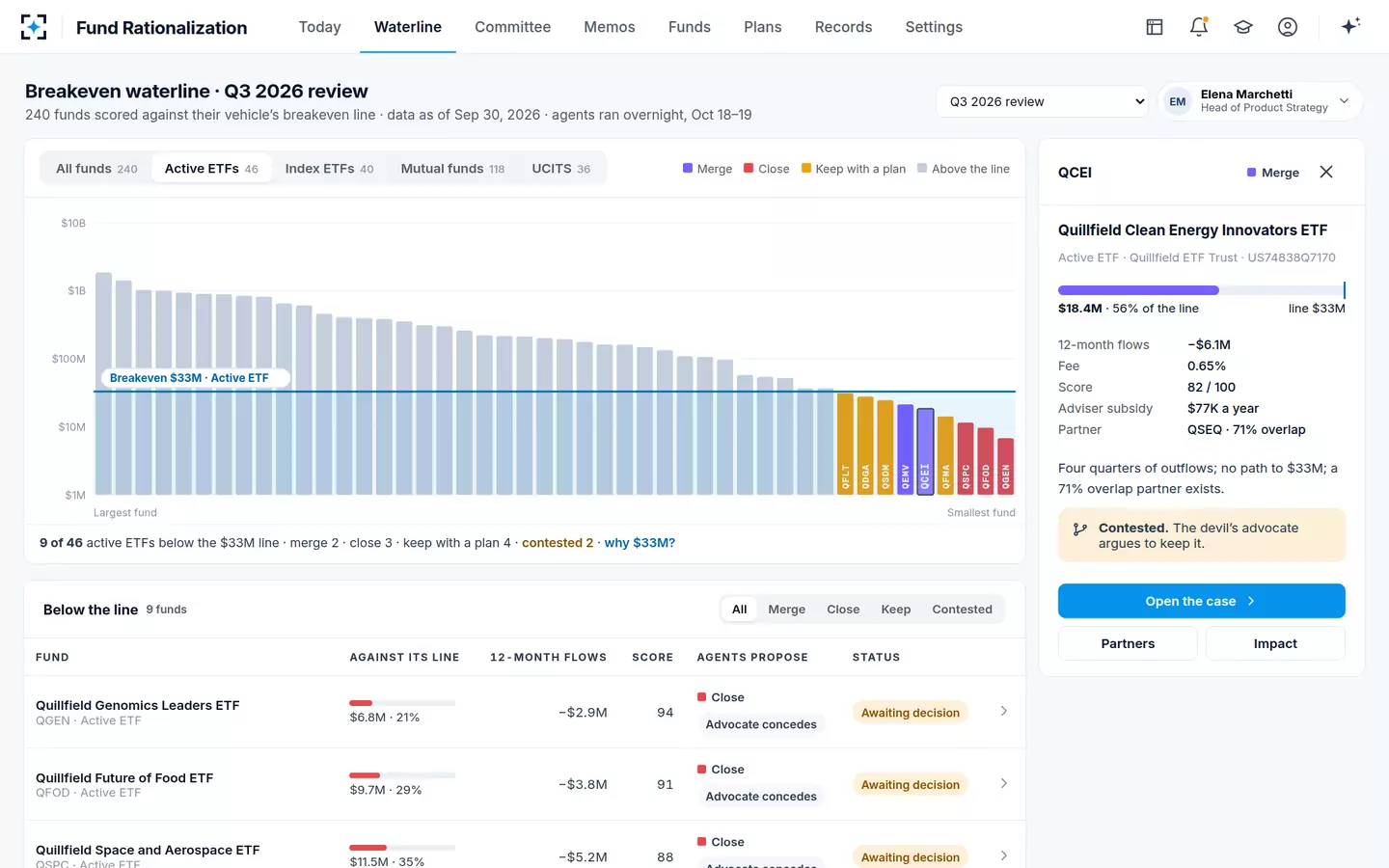
It does not decide, and it is not a substitute for counsel. The agents propose, explain, cite and draft; they never decide, sign, file or release. The vote test is flagged "for fund counsel to confirm", the tax status stays "intended" until counsel's opinion, and nothing reaches the board portal until the treasurer and counsel have both signed. Firms that review a dozen funds once a year may find a well-kept workbook enough; the case for agents grows with the number of funds, the number of vehicles and the number of languages the evidence arrives in.
Only the chair decides, with a reason code and the conditions attached
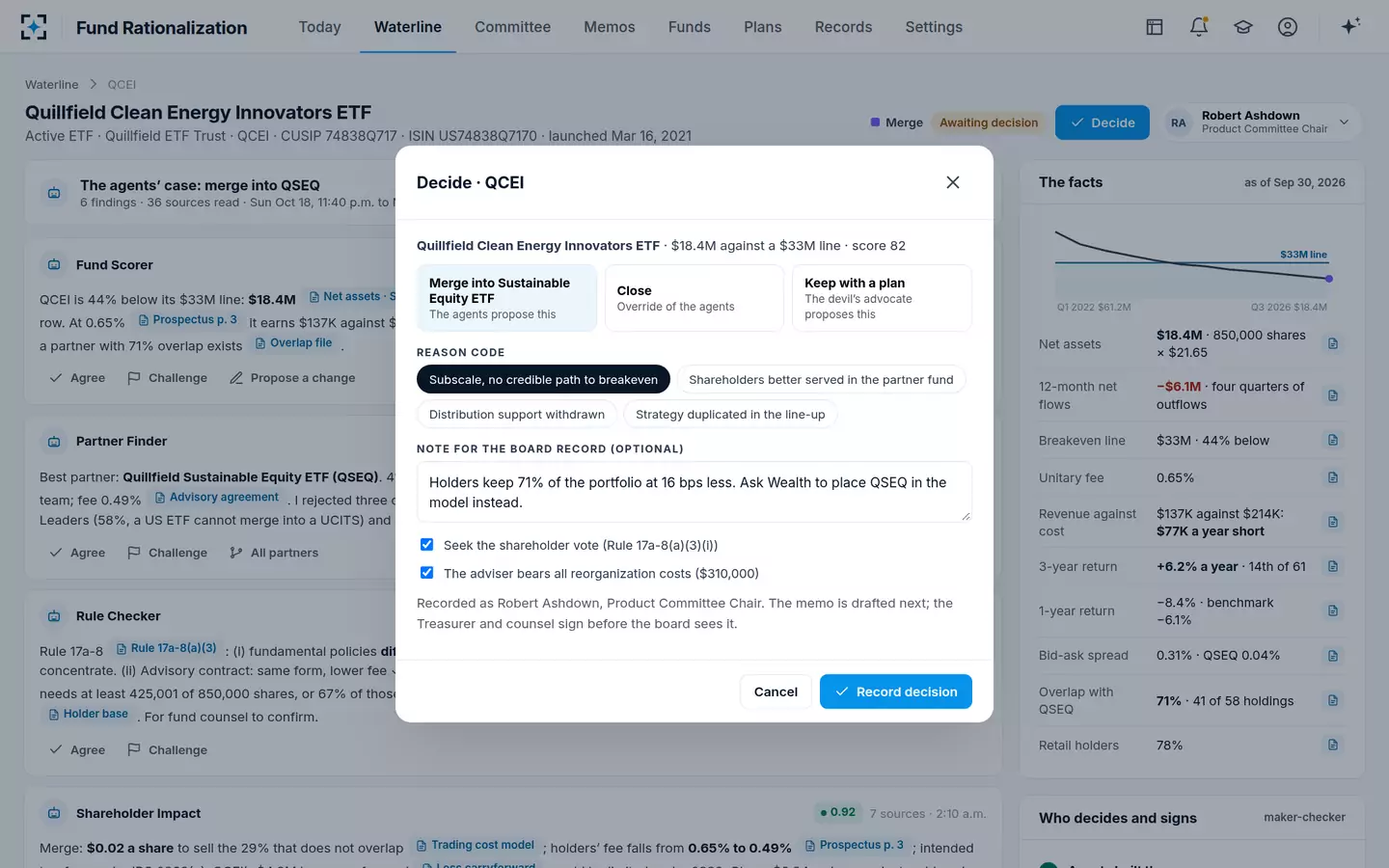
The template's last fields lead straight into the rules: when a fund merger needs a shareholder vote walks through the four conditions on one case. To see the whole review on your own funds, start from Fund Rationalization.
Questions people ask
What is fund rationalisation?
Fund rationalisation, also called product rationalization or fund consolidation, is the review in which an asset manager decides, fund by fund, which subscale or overlapping funds to merge, close or keep. In the US it ends in board determinations under Rule 17a-8 for a merger, or a board-approved plan of liquidation; in the EU a UCITS merger needs prior authorisation by the merging fund's home regulator.
What is a product rationalization framework, compared with a template?
The framework is the policy: the breakeven lines by vehicle, the scoring weights, the thresholds for proposing a merger or closure, and who decides. The template is the form each fund's case is written on. In the sample firm's settings, a score of 70 or more proposes merge or close and 50–69 proposes keep with a plan, and each weight change needs two approvals.
How often should a fund line-up be reviewed?
No rule sets a frequency for the review itself, but the triggers recur: the advisory contract must be approved at least annually in the US, and the UK assessment of value runs at least annually. A quarterly review lets a fund kept with a plan be re-checked against its milestone before the next annual cycle.
Who decides to merge or liquidate a mutual fund?
The fund's board decides whether the fund merges or liquidates, usually on the adviser's proposal; for an affiliated merger the board, including a majority of independent directors, must make the Rule 17a-8 findings. Shareholders vote when the rule's conditions are not met or when state law or the fund's charter requires it.
What is the process of product rationalization in asset management?
Score every fund against its own breakeven line, shortlist those below it, find merger partners, test the vote and tax questions, price each option per share, hear the case to keep, decide in committee, then take the board memo and findings to the board. The SEC staff expected about 400 affiliated fund mergers a year when it rewrote Rule 17a-8 in 2002.
Can a spreadsheet be the product rationalization template?
Yes, for a small line-up reviewed once a year, provided each figure carries its source and someone is assigned to argue the case to keep. It struggles when the evidence arrives from five systems and several languages, which is where the sample review spent most of its estimated 38 business days by hand.